Lesson 9 |
August 19 - 25 |
Approaches to Witnessing |
 |
Lesson 9 |
August 19 - 25 |
Approaches to Witnessing |
|
WHAT IS "CHURCH"? We use the term to mean a denomination, a building, or the "body of Christ." This week focuses primarily on the local congregation.
| DEFINITION: A church is a local community of Christians that meets to worship God, expresses its love through fellowship, receives sustenance from God's Word, and fulfills the Great Commission of Jesus Christ. |
The climate of a church determines how it feels to be part of a particular congregation. A healthy church creates a climate that stimulates witnessing and nurtures those who accept the gospel.
The apostolic church developed such a climate and attained such a balance of worship, nurture, fellowship, and mission that it grew daily (Acts 2:47). As you study this week's lesson, compare the apostolic church to your local congregation in the area of witnessing.
THE WEEK AT A GLANCE:
I. Characteristics of Christian Groups (Acts 2:42-47).
II. A Peculiar Lifestyle (Acts 1:14; 2:42, 44; 11:26).
III. Prayer Meeting (Acts 12:1-19).
IV. Boldness in Witnessing (Acts 4:23-30; 8:14, 15).
V. Christ-Centered Preaching (Acts 2:22-24, 32, 33, 36).
MEMORY TEXT: "Then the church throughout Judea.
Galilee and Samaria enjoyed a time of peace. It was strengthened;
and encouraged by the Holy Spirit, it grew in numbers. living in the fear
of the Lord"
(Acts
9:31, NIV).


List the characteristics of the early Christians.
Acts
2:42-47.
The early Christians had three main purposes. They were also devoted to four functions essential for a vibrant Christian life. These functions are a part of the three purposes. All of our church meetings today should aim to meet these three purposes and fulfill these four functions:
1. An upward purpose: to glorify God. The disciples "were continually in the temple, praising and blessing God" (Luke 24:53). Worship, then, is one of the four functions. Praise and prayer characterized the worship of the early church.
2. An inward purpose: to grow spiritually and to enjoy fellowship with other members. Another two of the functions, therefore, are nurture and fellowship. Notice that the early Christians were devoted to the apostles' doctrine. This devotion nurtured them with the spiritual food they needed for becoming like Christ.
Christian fellowship is not merely a subjective feeling of belonging. It is different from membership in a tennis club or civic group. Christian fellowship is more like the commitment of love and obligation we have toward members of our own family. That is why the early church "had everything in common" and ate together.
3. An outward purpose: to preach the gospel. The fourth function of any church should be mission. The early church demonstrated a sense of mission like no other church since. A group of individuals sharing together in worship, nurture, and community will not be legitimate if its members remain inward. As a result of outreach, the early disciples received new converts into the church every day.
Had everything in common. "To have things in common was not unusual in Jewish life of the time. Visitors to the yearly feasts often had their needs supplied by their friends in Jerusalem. It is clear, however, that something more than this is implied in Luke's statement. The Christians were thrown back upon themselves, and a new, a Christian, economy was set up. However, this does not mean the institution of what is called Christian socialism. It was probably a continuation and enlargement of the 'bag,' or common purse, of John 12:6; 13:29. The new converts would be the more ready to share their material possessions because of their new-found love for Christ and for one another, and their earnest expectations of the Lord's soon return."—SDA Bible Commentary, vol. 6, p. 149.
How can modern churches meet the above three purposes and fulfill the
four functions? How is your church managing this responsibility? How
can you help to make
improvements? |
Early followers of Jesus were distinguished by their fellowship. Which expressions in the following verses describe the togetherness of the early Christians?
Acts 1:14 _______________________________________________________________
Acts 2:42 _______________________________________________________________
Acts
2:44
_______________________________________________________________
"The proclamation of the gospel was to be world-wide in its extent, and the messengers of the cross could not hope to fulfill their important mission unless they should remain united in the bonds of Christian unity, and thus reveal to the world that they were one with Christ in God."—The Acts of the Apostles, p. 90.
Friendship with other members is the first step toward a new member's assimilation into the church. If fellowship is absent, the church will stagnate or decline. If new members cannot name a minimum of seven new friends in the church within their first six months of membership, they will leave. (See Win Am, The Church Ratio Book [Pasadena, Calif.: Church Growth, 1987], p. 23.)
Where were the disciples first called "Christians"?
Acts
11:26.
Why?
The title of "Christian" may have arisen from local gossip: "Those people are always talking about Christ!" Earlier, they were called those "who were of the Way" (Acts 9:2, NKJV; also see 19:23 and 24:14).
"Living, as they were, in the midst of a people who seemed to care but little for the things of eternal value, they sought to arrest the attention of the honest in heart, and to bear positive testimony concerning Him whom they loved and served. In their humble ministry they learned to depend upon the power of the Holy Spirit to make effective the word of life. And so, in the various walks of life, they daily bore testimony of their faith in Christ."—The Acts of the Apostles, p. 158.
List the names of some of the new members in your church. How can you
make them feel welcome?
|
It was Passover. To please his opponents, Herod had ordered the arrest of Peter. He had planned to give Peter to the people, much as Pilate had done with Jesus. Despite the imminence of his execution, Peter slept while the church in Jerusalem prayed for him.
How does the Bible translation you are using describe the believers' prayers?
Acts
12:5.
The Greek word translated "without ceasing" or "constant" (NKJV) is the same word that describes Jesus' prayer in Gethsemane (Luke 22:44). In 1 Peter 4:8, the word is translated "fervent" and suggests great intensity. We do not know the exact words of their prayers. Were they praying for Peter's release? For the will of the Lord to be done? What does one pray for under such circumstances?
We do know, however, that their prayers were answered even while they prayed. God moves on His own schedule in answering our prayers. Sometimes He waits, and sometimes He does not even wait for the "Amen." The latter happened in this case.
How did the believers react to Peter's deliverance? Imagine what may have
happened in that prayer meeting after Peter left.
Acts
12:13-17.
In the book Christian Service, pages 211-214, we find the following advice regarding prayer in the church as a form of witnessing:
1. Prayer meetings should help and encourage those attending. To do this, we should share our own experiences.
2. Prayer meetings should be interesting. Avoid lengthy speeches and formal prayers.
3. Praise and thanksgiving should also characterize our prayer meetings. These will prevent us from complaining and will dispel the power of Satan.
Can you think of other ways prayer in the church family can serve as a
form of witnessing?
| What is missing in the prayer meetings of your church? List ways these
meetings can be improved. How could you help to revive interest in this church
service?
|
After Jesus ascended to heaven and before the coming of the Holy Spirit, the disciples met for long seasons of prayer in an upper room and went to the temple where they praised and blessed God (Luke 24:50-53). This combination of praise and worship with sincere prayer and supplication is an unfailing formula for drawing near to God.
For what did the church in Jerusalem pray after the Sanhedrin released
Peter and John? Acts
4:23-30.
What convictions did the believers express in this prayer?
verse 24 ________________________________________________________________
verses 27, 28 ____________________________________________________________
verses
29, 30
____________________________________________________________
Their prayer itself became a witness as they expressed in it their belief in their Creator and their expectations that He would help them to perform "signs and wonders" (NKJV). Surely their times of prayer together matched the requirements set forth for such meetings in yesterday's lesson.
According to
Acts
8:14, 15, for what specific matter did the apostles pray in Samaria?
"The Lord is more willing to give the Holy Spirit to those who serve Him than parents are to give good gifts to their children. For the daily baptism of the Spirit every worker should offer his petition to God. . . . The presence of the Spirit with God's workers will give the proclamation of truth a power that not all the honor or glory of the world could give."—The Acts of the Apostles, pp. 50, 51.
| If your local church were facing the same type of persecution the
Jerusalem congregation was facing in Acts 4, how would its members respond?
Pray that with the indwelling of the Holy Spirit, you and your fellow church
members always will be able to witness boldly.
|
Summarize in your own words Peter's sermon at Pentecost.
Acts
2:22-24, 32, 33, 36. What were the results? Based on these results, what
conclusion can you draw about the content of
sermons?
Your Summary |
Sermon Results |
Conclusions |
|
|
Peter's sermon, as do many of the sermons in Acts, consists of five points. These points may not always appear in the same order, and occasionally some of the sermons will omit a point. But generally they are there. These five points answer the following questions:
1. What did Jesus do? (v. 22).
2. What did the nonbelievers do? (v. 23).
3. What did God do? (v. 24).
4. What are we (Jesus' followers) doing now? (v. 32).
5. What can you do? (v. 38).
Without focusing on Christ in our preaching ministries, "there is little incentive for our members to bring their non-Adventist friends to church. If they bring their neighbors and friends and we preached Christ and made calls to accept and follow Him, it would bring a new dynamic into our churches as it does our public meetings."—Fowler, Evangelism 2000, p. 52.
Evaluate Peter's presentation of Jesus as Savior in
Acts
4:12. Then use your own words to describe his
message.
When sinners accept Jesus as Savior and call upon the name of the Lord, His blood cleanses them from all sin. The believers then become new creatures who want to keep the commandments of God through the indwelling of the Holy Spirit. Their names are written in the Book of Life (see Acts 16:31; 22:16; Rom. 1:13; 1 John 1:7; 2 Cor. 5:17; John 14:15; Gal. 5:16-26; Rev. 21:27).
| Review the five questions Peter's sermon raises in
Acts
2 by reading each answer as if you were a part of the audience. Do
you have the assurance that Jesus forgives your sins? Do you have eternal
life? Tell it to others!
|
FURTHER STUDY: This week we studied various characteristics of church life that serve as part of the church's witnessing activities. Read the following verses to discover another characteristic of a healthy church that serves as a positive witness: Malachi 3:8-10; Mark 12:41-44; 2 Corinthians 8:1-7.
Also read any or all of the following: Testimonies to Ministers and Gospel
Workers, "The Church of Christ" pp. 15-32; The Acts of the Apostles,
"A Liberal Church"
pp. 335-345.
"God has a church on earth who are lifting up the downtrodden law, and presenting to the world the Lamb of God that taketh away the sins of the world. The church is the depositary of the wealth of the riches of the grace of Christ, and through the church eventually will be made manifest the final and full display of the love of God to the world that is to be lightened with its glory."—Testimonies to Ministers and Gospel Workers, p. 50.
|
||||||||||||
SUMMARIZE this week's lesson by describing
in your own words the type of church life that serves as a witness to not
only the community but the
world.
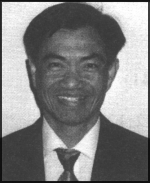
When Thongsouay Sakdarak was 11 years old, his Laotian parents sent him to a monastery to study to become a Buddhist monk. He remained for 12 years, mastering the writings of Buddha. He left the monastery to teach history. Then in 1983 he and his wife fled Laos for Thailand.
While living in a refugee camp, Sakdarak met a Christian man who talked to him about the Bible. One day his friend read John 1:1 to him. The verse startled Sakdarak. He recalled that Buddha had said that if his followers obeyed the Word, they would be released from sin. Sakdarak recalled other scriptures that told of the Messiah who would come.
His friend gave him a Bible. As he read, he found the crucifixion story. Sakdarak recalled that the Buddhist scriptures had stated that the coming Messiah would have marks or circles in his hands and feet.
After two months of careful study, the former monk was baptized. He began teaching the Bible to fellow refugees. He explained to them that the one message that runs through the teachings of Buddha is that those who find the true Word and obey it will be saved. Sakdarak shared this good news with anyone who would listen.
 But
when he told his wife, Khanthaly, about his discovery, she did not share
his joy. In fact, she took his Bible, threw it on the ground, and jumped
on it. Within her culture this was the highest level of insult one could
give.Sakdarak was crushed at his wife's response. For two weeks the couple
did not speak or even look at each other. A divorce seemed unavoidable.Then
one day Khanthaly reluctantly went to church with Sakdarak. A Laotian hymn
touched her heart, and the Holy Spirit opened her understanding. In spite
of strong resistance from her family, Khanthaly took her stand for Christ.
But
when he told his wife, Khanthaly, about his discovery, she did not share
his joy. In fact, she took his Bible, threw it on the ground, and jumped
on it. Within her culture this was the highest level of insult one could
give.Sakdarak was crushed at his wife's response. For two weeks the couple
did not speak or even look at each other. A divorce seemed unavoidable.Then
one day Khanthaly reluctantly went to church with Sakdarak. A Laotian hymn
touched her heart, and the Holy Spirit opened her understanding. In spite
of strong resistance from her family, Khanthaly took her stand for Christ.
Today the Sakdaraks work among the Laotian refugees in Southern California. Sakdarak has written two books that compare the Bible and Buddha's writings and show that Jesus is the promised Word, the Messiah, the Son of God.
Thongsouay Sakdarak (left). J. H. Zachary is coordinator of international evangelism for The Quiet Hour and a special consultant for the General Conference Ministerial Association.
Produced by the General Conference Office of Mission Awareness |


Join the SSNET moderated email discussion group. You are also warmly invited to join a group discussion of this lesson Sabbath morning with your local Seventh-Day Adventist congregation.
Editorial Office: 12501 Old Columbia Pike, Silver
Spring, MD 20904.
Principal Contributor: Carlos Martin
Acting Editor: Lyndelle Brower Chiomenti
Editorial Assistant: Soraya Homayouni Parish
Art and Design: Lars Justinen
Pacific Press Coordinator: Paul A. Hey
Copyright © 2000 General Conference of Seventh-day Adventist. All Rights Reserved.
This page is Netscape  friendly.
SSNET Web Site Home page.
Directory of adult SS quarterly
Bible Study guides.
Prepared for the Internet by the SSNET
Web Team.
Last updated July 29, 2000.



