Lesson 2 |
July 1 - 7 |
The Power and Joy of Witnessing
|
 |
Lesson 2 |
July 1 - 7 |
The Power and Joy of Witnessing
|
|
A LOOSE CONNECTION. Herbert Jackson told a seminary mission class that while he was a missionary, he was given a car that would not start without a push. When he would leave to make his rounds for the day, students from the nearby mission school would cease their studies to give him the push he needed. Then as he visited people throughout his territory, he would either leave the car on a hill or keep it running.
For two years, he fussed this way over his car. When his replacement came, Jackson informed him about the car's temperament. Curious, his replacement looked under the hood. "Dr. Jackson!" he exclaimed. "The only trouble with this car is a loose cable!" After tightening the offending line, Jackson's replacement got into the car and turned the key. The vehicle blasted to life. The power had been there all the time. Only a loose connection prevented Jackson from using it.—Craig Brian Larson, editor, Illustrations for Preaching and Teaching: From Leadership Journal (Grand Rapids, Mich.: Baker Book House, 1993), p. 182; adapted. So it is with the Holy Spirit. He is the power behind any witnessing we do.
THE WEEK AT A GLANCE:
I. Searching Within (Acts 1:14; 2:1).
II. Conditions for Enabling Baptism (Acts 1:5, 8, 14).
III. Filled With the Spirit (Acts 4:23, 31; 6:1-5; 7:54-56; 11:22-24; 13:9).
IV. The Latter Rain (Acts 2:14-21; Joel 2:23, 28-32).
V. Fasting (Acts 9:7-9, 18, 19; 13:1-3; 14:21-23).
MEMORY TEXT: "And with great power gave the apostles
witness of the resurrection of the Lord Jesus: and great grace was upon them
all"
(Acts
4:33).


What were the believers praying for while they were gathered in the upper room?
Acts 1:14 ___________________________________________________________
Luke 24:49 _________________________________________________________
Acts
1:4 ________________________________________________________
What does it mean that they "continued with one accord"?
(Acts
1:14).
In Acts 1:14 and 2:46, the phrase "with one accord" means "persevered with one mind." In chapter 2:1, important evidence supports the translation "they were all together" (see SDA Bible Commentary, vol. 6, pp. 10, 127, 134). Contrast the mood now apparent with the one at the Last Supper (Luke 22:24).
As the days passed, how easy it would have been to criticize one another! Some could have pointed to Peter's oaths and curses, others to Thomas's doubting nature. More than one could have remembered that the sons of Zebedee had actually asked for the two chief seats in the kingdom, and some could have commented about Mary Magdalene's past. How could the Lord bless such a group of people?
"Oh, it is so easy to turn the searchlight on others instead of on self.... We are prone to blame others for our own lack of power. But Pentecost proves that if our repentance is true and deep, no blessing is withheld because of past sins. Thank God for that! Let us then draw together, and draw near to Him. Then the Spirit will come."—Froom, The Coming of the Comforter, p. 110.
"As the disciples waited for the fulfillment of the promise, they humbled their hearts in true repentance and confessed their unbelief"—The Acts of the Apostles, p. 36. "The disciples prayed with intense earnestness for a fitness to meet men and in their daily intercourse to speak words that would lead sinners to Christ. Putting away all differences, all desire for the supremacy, they came close together in Christian fellowship."—Page 37.
Would I have been among the ones getting ready to receive the power of
the Holy Spirit at Pentecost? How can I make sure I am among the ones
today who are searching to connect with Him?
|
Even though the disciples had already been baptized with water, what other
baptism did the Lord promise them?
Acts
1:5, 8, 14 (compare
Mark
1:8).
"Christ has promised the gift of the Holy Spirit to His church, and the promise belongs to us as much as to the first disciples. But like every other promise, it is given on conditions."—The Desire of Ages, p. 672.
Based on each of the quotes below, what are these conditions?
1. "There are many who believe and profess to claim the Lord's promise; they talk about Christ and about the Holy Spirit, yet receive no benefit. They do not surrender the soul to be guided and controlled by the divine agencies.... They want to manage themselves. This is why they do not receive the heavenly gift."—The Desire of Ages, p. 672.
Condition ________________________________________________________
2. "There is no limit to the usefulness of the one who, putting self aside, makes room for the working of the Holy Spirit upon his heart, and lives a life wholly consecrated to God."—Christian Service, p. 254.
Condition
_________________________________________________________
3. "The Holy Spirit will come to all who are begging for the bread of life to give to their neighbors."—Christian Service, p. 252.
Condition
_________________________________________________________
4. "It is our work, by confession, humiliation, repentance, and earnest prayer, to fulfill the conditions upon which God has promised to grant us His blessing. A revival need be expected only in answer to prayer."—Selected Messages, book 1, p. 121.
Condition
_________________________________________________________
Summarize a fifth condition for receiving the Holy Spirit.
Acts
5:32. How can you make sure that all five conditions are present
in your
life? |
What were Peter and the disciples able to do when they were filled with
the Holy Spirit?
Acts
4:23, 31.
No doubt Peter was filled with the Holy Spirit when he preached as he did on Pentecost. It was a fulfillment of the Lord's promise given in Matthew 10:19, 20: "Do not worry about how or what you should speak.... It is not you who speak, but the Spirit of your Father who speaks in you" (NKJV).
Ephesians 5:18 commands all Christians to "be filled with the Spirit." Being "filled with the Holy Spirit" is a special empowering of the Holy Spirit over and above the ordinary. For lack of this special empowering, one's testimony and spiritual life are weak.
List others whom the book of Acts describes as being filled with the Spirit.
As a result, what were they able to do?
Acts
6:1-5;
7:54-56;
11:22-24;
13:9.
TEXT |
THOSE FILLED WITH THE SPIRIT |
WHAT THEY WERE ABLE TO DO |
|---|---|---|
| Acts 6:1-5 | ||
| Acts 7:54-56 | ||
| Acts 11:22-24 | ||
| Acts 13:9 |
| Consider the following prayerfully: "Morning by morning, as the heralds
of the gospel kneel before the Lord and renew their vows of consecration
to Him, He will grant them the presence of His Spirit, with its reviving,
sanctifying power. As they go forth to the day's duties, they have the assurance
that the unseen agency of the Holy Spirit enables them to be 'laborers together
with God.' "—The Acts of the Apostles,
p. 56.
|
What did God promise to the church, according to
Joel
2:23, 28-32? Also read
Acts
2:14-21.
To consider Peter's use of Joel's prophecy correctly, we must understand three points about it:
1. The Holy Spirit helps all who receive Him to understand and communicate God's will (Joel 2:28).
2. The Holy Spirit is imparted to all who honestly desire Him regardless of age, gender, or class (vs. 28, 29).
3. Salvation is available by calling "on the name of the Lord" (v. 32).
Find verses in
Acts
2 that tell how each of these points was visible at Pentecost and write
them on the lines below.
______________________________________________________________________
______________________________________________________________________
"When the Holy Spirit came upon the church, men's mouths were opened to utter the word of the Lord; and the gift of this prophetic proclamation fell upon persons old and young, upon the rich and the poor, upon men and women. This event accompanied the beginning of the new age, the day of the Messiah's reign, thus bringing to a close the former ages and pointing on to the culmination of God's work in history when Christ should overcome all his enemies."—George Arthur Buttrick, commentary editor, The Interpreter's Bible, (Nashville, Tenn.: Abingdon Press, 1956) vol. 6, p. 753.
"The outpouring of the Holy Spirit on the day of Pentecost was the former rain, but the latter rain will be more abundant. The Spirit awaits our demand and reception. Christ is again to be revealed in His fullness by the Holy Spirit's power."—Christ's Object Lessons, p. 121.
The Holy Spirit's power is always manifested in action, and with the power that the Holy Spirit brings, thousands of voices will proclaim the final warning of the three angels' messages of Revelation 14:6-10.
| When "we have an enlightened people, that know by experience what
it means to be laborers together with God"; when "the largest portion of
the church [become] laborers together with God"; when "we have entire,
wholehearted consecration to the service of Christ, God will recognize the
fact by an outpouring of His Spirit without
measure."—Christian Service,
p. 253.
Are you wholeheartedly consecrated "to the service of Christ"? If
not, why not? How can you begin to obtain such an experience?
|
| DEFINITION: Fasting is the intentional act of abstaining from food often for religious purposes. It is usually accompanied with Bible study, prayer, devotion, and meditation. "The principle behind fasting is that when conducted judiciously, it contributes to good health, and hence increases spiritual sensitivity. "—SDA Encyclopedia, s.v. "Fasting." |
The digestion of food drains energy from the brain to the stomach. Fasting for a short period of time, therefore, can assist the Holy Spirit in helping our minds understand spiritual truths. It can be an important companion to intercessory prayer for the church, for others, and for one's self.
Fasting is not necessary for receiving the power of God, but it is an important spiritual exercise that God honors. Fasting with a pure heart and for the right reasons may open doors that other keys have not been able to open (Matt. 17:21).
"For certain things, fasting and prayer are recommended and appropriate. In the hand of God they are a means of cleansing the heart and promoting a receptive frame of mind. We obtain answers to our prayers because we humble our souls before God."—Counsels on Diet and Foods, pp. 187, 188.
Christ both upheld the discipline of fasting and foresaw that His followers would do it (see Matt. 9:15; 17:2 1). However, fasting is not a commandment.
In what circumstances did the early Christians fast?
| TEXT | REASON FOR FASTING |
|---|---|
| Acts 9:7-9, 18, 19 | |
| Acts 13:1-3 | |
| Acts 14:21-23 |
If, because of health reasons, it is unwise for you to fast from food, you might consider "fasting" from something else, such as spending time watching television or surfing the Internet.
| What would be important enough in your local church to inspire a time
of fasting? Who should take the initiative to proclaim such a time? How will
you plan to participate?
|
FURTHER STUDY: To learn more about the work of the Holy Spirit, read the following verses: Gen. 1:2; Isa. 59:19; John 15:26; 16:13; Rom. 8:26, 27; 1 Cor. 2:13, 14.
Also read any or all of the following: Christian Service, "The Holy Spirit"
pp. 250-256; The Acts of the Apostles,
"Pentecost" and
"The Gift of the
Spirit" pp. 35-56; Testimonies to Ministers, "Pray for the Latter
Rain" pp. 506-512.
"Those only who are constantly receiving fresh supplies of grace, will have power proportionate to their daily need and their ability to use that power. Instead of looking forward to some future time when, through a special endowment of spiritual power, they will receive a miraculous fitting up for soul winning, they are yielding themselves daily to God, that He may make them vessels meet for His use.... Daily they are witnessing for the Master wherever they may be, whether in some humble sphere of labor in the home, or in a public field of usefulness."—The Acts of the Apostles, p. 55.
|
||||||||||||
SUMMARIZE this week's lesson by explaining
in your own words the following concepts: (1) being of one accord; (2) the
relationship between fasting and the Holy Spirit; (3) conditions for receiving
the Holy Spirit; (4) being filled with the Holy Spirit; and (5) the former
and the latter rain of the Holy
Spirit.
Andre Makong
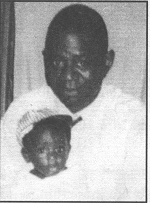
How can a 2-year-old child fall nearly 30 feet onto concrete and not be injured? I am convinced that God protected my young grandson, Andre Nathan, and used the accident to bring others to know God.
I was reading while my grandchildren, Andre and Jean, played nearby. I did not notice Andre wander away from his sister. Nobody saw him toddle upstairs or out onto the balcony. No one saw him climb the railing or fall silently onto the pavement 30 feet below. Only when I heard someone shouting outside did I realize that something was wrong. I raced to the door and found a crowd gathered around the boy. How could he have gotten outside? I wondered. Then someone said he had fallen from the balcony above. The boy was not crying and showed no signs of trauma or injury as he looked at all the strange people around him.
I rushed my grandson to the hospital where a doctor confirmed that Andre had not been injured; he did not even have a scratch on his body! Relieved, I returned home and contacted Andre's parents, who were traveling, to assure them that the children were fine.
That might have been the end of the ordeal. But word of the child's miraculous escape from injury spread throughout the neighborhood. One neighbor family came to see for themselves this child whom God had protected. They told me, "The God who lives in this house is not the same as the one who lives in our home." Others made similar comments, for in Africa miracle events often generate faith responses.
 As
a result of hearing about or witnessing Andre's escape from death, two families
are studying the Bible and a third is now attending church. The children
of one family join us for family worship when they hear us singing.
As
a result of hearing about or witnessing Andre's escape from death, two families
are studying the Bible and a third is now attending church. The children
of one family join us for family worship when they hear us singing.
As a grandfather I marvel at how God saved my grandson's life, but as a pastor, I marvel even more at how God has used this incident to lead others to Him.
Andre Makong (left with young Andre) is coordinator of Global Mission for the Central African Union Mission in Yaounde, Cameroon.


Join the SSNET moderated email discussion group. You are also warmly invited to join a group discussion of this lesson Sabbath morning with your local Seventh-Day Adventist congregation.
Editorial Office: 12501 Old Columbia Pike, Silver
Spring, MD 20904.
Principal Contributor: Carlos Martin
Acting Editor: Lyndelle Brower Chiomenti
Editorial Assistant: Soraya Homayouni Parish
Art and Design: Lars Justinen
Pacific Press Coordinator: Paul A. Hey
Copyright © 2000 General Conference of Seventh-day Adventist. All Rights Reserved.
This page is Netscape  friendly.
SSNET Web Site Home page.
Directory of adult SS quarterly
Bible Study guides.
Prepared for the Internet by the SSNET
Web Team.
Last updated June 18, 2000.



