Lesson 7 *November 7-13
Now Hear This!
Sabbath Afternoon
Read for This Week’s Study: Num. 13:26-30; Jer. 36:20-26; 2 Chron. 36:15-16; Matt. 23:30-35; 1 Cor. 10:6-12
Memory Text: "Now these things happened to them as an example, and they were written for our instruction, upon whom the ends of the ages have come" (1 Corinthians 10:11, NASB).
Some people today are encouraged to speak "their truth"—their experiences, their ideas, their needs, their boundaries, their convictions—whatever these may be. Every "truth" is valid (the thinking goes) and should not be silenced. What happens, however, when some of these deeply held "truths" conflict with the Truth, Jesus Christ, and His Written Word?
What happens is that some people will accept biblical truths and turn away from their errors; others, however, will cling to their lies. Some change their behavior in response to truth; others rebel against it. Such has been the history of humanity.
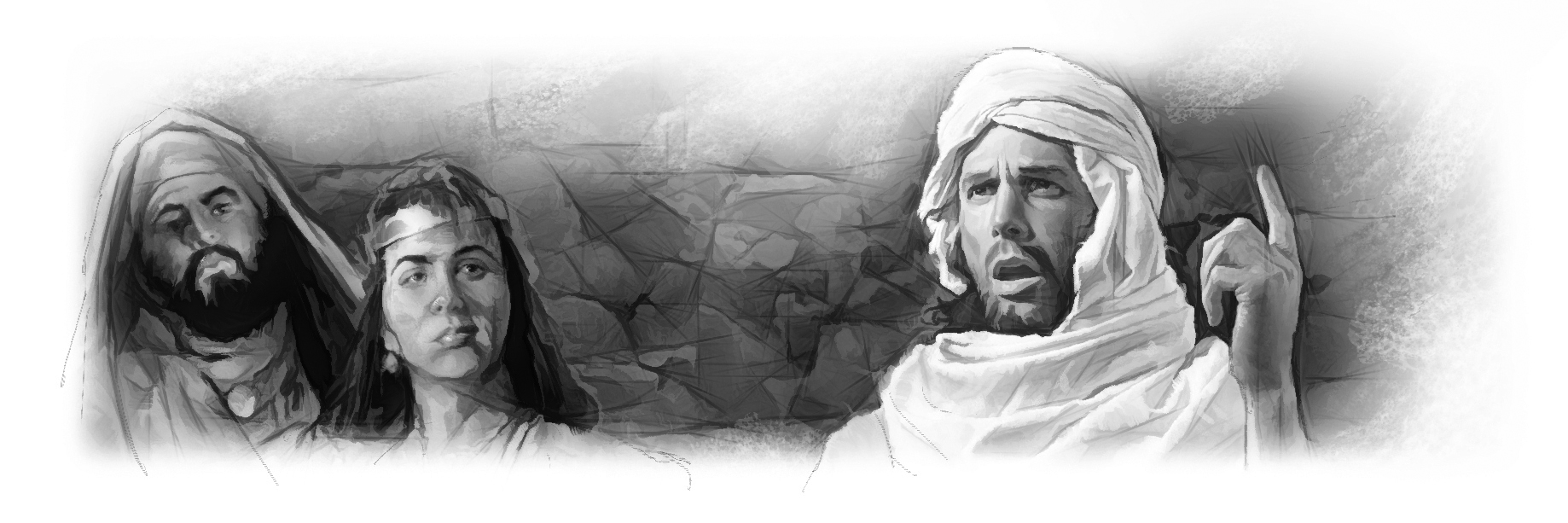
Biblical prophets were often called to deliver messages that people did not want to hear. As a result, many were criticized, ostracized, even threatened with death or indeed killed (Heb. 11:32-38). Despite all this, God's prophets faithfully proclaimed their messages because divine prophetic guidance was not optional for them. It was lifesaving instruction for the people of God. Hence the messages had to be delivered, no matter the personal cost to the prophet.
*Study this week's lesson to prepare for Sabbath, November 14.
Anger at God's Messenger
Moses, God's chosen leader, knew the joys and pains of guiding a mixed multitude through a wilderness in search of the Promised Land.
Read Numbers 14:4-11. What is happening in these verses? Why are the people upset with Moses and Aaron?
A close reading of these verses reveals that the children of Israel were angry at God because they did not trust Him. Moses and Aaron, the human representatives of God's ultimate Lordship, were easy targets for the nation's anger. The need for physical and mental safety is a core motivation that all human beings possess. When either is threatened, or we perceive something as a threat to our physical or mental well-being, we can become irate or even irrational.
Read Numbers 13:26-30. Why were the Israelites so afraid? What word of encouragement did Caleb share with them?
The Israelites harbored legitimate fears about the challenges that lay ahead in possessing the Promised Land, "but when men yield their hearts to unbelief they place themselves under the control of Satan, and none can tell to what lengths he will lead them."—Ellen G. White, Patriarchs and Prophets, p. 389. Moses faced an almost insurmountable leadership challenge in this moment. The fears of the people soon mushroomed into anger against Aaron and Moses and into open rebellion against God. When the people sought new leaders to replace the prophet/leader chosen by God (Deut. 34:10-12, Num. 14:4), Joshua and Caleb tore their clothes and pleaded with the people to trust in God despite their fears: " 'If the Lord delights in us, then He will bring us into this land and give it to us, "a land which flows with milk and honey." Only do not rebel against the Lord, nor fear the people of the land' " (Num. 14:8-9, NKJV).
It's easy to trust in God when things are going well, isn't it? How about when disaster strikes? How about when trusting God means discomfort or inconvenience? How well do you do then?
Destroying the Message: Part 1
Read Jeremiah 36:20-26. What was going on in the court, and how did the leaders respond to the prophetic warning?
Jeremiah was God's prophetic voice to the nation of Judah during a time of impending doom. For many years God through Jeremiah had been warning Judah of His displeasure with them, and that Babylon would conquer them and take them captive into exile (Jer. 6:8-19, Jeremiah 26). The Lord was seeking to save them, but they had to obey.
Judah's sins were many, open, and unchanging. Idolatry, child sacrifice, adultery, and tyranny were the norm during Jeremiah's time, yet the prophet's warnings and appeals were not heeded. As Jeremiah's prophetic ministry neared its end, God's appeals to His wayward children grew more intense, yet His efforts always remained redemptive. In Jeremiah 32, for instance, God tells Jeremiah to buy a piece of land and hold on to the deed, " 'For thus says the Lord of hosts . . .: "Houses and fields and vineyards shall be possessed again in this land" ' " (Jer. 32:15, NKJV).
It was love that moved God to have Jeremiah write a kind of final appeal for repentance and reformation. Jehoiakim's response to this message was one of disdain for God, His message, and His messenger.
Read Jeremiah 36:27-31. How did God respond to Jehoiakim's act of defiance?
Sometimes there is a tendency to believe that if we dismiss or destroy God's messages or His messengers, the message itself will vanish. Our unwillingness to heed God's prophetic Word does not erase the message God has for us. Our disdain only intensifies the harm that will befall us and our families because of our willful ignorance or rebellion. Jeremiah's prophecy about King Jehoiakim's end holds a grave warning for every human being (Jer. 36:30-31): we ignore God's warnings to us at our own peril, for we will reap the consequences of our sin and evil.
What does it tell us about God's loving character that He persisted in trying to reach His people despite their defiance?
Destroying the Message: Part 2
The human responses to the gift of prophecy can take many forms. In the case of Moses, the children of Israel fell into open rebellion against Moses and Aaron, driven by fear of the foes whom they would encounter when trying to enter the Promised Land. Years later, King Jehoiakim burned God's message in hopes of destroying God's prophetic word.
These, however, were not isolated cases by any means. The history of ancient Israel and Judah was, with rare exceptions, one of rejecting the prophets.
Read 2 Chronicles 36:15-16. How did the nation of Judah respond to messages sent by God to them through His prophets? How did God eventually react to Judah's behavior?
Jeremiah's prophetic ministry spanned the reigns of Josiah, Jehoahaz, Jehoiakim, Jehoiachin, and Zedekiah. The kingdom of Babylon, led by Nebuchadnezzar, was now at Judah's door. The prophecies of Jeremiah were all but fulfilled when a 21-year-old named Zedekiah came to the throne (2 Chron. 36:11). The Bible says, "He did evil in the sight of the Lord his God, and did not humble himself before Jeremiah the prophet, who spoke from the mouth of the Lord" (2 Chron. 36:12, NKJV).
Notice how Jeremiah's prophetic gift is described. He is seen as speaking out of the very mouth of God. Nevertheless, Zedekiah did not humble himself before the prophet. And yet Jeremiah, who was only a man, a sinner like all the rest of us, was a representative of the Lord, on whose behalf he spoke.
Jeremiah was one among many in that role. For centuries, God had been sending prophets to His people (Exod. 3:15, Ps. 105:26, Mal. 3:1, Isa. 6:8, Jer. 25:4, Matt. 11:13, Luke 11:49, etc.), not willing "that any should perish but that all should come to repentance" (2 Pet. 3:9, NKJV). This history of ancient Israel and Judah is the story of God's ceaseless attempts to reach His backsliding people with His promises of salvation, if only they would repent.
But at this late hour in Judah's history, the grace extended by God to Judah through the guidance and comfort of Jeremiah's prophetic voice was met, not with humility, faith, and repentance, but with laughter, mockery, and derision.
They mocked the messengers of God, despised God's words, and scoffed at His prophets. Surely, we today would never do anything like that—or would we?
Hypocrisy
Have you ever looked at things that others have done in the past and thought to yourself, If that were me, I never would have done what those people did! However, if we are honest with ourselves, we may not do the exact things that others do, but we often behave in similar ways, repeating the same mistakes while, perhaps, blinding ourselves willfully to what we are really doing. This is the principle Jesus Himself addressed when He said: " 'Hypocrite! First remove the plank from your own eye, and then you will see clearly to remove the speck from your brother's eye' " (Matt. 7:5, NKJV).
Read Matthew 23:30-35. What important but painful point is Jesus making here? What warning might we need to take from His words?
There is a sense in these verses that Jesus hated the behavior of the Pharisees because their hypocrisy was made even worse by a determined refusal to change. Jesus had had enough of the religion of the Pharisees. He was finished with spiritual elites in long flowing robes who were little more than whitewashed tombs filled with the bones of the dead (Matt. 23:27-28). They would not confess or forsake their sins, even when the sins were pointed out to them, even when Jesus again and again gave them a chance to repent and be saved.
In His dealing with these men, no wonder Jesus would call them "Hypocrites"! The line often went like this: " 'Woe to you, scribes and Pharisees, hypocrites!' " (see Matt. 23:14-15, 23, 25, 27).
Their lives were, indeed, characterized by saying one thing while doing another. Such was their approach to the prophets. They thought, for instance, that by beautifying the tombs of the prophets, they were honoring the faith; but in the important things, such as repenting at the words of the prophets, they refused to do so. Instead, they wanted to be associated with the power and pathos of the prophets, but not the content of their messages. In burnishing the tombs and sepulchers of God's servants, they reasoned to themselves that they would never have shed the blood of God's messengers. Yet, at that very time they were planning the murder of someone much more than a prophet—the Messiah Himself.
How do we make sure that in principle, we don't do the same thing: outwardly acting religious while inside being full of rebellion and greed and hate?
For Our Admonition
All these accounts in the Old Testament, however sordid and sad, were given for a good reason: ideally, so that we should learn lessons from them about what happens when we rebel against God.
Read 1 Corinthians 10:6-12. According to the apostle Paul, why did God inspire prophets to write what they wrote in the Bible?
In these verses Paul draws a straight line connecting the past and the present, connecting ancient Israel and the church, of which we who have accepted Jesus as Lord and Savior are now a part (Gal. 6:14-16).
Paul makes clear that the past record of humanity's experiences with God—be they good or bad—are not to be overlooked or discounted. In fact, God thought it so important that He codified it as examples "to the intent that we should not lust after evil things as they [our forebears] also lusted" (1 Cor. 10:6, NKJV). In other words, the past is often prologue to the future. The past often sets the context for what is presently happening and what will happen in the future.
In effect, God is saying that we are not doomed to repeat the mistakes of past generations, if only we heed the admonitions of Scripture and the prophetic messages sent by Him to us through His prophets. If we listen, learn, and obey, our lives will be established, and we will prosper (2 Chron. 20:20). For some, even spiritual prosperity has been defined by having nice homes, cars, clothing, and other material possessions. While God promises to take care of our needs, He also wants our souls to prosper, even as we prosper in other ways (3 John 2). But true lasting spiritual fullness in the Christian life requires obedience to God's messages.
God does not waste words. When He speaks, His Words are eternal. Their power and efficacy never end (Isa. 40:8). They are given for our admonition, "upon whom the ends of the ages have come" (1 Cor. 10:11, NKJV). If that were true back then, how much more should those words apply to us today?
When you read accounts in the Bible of rebellion and disbelief, what lessons can you draw from them that could help you avoid doing something similar?
Receiving and Delivering Her Messages
Arthur White, Ellen G. White's grandson and a former director of the Ellen G. White Estate, estimated that during her lifetime his grandmother received hundreds of visions and prophetic dreams. The visions lasted from a few minutes to several hours and at times were witnessed by large groups of people. On some occasions even her skeptics had the chance to examine her during such public manifestations.
Like biblical prophets, Ellen G. White experienced supernatural phenomena while in vision. In 1868, James White gave a detailed description of Ellen White's state during a vision. She was "utterly unconscious of everything transpiring around her"; she did not breathe; her muscles became "rigid" and her "joints fixed"; her movements and gestures were "free and graceful"; and her eyes were open. After coming out of vision she would temporarily lose sight, yet her eyesight was not impaired. No one could control when or how long she would be in vision, as the visions were usually unexpected by Ellen White herself. (See James White, Life Incidents, pp. 271-274.)
As in Bible times, the reaction of people to the messages varied. Some accepted God's counsels; others rejected them. As Ellen G. White put it: "God has set me as a reprover of His people; and . . . as He has laid upon me the heavy burden, He will make those to whom this message is given responsible for the manner in which they treat it. . . . I have not chosen this unpleasant labor for myself. It is not a work which will bring to me the favor or praise of men. . . . In the name and strength of my Redeemer I shall do what I can. I shall warn and counsel and reprove and encourage as the Spirit of God dictates, whether men will hear or whether they will forbear. My duty is not to please myself, but to do the will of my heavenly Father, who has given me my work."—Testimonies for the Church, vol. 4, pp. 231, 232.
Interestingly, many of those who rejected her prophetic messages did so based on their own unbelief or personal disagreements with Ellen G. White, rather than on theological grounds. Ellen G. White was very gracious to those who expressed skepticism about her prophetic gift. In fact, she made it clear that such people should be treated with "long patience and brotherly love . . . until they find their position and become established for or against."—Testimonies for the Church, vol. 1, p. 328.
Ellen G. White was convinced that the real proof of her prophetic gift was the messages that God gave to her. If people were honestly searching for the truth, she believed they would come to see that her gift was genuine and authentic. She trusted God to lead them on their quest to better understanding, yet she also wrote that God has given us sufficient evidence "to balance our faith on the side of truth."—Testimonies for the Church, vol. 4, p. 231.
To discover more, visit https://whiteestate.org/absg/7.
God Is First, Part 2
Naum remembers well the day he learned that there would be a Seventh-day Adventist secondary school and college in his own country.
“A brother from the Yugoslavian Union came to visit my church and told us about an Adventist school that was going to be opening. We were delighted!”
The school in Maruševec opened in 1969 with 45 students.
“It was like a miracle to have this school!” exclaims Naum. “We were the first generation, the experimental generation. The staff read the book, Education, by Ellen G. White, and the education we received was the best!”
Since the school was not then accredited, the students had to pass all 17 subject exams given by the government at the end of every school year.
“It was a severe drill,” Naum recalls, “but at the end of the fourth year, we were scoring higher than the students from the State schools! We were considered to be the best school in what was then Yugoslavia.”
After graduating, Naum attended university in the city of Zagreb where he studied French and Latin. Upon completion, Naum had two job offers— one from the communist government, offering him a highly desired political position with many benefits; the other a teaching position at the Adventist school in Maruševec.
In speaking with the government officials, Naum said, “You know I’m an Adventist. I’ll go to church every Sabbath. Why are you inviting me for this position?”
“Because we need honest people in politics; they are rare!” came the surprising response. “We need people with principles!”
“Thank you,” Naum replied, “but I’ve accepted a job at the school in Maruševec.”
For many years Naum faithfully served the students at Maruševec, not only by teaching them French and Latin, but eternal values.
“God and salvation—these were the first things I wanted my students to learn,” said Naum. “After that comes knowledge, and accepting the obligations in life—to take life seriously. We’re not playing at life; times are serious.”
In 2017, your Thirteenth Sabbath Offering helped build a much needed dormitory at the Maruševec Adventist Secondary School in Croatia. This quarter, your Thirteenth Sabbath Offering will help construct a new Seventh-day Adventist church in the capital city of Zagreb, replacing one of the largest and oldest Adventist church in Zagreb that was destroyed by a series of severe earthquakes in 2020. This new church building will enable members to meet for worship and other church activities and become a center of influence for the citizens of Zagreb. Along with the new church hall on the ground floor, rooms on the first and second floors will provide space for missionary, social, cultural, and other activities. A classroom for the “Prilaz School” will be included, along with a kitchen and large dining room. The center will open their doors to visitors via various projects that fulfill the needs of the surrounding community.

