
Sabbath: The True Joshua

Daily Lesson for Sabbath 29th of November 2025
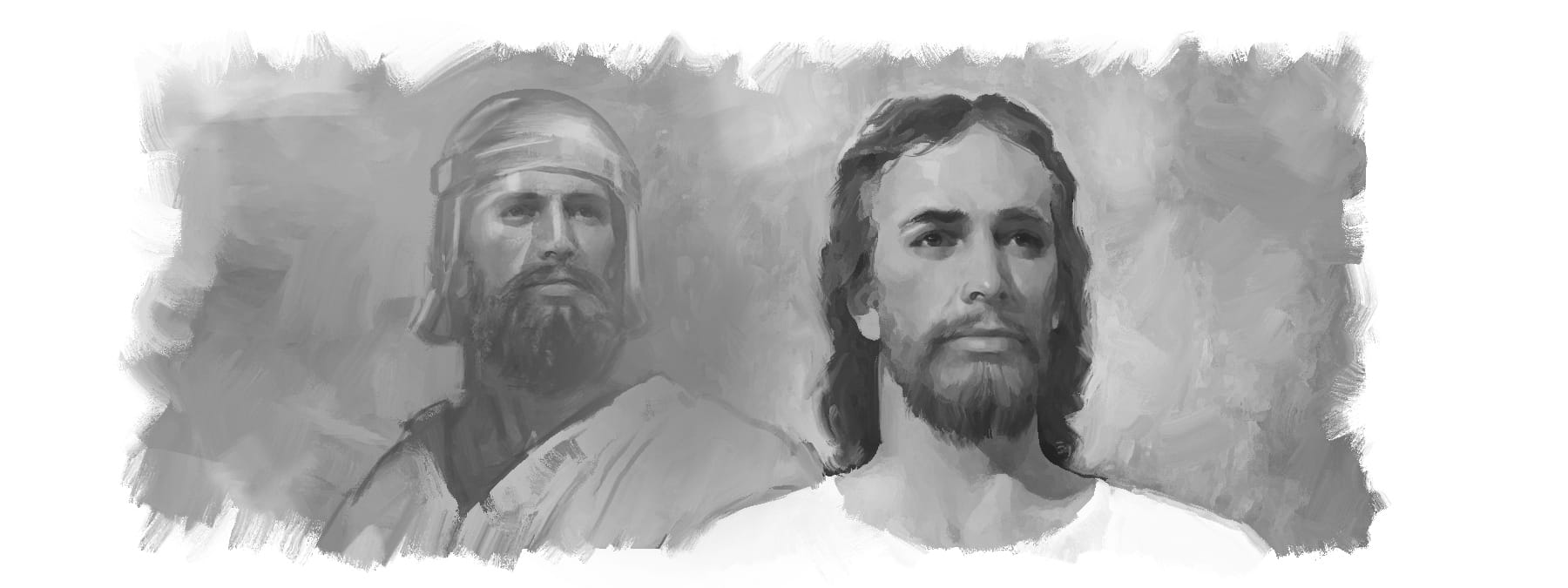
Image © Pacific Press
Read for This Week’s Study: 1 Corinthians 10:1-13; Matthew 2:15; Joshua 1:1-3; Acts 3:22-26; Hebrews 3:7-19; Hebrews 4:1-11; 2 Corinthians 10:3-5.
Memory Text: “Now these things happened to them as an example, but they were written down for our instruction, on whom the end of the ages has come” (1 Corinthians 10:11, ESV).
In the book of Joshua, there is a sense that the life of its main character points beyond itself to a reality that is much greater than the man himself. We see this principle all through the Bible, such as with the land of Canaan, a symbol of our eternal hope in a new earth. And, of course, the earthly sanctuary service pointed to a greater reality: “But Christ came as High Priest of the good things to come, with the greater and more perfect tabernacle not made with hands, that is, not of this creation” (Hebrews 9:11, NKJV).
But the question arises: In what way does Joshua point to a future fulfillment? How can we be sure that such an interpretation of the book is legitimate? What are the biblical principles that control the application of the book of Joshua to New Testament realities and to end-time events?
This week, we will look at principles of biblical interpretation concerning typology. We will study how the Bible itself contains indicators of typology and how the life of Joshua foreshadows the ministry of the Messiah and points to symbolism fulfilled in the church as well as in the consummation of human history.
*Study this week’s lesson to prepare for Sabbath, December 6.

I am always a tad wary of these type/antitype discussions because we often strain at minutia to relate from one to the other, and in doing so, we raise the level of theo-jargon above the understanding of most people. Even the words type/antitype are often seriously misunderstood and we often have to explain to listeners and readers that “anti” has two meanings: (a) against and (b) corresponding. (a) is the most common meaning, but (b) is the meaning used when we refer to antitype.
I am reminded of my high school science days when we encouraged students to draw diagrams of the equipment used in experiments. These diagrams were the “type”. The antitype was the equipment itself. The diagram was a two dimensional representation of the real equipment and it left out a lot of detail to emphasis the key features of the equipment. Typically, the diagram made little distinction between materials and colour was omitted. Structure and relationship was important. Someone could look at a diagram and gain a useful understanding of the equipment used in the experiment.
Another important aspect of the science diagram/experiment is that the diagram (type) is often drawn after the experiment (antitype).
I think we need to keep this in mind when looking at theological type/antitype. The type is a representation of something important in the antitype, and secondly the fact that an event of person is identified as a type typically occurs after we have encountered the antitype. That does not reduce the importance of types, but, we should not expect them to be an exact model of the antitype.
The type/antitype theology is not peculiar to Seventh-day Adventists but among modern Christian churches we are up among its highest users. That raises the issue that when we talk to others about themes where the type/antitype terminology is useful for us, it may not be understood by others.
Thank you, Maurice, for this very insightful explanation. I actually had no idea despite being an SDA for decades. But hearing the discussions on this I agree with you as they always left me weary as well. Thank you.
I tend to agree. Obviously there are some characters in the Bible whose ministry Jesus fulfilled in some way. Adam, Moses, David are some of the obvious ones. But I do sometimes fear that when we make Jesus the fulfillment of all sorts of Old Testament characters, there is the risk of these people almost becoming symbols. But they were real people.
The book of Hebrews also emphasizes over and over that Jesus is better than any of these Old Testament characters. So we have to be careful in our applications.
Whether type/antitype or not, the righteous people of the Old Testament reflected God in different ways. In this sense, we should not be surprised to see parallels with Jesus. In the end, whether a Bible character is a true type or just a righteous person, we can still learn from them.
The memory text for lesson ten (10) is profoundly timely for our critical examination.
“Now these things happened to them as an example, but they were written down for our instruction, on whom the end of the ages has come” (1 Corinthians 10:11, ESV).
Paul was referring to Israel’s failures in the wilderness (1 Corinthians 10:1–10). What are these failures that happened to the covenant people that should be spiritual warnings to us today?
• Idolatry
• Sexual immorality
• Testing God
• Grumbling
Israel’s experiences are typological warnings for us as the last generation. The covenant people experienced miracles, divine guidance and covenant privileges, and yet they perished due to disobedience. Likewise, we, particularly the Seventh Day Adventist Christian, know about prophecy, understand world events and are aware of the signs of the times. Are we prepared for the second coming of Jesus Christ? Paul is giving a warning that knowing history (typology) is meaningless if it does not produce holiness. History was written to wake us up from spiritual slumber. From the memory text (1 Corinthians 10:11), Paul wants us to pick a few lessons:
1. We should be spiritually alert, as Jesus warned us, “Watch” (Matthew 24:42), “Be ready” (Matthew 24:44) and “Keep awake” (Mark 13:33).
2. We must resist the sins that destroyed ancient Israel, particularly idolatry, sexual immorality and taking God for granted.
3. God expects us to learn from what befell ancient Israel. The last-day church needs to be more vigilant.
4. “The end of the age” demands purpose-driven living, a daily walk with Christ, daily repentance, Spirit-led obedience and mission-minded living.
We, as the last generation, must not repeat the mistakes of ancient Israel but learn from them, live vigilantly, and prepare our hearts and lives for the soon coming of Jesus Christ.
Paul is referring to the failures of Israel in the wilderness under Moses’ leadership.
But why is this connected to Joshua?
Thanks, Douglas. There is a lesson to be learned. Moses, as a human being, had his own failures. However, there is One who is Greater than Moses, and that is Jesus Christ. If we surrender our will to Him, we shall arrive at the promised heavenly Canaan successfully.
Appreciated Omwenga.Israel’s failure under Moses created the need for a new leader who would succeed where they failed.
The ancient Israelites kept on repeating the same mistakes they did while not only under Moses’ leadership but also Joshua’s. These are lessons we need to learn.
Yes. And until in our generations , it still happens in our midst. O Lord please guide us always, please strengthen our weaknesses of faith. All of us want to be in Canaan with our Lord Jesus Christ 🙏 ❤️.
The story of Joshua is one of God’s great faithfulness. In Joshua 3–4, the setting aside of memorial stones was meant to remind the children of Israel of the miraculous and historic crossing of the Jordan River—an event that points forward to what God would ultimately fulfill in Jesus Christ, who miraculously provides the way for His people to cross from the world of sin into the heavenly Canaan. Joshua’s name means “Yahweh saves,” and the New Testament gives this same name—Yeshua, Jesus—to Him who brings God’s people into a far better inheritance. Just as Joshua was a servant of the Lord commissioned to lead Israel into the promised rest, Jesus leads His people into eternal life. And where Joshua set up stones as a memorial of God’s deliverance, Jesus, the final Joshua, establishes a new covenant—an everlasting memorial of God’s saving grace. Thus, the story of Joshua reveals God’s unfolding plan of redemption, completed in Jesus Christ, the ultimate Savior.
The saying is that the one who asks the questions sets the tone of discussion. There certainly are a lot of questions today. I had the opportunity today to listen to a testimony, which I found was a story. To make a long story short. An airline pilot of another country was piloting a modern jet with over 200 souls on board. One engine went out, then the hydraulics failed except for the controls. The controls became so heavy, that he couldn’t lift the left wing and a spiral started downward over the Mediterranean. He had not prayed to God in the past, yet he had associate pilots in training who did. He knew that he could not save the plane. He remembered his Christian friend who had prayed for him. He got on the intercom and said; “a voice whispered to me you can’t save the aircraft but I can.” While still on the intercom he prayed, “Dear Jesus, save us I cannot.” Soon the aircraft leveled out and landed in Athens Greece. After that experience, the airline pilot gave his heart to Christ and is now a devoted Christian. God answers prayers. We have found that Joshua sought the Lord in prayer many times. And God answered Him.
We shall find out this week just how Joshua was a type of Christ. So was Abraham. Abraham took his son up mount Mariah to be a sacrifice symbolizing the sacrifice God the Father did for us, by giving us His one and only Son, the Son of God. I hope this week brings us closer to Christ, or if you prefer strengthens our grip on Christ. If you look back on Fridays blogs, nothing can pluck us from Christ, cause we keep our eyes on Him, or if you prefer we spend time with Him daily. Christ set the example of totally depending on God the Father, another type or symbolism Joshua set. Was he successful? Yes, always when he sought the Lord first. Many nations were run over, or destroyed with the Lord going before Joshua.
In the Abraham example, it was actually Isaac who was a type of Christ.
What’s in a name? The ancients didn’t name their children with catchy, or interesting sounding names. They named them after events surrounding their birth or the character they either displayed, that they hoped that they would display, or they were instructed by an angel. (examples; Jacob, Moses, John, and Jesus) Many examples could be given but time and space constraints dictate restraint.
I did find this bit of information of the comparison of Joshua/Jesus from Wikipedia to be interesting to say the least.
“The English name “Joshua” is a rendering of the Hebrew Yehoshua, and is mostly interpreted as “Yahweh is salvation”;[10][11] although others have also alternatively interpreted it as “Yahweh is lordly”.[12] The theophoric name appears to be constructed from a combination of the Tetragrammaton with the Hebrew noun יְשׁוּעָה (Modern: yəšūʿa, Tiberian: yăšūʿā), meaning “salvation”;[13][14][15][16] derived from the Hebrew root ישׁע (y-š-ʿ), meaning “to save/help/deliver”.[17][18] Other theophoric names sharing a similar meaning can also be found throughout the Hebrew Bible, such as that of the son of David אֱלִישׁוּעַ (ʾĔlīšūaʿ), whose name means “My El (God) is salvation”.[19][20]
“Jesus” is the English derivative of the Greek transliteration of “Yehoshua” via Latin. In the Septuagint, all instances of the word “Yehoshua” are rendered as “Ἰησοῦς” (Iēsûs), the closest Greek pronunciation of the Imperial Aramaic: יֵשׁוּעַ Yēšūaʿ.[21][22][23][24] Thus, in modern Greek, Joshua is called “Jesus son of Naue” (τοῦ Ναυή, tû Nauḗ) to differentiate him from Jesus. This is also true in some Slavic languages following the Eastern Orthodox tradition (e.g. “Иисус Навин”, Iisús Navín, in Bulgarian, Serbian and Russian, but not Czech)
Joshua – Wikipedia
Having shared that, I look forward to this week’s study as we see the similarities and probably the differences of these two individuals that are main characters of the Judeo-Christian faith.
I agreed with today’s reading as it reflects on activities that could derail one from continuing to be faithful to God. Temptation could manifest itself in several ways to obstruct us from achieving our primary objectives, and the need to be mindful of what could be persuasive enough to overcome our faith, as a result of temptation, should indeed be a subject of interest. A commitment to fornication comes with a great interest of desire, especially if one intends to commit to fornication, as a result of self-interest, and without the courage to hold on to God’s commandment. The apostle Paul’s message to the Corinthians, on the subject of fornication and idolatry was a reminder of what could make one fall. The message seems to be encouraging because it advises us to run away from idolatry. 1 Corinthians 10: 1-14.
Acts 3:25-26 – ”You are sons of the prophets, and of the covenant which God made with our fathers, saying to Abraham, ‘And in your seed all the families of the earth shall be blessed,’ To you first, God, having raised up His Servant Jesus, sent Him to bless you, in turning away every one of you from your iniquities.”
2Cor.10:35 – ”For though we walk in the flesh, we do not war according to the flesh. For the weapons of our warfare are not carnal but mighty in God for the pulling down strongholds, casting down arguments and every high thing that exalts itself against the knowledge of God, bringing every thought into captivity to the obedience of Christ, ..”
The land and the temple, given to the children of Israel, were to fulfill their by God given purpose. Joshua, the prophets, judges and everyone called by Him, were to teach to recognize their dependency on the True God of Creation – that all good things happen by God’s ‘goodwill’ – His Providence.
And then came Jesus – His life embodying the essence of our heavenly Father’s restorative work on behalf of mankind and all His Creation from the Beginning – elevating His Love of humanity as His essential motivation, exposing our need for wisdom and discernment through the help of the Holy Spirit in order to properly apply His teachings of how to rightly maintain our fellowship with the Father as stewards of His ‘LOVE’ – “tikkun olam” – helping to ‘repair the world’ – Deut.16:20; Amos 5:24; Matt.5:13-16; John 7:37-39.
Of the 12 spies, Joshua and Caleb were the only ones to believe God’s promise about Canaan. Let us strive to do the same and believe in God’s promises to us, because His plans are of prosperity and hope for a great future. “For I know the plans I have for you,” declares the Lord, “plans to prosper you and not to harm you, plans to give you hope and a future.” Jeremiah 29:11