
Sunday: Fellowship in the Gospel

Daily Lesson for Sunday 4th of January 2026
Read Philippians 1:3-8. What is Paul thankful for? What reassurances does he give the Philippians, and why is that important?
Paul established the church in Philippi; thus, we can see the warmth of Christian fellowship pervading his letter. Though separated by hundreds of miles, Paul, chained and imprisoned, carries the church and its members on his heart; he longs for them “with the affection of Jesus Christ” (Philippians 1:8, NKJV); he gives thanks to God for them. Paul’s prayer of thanksgiving even gives a glimpse of Jesus’ intercession for us in heaven.
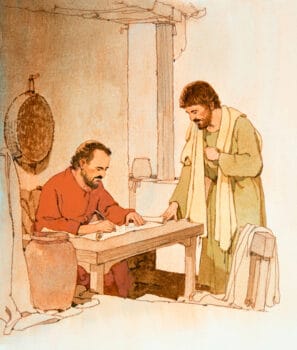
Image © Lifeway Collection at Goodsalt.com
On the high priest’s breastplate were 12 stones representing the 12 tribes of Israel. The people were to be “on his heart” as he interceded for them (Exodus 28:29, ESV). In an even greater way, as our High Priest in the heavenly sanctuary, Jesus carries the names of His people with Him before the Father.
Interestingly, the wording of Philippians 1:3 is ambiguous, underscoring the close relationship between Paul and the Philippians. It’s usually translated that Paul remembers them in prayer, but it could also refer to their remembrance of him. In any case, it underscores the close mutuality they share, which the word “fellowship” (Greek: koinonia) also underscores. As Paul had fellowship in Christ’s sufferings (Philippians 3:10), the Philippians “shared” (Greek: sunkoinōneō) in Paul’s sufferings and shared financially to support Paul’s ministry (Philippians 4:14-15). This mutuality, which was “from the first day until now” (Philippians 1:5), leads him to thank God for them and to pray for them “with joy” (Philippians 1:4).
Interestingly, Paul describes his prison setting quite positively—as providing opportunity for “the defense and confirmation of the gospel” (Philippians 1:7, NKJV). His use of these two legal terms suggests his trial is imminent, but also that Paul is actively engaging soldiers and visitors with the gospel. Defending it (Greek apologia) against attacks and confirming its eternal verities are both essential. Paul seems to care less about his own future than about vindication of the gospel itself. Whether he lives or dies, Paul is confident that God will finish the “good work” He has begun in all who trust in Him (Philippians 1:6).
|
How do you understand the promise that God will finish the “good work in you” (Philippians 1:6)? What does that mean? Will this work ever end before the Second Coming? |

We sometimes downplay the importance of social grouping in our Bible study. We can be so heavenly minded about our doctrines and definitions that we forget how important it is to interact at a social level. The success of the early church depended on people who not only believed in Jesus, but who got on with one another and supported one another. Listen to Paul:
In this respect we find that Paul was remarkably tolerant. I am jumping ahead a bit but in Colossians we find him tolerating those who preached the Gospel differently to him. It is perhaps a salient message for those of us who argue that point on some points of doctrine.
In my experience, I have seen the very best and worst of church social cohesion. Sometimes it has taken the tragedy of a death for members to put aside their differences. At the graveside, they have been united in their love for one another and realise the importance of the Gospel despite their theological understandings. I have also seen too many people leave the church, where differences have been magnified to the extent they have broken the cohesion of love.
There is a lot of the Gospel in a Potluck lunch, or church social, where we talk together and laugh a lot and even cry a little. And it is on those occasions when we hear the prayers of others, and the Holy Spirit can guide us into actions that answer those prayers. That is where God can work miracles.
How important is fellowship (friendship) in the gospel ministry, using the Philippian church as the case study?
“So, it is right that I should feel as I do about all of you, for you have a special place in my heart. You share with me the special favour of God, both in my imprisonment and in defending and confirming the truth of the Good News.” (Philippians 1:7, NLT).
Paul’s relationship with the believers in Philippi occupied a special place in Paul’s heart and stands as the warmest and most mutually supportive in the New Testament. From the onset, Paul describes them as his “partners in the gospel” (Philippians 1:5). Paul cherished this fellowship (relationship) as a living example of what a community of believers ought to be. It was gospel-centered, sacrificial, joyful, and enduring in hardship. This kind of fellowship is one we should emulate in advancing God’s mission in the world today.
Examining the Philippian fellowship, important lessons can be picked up for the advancement of the gospel of Jesus Christ.
1. True Christian fellowship must be Christ-centered.Sadly, some Christian fellowships are based on social connections, age, race, colour, language, nationality, economic status, etc. Perhaps, the time has come when we should examine our fellowships from the perspective of the gospel of Jesus Christ.
2. True Christian fellowship must embrace the spirit of sacrifice. The Philippian fellowship gave generously and stood by Paul during hard times. Genuine fellowship requires giving (time, resources, encouragement, prayer), particularly when it is inconvenient.
3. True Christian fellowship should support one another in suffering. Christian fellowship should not disappear in times of hardship. Believers should hold one another’s hands and walk in solidarity. This is what strengthens a community of believers and displays the gospel of Jesus Christ.
Paul rejoiced and prayed for the Philippians, and he was filled with joy because he understood the power of prayer within Christian fellowship. As Paul prayed for the believers in Philippi, it was clear that prayer was not about changing God’s mind, but about aligning the will of God’s people with His own. This reflects the heart of Christ’s prayer, “Nevertheless, not My will, but Yours, be done” (Luke 22:42). Paul openly acknowledged that it brought him great joy to pray and make requests to God on behalf of these saints. He knew that prayer meant directly engaging with the Creator of the universe, and that nothing is too difficult for Him.
Paul also understood that perfect peace and abundant life come from a changed perspective—seeing life the way the Lord sees it. This transformation happens through prayer, which ensures that Christian fellowship is rooted in an eternal vision and leads to changed hearts. As Scripture reminds us, “And the peace of God, which surpasses all understanding, will guard your hearts and your minds in Christ Jesus” (Philippians 4:7). When we truly realize how great, mighty, and merciful the Lord is, it becomes easier to trust Him in every circumstance within our families, careers, engagements, businesses and within our communities—knowing that He loves us more than anyone ever could.
Through prayer we can share in Thanksgiving the experiences and fellowship of our fellow believers and the impact of the prayers in the lives of those we pray for.
I have this hope that what God started to work in me, He will finish until He decides, whether in death or at His second coming. Looking back gives me this assurance! My part is to persist in my relationship with the Lord!
God has assigned His children work to sustain their livelihood as well as the gospel. Sometimes, it seems we are not progressing, and we are out of resources. But, Philippians 1:6 assures us that God will provide to complete the work.
♫ check out Acapella Vocal band:♫
https://youtu.be/OHps_fAZKHc?si=31Pm99yIVRCSCTVa
To fellowship in the gospel keep these text in mind. You may put them in your own words, but put them in memory, then you are prepared incase you land in prison for the Lord.
John 8:31, ye are My disciples if ye love one another.
John 13:35 ye are My disciples if you abide in My Word.
John 17:12 you are not lost because you are in My flock.
Romans 8:16 the Holy Spirit is witness of your spirit as being sons and daughters of God.
Romans 8:26 in our weakness, the Holy Spirit intreprets our humble groanings to God in groanings acceptable to God.
As a Christian, do you have someone in your journey of faith who crosses your mind and leaves you filled with joy and you thank God for them. Unfortunately, some have brethrens whom when they cross their mind, they spit in disgust. May God mould us to embrace his affection.
As humans, we are prone to sin. God is doing and will continue to do a good work in and through us, and sometimes that includes correcting us. I pray that I continue to listen to His gentle guiding voice. Life is a progression of God doing good works in us and this process will not be complete until He returns.
Yahweh is ALWAYS willing to do a good work in us but the question is, are we willing to allow Him in to do this work? Self is the greatest battle & until we loose self DAILY, the work can never be completed…