
Monday: Paul’s Prayer Requests

Daily Lesson for Monday 5th of January 2026
Some years ago, there was a pastor who talked about prayers that revolve around me, me, me, and my needs or desires. He aptly characterized them as “selfish little prayers,” because God has bigger things in mind.
Read Paul’s prayer in Philippians 1:9-11. What is its focus, and what big requests does he make? What does it tell you about prayer?
This prayer is only forty-three words in Greek, but it encapsulates all of Paul’s concerns, which he will expand on in the rest of the epistle: love, knowledge, discernment, being sincere, not causing offense, and the righteousness we have through Jesus Christ. Underlying this prayer, as well as Paul’s previous expressions of thanksgiving, is an emphasis on the church as a whole. Paul’s prayer is completely others-focused, on behalf of the whole church and for its well-being. Let’s look more closely at some of the individual elements of the prayer:
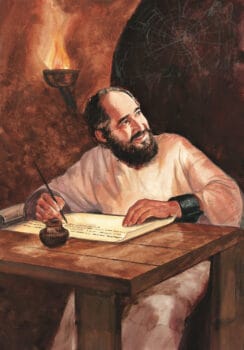
Image © Lifeway Collection at Goodsalt.com
Love to abound more and more. Paul doesn’t just pray for more love but for love guided in a specific direction: “in knowledge and all discernment” (Philippians 1:9, NKJV). The reference to knowledge is not to merely intellectual knowledge but implies a knowledge of spiritual things that can be gained only by fellowship with God and study of His Word (see Ephesians 1:17, Ephesians 4:13, 1 Timothy 2:4).
Discernment. This is explained by Paul as being able to “approve what is excellent” (distinguishing it from what is morally harmful) “and so be pure and blameless” (Philippians 1:10, ESV).
Being sincere. The word in Greek means “judged by the sunlight” and refers to an untainted purity of action: “Everything that Christians do should be as transparent as the sunlight.”—Ellen G. White, Reflecting Christ, p. 71.
Not causing offense. This means not being a stumbling block, not saying or doing anything that would make it more difficult for a person to believe.
Righteousness through Christ. Paul dwells at length on this in the epistles of Romans and Galatians and will expand on it also in Philippians 3:1-21. We have no righteousness of our own but only what we receive through Christ.
|
Whatever else we do, how can our love “abound still more and more” (Philippians 1:9, NKJV)? Why is that so important for the Christian life? (See also 1 Corinthians 13:1-8.) |

We often cast prayer as a two-way conversation between us and God, but Paul is using it as a three-way conversation between God us and others. My mother prayed for all her offspring by name. We knew she did because she told us. This was not some wishful thinking on her part that we would remain true to God. She wanted us to know how much she loved us all. Her love for us reflected her relationship with God and she wanted us to be part of that relationship. Prayer is not a “remote control” device. It is an immersive experience device where we all take part.
Recently Carmel and I took part in a Virtual Reality exhibition on Egypt. We had to wear helmets on our heads that obliterated the real world and substituted a 3D image and surround sound. It was quite surreal (read “really scary” if you are like Carmel). We were taken to the top of the Great Pyramid and were invited to walk around the edge and view the scene below. Carmel held my hand because the image was so powerful she forgot that she was standing in a room with a flat floor and she could not fall anywhere.
In a world where sin obscures the reality with its images and can be scary at times, we need the experience of three-way prayer to provide a steadying hand to others. Don’t just pray for them, let them know you pray for them and back the prayer with action.
It is interesting to note that even though Paul was writing from prison when he was interceding for the believers in Philippi, he did not ask for his release from prison. Secondly, it is equally important to note that he prioritised spiritual needs over physical needs. He was not indifferent to physical concerns, but he knew that God always supplies physical needs through spiritual realignment (Philippians 4:19). “Seek the Kingdom of God above all else, and live righteously, and he will give you everything you need.” (Matthew 6:33,NLT).
Why did Paul prioritise spiritual requests to physical concerns?
1) Paul’s greatest desire for the Philippians was for eternal blessings over physical blessings. Material needs belong to the present and are temporary, but spiritual blessings are eternal.
2) Paul knew that spiritual maturity is what believers in Philippi wanted most to strengthen them to endure any circumstance, as they were under persecution.
3) Paul knew that spiritual maturity would guard the church from error and false teaching. This was their surest safeguard from internal tensions, potential false teaching, and church instability.
4) Paul wanted the Philippian church to focus their attention on the glory of God. Physical needs are often self-centered and therefore, he sought to make their worship to be God-centered.
5) Paul knew that church effectiveness and growth were dependent on spiritual maturity rather than material abundance.
In our prayer requests to God, Paul reminds us of what should be our ultimate request.
“For I want you to understand what really matters, so that you may live pure and blameless lives until the day of Christ’s return. May you always be filled with the fruit of your salvation—the righteous character produced in your life by Jesus Christ, for this will bring much glory and praise to God” (Philippians 1:10-11, NLT).
To grow in love is not only a gift of God but also requires effort on our part. We need to allow the Holy Spirit to work actively in our hearts: as we learn to listen to His voice and let Him control our lives, we will surely grow in love.
“Love suffers long and is kind; love does not envy; love does not parade itself, is not puffed up; does not behave rudely, does not seek its own, is not provoked, thinks no evil; does not rejoice in iniquity, but rejoices in the truth; bears all things, believes all things, hopes all things, endures all things. Love never fails”. (I Cor. 13:4-8)
1Corinthians 13:1-8 is the engine of love. It is the force that drives deep love.
It may be easy to do acts of love but in no time, it becomes burdensome, tiring, or discouraging to continue. It is only by the enduring character of love as revealed in 1 Corinthians 13:1-8 can we abound in love.
And what about the Apostle Pauls’ prayer request, “Three times,” to have God remove “The Thorn in His Flesh?” Was this “A Selfish Prayer” on his part? Ellen G. White says very plainly, in so many words, that God is interested in dealing with “The smaller matters as well as the greater ones in our lives,” and therefore to take our smaller matters to him also. From this, I see a Pastor preaching against “Selfish little prayers” as being out of line. No Pastor should preach such “Nonsense.”
Pete, I think it is a little unfair to build a case against a pastor we do not know and have not heard, using Paul’s experience and quotes from Ellen White. Both Paul’s experience and Ellen White’s quote have great lessons in them about prayer, but they may not be applicable to the situation your Pastor is addressing. Without more information, your application does not necessarily follow. Folks do pray selfish little prayers about things they want or think are important to them, and that issue needs to be addressed. Without more information, I would be inclined to be a bit more generous to your preacher.
Not every message is for everyone. Certainly God wants us to bring our requests to Him. But we can be prone to just focusing on ourselves and the quoted pastor is probably thinking about that. Perhaps the expression of it was a little blunt, but he has a point. Does it apply to you and I? Only we can determine that.
I do know my prayer life has improved as I have moved beyond just “asking for things”. So the counsel, despite its bluntness, has value.
I disagree with u on this comment. The pastor didn’t say u shouldn’t pray for yourself, but just not do it all the time without praying for others. If u read carefully, he said its me, me, me n my desires only, nothing about anyone else.
Is there a difference between ‘the righteousness we have through Jesus Christ’, as the lesson writer states, and ”…being filled with the fruits of Righteousness which are by Jesus Christ, to the glory and praise of God?”
As I see it, there is a significant difference. Actually, one could say that the difference exposes the critical issues of why the Christian faith is considered by the world as ‘weak’; not strong enough to change the ‘status quo’ regarding how people live their life.
I see the difference between the ‘righteousness we have through Jesus Christ’, and the ‘righteousness of the fruit of the Spirit to the Glory and Praise of God reflected in ‘seeking satisfaction of oneself’, versus the ‘serving the Honor and Glory of God’.
Paul, in his prayer, highlights the need to increase the evidence of the power of the changes working in the life of the believer: “the love to abound more and more in knowledge and discernment; to be able to approve the things that are excellent, that they may be sincere and without offense, and to be filled with the fruits of righteousness which are by Jesus Christ, to the Glory of God.”
We need not worry when living for the Glory and Honor of God.
God’s promise to Israel –
Isaiah 46:1
”Even to your old age, I will be the same, and I will bear you up when you turn gray. I have made you, and I will carry you, I will sustain you and deliver you.”
Jesus’ request and promise to the Ecclesia –
John 14:16-18
”And I will ask the Father, and He will give you another Advocate to be with you forever – the Spirit of Truth. The world cannot receive Him because it neither sees Him nor knows Him. But you do know Him for He abides with you and will be in you. I will not leave you as orphans; I will come to you.”
In our prayers, we need to trust the Holy Spirit to re-calibrate our life, enabling us to acknowledge that the Christian’s life is the ongoing work of the Holy Spirit in us to live to the Honor and Glory of God!
I think you make is sound very complicated Brigitte. A vine has roots branches and fruit. They are all connected together and dont work without that connection. Some Christians do not mention all the parts when they make comments or talk to one another it depends on what the topic is. Most of us recognised the connectedness though. That is the good thing about the Gospel – We do not need to write essays about it – we just need to accept it and put it into practice. It is that easy!
“the righteousness we have through Jesus Christ’,
Vs
”…being filled with the fruits of Righteousness which are by Jesus Christ, to the glory and praise of God?”
The statements are one but reflecting the different aspects of flow of events and actions.
Righteousness originates from Christ and is a gift to man. Righteousness in a man, still by the power of Christ works in man to produce and fill him with fruits of this very righteousness which is of Christ. Fruits of righteousness in man – engineered by Christ – bring glory and praise to God. When fellow men witness, experience and are impacted by this righteousness, its evidence of God in him and give due glory and praise to the bona-fide owner – God. This is the letter and spirit of Matt 5:16
God bless you all, i learn alot from you guys. Its been solid two years since i discovered this page.
In the memory verse for this week, what is Paul asking us to be confident of? Philippians 1:1-7. Hint, not only confident but to participate in.
In my view, Paul’s thanksgiving in Philippians 1:3–8 shows that fellowship in the gospel is more than an emotional bond; it is a spiritual relationship established by God Himself. Paul gives thanks because the believers in Philippi faithfully supported the work of the gospel from the beginning—through prayer, shared suffering, and practical support. That is why his prayers for them are always filled with joy.
The promise in Philippians 1:6 is deeply encouraging: the God who began a good work in the lives of believers is the same God who will bring it to completion. This “good work” is not merely ministry activity or religious effort, but an ongoing process of transformation—how God shapes our faith, character, and faithfulness to Christ. This assurance does not rest on human strength, but on God’s faithfulness.
Paul writes these words while he is in prison, yet his focus is not on his own suffering. Instead, he sees his situation as an opportunity to defend and confirm the gospel. This reminds us that suffering does not stop God’s work; often, it becomes the very means through which the gospel is made clear and powerful.
The promise that God will complete His work does not mean that believers will reach perfection before the Second Coming. Spiritual growth is a lifelong process. However, we have a certain hope that on “the day of Christ Jesus,” what is still incomplete will be fully accomplished by God.
For this reason, Philippians 1:6 gives both comfort and hope: God is actively working in our lives today, and He will never abandon the work that He has begun.
Thank-you Richard. Your answer was just what I was looking for.
We pray for those we love, thats easy enough to do right? We love our families, friends, and ourselves, so naturally these are on the forfront of our prayer lists. Jesus said in Mathew 5:46
“For if you love those who love you, what reward do you have? Even the tax collectors, do they not do the same?”
I think the challenge here is to love when it’s not easy to love. Love the people in our life that are difficult to love. God already knows our needs and desires, and while it is OK to pray for these as well, our main focus should be outward and not inward. We are put here to serve one another. If we are not loving one another, then how are we going to know what to pray for?