
Thursday: Living the New Life

Daily Lesson for Thursday 12th of March 2026
Paul’s concern for peace and harmony in the church appears clearly in the last verses of Colossians 3:1-25. We’ve already looked at God’s peace in some detail (see Lesson 7). Unlike the pax Romana, the pax Christi is not a peace imposed from the outside but is to “rule” us from within. That can happen only if Christ is in control.
Read Colossians 3:16-17. What specifically enables Christ to be in control, and what role does music play in all this?
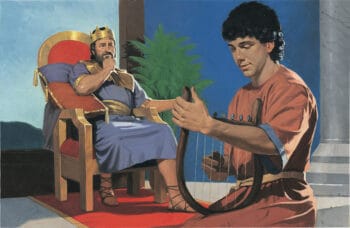
Image © Lifeway Collection at Goodsalt.com
The language is very descriptive. It pictures the word of Christ making its home in us. That happens when we read the Bible attentively in order to listen and learn from God’s wisdom. Apparently, though the Greek text is somewhat ambiguous, music plays an important role in “teaching and admonishing one another” (Colossians 3:16).
But not just any music. Paul uses very specific terminology both here and in Ephesians 5:19: “psalms and hymns and spiritual songs.”
Though we can’t be certain, it seems a distinction is made here between the existing Old Testament collection of psalms and a growing New Testament collection of hymns. “Spiritual songs” may be a more general term for any song of praise related to the spiritual life or the life of the church. The words of the songs are the means of teaching the truth and giving instruction on living the new life of a Christian. Many great hymns of the past few centuries have powerfully uplifting messages of hope and assurance, so needed in a world that so easily drags us all down.
Music’s influence is powerful. David’s playing of the harp had a soothing effect on King Saul (1 Samuel 16:23). But when David became his rival, Saul’s anger and resentment rose (1 Samuel 18:10-11). Calm classical music has been clinically shown to reduce anxiety, optimize brain function, increase relaxation, help with pain, and increase socialization.
Who among us has not seen for themselves the powerful influence music, for good or bad, can have on our emotions and thoughts? Music—the right music—can be spiritually uplifting.
|
We are told that whatever we do, “do all in the name of the Lord Jesus” (Colossians 3:17). Can you truly say that you do that? If not, how can you change; that is, what must you stop doing if you cannot do it in the name of the Lord? |

I am a little surprised the author has centred on music in today’s lesson, given some of the arguments I have seen in church circles around music. I still remember having an email argument with Dr Samuele Bacchiocchi over his criticism of Avondale Music, without him even visiting the place. I won the argument, by the way. It was not about the music but rather his research methodology into music. But that is a digression.
What bothers me about music in our spiritual lives is that we have moved from a participation to performance model. I know this is, in part, decrepit old man talk, but in my youth we often sang together for fun. Many homes had a piano and typically family evening worship involved singing around the piano, at least on Friday nights. Now, we are more likely to listen to our favourite group on YouTube, or other Internet source. I don’t think it is just a church phenomenon either. I think participatory music experiences where everybody takes part in the secular world have diminished too.
My memory is long enough to remember the days when I played in orchestras (clarinet) and sang in choirs (rusty baritone). There was something quite heartwarming about performing together and making a noise that sounded credibly harmonious. Although I can no longer play or sing, I remember the lesson of working together. In the performance, you could barely hear your own instrument or voice but the combined sound was beautiful and often moving.
And that lesson is probably the most important of all. In our community of believers, we may not even notice our contribution, but the effect of working together in harmony produces something beautiful that others want to be part of.
Paul must have heard our conductor’s instructions during our practice sessions:
Let’s make music together.
I agree. My wife and I like to participate in praise music but neither of us sing well, in fact quite poorly. Fortunately, we now belong to a church in Augusta, GA that is quite talented and everyone sings very enthusiastically making it possible for us to participate without distressing those around us, LOL. Our new pastor commented about the congregation’s lively participation on his 2nd Sabbath. He is elated to see it. Group participation is an important aspect of worship!
Make a joyful noise unto the Lord” is a command from Psalm 100:1 (KJV) for all lands to praise God with enthusiastic, heartfelt sound—whether through song, shout, or music—reflecting gratitude and joy. It all sounds wonderful in heaven. When I get there I will be able to sing in perfect four part harmony. Until then, I will keep making a joyful noise, with the emphasis on joyful. 😉😊
And I can’t wait to sing in that choir in heaven!
I look forward to the singing in the heavenly choir bit too Jeanie. But, in the absence of that talent in my present life, I hope to create harmony in other ways in the Kingdom of Heaven at hand now.
In a world that floods our lives with notifications, opinions, and endless options, truth has become increasingly rare. Studies suggest that 91% of people lie routinely about trivial matters, 36% admit they would lie about important matters, 86% regularly lie to their parents, and 69% lie to their spouses. Choosing a new life in Christ means choosing a different path—one where we filter what we say, pursue truth, and align our lives with the rhythm of God’s design. It requires saying no to distractions and yes to the priorities God has set before us. Rather than chasing fame or the approval of the world, we choose Christ in all that we do, embracing a life that is grounded, steady, and faithful. Scripture reminds us of this calling: “Do not conform to the pattern of this world, but be transformed by the renewing of your mind” (Romans 12:2). God invites us to find strength not in the spotlight, but in a quiet, faithful life that resists the noise of comparison and the pressure to prove ourselves. Ultimately, this new life is a daily choice to focus on what matters most—our relationship with God
The caption for today’s study is very befitting, “Living the New Life”. Are we living Christians or “dead” Christians? Last week (Monday) we studied, “Rooted and Growing in Christ”. We were reminded that when we are rooted in Christ, it brings growth, growth brings stability, stability brings maturity and maturity brings fruition. The takeaway message was that as Christians, we must bear fruit and good fruit. The Christian life that we have been called into is not a part-time or a casual life, but a continuous one. As the branch is always attached to the vine for its living, so as to our Christian life must be living by being continually attached to Christ (John 15:5).
Today’s lesson is reinforcing last week’s lesson by once again reminding how Christ living can be enabled. “Let the word of Christ dwell in you richly in all wisdom; teaching and admonishing one another in psalms and hymns and spiritual songs, singing with grace in your hearts to the Lord” (Colossian 3:16, KJV). It is critical to note the role music plays in a Christian life. Paul is telling the believers in Colossae to encourage one another through music. Music plays important roles in creating an enabling environment for worship and praise, bring joy, healing, convey spiritual messages, remember God’s goodness, promote fellowship and prepare hearts to receive the word of God. Paul was not simply telling the Colossians to sing, but to let “singing with grace in your hearts to the Lord”. Our singing need to be a means to connect our lives with God. Our singing need to bring rich experience how God has carried us through in our Christan journey. Each believer ought to have a song for the Lord.
“1 Sing a new song to the Lord!
Let the whole earth sing to the Lord!
2 Sing to the Lord; praise his name.
Each day proclaim the good news that he saves.
3 Publish his glorious deeds among the nations.
Tell everyone about the amazing things he does.
4 Great is the Lord! He is most worthy of praise!
He is to be feared above all gods.” (Psalms 96: 1-4, NLT)
God is great! To Him, all glory! Simply by being alive, we can say, “God is great!” He is marvelous, and we should worship Him forever! May all honor, power, and glory be to Him Who made heavens and Earth. May our lives be a result of constant praise, because He is good all the time!
Hymns and Psalms foster the joyous stimulating brain chemicals, when singing a song of praise and gratitude, and love for God.
1 Chronicles 16:8-10,23-24.
Paul sang hymns in prison to perk up their situation.
Participate in congregation and private singing, it invigorates the soul by keeping a song on your heart. Psalms 40:3.
And the congregation said amen and amen. 1 Chronicles 16:36.
The Lord God is near us in prayer, Bible-reading, and singing of spiritual hymns.
As children of God, His name is our guide. Not only the mere name but what that name stands for. In summary,God and what His name stands for must influence our actions.
In Jesus’ time, the world knew the pax Romana—a peace kept by military power, heavy taxes, and wealth. It looked stable, but it was fragile and often unjust.
Today, we see similar patterns when peace is achieved by power, money, or political loyalty rather than truth and justice.
Christ offers a different peace—the pax Christi—rooted in obedience to God, love for others, and reconciliation. His peace transforms hearts and communities, and it lasts even when circumstances are uncertain. As His people, we are called to live this peace, showing justice, mercy, and unity in a world that often values control over true righteousness.
Yesterday, I quoted Col.3:16 in a different bible version. Today’s lesson uses the NKJ’s version the following way:
”Let the word of Christ dwell in you richly in all wisdom, teaching and admonishing one another in psalms and hymns and spiritual songs, singing with grace in your hearts to the Lord.”
Yesterdat’s quoted version renders Col.3:16 quite differently:
”Let the message of Christ dwell among you richly as you teach and admonish one another with all wisdom through psalms, hymns, and songs from the Spirit – singing to God with gratitude in your hearts.”
Yes, “the ‘word of Christ’ makes its home in us”. But it is not the words, by themselves, which are understood. It is the Spirit resonating within the heart which brings to life the LIVING Word – Jesus Christ – in us; making melody in our hearts. His is the melody of a Life of gratitude and thankfulness, expressed through our songs when fully accepting our new life in Him.
It is not the intellectual learning of Scripture which is passed on through the Word of God with which we ‘teach and admonish one another’. It is the Spirit of Word of God expressing Himself as we read the Living Word and experiencing His joy in songs of praise and righteous actions.
As we focus on loving God with all our heart and mind, His Spirit will make His home within our being. He is only a thought away, will always speak to us, always guiding our thoughts and actions – never leaving us as we ‘live our new Life’ in Christ!
Brigitte, thanks for pointing out that we cannot accomplish anything without the Holy Spirit.
Music is definitely spiritually powerful. But some of the parts of today’s lesson seemed to be subtle shots at people who enjoy “the wrong music”, whatever that is.
Today’s text emphasizes that music should be part of our worship. Beyond that, trying to figure out what psalms, hymns, and spiritual songs are is probably unproductive. It’s safe to say our church music is nothing like the music Paul and his fellow believers were singing. The Bible also gives very few specifics about what “good music” is.
So I wish we would stop fighting about music and trying to define what is appropriate. The reality is that every generation thinks their music is good and what comes after isn’t. The music that is well-loved today was once considered taboo. That was true of the Wedgewood Trio, the Heritage Singers, the Gaithers and so on. Some of you quote song lyrics that any church would accept today, but back in the 80s, even Sandi Patty and Steve Green were scrutinized by the traditionalists.
I enjoy classical music and it is good music when I’m working at my lesson planning and marking (as is a lot of instrumental music). But I like a lot of other music and I’ve been blessed by it too. I can’t imagine a God of diversity would like one type of music.
There is some newer music that makes me uncomfortable, just as some of my music made my dad uncomfortable. And some of his music made my grandma uncomfortable. That’s just the way it is. I try to remember this and not judge what younger people are blessed by. It’s up to them to assess whether it is good for them or not.
When I was baptized in 1972 all the churches sang from the hymnal which was in the pews. The church was full and everyone sang the hymns in unity. The sound of all singing would fill the church. Each hymn it seemed contained an important Bible truth while uplifting Christ. It gave me a sense of belonging and common belief.
Now my current church NEVER sings from the hymnal. Instead we pay a musical group to sing rather trite and repetitive often hypnotic and cliched ditties, accompanied by VERY loud drum beats. I get the sensation that I think Moses got when he came down from the mountain, “the noise of war in the camp”..! It’s a performance in which no one knows the melody and maybe 5-10% of the congregation actually sing.
To my thinking this style brings disunity not unity. I believe at least half the congregation feels the same. I would be OK with a 50-50 mix of hymns and ditties but it’s not happening. This is the new way of “deconstructing church”
Any thoughts??
I have pretty much the same journey Edmund, but when I look back on some of the hymns we used to sing, some of them were pretty light on too. I can remember some good singable tunes with some pretty fluffy messages. And when I look at some of the new songs, some of them have some pretty deep messages. What I am saying is that Church music has always had its mix of message and fluff, singable and repetative. And I am very hesitant to step in and criticise the new, because I am an old man and we often have a stong connection with the old.
There are some seriously good modern church songs, that make you think, I will mention one;
If you know the back story to this song, you will know why it is probably one of the most important messages about music for this time.
I dream of a church where I sing the songs you like and you sing the songs I like because we are fellow believers. If each person would prefer the other, there would be no problems in this regard.
I’m not sure how to address your problem at church. If only a few people are singing, that doesn’t sound ideal. Maybe you could gently approach someone and suggest that one hymn be sung each Sabbath. Or maybe they could consistently sing certain praise songs so people could learn them. However, ultimately we can only control us. If you approach the situation positively and perhaps compliment the people doing the music, you may break down barriers. Perhaps one day you will have the opportunity to tell someone about a hymn you really like and maybe they will do it because they care about you. As older people, we usually have to make the first concession. I don’t think the people leaving out hymns necessarily mean to be selfish – they probably haven’t thought it all through.
Thank you for that thoughtful response Christina. Perhaps I will get up the courage to talk with the performers. I have expressed myself to the leaders of the church and nothing changed. It has even been suggested from the pulpit that if we don’t care for the current church philosophies we should look for another church. Anyhow, I do love the fellowship in the adult Sabbath School class.
Some hymn titles from the SDA hymnal (#’s 1-8)Praise The Lord; All Creatures of Our God and King; God Himself is with Us; Praise, My Soul, the King of Heaven; All My Hope On God is Founded; O Worship the Lord; The Lord in Zion Reigneth; We Gather Together;. I could go on and on at random and not find a “light” or “fluffy” song. The new songs for the most part it seems focus on my wants, needs, likes and desires not on praise to God and Christian unity. The loud rhythmic beating of the drums gives the aura of calling fire down from heaven on Mt Carmel.
However I will try a second time to express my thoughts to the singers/performers; maybe they will be receptive!
Edmund, your church does not sound like the greatest place to be! But of course I am only hearing your side of the story. You are probably in a tough situation if the pastoral team isn’t willing to listen to you. But everything is a cost/benefit analysis and the Sabbath School class you enjoy may outweigh the negatives of the music.
I am 46 so I am kind of smack dab in the middle of the music at church. I like a lot of praise songs and some of them are actually quite solid. But I grew up with hymns and I love them too. I would like a church that appreciates both. But my own church is singing less and less hymns too and that’s something that is probably going to be more and more of the reality.
I would encourage you to keep looking for opportunities to gently express your desires for more balanced music. Pray about it a lot too – God can change hearts and I imagine at least some of the leaders are sincere. In the meantime, try to listen to music that blesses you on Sabbath. No one can take that away from you.