
Monday: Foolishness to Those Who Are Perishing

Daily Lesson for Monday 6th of July 2026
In contrasting human foolishness to divine wisdom, Paul states that the “message of the cross is foolishness to those who are perishing” (1 Corinthians 1:18, NKJV). This is the first of six references to foolishness or foolish in 1 Corinthians 1:18-31.
Read 1 Corinthians 1:20-21,23,25, and 27. How do these references to foolishness help us understand what Paul meant when saying that the message of the Cross is foolishness to those who are perishing?
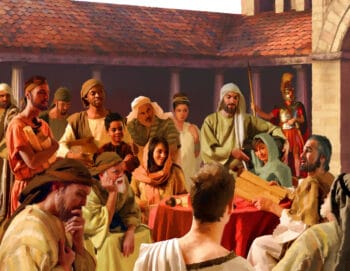
Image © Jim Howard at Goodsalt.com
The Greek word for “foolishness” in 1 Corinthians 1:18 is mōria. This word occurs only five times in the New Testament, and all in 1 Corinthians (1 Corinthians 1:18,21,23; 1 Corinthians 2:14; 1 Corinthians 3:19). Apart from mōria, other words from the same family occur numerous times in the New Testament.
The reference to foolishness in 1 Corinthians 1:18,23 is not denigrating the Corinthians’ intellectual capacity but directing attention to their unwillingness to consider the truth of the gospel. As a result, Paul also had to confront immoral behavior and thought, lack of discernment, and even rebellion against God.
Think about Paul’s situation in this city. He comes to a place that prides itself on its own so-called knowledge and wisdom and cultural sophistication. And, in this context, he talks about a Galilean Jew, Jesus of Nazareth, who had been crucified by the Romans and then raised from the dead—all in order to pay for not only their sins but for the sins of the world. Can this guy be serious? Who was he kidding? This wasn’t some deep new philosophical concept, either, that could be parsed and analyzed by philosophical tools; it seemed to be lunacy, nonsense, nothing that any smart and educated Corinthian could take seriously.
And, as foolish as Paul’s message sounded to the pagans, for many of the Jews, the message of the Cross sounded worse. What Jew was expecting a Messiah to be executed by Rome? The Messiah was supposed to overthrow the Romans, not be crucified by them.
Thus, from the start, Paul had a lot going against him in Corinth. And yet, despite all this, souls—Jewish and Gentile—were won to the gospel.
The message here?
Whatever opposition we face, God has people who are open to hearing the truth. We must be ready to be used by Him to reach these people wherever they are, even in places today that are as bad as, or even worse than, Corinth was.

We often take a fair bit of comfort from reading the second part of 1 Corinthians 1 because we think it explains why “others” do not accept the Gospel. The religious people (the Jews) seek supernatural signs before they will believe, while the educated people (the Greeks) want logic and reason. We take refuge in the notion that we see through this and have accepted the “foolishness” of Gospel through the work of the Holy Spirit and know how to be saved.
However, Paul continues on and gives a bit of food for thought for those who think we have got it all together:
We have this hymn we love to sing titled, “We Have this Hope”. Perhaps the title should be changed to something a little more challenging, “We Share this Hope!”
A really good reminder about “nobodies” and “somebodies.”
I’ve often marveled at how the people the world considers “somebodies” can sometimes be far behind the so-called “nobodies” in the qualities that truly keep society together—kindness, honesty, integrity, and a solid moral compass.
I’ve also noticed that the more educated or intellectually accomplished someone becomes, the easier it can be to turn simple truths into endlessly sophisticated debates. Things that once seemed straightforward suddenly become endlessly nuanced or redefined. Sometimes it feels as though we’ve reached a point where even the most basic realities are treated as though they’re endlessly negotiable.
Knowledge is valuable. But wisdom is something else entirely.
What did this epicurean council believed
In my view, the dominance of two great philosophical thinking: stoicism and epecuruan had great ideological significance for Corinthians. Thus, for example, resurrection in the framework of atom discourse was a challenge to the to discern.
The message of the cross remained deeply offensive to the Jews of Jesus’ day and of Paul’s day. So much so that whenever Paul started preaching, riots would break out. His Jewish opponents became so violent that they threw off their cloaks and kicked up dust into the air with the aim of killing Paul. Earlier, quite a number had taken an oath not to eat again until they had assassinated him. This should not surprise us because, as Paul writes in 1 Corinthians 1:23, “But we preach Christ crucified, unto the Jews a stumblingblock, and unto the Greeks foolishness” (KJV).
Since the inception of Christianity, the church has endured the mockery of the unbelieving world, particularly concerning the message of the cross. With every generation, the brilliant ones have employed satire, mockery, and irony to show how the message of the cross does not make any sense. The apostle Paul, in his day, faced such mockery as recorded in Acts 17. Before he came to Corinth, he was in Athens, where he preached on Mars Hill. A select group of Epicurean and Stoic philosophers assembled there to hear him preach the gospel. He made the case as he preached Christ and Him crucified and resurrected. They mocked him at the beginning, saying, “What is this babbler trying to say?” and they mocked him again at the end. Yet, as Paul reminds us in 1 Corinthians 1:18, “For the preaching of the cross is to them that perish foolishness; but unto us which are saved it is the power of God” (KJV).
Jews demanded miraculous signs, while the Greeks were looking for wisdom. During that time, people were looking for a polished system of philosophy, with exciting public rhetoric delivered by skilled speakers. These men went from place to place and were called the Sophists. They were paid to present polished, high-sounding philosophies. The Greeks enjoyed this because it was their entertainment, and they paid handsomely if it was done well. What both the Jewish and Greek skeptics did not realize was that Christ crucified was the infinite answer to their questions and their quest. As Paul concludes in 1 Corinthians 1:24, “But unto them which are called, both Jews and Greeks, Christ the power of God, and the wisdom of God” (KJV). Jesus remains the greatest display of power there has ever been on planet Earth. He is also the greatest display of wisdom there has ever been on planet Earth.
Mmmmm, 1/2 of the memory verse today. Have you memorized it yet? Let’s turn to Proverbs and find text’s that Paul may have studied. However, don’t forget Soloman was also inspired by the same One as Paul was. Proverbs 10:4, 7, 28. The Holy Spirit was active in the Old Testament too. Ezekial 36:27.
Can this guy be serious? Yes. Does he know what he is talking about? Yes. How is his integrity? He is honest. Did he have slack hands. No, he was a tentmaker. Did he have this hope, hope in the coming of our Lord. Yes. Well then sounds like we need to listen attentively to him. I get very solemn when I contemplate the Cross of Christ. 2 Timothy 1:7. After all when He was on the Cross, I was on His mind. Mind you, you too, no matter who you are.
Although God’s plan was designed before the creation of the world (Ephesians 1:4-5), we must never forget that its execution came at a great cost. Ultimately, then, we are the ones responsible for the blood that dripped from our Savior as He prayed in the garden of Gethsemane. And we are the reason Jesus’ soul was overwhelmed with sorrow to the point of death on the cross, which we’re blessed to be studying this week. Indeed, these bloodied sweat drops came at a great cost; let us never forget that. It deserves the utmost solemnity; it’s truly beyond our human understanding, but again, the goodness of God allows us faith to accept its truth, so that we know that it wasn’t in vain. We can also look to the cross and find joy knowing that someday we will live in eternity with The One who died that unfathomnable death…for ALL for us!
Knowledge and understanding are not enough to truly make someone to appreciate, embrace, and submit to God’s truth without the work of the Holy Spirit. Knowledge and understanding alone are not sufficient to bring anyone to a saving relationship with Jesus Christ. Satan has full knowledge and understanding of Jesus Christ but does not have a saving faith in Him. It is terribly sad to note what sin has done to our ability to discern spiritual things. Sin has darkened our understanding of spiritual things (Ephesians 4:17–18). Sin has skewed our hearts away from God (Romans 8:7). Without the Holy Spirit, we can have all knowledge and understanding about salvation and yet be lost. It is only the Holy Spirit who convicts, enlightens, and draws us to Jesus Christ (John 16:8–13).
Paul appreciated the intellectual and philosophical prowess of the Corinthians and yet described them as “foolish” because they did not have the power to save. It is too sad to note that the religious leaders of Jesus’ time knew so much about the scriptures, yet many chose to reject His message. Adam and Eve knew God’s commandment but chose to distrust Him. Paul is reminding us that salvation is not simply acquiring information about salvation, but having a relationship with the one whom the information is all about.
“If any of you is lacking in wisdom, ask God… and it will be given you” (James 1:5).
Amen
Only a born again Christian is able to understand the spiritual things of God. Otherwise a person who claims to keep the commandments of God especially the holy Sabbath without the born again experience , is like a man who went to a shop bare footed , then he bought a pair of socks instead of a pair of shoes “!!.
God’s kingdom operates on principles that are foolishness to the world simply by their nonconformity to the standards of the world.Often, a person who attempts or choses to abide by the principles of God faces hardships.
As I mentioned yesterday, the “cross” was the ultimate mic drop, rug pull, and might I add, plot twist ever. In the eye of unbelief it seemed like defeat, as though Jesus was some kind of loser in His quest to rescue humanity. This is where the tables of understanding are overturned in our minds. God used, and still does, the foolish things of the world to confound the supposed wise. He still uses the “weak” things to put to shame the strong.
God, the Master of paradox is still outmanuevering the so called wisdom of man through the “foolishness” of the cross today. The intellectual and the erudite don’t see the wisdom of God in the cross because in all their supposed intelligence they miss the paradox of it all. To them Christ calls out saying; “Come be a fool as well!” You don’t need degrees, ThD’s, or PhD’s to believe. Sometimes those things get in the way. All you need is a simple childlike faith. “For the power of paradox opens your eyes and blinds those who say they can see.”
Theologian, songwriter and Christian musician eloquently captures this conumdrum in his song, “God’s Own Fool”. I will share the lyrics and a link to hear this profound song which so eloquently captures this paradox. It is said that; “A picture is worth a thousand words!” Sometimes, so is a song.
God’s Own Fool, Michael Card
1Cor.1:18 – ”For the message of the cross is foolishness to those who are perishing, but to us who are being saved it is the Power of God.”
Jesus’ ministry lasted only a short while, but what He taught, and the example He lived for all to emulate was so impactful that it forever challenged the concept of how mankind perceives its life in this world and, for those who believe, the world to come.
I think the believer’s heart is impacted the most when accepting Jesus’ Message, resulting in a mind open to accepting the Holy Spirit’s revelations. On the other hand, “an UNWILLINGNESS to consider the truth of the gospel” hardens the heart, perceiving the message to be ‘foolishness’.
Paul, in his letter to the Romans highlights what appears as ‘foolishness’ to those who perish:
Rom.3:22-24
”And this Righteousness from God comes through FAITH in Jesus Christ to all who believe. There is no distinction, for all have sinned and fall short of the Glory of God, and are justified freely by His Grace through the redemption that is in Christ Jesus.”
I consider this to be the ‘Message of the Cross’ which is ‘foolishness’ to those who perish. But to us who are being saved, it is the ‘Power of God’ [unto salvation’].
The hearer has to first accept that all sin before seeing the need for a Savior and the God who offers to safe us from the effects of our ‘unrighteousness’. To the world, to consider someone who died on a cross to be their ‘Savior’, is about as ludicrous as asking a beggar for money. The world is truly blinded by its own hubris and cannot understand the Wisdom of God; it remains ‘foolishness’ to them.
Am I ready to tell the truth to people who are willing to hear it? Perhaps the question before this is: what is the truth? And the answer may be “the truth has a name”, nothing else.