
The Great Controversy – Introduction

If asked, “What central theme runs through all the Bible?” how would you respond? Jesus? The plan of salvation? The cross? Yes to all three, of course! But these three important topics unfold against an even more all-encompassing theme: the great controversy. This theme pervades the Bible, from the book of Genesis to the book of Revelation.
The great controversy began in heaven with Lucifer’s rebellion against God. At the heart of this cosmic conflict is the issue of God’s love. Is He fully loving? Does He have the best interests of His creatures in view? Or is He an authoritative dictator desiring only what is in His own self-interest?
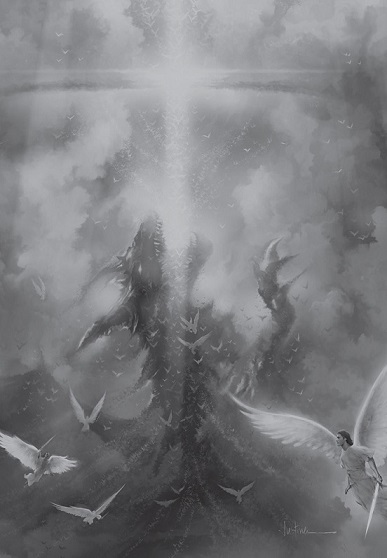
Image © Pacific Press
This quarter’s lessons trace world history from God’s viewpoint, as prophecy reveals it, from the time of Christ down through the centuries to our day and beyond. God’s very nature is love, and therefore, all His acts are loving, though this fact may not always be evident to finite human beings or even angels. But God’s love is progressively revealed as the great controversy unfolds. We see its height and depth most clearly through the Cross. At Calvary, God’s love was displayed before the entire universe when Christ poured out His life to redeem humanity, and Satan’s ultimate defeat was assured.
Yet, the battle rages on. Satan tried to destroy Jesus on the cross and, through the centuries, we see him trying to destroy God’s people. Although Satan has viciously persecuted Christ’s church and slaughtered millions, God has always been present with His people and will never leave them.
This quarter will trace the major developments in the great controversy, beginning with the rebellion in heaven. We will explore the central issues of the conflict between Christ and Satan. We will see the indomitable courage of the Waldenses despite fierce persecution, and the determination of the Reformers to follow Bible truth even in the face of torture, chains, the stake, and martyrdom.
Commenting on the faith of these spiritual giants, Ellen G. White states, “The Bible was their authority, and by its teaching they tested all doctrines and all claims. Faith in God and His word sustained these holy men as they yielded up their lives at the stake.”—The Great Controversy, p. 249.
The Reformation kindled a torch of truth that still burns brightly. The Reformers’ bedrock faith in Scripture and their steadfast assurance of salvation by grace through faith paved the way for the rise of the Advent movement, championed by William Miller and a host of others around the world.
The Seventh-day Adventist Church was raised up by God to build on the foundation laid by the Reformers in order to restore biblical truths that had been lost sight of through the centuries. Central to its mission is proclaiming the three angels’ messages of Revelation 14:6–12, God’s final warning to a world soon to come to an end.
This proclamation arouses the wrath of Satan, pictured as a dragon by the apostle John: “And the dragon was wroth with the woman, and went to make war with the remnant of her seed, which keep the commandments of God, and have the testimony of Jesus Christ” (Rev. 12:17). We also will study the final events in the great controversy, including the triumph of God’s love over all the principalities and powers of hell, that ushers in the creation of new heavens and a new earth.
Though the basis of this quarter’s lessons is the Bible, we will use the book The Great Controversy, by Ellen G. White, as our thematic outline in studying this tremendous topic. The chapters on which each lesson is based are noted to facilitate its use as a companion book for further study and sharing that we all might more fully “know the love of Christ which passes knowledge” (Eph. 3:19, NKJV).
A native of Connecticut, USA, Mark Finley, an internationally known evangelist, was a vice president at the General Conference from 2005 to 2010. After retiring from full-time employment, he became an assistant to the president of the General Conference. Pastor Finley and his wife, Ernestine, have three children and five grandchildren.

When Mark Finley says that we see Christ and God’s love most clearly at the Cross, I think of these two writers. I love it that God doesn’t deny the reality of suffering or tell us to get used to a beauty in death…but instead walked through death and suffering before us , and now with us, and promises to eradicate these effects of sin someday.
John Stott in his book called “The Cross of Christ” says,
Edward Shillito is a poet who lived during WWI and he wrote of suffering in a poem called, “Jesus of the Scars”. Here are a few (paraphrased) lines, speaking of world religions …
The “Great Controversy” is between Christ and Satan, not between persons, or people groups.
For sure, but groups of people can be players in this controversy.