
Tuesday: Joshua, the Type

Daily Lesson for Tuesday 2nd of December 2025
In the light of biblical typology, what is the significance of the multiple parallelism between the lives of Moses and Joshua? See Exodus 3:1-2; Joshua 1:1-3; Numbers 13:1-2; Joshua 2:1; Exodus 3:5; Joshua 5:15.
As we discovered in the first week, Joshua was presented as a new Moses who, in the life of the second generation, repeated the most significant steps of the Exodus from Egypt. Just as Moses was, Joshua was commissioned by a personal encounter with the Lord. Under the leadership of both Moses and Joshua, Israel’s fame among the nations inspired fear.
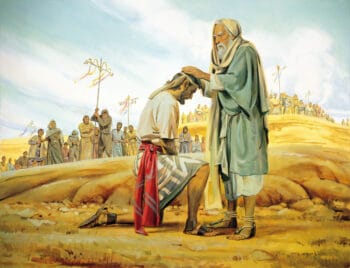
Image © Lifeway Collection at Goodsalt.com
Moses led Israel in crossing the Red Sea, and Joshua led Israel in a miraculous crossing of the Jordan. Both leaders were reminded of the necessity of circumcision and the importance of the Passover. Manna began to fall in the time of Moses, and it ended with Joshua. Both were commanded to take off their sandals. The outstretched hand of both signaled victory for Israel. Moses gave instructions for the division of the land and the institution of cities of refuge. Joshua fulfilled the instructions. Both gave a farewell address to the nation and renewed the covenant for the people at the end of their ministry.
Study Deuteronomy 18:15-19, Deuteronomy 34:10-12, John 1:21, Acts 3:22-26, and Acts 7:37. Who fulfills the prophecy of Moses about a prophet like himself? How does Joshua fit into the picture?
Joshua’s life was a partial fulfillment of the prophecy made by Moses (Deuteronomy 18:15,18). However, the prophecy made by Moses was not fulfilled in its ultimate sense. In its ultimate sense, the prophecy could be accomplished (or fulfilled) only by the Messiah. The Messiah knew the Father intimately (John 1:14,18); He was true and revealed God truthfully (Luke 10:22, John 14:6, Matthew 22:16). God indeed put His words in His mouth (John 14:24). So, both the life of Moses and that of Joshua become types of the coming Messiah, Jesus.
|
How central is Jesus to your own walk with the Lord? Why must Jesus, and what He has done for you, be the foundation of your whole Christian experience? |

I want to take a little side-step this morning because while today’s lesson is about type/antitype in our conventional sense, it also mentions succession. And sometimes the mundane is more important than the sublime. Many organisations have difficulty in transitioning leadership. You often see that in the business world where the founder and leading light for an organisation retires, or dies, and the new leadership team has difficulty in transitioning the organisation into the new management.
Right now we are seeing the Murdoch family at war with one another. Rupert Murdoch has lived well into his 90s and has had a controlling interest in his media empire. The transition to Lachlan, his son was challenged by his other children and it ultimately ended up in the courts. My understanding is that the courts have now decided Lachlan can take control but it has involved huge payouts to the other family members. It remains to be seen whether Lachlan can successfully control the media empire. I am guessing that it is not going to be easy,
Moses had been the leader for the Hebrews for 40 years, and we know that Joshua had been with him for most of those years, I recall that Moses had an interesting conversation with his father-in-law about leadership style early on in the Exodus experience where Moses learned the importance of delegation. I suspect that in aftermath of that meeting Joshua took on some of the delegated responsibilities. In the sense of leadership development, Moses was the type or pattern, and Joshus was the antitype in the sense that his role corresponded to that of Moses.
It is useful to understand Moses and Joshua were different in their personalities Joshua was not expected to be a copy of Moses. He had a different leadership style but he understood the intent and purpose that God had intended for the Hebrews.
Most of us in this conversation are Seventh-day Adventists. We have a relationship with an organisation that has leaders and these leaders must be replaced from time to time. I am not just talking about the world church leadership, but in our own congregations. Do we think about succession planning and training for even the little leadership roles? Or do we think that a prayer and a promise before a nominating committee meets is sufficient preparation? Our relationship with Jesus can benefit from good organisational practice, even in the local congregation.
“Imitate me, just as I also imitate Christ.” (1 Corinthians 11:1).
“Joshua” and “Jesus” are the same name (Hebrew: Yehoshua / Yeshua = “Yahweh saves”). Joshua embodied the Christlike qualities. What can we learn from Joshua as he foreshadowed Christlike attributes? We ourselves cannot be a type of Christ, but by drawing some lessons from Joshua, we can develop Christlike qualities.
1. Joshua teaches us Christlike courage – Joshua exhibited steadfast courage by trusting the presence of God. Likewise, as believers, we grow Christlike courage by trusting God’s Word over our fears. “Be strong and courageous.” (Joshua 1:6–9)
2. Joshua teaches us Christlike obedience – As Jesus said, “I always do the things that please the Father.” (John 8:29), Joshua at all times obeyed God’s commands. Likewise, at all times, believers should obey God’s Word.
3. Joshua teaches us Christlike servant leadership – As Jesus said, “I am among you as one who serves.” (Luke 22:27), Joshua always wanted to serve others first. As believers, we are required to put others before self.
4. Joshua teaches us Christlike dependence on God’s presence – Joshua demonstrated that victory only comes from God. Even so, Jesus always sought the presence of His Father. Likewise, we as believers should seek God’s presence in every decision.
5. Joshua teaches us Christlike perseverance – Jesus endured so much, even as Jesus endured the cross. We, too, grow to be Christlike through perseverance.
6. Joshua teaches us Christlike faith in God’s promises – As Jesus always lived the perfect trust in His Father’s promises, Joshua also saw the reality of God’s promises than what his eyes would see. Faith in God’s promises shapes us into Christlikeness.
Following Joshua’s example becomes a pathway to becoming more like Jesus.
The transition teaches us that succession is about continuing mission, not copying personality.
God does not need another Moses.He needs the right next leaderone who understands the mission even if he leads differently.God gave:long-term mentoring,shared work experience,public affirmation,clear transition of authority and consistent mission focus.
And then He said to Joshua,“As I was with Moses, so I will be with you.”The church often says the opposite:“As we were with Moses, good luck to you!
Joshua is portrayed as a type of Christ with a type being someone in history who foreshadowed the great work of Jesus Christ. Joshua fulfilled the promises of God by leading the israelites to the promised land. He acted has a shadow of Jesus Christ by leading the people of God through the Jordan River, leading an offensive against gentiles, indeed his given name Joshua pointed to a saviour who would lead God people to the heavenly canaan and save God people from sin. Just as Joshua brought Israel into the promised land that had blessings Jesus Christ brought us the blessed hope of crossing the sinful world to the better side in heaven. It is from this position that we can meditate on the promises of God carrying the sword of the Spirit- the Word of God, so that the nations would bow before Christ (cf. Joshua 1:8; Matthew 1:21; Joshua 5:13–15).
Jesus must be central to my walk with the Lord because He is the only true foundation of the Christian life. Moses, Joshua, and all the great men and women of Scripture were powerful examples, but only inasmuch as they reflected the character and mission of Christ. They themselves were not the standard—they pointed to the Standard.
Moses was a type of Christ as the intercessor and mediator. Joshua was a type of Christ as the leader who brought God’s people into the Promised Land. But both men, as faithful as they were, had human limitations. Their ministries served as shadows of the greater reality that is found in Jesus alone.
That is why my Christian experience cannot be built merely on imitating biblical heroes. If I try to live by their strength, I will fail where they failed. If I build on their virtues, I will inherit their weaknesses. But when I build on Christ—His life, His sacrifice, His victory, and His righteousness—my foundation is unshakable.
Jesus is central because:
• Only Jesus can save me. Moses could intercede, but he could not atone. Joshua could lead, but he could not conquer sin. Salvation rests on Christ alone.
• Only Jesus gives power for obedience. The lives of others may inspire me, but only Christ can transform me.
• Only Jesus provides the perfect pattern. Every other example is imperfect; Christ alone reveals the complete image of God.
• Only Jesus is with me always. Moses died; Joshua died. But Jesus is my living, present High Priest, intercessor, and Captain today.
So while we can appreciate Moses, Joshua, and the faithful heroes of the past, we follow them only as they lead us to Christ. My spiritual life must be rooted entirely in who Jesus is and what He has done for me—because without Him, I have no hope, no power, and no victory. With Him, I have everything.
Thank you, Beverley for the crucial reminder of the absolute centrality of Jesus. He is not only an example, but more importantly, the true source of power to obey.
I want to bypass the legalese of type versus antitype discussion and bring the matter down to the crux of the matter and the discussion question at the end of today’s lesson. It matters not who your leader is if you won’t follow them. In the military that is called insubordination.
As a Christian, those that confess and accept Jesus must by necessity not only receive Him as Savior, but also as Lord. The Savior acceptance is easy, being set free from the penalty and power of sin. The lordship aspect of Christianity is altogether a different matter. It requires that we follow in the footsteps of Jesus through submission and subordination of our will to the Holy Spirit’s power and presence in our life, to actually live the life we are called to live. There is no dichotomy between the two, it is a package deal. Jesus rightfully has a beef with some of his followers. In Luke 6:46, He calls them out. Jesus must be Lord of all or He is not Lord at all.
As Christians we wear His name, the name above all names. As Christians we wear His Robe of Righteousness. Lord help us, help me to wear them to your glory and not defame your name or soil your your spotless robe. If we do, may we wash it in the blood of the Lamb so that we and it shall be white as snow. (Isaiah 1:18) May we never forget that we wear your Name, Lord. So, help us, God!
There is nothing of ourselves that we can do. It is by the sacrifice of the saving love of the almighty God of the universe. The one and only healer of hearts that redeems to be worthy of salvation. Praise God that He knows our heart. Man looks at the outward appearance but God looks at the heart.
How can that which is ‘in part’ – type – foreshadow that which is ‘perfect’ – antitype, unless it finds its commonality in God’s spiritual Truth? I can accept ‘type’ and ‘antitype’ only in the context of the greater message of Salvation which God always shares by those He calles to instruct what His Spirit reveales to them.
Prophets – messengers and leaders of old -, the ‘type’, all point to the living testimony – Jesus, the ‘antitype’ – the Word of God – embodied through Jesus the Christ, inspired by the Holy Spirit.
Their message is clear and simple:
Deut.6:5-10- <”Love the LORD your God with all your heart and with all your soul and with all your strength, …”
Matt.22:37-38 – ”Love the Lord your God with all your heart and with all your soul and with all your mind. This is the first and greatest commandment.”
Mark 12:30 – ”You shall love the Lord your God with all your heart and with all your soul and with all your mind and with all your strength.”
When studying the ‘meaning of type and antitype’, I am certain when applying these Scripture quotes that they will reveal the gateway to experiencing God’s integrity and trustworthiness. Without carefully applying this Truth first, regardles the many studies, we are in danger to be a resounding gong or a clanging cymbal of our own intellectual prowess/astuteness – 1Cor.13:1.
Jesus Christ fulfilled Moses’ prophecy because He said in Matthew 5:17 that I came not to destroy the law or the prophets, but to fulfil the words of the prophets. Because Joshua led the Israelites to the promised land, it would be appropriate to infer that he fit into the picture because he acquired the promised land in the same way that Jesus Christ fulfilled the works of the prophets. While Joshua killed to acquire the land, Jesus Christ shared His own blood to cleanse the sins of the land.
Because I adopted the doctrine of Jesus Christ to guide my faith, He is the central Lord of my day-to-day activities. Jesus Christ bears witness to the works of the prophets, He believes in His father’s (God’s) commandment, He urges us to adopt His doctrine and believe in Him to live again, and because I believe in Him, He is the foundation of my whole Christian experience.
While walking with the Lord, we may learn from Him. Jesus is the full figure and best antitype of God’s love for His creatures. By being connected with Him, we share His mercy, and the contemplation of His life can make us softer, with a heart open to the divine knowledge of the Comforter.
I have mentioned this before in earlier weeks, but I’m even more convinced now, so I will mention it again. I do not see anything that convinces me that Joshua was a partial fulfillment of Deuteronomy 18:15-19. I don’t think it’s particularly good interpretation to make that connection. For one, I can’t see any place in the Bible that calls Joshua a prophet. He was a warrior. In fact God spoke to him through the priests (see Numbers 27:21) rather than receiving direct visions. Unless we use the term prophet loosely, it doesn’t work. Deuteronomy 34:10-12 (perhaps written by Joshua himself following Moses’ death) also emphasizes that Moses’ experience with God was unique.
Also, Joshua had been commissioned when Moses gave his farewell discourse of Deuteronomy (see Numbers 27:22). So if Joshua was the fulfillment of another prophet, wouldn’t Moses say that God has given you Joshua as another prophet? The fact that he didn’t suggests to me that the verses are messianic in nature. Peter and Stephen also make that application.
Certainly Joshua’s experience paralleled Jesus in some ways. But is this to make him a type of Jesus or is it just God working in similar ways with different people? I’m not 100% sure. I still feel that we need to be cautious about making everything a type of something. It’s easy to make the evidence fit while ignoring what doesn’t. I also am concerned when we spiritualize real stories too much. That’s exactly what the people who don’t believe in Genesis do. They say Adam and Eve, the flood and so on are just representations of spiritual concepts. Now we don’t believe in that, but if Bible characters are types of this and that all that time, the risk may be there more than we think.
I asked God to help me understand the sabbath school lesson and the spirit led me here.
Great insights blessed people.