
Monday: Type and Antitype

Daily Lesson for Monday 1st of December 2025
Interpreters of the Bible cannot arbitrarily decide on what constitutes a biblical type or how that particular type is fulfilled in the New Testament and beyond. The Bible itself provides some controls and principles as to the application of biblical typology.
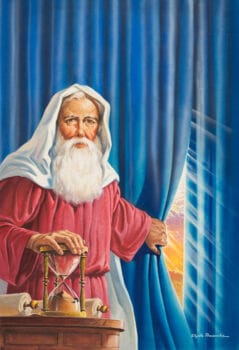
Image © Review & Herald Publishing at Goodsalt.com
Similarly, the New Testament unfolds the antitypical fulfillment of a type in three distinct phases: (1) in the life of Christ (the Christological fulfillment), (2) in the experience of the church (the ecclesiological fulfillment), and (3) at the end of time (the eschatological fulfillment).
We can find these types and antitypes all through the Bible, and they are very helpful in showing readers how to understand the Bible and what truths the Word of God is teaching about Jesus, salvation, and the ultimate hope that we have.
Look at the following Old Testament types: Israel, the Exodus, and the sanctuary. How is each fulfilled in the three antitypical phases: the Christological, the ecclesiological, and the eschatological?
- Israel
a. Christological phase (Matthew 2:15)
b. Ecclesiological phase (Galatians 6:16)
c. Eschatological phase (Revelation 7:4-8,14)
- The Exodus
a. Christological phase (Matthew 2:19-21)
b. Ecclesiological phase (2 Corinthians 6:17)
c. Eschatological phase (Revelation 18:4)
- The Sanctuary
a. Christological phase (John 1:14, John 2:21, Matthew 26:61)
b. Ecclesiological phase (1 Corinthians 3:16-17; 2 Corinthians 6:16)
c. Eschatological phase (Revelation 3:12, Revelation 11:19, Revelation 21:3, Revelation 21:22)
“Since Scripture has a single divine Author, the various parts of Scripture are consistent with each other. . . . All the doctrines of the Bible will cohere with each other; interpretations of individual passages will harmonize with the totality of what Scripture teaches on a given subject.”—Raoul Dederen, ed., Handbook of Seventh-day Adventist Theology (Hagerstown, MD: Review and Herald Publishing Association, 2000), p. 65.
|
What do you do when, at times, you find it hard to understand the meaning of certain passages? |

My PhD thesis is 360 pages long and I know of only 4 people who have read it cover to cover: My supervisor, and my examiners. Some of my friends who know nothing about transactions and concurrency control read parts of it. The most cogent comment I had from one of them was, “I haven’t a clue what you are talking about, but it reads well. “I concluded that I have written something for the experts and complete nonsense for my friends and family who I see every day.
Sometimes I feel our conversations about type/antitype are a bit like my PhD thesis. It lets other Christians know that we know something but it’s nonsense to the people for whom it matters most – those who need to hear and experience the Gospel.
So here is my minimalist thesis for today’s lesson – no big theological terms – no exam at the end:
.
How does that sound?
Sometimes we use complex words or concepts that only a few people really understand but for the people we most want to reach,those without that background,these words are confusing or meaningles.
But the Bible’s message can be simplified so that everyone can grasp the main truths.
The goal is to communicate the Gospel clearly, not to impress people with technical terms.
I agreed with you.
Perfect. Thank you.
I cannot say a bigger Amen
I second it. Amen and amen.
Total agreement. Amen!
I say Amen
Not all will understand those meanings , but the Bible is clear
I too say amen to Douglas script.
I agree. If our religion doesn’t change the way we live, what good is it? There will be many people in Heaven who had limited knowledge of types and antitypes but loved well. I have known some of them personally.
I enjoy studying theology and it’s good for our growth. But it will never be the greatest thing.
I really like your minimalist thesis – it’s clear, Christ-centred, and easy for anyone to grasp. Since this is a lesson study guide, there is understandably some level of deep understanding expected. However, what really matters is how we break it down and share it with others, and how we apply it in our own spiritual walk. If these big themes help people see God’s love more clearly and respond by loving others, then we’ve captured the heart of the lesson, with or without the technical terms.
The Bible in both the New and Old Testaments shows that the people, the events, and all things that happened back were not isolated, accidental, casual, or adventrous; but rather intentional under God’s guidance, as they were types, shadows, and figures of the greater things that were coming (1 Corinthians 10:11, Romans 15:4). The figures were all prefigured in the happenings of the old things as shadows, since the old covenants, the old laws, the old ceremonies and rituals, ordinances, and rites were great treasures and pointers of what was to come (Hebrews 10:1).
What puts together the New and Old Testaments is that both were covenants, with one being not only a shadow but an anticipation that helped in looking forward to the new things. Both Testaments are exactly the same; the messaging of the gospel is the same, the plan of salvation in both is the same (Galatians 3:8, Ephesians 1:9–10). Only that one was pointing to the other (Hebrews 10:1). Back then it was a type; in the New Testament it is an antitype (1 Peter 3:21). Back in the Old Testament it was an anticipation, in the New Testament it is the fullness of time that has come to pass (Galatians 4:4, Luke 24:44).
What do you do when, at times, you find it hard to understand the meaning of certain passages in the Bible?
1) Reflect and pray – Scripture is not an ordinary book that can simply be understood by the human mind. It requires divine revelation. Prayerful reflection is simply asking the source (God) to simplify what He intended to communicate. Through prayer, the Holy Spirit will bring all things to light. “When the Spirit of truth comes, he will guide you into all the truth.”(John 16:13)
2) Read the broader context – Read the entire chapter. Try to understand the book’s major themes. Also, try to understand who is speaking, to whom and why.
3) Compare translations – Reading different translations can highlight the key message and make the meaning clearer.
4) Look up cross-references – Many Bibles include marginal notes linking related verses. Many times, the Bible interprets itself. When cross-referenced, a difficult passage becomes clear when paired with others addressing the same idea.
5) Use reliable study tools – Using Bible guides like study bibles, commentaries, bible dictionaries, or encyclopaedias can help.
6) Examine different theological perspectives – Comparing a range of viewpoints can show why people understand the passage differently and help you decide which view fits best. Also, consider understanding why you follow certain doctrines.
7) Talk to or ask someone – For instance, pastors, bible teachers, study groups, etc. This can provide deeper insight to reach your understanding.
8) Be patient and desire to grow spiritually – To read the Bible is not simply for head knowledge, but to grow spiritually and become more like Jesus. Understanding comes along with spiritual growth.
“Open my eyes, that I may behold wondrous things out of your law.”( Psalm 119:18)
Isn’t AI great! I found the exact answer & wondered why others don’t take advantage of this technological advancement to aid in understanding the Word. I am so happy you found it too. Great input to share!
So can someone explain which comes first type or anti-type?
Either one could come before the other, but typically in Biblical studies the type precedes the antitype and is only recognized as a type after the antitype has occurred.
Thank you
Type comes first as it foreshadows the anti-type. Hope this helps.
https://www.logos.com/grow/typology-in-the-bible/
Yes it has
In Scripture, the type always comes first, and the antitype follows. The type is the shadow or symbol given earlier, while the antitype is the fuller reality that comes later.
Although many types appear in the Old Testament and many antitypes in the New Testament, the key point is simply this:
shadow first (type), fulfillment later (antitype).
Usually, in our thinking type comes before antitype. However, the Greek word for antitype is only used twice in the Bible. And in this verse:
The words in bold is the translation of the Greek “antitypos”. Perhaps, timing is less important than correspondence.
Dear Brother Omwenga,
I often enjoy reading your comments on the daily lessons. However, I have a simple question, since the main focus of the gospel, that is recorded in the bible, is to lead people to Christ, are the tools mentioned in today’s comments available to the average person in our communities?
Understanding types and antitypes can be spiritually rich, but it can also be complex. For those who have studied Scripture for years, these connections feel natural, but for someone new to the faith, it can be a lot to absorb.
Because of this, we need to approach new believers with patience and clarity. Our goal is not to impress them with deep symbolism but to lead them to Jesus, who is the center of every type and antitype. Instead of starting with complicated structures, we can begin with what each symbol ultimately reveals—God’s character, His love, and His plan to save.
As they grow, we can gently introduce how the Old Testament shadows find their fulfillment in Christ’s ministry. But like Paul, we must discern when a person is ready for “milk” and when they are ready for “solid food.” Spiritual maturity takes time, and our explanations should be simple, Christ-centered, and free of unnecessary details that might confuse.
When handled with humility and patience, type–antitype discussions can strengthen faith rather than burden it. They become a way to help new believers see the unity of Scripture and the beauty of God’s plan—always pointing them to the Lamb of God, who is the substance behind every shadow.
Thank you, Beverley for your comments. I like your last Paragraphe, that we need to handled this with humility and patience when we face people who don’t the same understanding as us.
ELIEZER A TYPE OF THE “HOLY SPIRIT.”
As Eliezer was a servant of Abraham, so the Holy Spirit is a “Servant of God.”
As Eliezer’s mission was to go to Haran and get a bride for Isaac, so the Holy Spirit has been sent from Heaven to get a BRIDE FOR CHRIST.
As Eliezer was not sent to get a bride for Isaac until after he was typically offered up, so the Holy Spirit was not sent to get a Bride for Christ until AFTER HIS DEATH AND RESURRECTION.
As Eliezer did not talk about himself, but about his Master’s son, so the Holy Spirit does not talk about HIMSELF, BUT ABOUT CHRIST.
As Eliezer was urgent, so the Holy Spirit is URGENT. Gen. 24:53-56. 2 Cor. 6:2.
As Eliezer by the precious gifts he gave Rebekah revealed the wealth of his Master Isaac, so the Holy Spirit by His Gifts gives us a foretaste of what is in store for the Bride of Christ, the Church.
When Eliezer got Rebekah’s consent to be the bride of Isaac he himself took her back; he did not send her back while he remained with her kinsfolk. So when the Bride, the Church, is ready the HOLY SPIRIT WILL GO BACK TO HEAVEN WITH HER.
But what about the aspects of the story that don’t fit? Does the Holy Spirit pray for guidance? Does the Holy Spirit need the church to meet its needs (ie. water)?
I’m not saying that you can’t make applications from stories for your personal edification. However, I think there is a risk of applying symbolism to every story in the Bible. After all, the people mentioned in Genesis were real people. The situations were real too. I fear that making everything symbolic actually helps the people who feel Genesis is just allegory and there never was an Abraham. Ultimately, Abraham was not acting out a prophecy when he sent out Eleazar. He was seeking a godly wife for his son. Just because marriage is a symbol of God’s relation with the church does not mean that every time there is a marriage it is that way. When something is symbolic, it should be treated as such. Otherwise, we should be careful about making these applications.
If ‘type and antitype’ confuses me, how much more does it confuse those who still need to grasp the fundamental Truth that God loves them and offers guidance to address all problems occurring in their life – Phil.4:6-7.
Would we miss anything important to our faith if we do not grasp ‘type and antitype’? Jesus’ teachings were not about understanding the ‘difficulties’ or theological ‘peculiarities’ contained in the Word of God. Instead, He pointed out that a child would be able to receive the simple Truths that God loves him/her by faith – Matt.18:3-4.
By becoming/sounding ‘educated’, we might be in danger of becoming ‘wise in our own eyes’; alienating those who look to us for simple answers to their problems. It would be better to be like children again. Sharing with others that we trust Him, are thankful for the basic Truths our loving heavenly Father, whom we trust to meet all our needs, reveals to us. He loves us and is willing and generous to provide all things pertaining to our wellbeing – Matt.11:28-30.
I agree completely, not everyone who is sitting in Sabbath School class has a PhD.
Jesus taught the Common man, in common language. The educated did not listen. it’s hard to fill a cup that is already full.
I’m starting to wonder if using the term “symbolism” rather than type or antitype is more appropriate in some places. I did feel the verses used to support the three phases of the Exodus were not especially strong. After all, yes Jesus was called out of Egypt, but Egypt had been a place of protection for Him. He was certainly not escaping sin or paganism. And the other verses don’t say anything about Israel at all. The Revelation verse refers to Babylon. Are we stretching verses to make them fit?
For many years have found using the terms “symbol” instead of type and “actual/fulfilled” in place of antitype to work beautifully.
The Bible is a unified text, so often the best way to understand a difficult passage is by comparing it to others. This concept, known as cross-referencing, allows Scripture to clarify itself. This approach can prevent us from pulling passages out of context, avoiding misunderstandings.
It is definitely necessary to get a full understanding about types and antitypes in a biblical sense. I find that without the prophetic history shown in this lesson and throughout the bible, we can’t discern what is to come or how it will come. it’s as simple as the pattern of a person’s history tells a story of whats to come Amen.
I agree with today’s reading in that the Bible’s inscriptions are in parables, and the extent to which one might fully comprehend the Bible without consultation will be difficult for another individual to believe. I will share the facts that improved my understanding of the Bible during the transitional stage of my childhood. My parents were Christians, and they attended church on Sundays. As a child, my mother taught me how to read Psalms and Proverbs and created meanings from the readings with illustrations from the characters in my surroundings. The illustrations were so coherent as to remind a child of what might constitute a good and a bad outcome. However, when I transitioned from child to teenager, I became a member of the Catholic church because I was a student in a Catholic school. My godfather was a Chaplain from Switzerland and the Bible Knowledge teacher from the Catholic school I attended, and, because he knew a lot about the Bible, he tested our ability to understand the passages from the various books of the Bible. The lessons’ feedback helped students to understand most of the Bible’s passages. Now, as an adult, if I ever find it difficult to digest a passage in the Bible, I will read books with similar explanations to understand the passage.
Look at what AI describes for the words:
“A type is a symbolic prefigurement or foreshadowing of a greater reality, while the antitype is the fulfillment or reality that was foreshadowed. For example, in Biblical typology, the Old Testament Passover lamb is the “type,” and its symbolic fulfillment in the New Testament as Jesus Christ’s sacrifice is the “antitype”.