
Monday: Accusations . . .

Daily Lesson for Monday 8th of December 2025
Read the story of the returning tribes in Joshua 22:9-20. What accusations do the West Jordan tribes level against the East Jordan tribes? To what extent were these accusations well founded?
In contrast with verse 1, where the tribes on the east side are called by their usual form (Reubenites, Gadites, etc.), here a different expression is used: “sons of Reuben,” “sons of Gad,” and “the half-tribe of Manasseh,” which is in contrast to the “sons of Israel” (Joshua 22:11, NASB), thus representing a different entity.
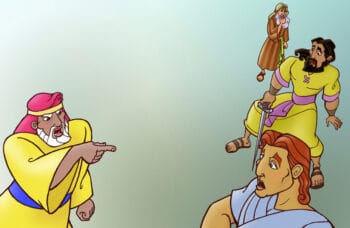
Image © Bible Adventure Collection at Goodsalt.com
In the narrative, the expression “the whole congregation of Israel” refers only to the nine and a half West Jordan tribes, underlining the rift that developed between the two groups. Indeed, the underlying question of the ensuing story is whether the tribes on the east side of the river can be seen as Israelites.
We would expect a smooth conclusion to the story; however, tension arises as the tribes from the east are reported to have erected an altar at the Jordan. The text here does not offer any reason for the act, nor does it describe the function of the altar or specific activity related to it. The ambiguity concerning the meaning of this altar is increased even more if we observe the flashbacks to the first crossing of the Jordan, in chapters 3 and 4, where all Israel entered the edge of the Jordan to cross the river into mainland Canaan. Here a part of Israel comes to the region of the Jordan, but now to cross the river in the opposite direction.
In both cases, a structure of stones is erected. The first served as a memorial, while the second is perceived to be an impressive altar. The question that inevitably comes to mind is: “What do these stones mean?” (compare with Joshua 4:6,22). Is this altar built for sacrifices, or is it only a memorial? Are these other tribes already starting to fall into apostasy?
Lack of consultation with Joshua, Eleazar, or the tribal leaders creates room for a misunderstanding that potentially can lead to terrible conflict.
|
What are Jesus and Paul referring to when they admonish us to avoid judging others? Read Luke 6:37, John 7:24, and 1 Corinthians 4:5. Why is it so easy to jump to wrong conclusions about the motives of others? |

This week’s lesson is a classic example of how we lose trust in one another. The West-side nation saw the East-side nation doing something and assumed that it was wrong, and started judging them. This was serious; so serious, they were willing to go to war over it.
I have been reading a book recently on the loss of trust that has developed in our own culture. We no longer trust our churches, our government institutions, and our education systems. The new buzzwords in our society are, “alternative facts” and “fake news”. The media love it because conflict generates news that people watch, and if people are watching, they are making money. They live by the maxim, “Never let the facts get in the way of a good story!”
The problem is that misunderstandings as well as genuine differences often get magnified and our language becomes sharper and more accusatory until we are calling those with whom we disagree, traitors, unpatriotic, or worse.
And it happens in the Seventh-day Adventist Church, too. It is not uncommon for the accusation that there are Jesuits in our midst when speaking about those with whom we disagree. I submit there is little room for healing wounds when we are calling one another names.
There is a solution, but once again, the division of the event into daily lesson bites, applies a limit.
It is interesting that we are told not to judge others, but the reality is that we must evaluate, or “judge” others, and we do this all the time.
My brother was a police officer in Queensland, and when dealing with people, a police officer is taught to judge others – this can sometimes save their lives. Obviously, our evaluation of a situation caused by the actions of others needs to develop. This is where probing and ongoing analysis is required.
Unfortunately, this ongoing analysis has at least two problems:
Firstly, it can be influenced by certain preconceived ideas or biases resulting in a failure of definition and false conclusions (this week’s lesson). These influences can be both personal and collective (cultural).
Secondly, we can use our analysis to “steal” the reputation of another, and “bear false witness” – which is contagious! (Known as lashon hara (evil speech) – and considered a very serious sin – see Numbers 11:1)
This is why dissenting opinions or perspectives can be a God send – provided our pride doesn’t derail the Priesthood of Believer principles that God has given us to safeguard the integrity of both truth and reality.
Interestingly, another phenomenon caused by faulty evaluation is projection. We project on others the very problems we have ourselves (see Matthew 7:1-2). This is often seen in politics where one side accuses the other of the very things they are or were actively pursuing. This is an effective tool to direct scrutiny elsewhere.
I believe that the “judging” the Bible forbids is the judging of motives. That was the issue with the altar built at the Jordan.
The actual motive was to preserve unity while the main body of Israel judged the motive to be division and establishment of a competing system of worship.
Think of how much misunderstanding, heartache and tragedy could be avoided if we simply stopped assuming motives. and asked, “Why did you do this?”
It’s a tricky thing because we must judge what we see – it would be foolish not to. But judgments can be wrong. You mention the police, and I agree they have to make judgments – even split second ones. But they can make mistakes. One of the classic ones from my country, Canada, happened a few years ago when the police tackled a teenage woman dressed as a stormtrooper who was promoting a Star Wars themed business. The poor lady got a bloody nose and probably a good scare. That’s a great example of split second judgment that was faulty. It started with people calling 911, so they were the first to make a bad judgment.
Luke15:28-31
28. The older brother stalked off in an angry sulk and refused to join in. His father came out and tried to talk to him, but he wouldn’t listen.
29. The son said, “Look how many years I’ve stayed here serving you, never giving you one moment of grief. But have you ever thrown me a party so I could celebrate with my friends?
30. Then this son of yours who has thrown away your money on whores shows up — and you go all out with a feast!”
Like in Joshua 22, where the West Jordan tribes accused the East Jordan tribes of rebellion without asking or understanding, here the older son accuses his father of partiality without listening to his explanation.
This demonstrate how assumptions, judgment, and anger can distort perception, create conflict and prevent celebration or healing—just like in Joshua 22 or real-life church situations.
Accusations often stem from misunderstandings and are capable of weighing us down with feelings of guilt, defeat, and shame, besides feelings of God’s rejection. In the book of Joshua 22, the western tribes assumed and accused the eastern tribes of turning away from the true God since they saw a huge altar under construction. Instead of confirming, they assumed, judged, and concluded that it was a rival to the true worship of God (Josh. 22:10–12). However, the altar was meant to be a reminder that they too belonged to God (Josh. 22:26–27). This shows that assumptions generate unnecessary conflict and that the devil enjoys it when brethren accuse each other, misunderstand each other, and judge each other.
Jesus cautions against the spirit of judging others. Often when people asked Jesus about the sins of others, He redirected their focus to their own walk with God (Luke 13:1–5; John 21:20–22). Christ, being the One who forgives all sins and knows us more than we know ourselves, encourages us to desist from assumptions and instead live faithfully, practicing grace. Only God knows and sees our hearts and encourages us to love and not condemn.
God is the only and true Judge of us all. Thank God for this! May each one of us consecrate our lives to Him, because we are all going to face Him alone at the end.
“Judge not, and you shall not be judged. Condemn not, and you shall not be condemned. Forgive, and you will be forgiven”. (Luke 6:37).
Forgiveness is in the Lord’s perfect and simple prayer, because none of us can pardon sins! And we must learn to forgive every day, before Heaven forgives us. Horizontal and vertical relationships balance each other.
It’s very easy to jump to a conclusion about a response. The back story is always relevant to the response. In this case the 9.5 tribes were recalling what had happened at Peor and with Achan. Individual decisions had brought Gods judgment upon all the tribes. They also must have recalled that in Deuteronomy 12:5-7 God specifically said one place of worship in a location he would choose. While the 9.5 tribes prepared for war they sent a high priest and the tribal leaders to investigate. This to me shows a desire for understanding. Let’s also not forget the statement, if what you possess is unclean, come join us on the other side in our possession. I see the desire to preserve unity of all 12 tribes. The response makes me wonder if there was some previous conversation about the 2.5 tribes staying on the east side of the Jordan.
You are right that the memories of Peor and Achan no doubt made the 9.5 tribes overreact somewhat. It seems that is what we humans do – we either ignore the wrong or come out blazing to eradicate it.
I guess we’ll get into it more the rest of the week. But I feel both sides were to blame in this issue. The Eastern tribes should have said what they were doing before they built the altar (though maybe it was an impulsive decision made and they couldn’t really run back and tell the other tribes). The other tribes should not have defaulted to going to war and making accusations.
It is easy to jump to conclusions about others’ motives because we can only see outward behavior, not the heart. Our own experiences, emotions, biases, and assumptions often fill in the gaps, leading us to misread people. Only God sees the full picture, which is why Scripture calls us to humility and caution when judging others.
Matthew 7: 15-20 says by their fruits ye shall know them. A good tree does not bear bad fruit, nor can a bad tree bear good fruit. God gives us the gift of discernment, and we are called to use it wisely.
If and when we are wrongfully accused we need to respond with prayer for the accuser, self-reflect, forgive the accuser, trust God’s ultimate justice, and focus on your own heart and relationship with God, rather than getting defensive or angry. This is not easy, and if the Holy Spirit guides you to respond, ensure it’s the Holy Spirit not ‘a’ spirit.
Judging fruit by its appearance can bring us to wrong conclusions either way. On the other side of wrongly accusing by appearance can be wrongly excusing fruit by its appearance so that while looking good on the outside it can be rotten on the inside. Eve experienced this in the garden of Eden. I have bought fruit at the store that looked good but tasted terrible. I have experienced the fruit of sin that appeared pleasant, but later bit as an adder. The other side of believing good of all men is to “try the spirits”whether they be of God. 1 John 4:1
In my area of Northern New England, USA, one of the biggest discussions dividing churches is regarding the doctrine of the Trinity. What may begin as discussions I have experienced as progressing to yelling, arguing, crying, accusations, and division, where members are asked to leave, or they leave on their own to start home churches, or to worship alone at home on Sabbaths with online resources. I share this not to begin a discussion here about our own views on this topic, but to draw a parallel between this and what happened to the Israelites in our lesson this week, with applications we can make.
I agree with Myron Norman’s comment that there could very well be a backstory where the 9.5 tribes could have been harboring some feelings about the 2.5 tribes staying east of the Jordan….feelings that they had not fully followed God’s plan and command for the 12 tribes as a whole. Similarly, I think there are Adventist members who have a growing distrust of the Seventh-day Adventist General Conference and leadership because of choices made re: ties to the United Nations, to government funding, to ecumenism, to the change of logo, to its formal position on religious liberty during Covid-13, etc. So the seeds of a lack of unity and open dialogue in what it means to be God’s remnant commandment-keeping people have been planted.
Those who hold anti-Trinitarian beliefs may assert that anti-Trinitarianism is one of the old landmarks of Adventism based on passages showing that some pioneers did not believe in the Trinity and did not use the word favorably. They believe that the doctrine of the Trinity came from the Catholic Church rather than from Scripture. So their conclusion from these quotes by early pioneers and from their careful Bible study and online research is that the doctrine of the Trinity is another piece of evidence of how today’s mainline Adventist Church has strayed from its roots and from searching the Scripture until all are in unity of thought.
Those who hold the view of the Godhead as a Trinity may say that the Father, Son, and Holy Spirit are repeatedly referenced in the Bible as working together to save lost humanity. They may explain that while it is true that many early Adventists did not believe in the Trinity, God was gradually leading His people into a fuller understanding of truth through progressive revelation. They note that Ellen White used phrases like “the heavenly trio,” “the three great Worthies,” “the three great powers,” and “the three holiest beings in heaven.” They are concerned that those who question the Trinity may also question the divine personhood of the Holy Spirit and the full divinity of Jesus Christ as co-eternal with the Father.
I hope I’ve presented the two sides fairly and in an unbiased way. What I maintain when I speak with anyone of any position on this subject is that I feel God wants us to be completely focused on Jesus and His work for us. I believe there will be many people in heaven who held erroneous beliefs and did not have 100% correct theology or doctrinal accuracy in their understanding…myself included. We will have an eternity to study the nature of God and even then, I’m sure we won’t be able to comprehend everything about Him fully.
We can affirm as from God’s Spirit, hearts genuinely wanting to know the truth and searching in Scripture for answers to questions. I believe God calls us to respond to the light He has given us so far, to balance seeking for new light with obeying and making changes to our daily lives based on what He has already revealed. It can be easy to get sucked into a never-ending wormhole of wanting greater insights and spending time in religious academic pursuits, such as Eve wanting greater knowledge of good vs. evil than the knowledge she already had, and prioritizing new knowledge over living up to the directions she was sure of. We are to study to show ourselves approved (2 Tim. 2:15), but not to get stuck in never-ending controversies.
Also, I believe God wants us to approach one another in humility and in prayer to address healing emotional wounds from our pasts in how we brothers and sisters in faith relate to one another. I don’t think we are called to persuade one another of doctrinal points as we see them, from a position that we have all the answers and they don’t, but we are called to love one another (John 13:35). Jesus modeled listening and asking questions. When we see people the way God sees them, we will be able to truly love the people who disagree with us. We will be inspired to pray for them and with them. We will be gentle in spirit during our Bible studies together and not get stuck arguing about areas of Scripture we interpret a bit differently, but focus on areas of agreement where the Holy Spirit is leading us. We can all agree that God is working to save souls and we can partner together, just as Israel did, in seeking His face to reflect His light and glory to our neighbors. They may have never come to agreement about the 2nd altar, but they were to move forward in unity as God’s people.
I think Jesus and Paul were referring to the fact that one must not judge another because the Lord, who reserves the right to reveal hidden matters in darkness, will examine everyone’s heart and judge in righteousness. However, if one chooses to judge another, the individual must judge in righteousness.
Matters regarding judgment could sometimes be difficult to ascertain, and if one is not sure of what might constitute an absolute judgment, then the person must not judge for judgment’s sake, knowing that the decision might not be righteous enough to condemn another. Miriam and Aaron once made a hash statement to draw a parallel between Moses and them, and when the Lord heard it, He became angry and turned Miriam to leprosy (Numbers 12). In a similar situation, God rebukes Job’s friends for not speaking the right things about Him (Job 42:7-10). I, for one, will refrain from quick comments that might appear to be judgmental to avoid judging others, particularly in matters that might not be clear enough for one to decide.
Our heart is the seat of our thoughts and actions. What conduct should one expect from a heart dedicated to love the Lord? Scripture clearly explains the Holy Spirit’s work upon the heart of the believer; governing conduct accordingly – Gal.5:22-26.
Religious zealotry, no matter its ‘good’ intentions, is not the right spirit with which to express one’s love for God. Unguarded emotions, based on a judgmental frame of mind, are expressed – hurting others in the name of ‘protecting them from evil’. Paul was at one time a zealot bent on destruction of the followers of Jesus because he thought he loved God. But God called him to instill true love in him by filling him with His Holy Spirit – Acts 9:1-19.
Our weaknesses might just lay dormant, though, most likely, given the right circumstances, they could be aroused. Though we have been given the motivation and the means to deny them free range, we need to want to be loving and kind and, if at all possible, live peaceable with those we come in contact with – Col.3:13; Eph.4:32.
I think there are plenty of people and organizations in the Seventh-day Adventist church who should take this story to heart. The mainstream media can be divisive, but we generally take our cues from the society around us. Not naming names, but you probably know who I am talking about. Right and left are often equally guilty. We tolerate whoever we agree with, but we probably need to stand against it much more.
I think the reason we are so prone to judging (besides the sinful nature factor) is that we imagine everyone thinks like us. If we would never do something, we assume someone who does it is a rebel. If something means a particular thing to us, we assume it’s the same for others. The reality is that we perceive things so differently. This can be because of cultural or family background, intellect, personality… This is why understanding each other is so important.
The decision of the two and a half tribes to build an altar without first consulting Joshua, Eleazar, or the tribal leaders reveals how easily a lack of communication can open the door to misunderstanding. Their silence created suspicion, stirred fear of rebellion, and brought the nation to the brink of a devastating conflict. This moment highlights how even sincere intentions can be misread when God’s people act independently without transparency. Open communication and shared counsel are essential to preserving unity and preventing unnecessary strife among believers.