
Sabbath: Living in the Land

Daily Lesson for Sabbath 6th of December 2025
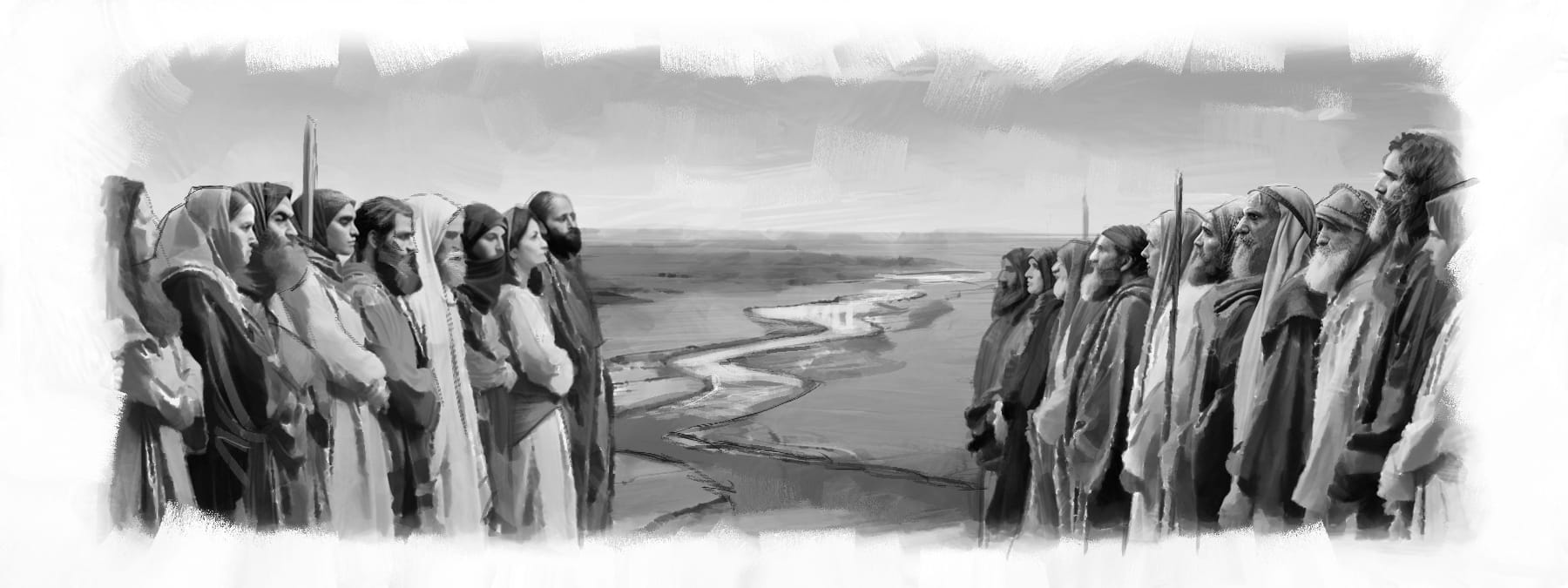
Image © Pacific Press
Read for This Week’s Study: Joshua 22:1-34; Ephesians 6:7; John 7:24; Numbers 25:1-18; Proverbs 15:1; 1 Peter 3:8-9.
Memory Text: “A gentle answer turns away wrath, but a harsh word stirs up anger” (Proverbs 15:1, NIV).
Living in a community can, at times, lead to disputes and tension. This is especially true in a community, such as the church, where people from different backgrounds and social strata—and who are sometimes brought up in completely different cultures—live and work together for a common purpose.
This week we will study Joshua 22:1-34 and a challenge that arose from a great misunderstanding among the people. At the beginning of the book, Joshua commanded some tribes to cross the Jordan and participate in the conquest, along with the tribes on the west side of the Jordan (Joshua 1:12-18). Now that the task is accomplished, they are free to return. However, at the east side of the Jordan, they build an altar that raises concern among the West Jordan tribes.
Why is it dangerous to jump to a rash conclusion about the behavior of others? How can we foster unity in the church? Why is it important to keep in mind the larger scope of our calling and not to get caught up in distractions? These are some of the questions we are going to deal with this week.
*Study this week’s lesson to prepare for Sabbath, December 13.

“Hear, O Israel: The Lord our God, the Lord is one. Love the Lord your God with all your heart and with all your soul and with all your strength. These commandments that I give you today are to be on your hearts. Impress them on your children. Talk about them when you sit at home and when you walk along the road, when you lie down and when you get up.” (Deuteronomy 6:4-7, NIV)
God was central to Israel’s peaceful and happy living in the Promised Land. It is indeed fundamental to note that happiness and peace are not based on the abundance of physical blessings but on having an intimate relationship with the Author of peace and happiness. This is true to us as well. “Peace I leave with you; my peace I give you. I do not give to you as the world gives. Do not let your hearts be troubled and do not be afraid.” (John 14:27, NIV). Regardless of the physical blessings that come our way in this life, without the Prince of peace being with us, all will be in vain.
“For he himself is our peace, who has made the two groups one and has destroyed the barrier, the dividing wall of hostility.” (Ephesians 2:14, NIV).
Phew! Living with one another? In a world that thrives on conflict, getting on with one another seems a pretty tall order. I’m not going to shoot all my arrows in my first comment, but I will give you part of a letter my father wrote to me before I married Carmel.
In essence, he said, “Don’t try to change Carmel. Learn to adapt. You are not always right!”
We are still married 57 years (I think) later, and I reckon we have both done a bit of adapting.
Is their a lesson from that for our spiritual lives, and in our church community interactions? I will probably ask the same question at the end of this week.
Wise words from a wise father, it seems we have a strong urge and inclination to always be the right one, and in doing so we fail to swallow our pride even when we are proved wrong. We surely need to learn to adapt, be humble for peace sake.
Living in the promised land wasn’t easy as it looked before crossing over to Canaan. Just like us who must deliberately focus on the distracted who remain our mission field. It is our duty to help turn enemies of the cross into lovers of the cross with the good news of Jesus Christ, which alone can save them from eternal destruction (Philippians 3:18–19). Just like the israelites after crossing Jordan to the promised land, We live among people in our communities, neighborhoods, and even in our own homes—people who live for what tastes good, looks good, sounds good, and feels good, a people distracted by the senses and driven by unrestricted appetites, whose “god is their belly” as Scripture says. Yet God has called us to live among them as examples and witnesses of what He can do in their lives, just as He has done in ours, because “Christ Jesus came into the world to save sinners” (1 Timothy 1:15).
Because a rash conclusion might not be substantial enough to address a rebuke, especially when the angry person did not reserve the need to inquire about the action believed to violate an existing decree. If one reserves the need to ask why another individual chose to pursue a course without a consultation of the other, the response might help to propagate an idea to understand the reason behind the action.
To foster unity in the church, one must learn to share interest in different ideas, define the ideas and reflect their meanings to the commandment, decide on how the ideas might support or undermine the core values of the commandment, and allow the entire congregation to offer their opinion on the matter. On a broader spectrum, the majority of the congregation would decide to support the commandment. The procedure the church may adopt to decide on the matter will revive conflictual opinions to unite the congregation in one faith.
Because I might be fortunate to live again if I observe the Lord’s commandment without flattering my mind with a behavior that might contradict the values of the Lord’s commandment, I will consider the large scope of my calling.
Joshua was given the task to help Israel establish their life in the new land based on the exclusive relationship with their own God.
Joshua 22:5 –”But take careful heed to do the commandment and the law which Moses the servant of the LORD commanded you, to love the LORD your God, to walk in all His ways, to keep His commandments, to hold fast to Him, and to serve Him with all your heart and with all your soul.”
As it was then, so it is now. Living the life of a Christian ought to be the evidence of our relationship with our God; evidenced by a changed heart upheld by the Love our heavenly Father has for us. He directs us to love Him in return, love His Son, our Lord and Savior Jesus Christ, and love His Holy Spirit given to be our counselor to the exclusion of everything else.
Neglecting to diligently love them with all our heart, placing our love for them first and foremost, will allow the enemy of our soul to gain a foothold in our heart and mind. A consecrated, filled with the love of and for God, is the stronghold the adversary cannot prevail against – Matt.16:13-19.
Everyone may have a different interpretation of their surroundings, based on the geographic and social/cultural context and prior experience. The conflict typically arises when empathy is missing from both sides.
Joshua 22:5 -”But take careful heed to do the commandment and the law which Moses the servant of the LORD commanded you, to love the LORD your God, to walk in all His ways, to keep His commandments, to hold fast to Him, and to serve Him with all your heart and with all your soul.”
if we are to to love the LORD your God, to walk in all His ways, to keep His commandments, to hold fast to Him, and to serve Him with all your heart and with all your soul. of a trueth we will know how to deliver messages, know how to deliver a gentle answer that turns away wrath because he or she that does the above indeed the spirit dwels in her or him.