
Tuesday: Nailed to the Cross

Daily Lesson for Tuesday 3rd of March 2026
Read Colossians 2:11-15. What issues does Paul seem to be combating here?
How often have we seen these texts, especially Colossians 2:14, misused as an argument against the law and keeping the Sabbath?
To help understand these texts, two main interpretations have been proposed by Seventh-day Adventists: First, the “handwriting” nailed to the cross is the list of charges leveled “against us,” similar to the writing Pilate hung on Jesus’ cross (Matthew 27:37; John 19:19-20). Or, second, the ceremonial law written by Moses (see Deuteronomy 31:24-26) was nailed to the cross.
When we look at the verse in its larger context, we can see that it is clearly talking about the ceremonial law.
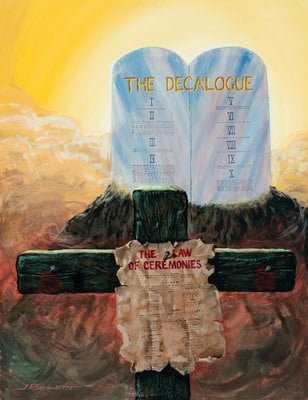
Image © Review and Herald Publishing Assn. Goodsalt.com
Paul also refers to “circumcision made without hands” (Colossians 2:11), that is, “of the heart” (Romans 2:28-29; compare Deuteronomy 30:16), in apparent contrast to fleshly circumcision, which was one of the most important stipulations of the ceremonial law (Leviticus 12:3; compare Exodus 12:48).
Paul then connects this inward change with “putting off the body of the sins of the flesh” and with baptism by immersion. With this baptism, we identify ourselves with Christ’s death and resurrection (Colossians 2:11-12).
This conversion experience is then likened to having been “dead in trespasses” and “made . . . alive” with Christ, who “forgave us all our trespasses” (Colossians 2:13, NRSV).
The word “ordinances” (Colossians 2:14) refers to legal decrees, whether secular (Luke 2:1, Acts 17:7) or ecclesiastical (Acts 16:4). This Greek word’s only other occurrence in Paul’s writings refers to the ceremonial law, which formed a wall of separation between Jews and Gentiles (Ephesians 2:14-15).
Because Paul has already referred to the forgiveness of sins and the inner change symbolized by baptism, it is unlikely he would return to that topic again with a different metaphor not used anywhere else in Scripture. Rather, Paul seems to be emphasizing a similar point as made in Ephesians: that the Gentile believers in Colossae need not worry about keeping the ceremonial law, including circumcision, nor about the purity laws that went with such a commitment (compare Acts 10:28,34-35).
Clearly, Paul was not suggesting that the Ten Commandments were nailed to the cross, not when elsewhere he defines sin as violation of the Ten Commandments (Romans 7:7).

Seventh-day Adventists have a special relationship with the Sabbath. Unfortunately, we often spoil that relationship by the way we talk about it. Most of the Sabbath arguments are forensic and lack the love and joy that rest should bring to us. They take a lawyer to work out what we mean.
The very best argument I ever experienced for Sabbath keeping was watching a Jewish family opening Sabbath at a table next to our tour group in Florence, Italy. It was an extended Jewish family and they were enjoying their opening Sabbath meal with special food, and wine. There was laughter, the singing of “Shalom Aleichem”, and storytelling. I can still see a little 5-year-old boy telling the (I presume) Exodus story, sitting on the lap of his grandmother, the matriarch of the family. Every time he hesitated one of his relatives would prompt him, and he would continue, with wide-eyed excitement. When he finished the whole family celebrated. Our brash secular tour group asked what they were doing. Is it a special celebration? No, it is Seudat Shabbat; we are welcoming the Shabbat, the Queen of the week. It made me be proud to be a Sabbath-keeper.
The lesson today is about legalistic religion and make no mistake about it; keeping Sabbath legalistically is quite rightly the target of Paul’s comments. We need to put a little joy and happiness into Sabbath-keeping. Far too much of our Sabbath liturgy has been set in medieval Sunday-keeping.
Here is a challenge: What Sabbath activity do you feel comfortable asking your secular friends to join in with?
I take my friends birding at 7:30am Sabbath morning. In a few weeks, I hope to be running an “Early Bird” group and I want my Adventist birdwatching friends to invite their friends to join in. We need to think outside the box.
If we are keeping Sabbath because we have an argument for keeping it, we are missing the point.
I like the novelty of the idea of having your secular friends Bird Watch with you 7:30 am in the morning. However I have a problem with Sabbath morning. You see my secular friends are certain somewhere along the lines to bring up ” their secular conversations” on His holy day. Some group of birds flying together may remind them of President’s Trump and Israel’s Leader ( can’t spell his name right now) war with Iran presently [fighter jets flying in formation] and its impact on the price of oil. I certainly would not like to be involved in such a discussion on Sabbath.
Birdwatchers don’t talk much – it spooks the birds. When we do talk, its about birds. Much safer than current affairs at present!
Interesting that you go bird-viewing on Sabbath Maurice. I have some friends that go walking on a Sabbath morning which I have been reluctant to join, maybe I need to think outside the box as you do???
We the Seventh Day Adventist Christians hold a very firm and grounded knowledge and understanding that the moral law (the Ten Commandments) was not nailed to the cross. The moral law is a true reflection of God’s character and remain unchangeable as God Himself in unchangeable (Malachi 3:6, James 1:17, Numbers 23:19). There is not any suggestion in Paul’s writings that the moral law was nailed on the cross. He himself validates the moral law and says that we must uphold it. “Do we then overthrow the law by this faith? By no means! On the contrary, we uphold the law.” (Romans 3:31). Paul goes on to say that the moral law is divine. “The law is holy, and the commandment is holy and righteous and good.” (Romans 7:12).
We who passionately argue in defending the validity of the moral law, what should be our loudest and strongest argument in support? Using tradition and emotions is not good enough. Since the moral law is the true reflection of God’s character (love, justice, faithfulness, righteousness, peace, goodness, truthfulness), therefore, we likewise should be in the forefront championing these virtues in all that we do. The greatest defence against the abolition of the moral law is to keep it wholesomely.
“Well then, if you teach others, why don’t you teach yourself? You tell others not to steal, but do you steal? You say it is wrong to commit adultery, but do you commit adultery? You condemn idolatry, but do you use items stolen from pagan temples? You are so proud of knowing the law, but you dishonour God by breaking it.” (Romans 2:21–23, NLT)
In the passage above (Romans 2:21-23), Paul is saying that theological arguments without obedience is pure hypocrisy. Obedience to the moral law provides credibility to our testimony in support of the law. We cannot defend the law which we violate blatantly. Paul is asking us some home-truth questions. “You tell others not to steal, but do you steal?” Keeping God’s laws does not make us legalists. But we testify that we have been transformed to reflect the character of God. The good news is that we can uphold God’s law faithfully through Christ who strengthens us through the power of the Holy Spirit (Philippians 4:13).
Very informative as always brother. Amen 🙏
People are often caught on camera doing the very things they boldly deny.Surveillance footage from multiple angles shows the truth, yet with astonishing confidence they insist, “I didn’t do it.” But denial does not erase evidence. In the same way, our case before a holy God is never in our favor. Unlike someone who might avoid a camera or hide behind a mask, nothing is hidden from an omniscient God. He knows every word we have spoken, every deed we have done, and even every thought that has violated His perfect Law. God does not grade on a curve or compare us to others but rather He demands perfection.For all have sinned and fall short of the glory of God” (Romans 3:23)
The apostle Paul declares that we were “dead in our sins.” Ephesians 2:1 Dead people cannot defend themselves, negotiate, or improve their condition. Before God’s holy standard, we had crossed the red line. The evidence against us was complete and undeniable. Our sin left us spiritually lifeless and fully exposed before divine justice. There was no loophole, no technicality, no appeal that could overturn the verdict.
God addressed the evidence in the most astonishing way. Instead of ignoring our guilt, He placed it upon Christ on the cross. As Paul writes in Epistle to the Colossians, the record of debt that stood against us was canceled, “having been nailed to the cross.” Jesus bore the full weight of our sins, satisfied God’s Holy law, and did what we failed to do. He fulfilled God’s standard perfectly. Our sins were nailed to His cross, and because of Him, our standing before God is no longer condemned but forgiven for we have been made righteous before God.
God addressed the evidence in the most astonishing way. Instead of ignoring our guilt, He placed it upon Christ on the cross. As Paul writes in Epistle to the Colossians, the record of debt that stood against us was canceled, “having been nailed to the cross.” Jesus bore the full weight of our sins, satisfied God’s Holy law, and did what we failed to do. He fulfilled God’s standard perfectly. Our sins were nailed to His cross, and because of Him, our standing before God is no longer condemned but forgiven, we are place under GRACE before God.
In light of the above; is God requiring another punishment for the sins Jesus already paid for?
When we break down Colossians 2:14, we see that Paul is talking about our sinful nature and the legal requirements that come with it. Sin creates a barrier between us and God, much like a large piece of paper filled with accusations against us. This is exactly what the “handwriting of ordinances” represents. It symbolizes the rules that we have broken and the condemnation that follows. Imagine real life: if we broke a law, there would be consequences, and that guilty feeling could weigh heavily on our hearts.
But then comes the good news; Jesus wipes the slate clean! The Bible says He “took it out of the way” and “nailed it to the cross.” This is not just a physical act but a spiritual one that means our sins, which were once a barrier, have been dealt with. The weight of our guilt and shame, which could have overwhelmed us, has been removed! It is like being given a new start. Everything we did wrong is now forgiven, and we can have a fresh relationship with God.
Thank you all so much for the valuable gems of truth deposited here in this space. Every facet points to the Pearl of great price.
It’s good to be reminded of the truth in Romans 2:21-24.
We who preach and teach the Sabbath, do we keep it? In spirit and in truth?
We who boast of the light of the Sabbath do we dishonour GOD by legally and self-righteously adhering to it thus ‘breaking the law’.
Is the Name of GOD blasphemed by unbelievers, through the way we ‘observe’ the precious love gift of the Sabbath?
As we diligently seek the Pearl of great price, for a deeper, closer, more intimate branches -to-vine relationship, may we truly rejoice in the LORD of the Sabbath as we celebrate it, in and through Him
The Cross solidified everything God had established prior to it including the ten commandments.The cross must not be an excuse for disregarding the law.
To me, this passage makes it clear that the ceremonial law was done away with, and not the Ten Commandments.
“For it makes no difference whether or not a man has been circumcised. The important thing is to keep God’s commandments.” 1 Corinthians 7:19 NLT
Every nation needs a written document of its coordinates: a constitution. The Christian constitution is the Bible, and people often misuse parts of it without considering the whole Word. This wisdom has to explain itself and be a source of discernment for the Holy Spirit’s voice. The Bible is the written letter of love from God.
I can understand the argument that this passage refers to the ceremonial law. For many reasons, it does not make sense for the 10 commandments to be done away with.
However, some parts of this passage continue to puzzle me. I am specifically not sure about the ceremonial law being “against us”. In a way, it actually wasn’t. The sacrifical system provided a way to be right with God. Of course, they were just shadows of Jesus’ work, but it seems a stretch to say they were against anyone. The other ritual laws served their purpose – either to make people aware of their contamination and need for God (ie. the many things that made people unclean) or to apply the principles of the 10 commandments (the civil law). Obviously most of these laws lost their meaning when Jesus died, but that didn’t make them bad. Also, before Jesus, it seems like God did want the nations to observe Israel’s laws. If Israel was to be a light, what else would be likely?
Certainly the ceremonial laws condemned those who failed to keep them, but the 10 commandments, being even more important, do the same. So wouldn’t they be “against” people too?
I just don’t know and wonder if there are other interpretations that make more sense here. However, I think we’re unlikely to find them as we are usually very invested in protecting the Sabbath.
I guess it’s odd to comment on my own comment, but I have changed my mind a little. I was actually reading from Leviticus last night after I posted and I was reminded again that there were so many rules about defilement and offerings to deal with that and various other restrictions. These were definitely a burden (which I feel was intentional – to look ahead to the One who would clean up all defilement). I imagine that’s what Peter meant in Acts 15:10 about a yoke that they nor their fathers could not bear. It actually surprises me that Jewish Christians would want to hold on to those things. But we are often not so different.
Neither the Greek words nomos (law) nor entole (commandment) are present in Colossians, except for entole being used in the sense of “instructions” to welcome Mark in Colossians 4:10.
A number of commentary authors have noted that what was nailed to the cross (in Greek, the “cheirographon”) was an “IOU” — our IOU of debt to God for having broken His holy law, and the Greek word “dogmasin” which was nailed to the cross along with the IOU usually means a judgment, opinion, decision, or decree (for instance, Caesar’s decree for a census and tax in Luke 2, or the decision of a church council in Acts 16).
So as I understand it, “ordinances” (King James Version) is not the best translation either here or even in Ephesians.
The Message has the picturesque suggestion “arrest warrant” issued for our inability to satisfy our enormous debt to God:
“Think of it! All sins forgiven, the slate wiped clean, that old arrest warrant canceled and nailed to Christ’s cross.”
(Colossians 2.14, The Message)