
Tuesday: The City of Corinth

Daily Lesson for Tuesday 30th of June 2026
Read Acts 18:1-3, 1 Corinthians 5:9-11, and 1 Corinthians 8:4. What can we infer about Corinth’s economy, morality, and religious life?
Corinth was an important center of the ancient world, renowned for its prosperous commerce. The city was destroyed by Rome in 146 b.c. and rebuilt by Julius Caesar as a Roman colony in 44 b.c. It is this Roman Corinth that appears in the New Testament. In the time of Paul, Corinth was one of Athens’ rivals and had even surpassed it in various aspects. Corinth had two important harbors that made the exchange of merchandise and the development of its commerce easy.
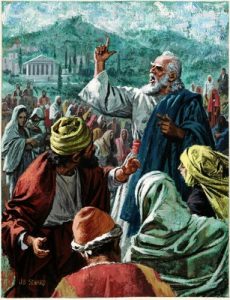
Image © Provident Collection Goodsalt.com
Indeed, Paul chose Corinth because of its importance and advantaged geographic location. “An opportunity was thus presented for the spread of the gospel. Once established at Corinth, it would be readily communicated to all parts of the world.”—Ellen G. White, Sketches From the Life of Paul, p. 99.
In addition, the flourishing commerce of Corinth would make it easier for Paul to support himself by producing and selling tents while proclaiming the gospel in that city (Acts 18:2-3). Obviously, missionary work in a large and wealthy city is not free of challenges. Corinth was marked by a blatant religious pluralism (1 Corinthians 8:5), as evident by its numerous shrines built in homage to such deities as Apollo, Athena, and Aphrodite, among others, and even the worship of such Egyptian gods as Serapis and Isis.
In addition to this religious confusion, Corinth was also known for its sexual licentiousness. Strabo, a Greek geographer and historian, mentions that there were 1,000 sacred prostitutes devoted to the worship of Aphrodite in her temple at Corinth. Although many scholars view this with suspicion and connect this claim to Athenian propaganda against Corinth, ritual prostitution was common in the ancient world. Sexual immorality was a problem in Corinth, as elsewhere. Idolatry and immorality were part of daily life, and this sad reality explains much of the content of 1 and 2 Corinthians.
|
In his missionary activity in Corinth, Paul faced the challenge of an idolatrous and licentious society. What challenges in today’s culture can make it hard to preach the gospel? How can we overcome them? How much difference, if any, is there between Corinth and our cities today? |

For the last three weeks, I have spent most of my time in Sydney. I am not a city person. I like to visit Sydney to go sightseeing, but living in the city, you realise the space between people is pretty small. You also get a feel for the secular and licentious nature of our city society.
As described earlier, Corinth was a secular and licentious society too. It was not going to be easy to preach the Gospel to them. They were not interested. It is noteworthy that Paul did not do a “fly and preach” mission project here. He settled in for 18 months, working at his trade and interacting with people around him. It took some time to develop the sort of relationships where ideas can develop and be understood.
In our modern world, we could probably take a lesson from Paul. Stay a while and get to know the folk you interact with daily. Live the Gospel and let it advertise Christianity for you.
The city of Corinth remains a small town with limited significance other than its rich and profound history. During Paul’s time it was a thriving, prosperous, strategic, and important metropolitan city. Corinth had a bustling life, gaining a reputation for outrageous immorality as travellers and revellers found an easy time in this city, which also kept the population growing. So Paul emphasized outstanding moral living in both letters of 1 and 2 Corinthians. Interestingly, the city manifests the grace of God, for if Christianity could thrive in Corinth, one of the most immoral centres of the ancient world, then Christianity can thrive anywhere. As much as Paul warns, “Do not be deceived: ‘Bad company corrupts good character'” (1 Corinthians 15:33).
Corinth had a reputation across the Roman Empire that wherever one lived, being referred to as a “Corinthian” was a polite word for a “promiscuous” person. This was the backdrop where Paul found himself. He went from the high-brow, academic, and intellectual atmosphere of Athens to a rough town drowning in pornographic apathy. And yet God says about Corinth, “I have many people in this city” (Acts 18:10). Because where there is darkness is usually where the light of God can shine the brightest, a regular theme repeated in the Bible.
It is in the midst of this craziness that the city of Corinth developed to become a devoted community of Jesus followers, known as the church in Corinth. The greatest irony is that in such a city where women were used as commodities, one of the early house churches in Corinth was at one point led by a woman. 1 Corinthians 1:11 tells us that Paul and Sosthenes heard from Chloe’s household that there were divisive quarrels within the community of believers. They dropped Chloe’s name in the letter as if everyone would know who they were talking about—Chloe’s house was the gathering place for believers! Clearly, Chloe and “the household” kept Paul informed through letters about how the church community was doing from time to time. Corinth stands as a testimony that there is no city that is beyond the reach of God’s grace, for “where sin increased, grace increased all the more” (Romans 5:20).
Thank you for noting the interesting detail about Chloe’s household. It reminds us that Christians in that time normally met in “house churches.” And one of these met in Chloe’s house.
House churches are becoming popular again, and it’s worth considering whether it might not be better to establish a local house church, rather than traveling a considerable distance to attend a larger church.
During Paul’s time in Corinth, sexual immorality was one of the common sins that plagued the city. Why is it that sexual immorality is a sin that torments urban areas? Why is it that sex, which is God’s gift to mankind, is profoundly abused? Does it suggest that mankind is largely incapable of handling God’s gifts (free will, speech, life, the earth, etc)?
Urban areas like Corinth bring good and bad opportunities. A concentration of people from all walks of life comes with the risk of moral degradation. Moral accountability is seriously eroded in large concentrations of people, some of whom are far from their families. Temptations increase with greater human interaction. The Bible records that as the number of people increased on the face of the earth, so did immorality (Genesis 6:1-2). In the book “Cry My Beloved Country”, cities are described as places where people are swallowed. The book continues to describe cities as places where moral characters are consumed. Where there is prosperity, the tendencies for sexual indulgence are rampant.
The sin of sexual immorality is one that can easily entice even those who are considered to be the “veterans” of faith. Sexual desire is one of the strongest part of human nature. This sin is very sneaky; even with just a bad look, you have done it. Unless the whole body (mind, heart and soul) is covered with the blood of the Lamb, many are in danger of losing eternity.
This is powerful we at risk sexual immorality is real, may God help us
To be honest, these days sexual immorality is everywhere, not just in urban areas. Yes, you might not see it as easily but with the Internet, it comes into many homes. And there has always been abuse in many forms.
Self promotion ie. Influencers, greed, power, false gods and divisive rhetoric. This is from one of the most powerful political World leaders, they are controlling the narrative including there is no separation between State and the Church. Jesus is our example in all things as He promised Paul ‘Do not be afraid to speak and do not keep silent For I am with you and no one will attack you to hurt you for I have many people in this city
Most places or cities are known for their behaviors, some cities like Johannesburg in South Africa are known for violence and murder, Some cities are known for tribalism, places normally tend to be known for something, like Corinth was known for Idols and prostitution. It is therefor important to always do a due diligence when you are moving to a place. Some places are not good for bringing up children. Like Sodom and Gomorrah was not a good place to reside or be close. Some places are better visited for evangelistic programs and thereafter leave because of their influence.
If you are talking about the inner city of large cities, I would tend to agree, but I live in a Canadian city of approximately 1 million people and feel quite safe. Now there is definitely homelessness and it’s sadly more and more common, but I don’t encounter too much that is Sodom like in my day to day life. I’m not saying my experience is true of every city, but I think it’s easy to make generalizations.
I think if we could adopt Paul’s method of moving and being a resident of a place you want to evangelize then we could get more converts than what we have as Ashton has mention and also as Ellen White has also espoused it in christian service but who is ready to move and settle in an unfamiliar loçation ? I think it requires courage and risk to move out of our comfort zone .
Christian witnessing does not need to wait until we move to a new location. We need to find the courage to witness where we live. If we are not communicating the Gospel to those nearest us, that dynamic is not going to change just because we have moved somewhere else.
Amen and amen! (Though I have a lot of growing to do in this area)
We always seem to be focused on something that is very “out of our comfort zone”, like moving somewhere else or even talking to the clerk at the store or the person on the bus and trying to witness to them. And I’m not saying any of that is wrong. But why aren’t we focused more on getting to know our neighbors or connecting with our colleagues? The long term impact will be much greater than with chance encounters. Yes, take opportunities as they come, but our main focus should be on those we interact with regularly.
Yes, indeed my wife and I took a Uber ride to the airport going back from our excursion recently. The driver brought up his attendance in church. I said, a church is only as friendly as we make it. He said absolutely. A first acquaintance, that may be as far as you get. We let the Lord lead.
Sexual immorality that was prevalent in Corinth at the time of Paul has a parallel of polygamy in our Africa Adventist churches and posing a fatal danger to the growth of the church, many church leaders have hesitated taking drastic measures like Paul for fear of losing polygamous members who contribute membership and finances to the church, so should the church here In africa take drastic measures like Paul by instructing members to shun polygamy?
Yes, of course…!!!
High pursuits of ambitions,secularism, instant and self gratification,impatience, the sujection of truth to realism,reliance on science to the exclusion of God etc are challenges to sharing the gospel. However, there is an opportunity to share the gospel when these life styles begin to have their toll on their adherents.
We tend to think licentious lifestyles were things of the past. However, popular music festivals of today reveal they are essentially the same ritualistic, sexually immoral, pagan festivals of the ancient worlds.
This licentious lifestyle has always been and is definitely a thing of today, if not worse! Even TV commercials use smooth subtle ways to promote their products, and some not so subtle at all. The internet, on and on…..it’s just everywhere. Sex trafficking….women and children, etc. Life is not valued as it should be. The enemy is on the move and will NEVER give up trying to kill, steal, and destroy. Come Jesus, come!
Another point to consider is we should not disassociate ourselves from unbelievers otherwise,we would not carry out Christ’s mission to tell them about salvation. But we are to distance from the person who claims to be a Christian ,yet indulges in sins explicitly forbidden in scripture and the rationalizes his or her actions by rationalizing sin, a person harms others for me whom Christ died and dims the image of God in himself or herself. A church like this is hardly fit to be light of the world!!!
“There is nothing new under the sun” – Eccl.1:9-10. The world is filled with its gods promoting their ideas and values. This should not surprise those who followed the call to come out of ‘this world’ to enter and live in the Kingdom of God. The world surrounds us, but we are no longer ‘part of this world’ – 1 John 17:15-16.
‘Corinth’ is filled with the spirit of this world. They have not yet encountered the Spirit of the ‘Word of God’ preached to them in the form of the Gospel. They have not yet encountered the ‘Living Word of God” – Jesus Christ -.
What does Jesus’ prayer ask of the Father to do for those who go out and share His Word? 1 John 17:18-19 – ”Sanctify them by the Truth; your Word is Truth.”
Jesus does not only ask the Father to sanctify the Apostles going out into the world to introduce the ‘Word of God and His Son Jesus Christ as its Messenger. He also asked Him to bless all who “will believe in me through their message.” 1 John 17:20-23
All humanity is called out of the confusion of this world “so that they may be brought to complete unity in the Spirit of Jesus Christ and the Father.” In this world, we encounter the ‘spirit of disunity’ wherever we go. But the ‘Word of God’ offers the Spirit of Unity in Jesus Christ. To preserve this unity is the highest calling. We cannot do this on our own merits but need to be filled with the power of the Spirit of God to do this for and through us – Eph.5:18.
Our world is not so different from Corinth. Two things that stood out to me that parallel are the idolatry and the pleasure seeking that existed there. We don’t worship idols, as such, but we certainly live in a world where people are quite uncomfortable with absolute truth. Pluralism is very strong. And though not everyone is involved in obviously immoral behavior, many people tend to focus on what makes them happy. Christianity is a poor fit for these two things.
So how do we overcome them, as the lesson asks? I think the only way is with our lives – showing people we have something better. This takes time. It’s not drive by evangelism. It requires building trust.
Thinking about how negative the morals might be nowadays will certainly leave anyone without hope. But the focus has to be on people who can stand for the truth, no matter the cost. How not to corrupt the mind with material riches and pleasure? That’s the real cultural challenge to fight against.
Let be like Paul’s life,he was first prosecuting christians reaching a point that he doesn’t want to hear anything about God ,bt later Good news come land on him and his life change completely to an apostle of Christ
Paul’s words in 1 Corinthians 5:9‑11 show his deep concern for the purity of the church. He knew Corinth was full of darkness, yet God had many people there. His warning is about those who claim to belong to Christ but live in the same corruption as the city. Discernment protects the community so that God’s light can shine even in the darkest places.