
Can You Spot Humility or Pride?

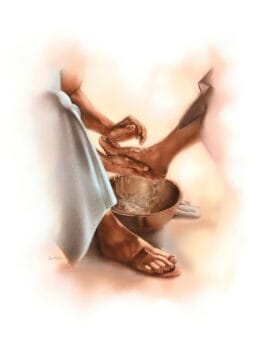
The Servant by Darrel Tank
Can you easily spot whether someone is proud? Or whether someone is humble?
“We’ve all known people with big egos … ” our lesson author writes. It might be worthwhile to remember that we most frequently see our own faults in others. So if we often spot the sin of pride in others, that might well be an indicator of the state of our own hearts.
Since my teen years, I’ve been attracted to people who seem humble. One of my college profs seemed so humble that I was sure he was very close to God. I was excited when he offered me the job of working under him to run the college bookstore. What a blessing! I determined to be worthy of his confidence in me.
After my senior year in academy, I was working full days during the summer to earn part of my college tuition. We were getting ready for the school year, and this morning Dr. I. laid out the day’s work. I worked hard and was done by about 1:30 pm. What to do? There was no way to contact my boss. But then I had a lightbulb moment: Elder F. in the business office across the hall had been in charge of the bookstore for years. Perhaps he could help me. And he did, by suggesting helpful things I could do.
When Dr. I returned at the end of the day, I was quite proud of myself for having completed the assigned tasks and then some! But Dr. I. was not pleased. He gave me what I still consider to be the worst dressing-down of my life, warning me against the sin of pride and telling me what a terrible sin it was for me to try to take his job from him! It was doubly traumatic because I had looked up to him so much. To this day, I can feel the utter devastation I experienced – that this man of virtue and humility could be so cruel to a 17-year-old student.
I went to my dorm room, threw myself on my bed and had a long cry over the wreckage of my idol, missing supper in the process.
I don’t know if anyone else found out about this incident, because I didn’t tell anyone. I worked for this same prof for a couple of years in different capacities, including personal secretary. And I saw conscious humility up close. It was not pretty. Note
Trying to be humble might not be a good idea.
So how do we recognize humility? Or pride, for that matter?
Should we even try to recognize humility or pride in others? If we had been among the Israelites in the desert, would we have recognized humility in our stern leader? Or might we have thought him to be proud, like Miriam and Aaron did?
I know I’m easily fooled by apparent humility – not just once. (I’m a slow learner.) I’ve also known some obnoxious folks who seemed full of themselves, but I suspect pride is much subtler. It sometimes masquerades as humility or spirituality – as in the parable of the Pharisee and the publican.
Perhaps we should stop for a moment and consider the situations in which we use the word “proud.” Do they all refer to the same quality?
- Pride in doing a job well.
- Pride in being in the wealthy class.
- Pride in being a member of a respected church.
- Pride in being better than a drug addict.
- Pride in being gay OR pride in being straight.
- Pride in being a son or daughter of the King of heaven.
Can you add to this list? (Let me know in the comments.)
We probably should not be looking for humility or for pride in others, because I believe these are symptoms of something deeper. They are heart issues, and we cannot read the heart. The first place to look is my own heart.
Our lesson author assumes that “We’ve all battled with pride.” Is this true? A battle means an active fight. How do we fight pride, if we know we are better than others, as the author suggests?
The way I see it, looking to Jesus is the only cure for the pride we all have. And I believe a continuing focus cannot help but make us humble, as we realize that Jesus values the drunk in the gutter as much as He values the preacher in the pulpit. In fact, the drunk who realizes he’s a sinner and pleads with God for help is likely closer to heaven than the preacher who is conscious of his humility. Our need is our greatest argument for salvation.
We probably all know the story of the mighty angel, Lucifer, who became proud enough to covet the position of the Son of God in heaven. But how did this pride arise? If Lucifer had not first focused on his own beauty and goodness, would he have become proud? So was the very first sin not a focus on self?
To undo the damage of sin and to save us, Jesus Christ came to this sin-damaged planet and modeled the “law of self-renouncing love, the law of life for earth and heaven.”
it will be seen that the law of self-renouncing love is the law of life for earth and heaven; that the love which “seeketh not her own” has its source in the heart of God. (See context in Desire of Ages, p. 19)
To “know God,” we need to understand the fundamental principle of God’s Kingdom which Christ came to demonstrate. He modeled not looking out for self, but renouncing self. What does that look like? (Check Phil 2:6-8 ESV) In Christ’s Kingdom, greatness is not measured by being over others, but by serving God and others. (Matt. 23:11)
Jesus emptied Himself, and in all that He did, self did not appear. He subordinated all things to the will of His Father. (Check context in Thoughts from the Mount of Blessings, p. 14)
Perhaps we could all learn to be more humble by following the counsel to “spend a thoughtful hour each day in contemplation of the life of Christ. We should take it point by point, and let the imagination grasp each scene, especially the closing ones.” (Read more at Desire of Ages, p. 835)
