
Introduction: Uniting Heaven and Earth

Think of the hardest job you’ve ever done. What made it hard? Was it the expectations, or the time allotted for the work, or both? Was it your attitude toward the task? Or perhaps it was the people you worked with? Or maybe it just seemed like an impossibility to ever succeed?
Consider the purpose of the plan of salvation: uniting heaven and earth. Sound impossible? Humanly speaking, it certainly is. Nevertheless, just before ascending to heaven, Jesus gave the apostles a seemingly impossible assignment: ” ‘Go therefore and make disciples of all the nations, baptizing them in the name of the Father and of the Son and of the Holy Spirit, teaching them to observe all things that I have commanded you’ ” (Matt. 28:19-20, NKJV).
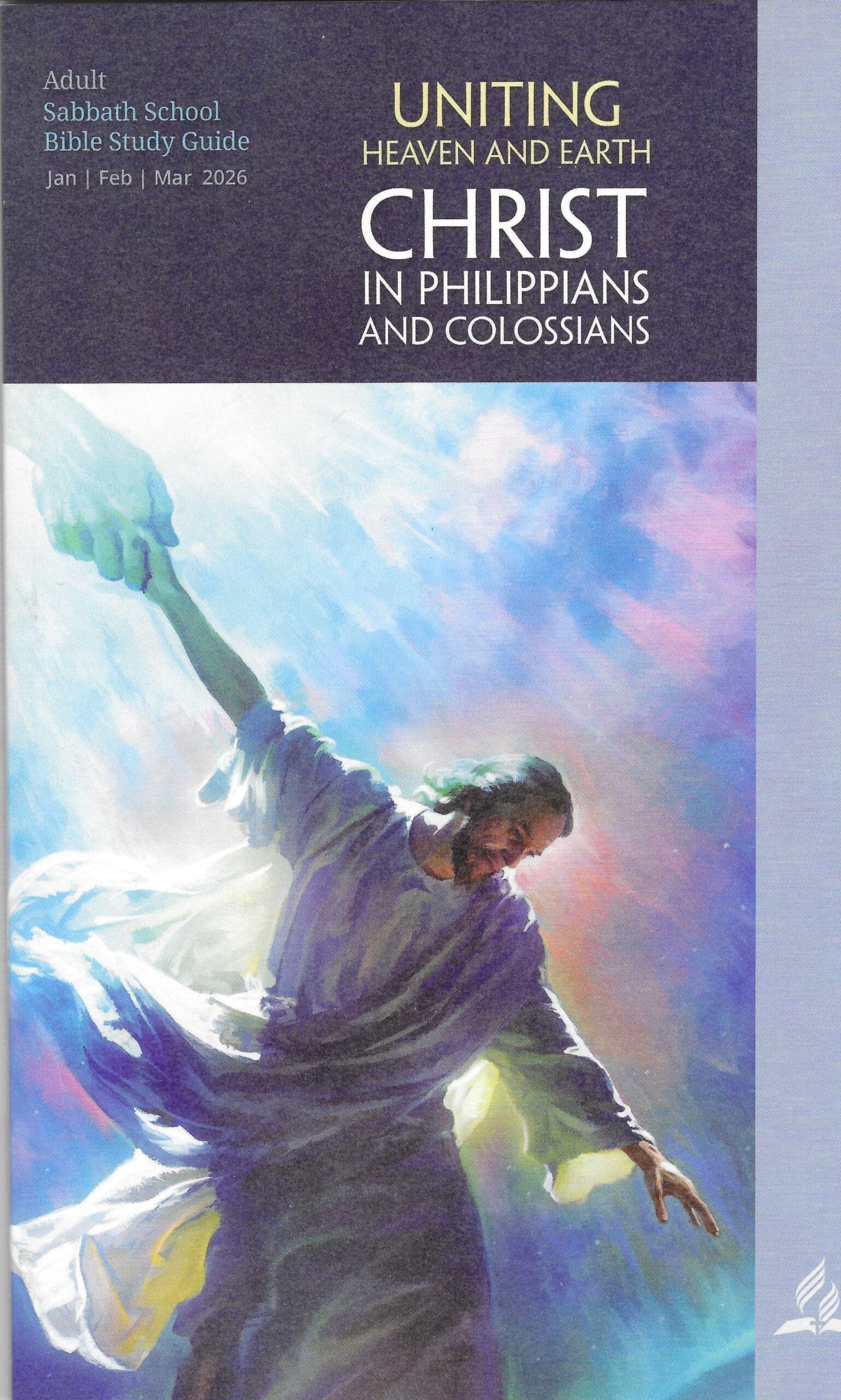
Image © Pacific Press
Jesus sent Paul to the Gentiles to accomplish this seemingly impossible task: ” ‘To open their eyes, in order to turn them from darkness to light, and from the power of Satan to God, that they may receive forgiveness of sins and an inheritance among those who are sanctified by faith in Me’ ” (Acts 26:18, NKJV).
Some might throw up their hands when given jobs like that. However, we should not overlook the promises Jesus gave on both these occasions. To the apostles, He added, ” ‘And, lo, I am with you always, even unto the end of the world’ ” (Matt. 28:20). And to Paul, Jesus said, ” ‘ “I have appeared to you for this purpose, to make you a minister and a witness both of the things which you have seen and of the things which I will yet reveal to you” ‘ ” (Acts 26:16, NKJV).
In short, Jesus gives humanly impossible tasks so we will rely on Him, rather than on ourselves, to accomplish them. He never gives us a job without supplying the power to do it. “As the will of man co-operates with the will of God, it becomes omnipotent. Whatever is to be done at His command may be accomplished in His strength. All His biddings are enablings.”–Ellen G. White, Christ’s Object Lessons, p. 333.
Image © Pacific Press
Amazingly, by the time Paul wrote to the Colossians, the gospel had been “preached to every creature under heaven” (Col. 1:23, NKJV). Of course, not all accepted it. But if we look carefully at the commissions He gave to the apostles (Matt. 28:18-20), and to the apostle Paul, Jesus never promised all would become disciples or all would be converted. The gospel is to be ” ‘preached in all the world as a witness to all the nations, and then the end will come’ ” (Matt. 24:14, NKJV, emphasis supplied). What does that witness look like? How exactly is it to be accomplished?
This quarter we’ll study Paul’s epistles to the Philippians and to the Colossians. They have important similarities. Above all, they reveal Christ, the only One able to unite heaven and earth. He is the ladder Jacob saw stretching from earth to heaven (Gen. 28:12; compare John 1:51). As the Son of man and the Son of God, He redeems us from sin, and He intercedes for us.
In studying these letters, we will see both these aspects of Jesus. We’ll consider some of the most sublime statements found anywhere about Christ’s divinity and how He gave it all up to save us. We’ll see Paul wrestling from prison with problems in one church he raised up (Philippi) and in one that he himself never even visited (Colossae). The connections Paul established throughout the “world church” of that time enabled him, even from a Roman prison, to respond to challenges. He knew his time was short, and he did all he could to draw the church closer to heaven and to each other. In so doing, he shows us how God’s church today can unite with heaven to fulfill the last-day commission of Revelation 14, which we know as “the three angels’ messages.”
Clinton Wahlen, Ph.D., is an associate director of the Biblical Research Institute at the General Conference. His expertise is in the New Testament, hermeneutics, and Adventist history. He has lived and worked in Germany, New Zealand, Russia, the United Kingdom, and the Philippines. He and his wife, Gina, have two grown children, a daughter-in-law, and two grandchildren.

When I was a child, I learned about heaven from my parents. It was above the stars, very pretty, with lots of angels. The sea was made of glass. God sat on a throne with Jesus on his right-hand side. We were going there for a while after the second coming. We kids could play with lions and snakes. Trying to make sense of all this was hard. I drew some pretty funny mind-pictures about all this, and I am glad I did not share them with others because they seem silly now,
Growing up, my mind pictures changed. But by then I realised that even though they had changed, the rest of the world wasn’t really interested in my mind pictures they could not see. They put it in the category of “invisible friends” that some kids have, and they look at me with withering scorn and say deprecating remarks about my intelligence.
Then it dawned on me that if others were to see God and Heaven as real, my life had to be a window into that reality. We can make a lot of noise about the work of the Holy Spirit and so on. But ultimately, we must make the decision of our own free choice to be a window through which the people near to us can see and experience heaven.
A prayer for this quarter: Teach us to be windows,
Christ “gave up all His divinity”!! I don’t think we’ll find that in Colossians or Philippians.
How about Christ giving up all the privileges of divinity?
I expect the wording is the problem here. I too disagree that Jesus gave up His divinity. I don’t think the Bible teaches that. However, He did empty Himself of the privileges of divinity. I think the writer meant that but it could have been worded better.
God would have used angels who are absolutely efficient, effective, swift and powerful to accomplish the seemingly impossible task of Matt. 28:19-20, however, He chose to assign the task to feeble human beings. God knows that by participating in this seemingly impossible task, we would become disciples ourselves. Therefore, by becoming a disciple maker, we become one. As feeble as we may be, God is calling us to go so that He can have an opportunity to perform the impossible in us.Let us willingly give God that opportunity.
I see we are already into interpretive issues. Dr Wahlen thinks “Christ’s divinity …. gave it all up to save us.” The NT uses many expressions to account for Christ joining us. I prefer the idea of being “among us” which we find most often in the birth narratives. Others think he “became us” or even “become one of us. . . ”
How do you language the Christ-event we celebrate each year ?
I like your idea of other ways of expressing the divine-human interaction, but I would also include the quote which I used in response to another commenter:
We have multiple nuances in our language to describe this relationship.
Why! I have to ask why? They say “A picture is worth a thousand words!”Why are we still using some of these same old images to represent Christ on the cover of our Sabbath School lessons?
If you have an issue with the lesson pahphlet per se, we suggest that you take it up with the Sabbath School Personal Ministries Dept. They con be contacted here:
https://absg.sspmadventist.org/contact
Sabbath SchooL Net is an independent ministry and we use the materials that department produces as provided.
I think I could shed light on the subject with my feeble heart to breathe in knowledge, if you pardon the expression. There was a discussion of Jesus Christ’s assignments on earth in the book of Isaiah, in which God reveals to the prophet His intentions. The misunderstanding part of this discussion is part of God’s plan because when Christ presented Himself for the job, God said, “Go and tell these people, ‘Hear but do not understand, and see but do not perceive. Make their heart fat and their ears heavy. They must understand what they see and hear with their heart and convert before they can get healed.” Isaiah 6:9-10).
Although Jesus Christ lived a simple life in the flesh and considered Himself the son of man, He was a divine spirit sent from the spiritual world to fulfill the words of the prophets. He fought the spiritual and the physical battle to accomplish His mission with the help of God’s divine spirit; however, when He completed the mission assigned to Him by God, He went back to God. Jesus Christ was indeed a God and a son to our heavenly father, who is the omnipotent God in heaven. If Jesus Christ were to continue to live on earth after completing His work, we would indict Him for assault, for Him to contradict Himself with His works.
It is therefore our duty to spread the testament derived from Jesus Christ’s works to every part of the world, for mankind of all kinds to bear witness to His works, and for them to convert from their ungodly manners to adopt the LORD’S commandment. It is our responsibility to fulfill the last part of God’s message to Isaiah, which is to help people to convert to get saved.
Jesus Christ indeed humbled Himself to endure humiliation and suffering without using His divine spirit to avenge because such action would compromise His mission. Jesus Christ advises us to do everything to the glory of God (1 Corinthians 10:31). It was not within His powers to avenge the scribes and the Pharisees because that was not part of His mission, which is why He humbled Himself to accomplish God’s mission.
I hope you find a path to clarify the doubts in mind.