
Tuesday: Paul in Philippi

Daily Lesson for Tuesday 30th of December 2025
During Paul’s second missionary journey, shortly after Timothy was added to the team, they are forbidden by the Holy Spirit to continue across Asia Minor (Acts 16:6). So, during a vision of the night, Paul sees a man pleading with him to “ ‘come over to Macedonia and help us’ ” (Acts 16:9, NKJV). So, immediately they head to the seaport nearest Macedonia and sail from Troas across the Aegean Sea to Neapolis, on the European continent. But rather than evangelize there, Paul, Silas, Timothy, and Luke, who joined them at Troas (as indicated by the use of “we” in Acts 16:11), head to Philippi.
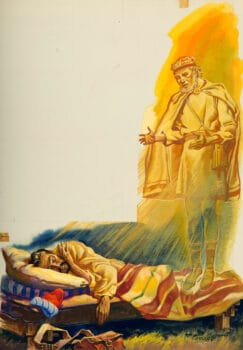
Image © Review & Herald Publishing at Goodsalt.com
In his evangelistic activity, Paul always thought strategically. Philippi was “the chief city of that part of Macedonia” (Acts 16:12). In fact, it was one of the most honored cities of the Roman Empire, being given the status of Ius Italicum—the highest possible designation a city could be granted. Its citizens had the same privileges as if the city were located in Italy, including exemption from the land tax and the poll tax, and anyone born in the city automatically became a Roman citizen. It was also an important stop along the Via Egnatia, which was the main overland road connecting Rome with the East. Establishing an important Christian presence there enabled them to bring the gospel to many other nearby cities, including Amphipolis, Apollonia, Thessalonica, and Berea (see Acts 17:1,10).
Interestingly, the official language in first-century Philippi was Latin, evidenced by the predominance of Latin inscriptions. In Philippians 4:15, Paul even addresses them with a Latin-sounding name, Philippēsioi, apparently in recognition of their special Roman status. Nevertheless, Greek was the language of the marketplace and of the surrounding towns and cities and the means by which the gospel was spread. Luke describes how Paul and his team joined people for prayer by the riverside, where Lydia and her household were converted (Acts 16:13-15). Being a businesswoman (“a seller of purple”), she would have been one of the major financial supporters in Philippi of Paul’s ministry. The time Paul and Silas spent in prison there led to the conversion of another entire household—that of the jailer.
The Holy Spirit knew that Philippi would be the ideal beachhead for the spread of the gospel through Europe, even though there would also be persecution. However evil it is, persecution can, in certain circumstances, enable the gospel to reach people who otherwise might not be reached.
Read Acts 9:16. How does this help us understand some of Paul’s trials? How might this help us understand some of our own? |

I should have read ahead yesterday and posted yesterday’s comment here. I actually wrote my comments a few days ago because I am rather busy this week. There is probably a better place to post this comment later on in the study too but I will post it here and refer back to it later if needed.
Colossae was about as different to Phillipi that you could get. It was in what is now Turkiye. It had been a working-class town built on dying wool but in Paul’s time it was on the way down. It was destroyed by an earthquake in AD 60 which was probably around the time Paul’s letter was written. It was rebuilt but did not return to its former status.
It was within walking distance from Laodicea (one of Revelation’s seven churches) and Hierapolis. This proximity is remarked on in the epistle to the Colossians where Paul suggested they swap letters. The Laodicean epistle was lost although there is a non-canonical one of doubtful authenticity. It is thought to be a compilation of Paul’s expressions, and sentences from other sources and does not contain any ideas not found in his other epistles.
Another interesting fact about the three towns also has biblical connections. Colossae was near Mount Cadmus and had a great cold-water supply from mountain fed streams. Hierapolis had natural hot springs and was famous in biblical times as a “tourist” destination for those seeking healing in its hot mineral waters. Laodicea had no natural water supply and had to rely on an ancient aqueduct over several kilometres to bring water into the city. You can see where the notion of “lukewarm” comes from.
Unlike Phillipi with its extensive archaeological diggings and modern tourist trade, the ruins of Colossae are hidden under a “Tell”. There has been some interest in the site in recent years but nothing like Philippi.
Colossae was less Roman in its religion and apparently fused elements from several religions. From Paul’s letter we find that the ideas of mysticism were popular. Also, the notion of “special knowledge” that formed the basis of Gnosticism was present. This threat was at the back of much of the Colossian epistle.
Although Paul never visited Colossae, he had a personal interest in the members of the Christian Church there. Paul mentions in Colossians he is sending the Onesimus to Colossia. Onesimus was Philemon’s slave, and we know Paul was sending Onesimus back to Philemon. It makes sense to make the connection that Philemon lived in Colossae.
It was not Paul’s initial plan to go to Philippi (Macedonia), but it was the prompting and guidance of the Holy Spirit. When Paul received the vision of the Macedonian man calling for help, he didn’t hesitate (Acts 16:6, 9). How can we know that the Holy Spirit is prompting and guiding us? The surest way we can know that the Holy Spirit is prompting us and guiding us is to be in tune with Him. We must be sensitive to the workings of the Holy Spirit. We must allow the Holy Spirit to work in us first if we have to identify His promptings and guidance. Those who live by the Spirit come to know the things of the Spirit.
“The person without the Spirit does not accept the things that come from the Spirit of God but considers them foolishness, and cannot understand them because they are discerned only through the Spirit. The person with the Spirit makes judgments about all things, but such a person is not subject to merely human judgments: ‘For who has known the mind of the Lord so as to instruct him?’ But we have the mind of Christ.” (1 Corinthians 2:14-16, NIV).
It is not by accident that we do things of God, but by aligning our will with His will. At all times, we should desire to do only that which pleases God. Then, God will make the desires of our hearts come to pass.
“Those who live according to the flesh have their minds set on what the flesh desires; but those who live in accordance with the Spirit have their minds set on what the Spirit desires. The mind governed by the flesh is death, but the mind governed by the Spirit is life and peace.” (Romans 8:5-6 ,NIV).
No mention is made of the fact that:
Paul’s mission begins with synagogue communities and God-fearers, not as the founding of a new religion but the expansion of Israel’s hope to Gentiles.
There is no awareness or consideration of the fact that 1. Paul’s vision of Macedonia is an invitation into Israel’s story.
2.Philippi is strategic because Jews and God-fearers lived there
3. That what Lydia represents is the Gentile inclusion into Israel’s covenant community as it says: Acts 16:13
“And on the Sabbath day we went outside the gate to the riverside, where we supposed there was a place of prayer (proseuchē), and we sat down and spoke to the women who had come together.” Key word: proseuchē (προσευχή)
In Hellenistic Jewish usage, proseuchē can mean:
prayer generally,
or a Jewish place of prayer functioning similar to a synagogue, especially where a synagogue building did not exist.
Josephus and Philo use proseuchē to refer to Jewish prayer-gathering places in diaspora cities, particularly near water (for ritual washing before prayer).
So the narrative assumes: Jewish Sabbath observance, Jewish prayer location, Jewish pattern of assembly
Pagans in Philippi did not gather for formal Sabbath prayer at riversides.
Discussion question:
How does recognizing Jewish presence and synagogue networks reshape our understanding of mission in Philippi?
There are clear supersessionist tendencies, assumptions, and traditional Protestant views toward Jews and Judaism embedded in the lesson, even though they are implicit rather than explicit. The overall framework assumes a replacement reading of Paul in which the early ekklēsia (church) is now the covenant people and Jewish covenant identity is not the interpretive horizon. The material nowhere acknowledges Judaism as a continuing covenantal reality, nor Paul as a Jew addressing Gentiles within a Jewish covenant framework. Instead, Paul is presented almost exclusively as a Christian missionary to the nations, imprisoned “for the gospel,” without reference to his Jewish identity, Torah loyalty, Jewish mission context, or Jewish audiences.
Welcome to our discussion, Sidney. Please note the guidlines for posting. This is a place for friendly discussion.
I think some of your concerns may be addressed in other parts of this study which will extend for 13 weeks. One of the issues of chopping a lesson into about ninety daily pieces is that we sometimes miss out on the tone and intent of the epistles as a whole. Certainly raise the issues, but please remember you are among friends.
Sidney – thank you for sharing your observations regarding Paul’s efforts to spread the Gospel. Please allow me to respond to your concern that the lesson does not sufficiently recognize the Jewish identity of Paul.
On the road to Damascus, Saul, the persecutor of Christians, became Paul, the true servant of God. The Gospel of Jesus Christ does not recognize heredity or positions gained through heredity or religious affiliation. The risen Christ Jesus found him well enough prepared and commissioned Paul to spread His ‘Good News’ to the Jews first, but also to the Gentiles.
He became the apostle to the Jews living abroad as well as the Gentiles they lived among. The Word of God is shared, heard and received by an open heart and is not based on the ethnicity of the one who speaks to share God’s Truth.
Though he was raised a Jew, his mission aimed at bridging the gap between the Jews and the Gentiles by bringing them together in the Spirit of the Gospel of Jesus Christ – so fulfilling his commission to unite Jews and Gentiles in the Spirit of the God revealed first to the children of Abraham, Issac and Jacob – Rom.1:16; Rom. 2:9; Rom.2:8-10..
I would say that Paul’s principal mission was to the Gentiles. Within the early church there were groups that strongly supported Christians becoming Jewish (as we see in Acts 15) which Paul pushed back against. He was certainly not against Judaism as we see in many of his letters. However, in many cities the Jews actually pushed him out, leading him to evangelize elsewhere. From what I see in Acts, he always started at the synagogue. Philippi obviously had a very small Jewish community (not enough men to form a synagogue) which was why they worshipped at the river.
It is possible that some of the people worshipping at the river were Gentiles worshipping – there were definitely God-fearing Gentiles like Cornelius around who had not taken the final step to become Jews. Of course the Sabbath was something the Jewish believers kept but we know it goes back to creation and would apply to all believers.
I don’t see anti-Judaism in the lesson for today. The passage referenced in Acts 16 makes few explicit references to Judaism besides the Sabbath (which as I said applies to all humanity). The author’s are focusing on the significance of Paul’s work in Philippi and cannot cover everything on one page. Seventh-day Adventists are not anti-Jewish by any means. Our heritage is linked to Judaism in many ways.
The outward acts baptism, hospitality, rejoicing are ways faith is confirmed and made visible.God works inwardly but faith naturally produces observable change in life.
When someone receives Christ, faith is confirmed by action, obedience, and the transformation of life, often influencing others around them.
Acts 16:15,33 and 34 Amplified Bible “And when she was baptized along with her household, she earnestly entreated us, saying, ‘If in your opinion I am one really convinced [that Jesus is the Messiah and the Author of salvation] and that I will be faithful to the Lord, come to my house and stay.’ And she induced us [to do it].”“And he took them the same hour of the night and bathed [them because of their bloody] wounds, and he was baptized immediately and all [the members of] his [household].”“Then he took them up into his house and set food before them; and he leaped much for joy and exulted with all his family that he believed in God [accepting and joyously welcoming what He had made known through Christ].”
In the game of Monopoly, the player who lands on the card “Go to Jail” must follow that instruction instantly, abandoning all strategies in the game for almost three turns and becoming totally ineffective until released. Paul experienced a similar situation in one of his stops at Philippi. He had been traveling from city to city preaching the good news, planting churches, and encouraging believers, when he was arrested and taken into custody. As a result, Paul could no longer carry on with his plans of preaching because he was incarcerated, and it seemed as though God had pressed the “pause” button. Yet Paul writes in Philippians 1: 12, “Now I want you to know, brothers and sisters, that what has happened to me has actually served to advance the gospel.”
Instead of becoming discouraged or complaining, Paul saw his incarceration as a unique and special opportunity to spread the gospel. At this low point, the entire palace guard listened to Paul share the good news, and his dedication multiplied the impact of his witness. Many believers in Philippi were motivated to freely and confidently spread the gospel themselves, inspired by Paul’s selfless example. Thus, Paul’s time in jail led him to witness the gospel more deliberately rather than accidentally. His imprisonment did not stop God’s work but became a means through which God fulfilled His purposes, showing that whatever the circumstances in our lives, God can use them to achieve His plans.
I am encouraged by the day’s lesson. He who welcomes Christ into his/her life can not remain the same ( 2 Corinthians 5: 17). The change in the life will be known and will be a major influence everywhere. Paul influences Timothy, Lydia, jailers, people by the river and the market place in Philippi. We are not called to wait for perfect places to witness but to start where God has placed us, our ” Philippi”. Like Lydia, if we are warm and hospitable and open our lives to others, we will create environments where others will explore their faith. I will need your prayers to be a Paul and Lydia as I work with youths.
Phillipi, a “little Rome” was not an easy place to evangelize. Customs like those Paul was accused of teaching, were not tolerated there. You would be met with hostility, and the law did not protect you unless you were a Roman citizen. Yet even in such a place where there were no synagogues and little outside religious influence, it was a strategic place to launch the gospel. Geographically, it stood beside a major Roman highway, making it easily accessible. Soldiers, veterans, government officials, and travelers frequently passed through Phillipi, so any idea that took a hold in the city, would spread throughout the Roman empire quickly. In deciding where to spend your time, don’t look for easy. Look for impact.
We don’t suffer a bit compared to what the first Christians did. Today, we can profess our faith openly, with no restrictions. Nevertheless, with all this freedom, some are still ashamed of the gospel and struggle to share their faith. Would we be ready to suffer for Jesus or our beliefs?
This could be assurance for those who are facing trials for God’s cause.
This is assurance that God already knows the trials of those who stand for His course and He will sustain and encourage them, even deliver them.