
Thursday: Linked to the Vine

Daily Lesson for Thursday 2nd of April 2026
Abiding in Christ can sometimes feel like one of the hardest things to do. We might know that it’s what we need, but the rush of life pulls us into its stream, and it all feels too hard. Following God can seem like the biggest burden ever, especially for those badgered by someone trying to get them to follow Jesus. This kind of religion can feel like drudgery because it’s all about external actions rather than what’s in the heart. Nothing could be further from what God desires, which is a relationship whose foundation is mutual love, not just rules; a chosen relationship (in which He first chose you) based on love and free choice.
Sometimes we might be partly connected to the Vine but not really abiding with every fiber of our being. We might go to church, pray, and do what we know is right, but inside we feel shriveled up. The truth is this: we can’t make ourselves abide in Jesus any more than a branch can make itself connect to a vine. God loved us first; He made the first move. Our response is always a reaction to what God has first done for us.
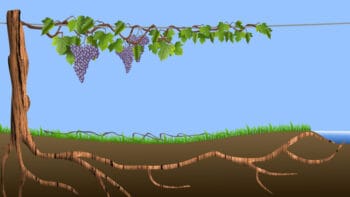
Image © Sherry Boettcher at Goodsalt.com
If you, meanwhile, look at how a grapevine survives through winter, you’ll learn a fascinating fact—the buds on the branches become dehydrated and isolated from the growing system until spring. When the soil warms up, the roots absorb water, and sap flows up through the trunk of the vine into the buds and then initiates growth. Without the sap flowing through the vine, no growth will happen.
The sap in a grapevine is like the work of the Holy Spirit in our lives. We might be like a dead branch, but when we choose to spend time with God, the Holy Spirit enters into us like the sap from the roots and brings us to life so that we start to grow. In the same way that we need to make a conscious choice to want to abide in Jesus, we must also ask for the Holy Spirit (the sap) to flow into our lives.
Read Luke 11:13 along with Jeremiah 31:3, 1 John 4:19, and Romans 8:9-11. What is the essential message here for us?
It’s actually the Holy Spirit who brings growth and ensures that we’re thriving and connected to the Vine. We need to ask daily for the Holy Spirit, who is here with us on earth to:
• be our Comforter (John 14:16-18),
• reveal Jesus to us (John 15:26),
• convict us of sin (John 16:7-8), and
• guide us into all truth (John 16:13).
|
Read this list again. How can each aspect of what the Holy Spirit does impact your relationship with God? |

I know that by the age most of us get to discussing things on Sabbath School Net we have forgotten most of the science we learned at high school. Or, I might guess, some of you were just plain naughty in science class and were too busy pinging spit balls at the ceiling or teasing the girls. (I went to a Boys’ College for my high schooling so we did not have any girls to tease.) If you were well-behaved enough to absorb some of the basic plant biology, you would have learned about the transport of nutrients, in woody plants. It essentially comprises vascular bundles (that is botanical for little pipes tied together) on the inside we have the Xylem that carries a solution of dissolved minerals from the roots to the leaves. Then we have the Phloem which carries a sugary solution we non-biologists call sap, back down the plant stem. And between the two sets of pipes, we have the Cambium which is where all the growing happens.
It is really a marvellous bit of engineering and when John recorded the parable of the vine, I am sure he did not know about the plant transport system. But if he had known I am sure he would have pointed out the importance of two-way action in the vine network. The plant grows when the minerals go one way and the sugar goes the other way. If one part of the system fails, then not only does it stop growth, it causes death.
All this is just a complicated way of saying that in our spiritual network it is important that two-way communication takes place. I am radical enough to suggest that in our church community we need to talk to one another more. That is one reason why a good Sabbath School program is so important. You should be able to bounce ideas off one another. I often make the point that we sometimes revert to catechistic restatements of doctrine in our lesson studies, when we should really be flowing ideas between one another, and growing spiritually in the process
Maurice, thanks again for your inspiring comments. I agree that we should share our Christian experiences instead of restating the doctrines of the daily lessons. Although we are at different levels spiritually, we should share our experiences as a form of encouragement to others, and glory to God.
What is the difference between abiding with the vine and linked to the vine?
Abiding with the vine (Christ) is much more than mere connection or knowing about Christ but have a relationship with Him. This is a deep and ongoing internal relationship with Christ. This is what brings fruitfulness. This relationship not only bears fruits, but it also brings growth (John 15:5). Christ dwells in us and us in Him (John 15:7). It is a very dynamic and spiritual relationship. However, linked with the vine (Christ) is more of an association with Him. It is a physical connection which does not necessarily bring fruitfulness and growth. One can be identified with Christ, with the church or having knowledge about Christ, but without being changed. For instant, Judas Iscariot was linked with Christ outwardly but did not abide in Him. He was just an acquaintance or an associate of Jesus. He was so close to Jesus, but his heart was too far away. Being linked to the vine is more physical than internal. It is temporally and because it does not bear fruit, it will be pruned.
“On judgment day many will say to me, ‘Lord! Lord! We prophesied in your name and cast out demons in your name and performed many miracles in your name.’ But I will reply, ‘I never knew you. Get away from me, you who break God’s laws.” (Matthew 7:22-23, NLT).
Those branches which simply enjoy the physical connection with the vine without yielding fruit will be in for a rude shock when the reality check comes. They will be cut off and thrown into the fire. This is very stern warning to us who enjoy association with Christ without having a relationship with Him. The time to examine our relationship with Christ is now. An association with Christ is far from being enough till we bear good fruit.
It is deeply comforting for us to know that there is joy that comes with abiding in Jesus, this joy is not by any means circumstantial. It’s not a joy that rises and falls with our emotions, stock market performance, our physical well-being, or how people treat us. This joy is more than the shallow happiness the world offers, which fades when life becomes difficult. I don’t need to be born into a particular family, ethnicity, or heritage to abide and belong to God. I don’t need to trace my lineage back to Abraham, for it is an open invitation.
The way to our God is not through ethnicity, nationality, or tradition, but through Jesus and Jesus alone. “Abide in me, and I in you. As the branch cannot bear fruit by itself, unless it abides in the vine, neither can you, unless you abide in me.” (John 15:4) Abiding and following Christ has never been through any particular race or ritual, but through a real connection with Him. Jesus says that branches that do not bear fruit will be cut off, thrown away, and burned. But those that are part of the vine—those truly connected to Christ—are cared for as they are pruned by God, who trims, cuts, and shapes them to ensure they bear fruit. Proximity to spiritual things is not the same as spiritual life. Some may appear close by attending church, knowing different languages, or even engaging in ministry, yet without a real, life-giving connection to Jesus, they have not borne fruit and therefore have no life. “I am the vine; you are the branches. Whoever abides in me and I in him, he it is that bears much fruit, for apart from me you can do nothing.” (John 15:5)
God has promised that if we remain connected to Him and truly abide in Him, He will not leave us. He is committed to our growth and will do whatever it takes to make us more like Jesus. Pruning may be painful and sometimes confusing, but it is always purposeful. God is not content to let us dangle like a tiny sprout; He is determined to shape us into fruitful branches that reflect Jesus. This means that obedience isn’t a burden but a blessing—not legalism, but love. It is a joyful response of our hearts to His invitation. The more we abide in Him, the more we realize our need to walk with Him. Our walk with Him becomes our joy, as His life flows through us, producing fruit that points the world to Him.
Beautiful reflection, brother in faith. At the end of it, I remembered my experience away from Christ – it was 10 years. The more time passed, the more discouragement took over my heart and mind, just as a branch far from the vine gradually withers. Indeed, all areas of a Christian’s life, with God guiding them, are happy. And this isn’t about worldly and momentary happiness, but true happiness. When we experience “abiding” in Christ, there’s no going back to our old selves. Glory to God!
God initiates the relationship with us and provides the resources to sustain it. The role of the Holy Spirit as a guide to the truth, comforter, revealer of Jesus and our conviction is remarkable. In my trials and disappointments, I need the comfort of the Holy Spirit. In a world full of sinful ambitions, I need the conviction of the Holy Spirit to make the right choices. The world is confused and not certain about it’s future. As such, we need the Holy Spirit to guide and direct us.
Thank you for sharing the different perspectives on this topic. I offer another view.
There is a song that goes like this … “Forever running, but losing the race… Were it not for grace”. The reality check here is that things will happen, we are in a lifelong ‘race’, but ultimately it’s grace, not just our effort, that sustains and saves us. Yes, God’s grace is sufficient for you and me in this race.
Wednesday’s lesson encouraged us to ABIDE in Jesus, that is, to live in connection with Him. SDA hymn #46 captures the essence of our desire for that closer relationship with Christ. Verse 2 says
Abide with me, ’tis eventide!
Thy walk today with me
Has made my heart within me burn,
As I communed with Thee.
Thy earnest words have filled my soul
And kept me near Thy side;
Yes, O Savior, stay this night with me;
Behold, ’tis eventide!
Let’s change the lyrics to say… O Savior, stay this day with me; Behold, ’tis abiding time! In Thursday’s lesson, ‘Linked to The Vine’, we learn how we can abide in Christ.
This comment isn’t just about today’s Sabbath School lesson. It is so encouraging and inspiring to read everyone’s comments that before I start studying the current day’s lesson, I start with yesterday’s lesson so I can read all of comments that I missed from the previous day because they were posted later than when I was on the web site the previous day. Perhaps other readers are already doing this, but if you haven’t, this is something you will benefit from.
The contrast between Adam and Christ offers one of the strongest motivations for why we must continue abiding in Christ daily.
As I reflected on Adam’s test, I found myself wrestling with a deeply personal question: What would I have done if I were in Adam’s shoes? If the choice before me meant losing for all eternity the love of my life—the one made from my very bones—I honestly shuddered at the thought. In that moment, I caught a faint glimpse of the emotional weight Adam must have felt as he faced the possibility of separation from Eve.
Yet that very struggle opened my eyes to something far greater. It gave me a small glimpse into what Christ had to experience in Gethsemane and at the cross as He wrestled with the awful prospect of separation from His Father. Adam faced the loss of the one he loved most on earth; Christ faced the felt separation from the One with whom He had shared eternal fellowship. The depth of that agony is beyond our full comprehension.
The first Adam stood in Eden and, in his decisive moment, chose the visible relationship before him over obedience to—and abiding in—the God who had given him life. His failure reminds us how quickly the heart can drift when trust in God is replaced by fear, emotion, or attachment.
Christ, the second Adam, stood in a far darker garden. In Gethsemane He faced not only the crushing weight of sin, but also the terror of separation from the Father’s presence. Yet where Adam yielded, Christ remained steadfast: “Not My will, but Thine, be done.” And what was the Father’s will? To save us from our sins.
This comparison deeply motivates me to keep abiding in Christ. If Christ was willing to endure such agony rather than let humanity be lost, then surely remaining in Him is not a burden, but a privilege.
The more I meditate on Christ’s Gethsemane victory, the more I am compelled to pray, “Lord, keep me so close to You that when my moment of testing comes, I choose as You chose.”
Abiding is no longer just a duty—it becomes my response of love and gratitude to the Savior who stood firm for me.
Ultra important truths told beautifully, Beverley Joseph! Thank you!
Abide in Christ is a wonderful experience . It brings piece of mind
I am asking: “what causes the sap to flow in the first place”? Natural laws are already in place to govern and satisfy nature’s various needs. What are man’s needs, and how does the Living Soul receives its nourishment and strength to produce good fruit? Using the metaphor of the ‘vine’, in nature as well as regarding the spiritual laws govern man, they are already in place and made evident by their outcome. For man, all God’s laws governing our Salvation are present in His Son – Jesus Christ – John 10:9-11.
The lesson writer states: “Without the sap flowing through the vine, no growth will happen. The sap in a grapevine is like the work of the Holy Spirit in our lives.” I see the ‘sap’ a bit differently. The ‘natural law’, already present to produce good fruit, is based on God’s Love. I see His Love as the sap flowing through the vine – dormant without warmth and sunshine. We are dormant until the Holy Spirit wakes us up. He provides the warmth needed to recognize the presence of God’s Love dormant in our heart – and, when turning to the warmth, the sap – God’s Love – it starts flowing freely.
To stay alive, both, vine and man need warmth. The Holy Spirit’s presence produces its spiritual fruit as man turns to Him for the warmth of His Light to foster Life. Jesus is the Vine, governed by God’s Law of Love, for us to abide in to produce good fruit.
The long, cold and dark winter of the soul has come to an end. God gave us His Grace to be accepted by faith. Now, the health and wellbeing of the branches depend entirely on the free-flowing relationship between the Sap – the Love of God, readily available throughout all times -, and our willingness to receive and ‘utilize’ it – John 15:4-6.
Love also requires choice. God loved us first, and we need to accept this fact. Also, we need to choose which side we stand on: love or hate!
The lessons’ authors (or perhaps editor) seem to feel it is important that we “consciously” do things – accept Jesus and ask for the Holy Spirit in particular. Just as I was uncomfortable last week with the idea that we MUST consciously choose Jesus to be saved, I’m also uncomfortable with the idea that we MUST consciously ask for the Holy Spirit for Him to work in our lives.
Now, please don’t get me wrong. I am not saying that we shouldn’t ask for the Holy Spirit. Asking is a way that helps us really understand our need. It’s the same reason why we should pray our requests even though God knows them. It’s for us. I think there’s a lot of value in asking for the Holy Spirit and I often pray this prayer.
However does that mean that the Holy Spirit does not work in the lives of people who don’t pray this prayer? Somehow it seems strange to suggest that is the case. Many of you were children when you first loved God. I don’t imagine that you asked for the Holy Spirit in your prayers growing up. I sure didn’t. In fact, the Holy Spirit is somewhat of a challenging concept for children to understand. But the Holy Spirit still worked in our lives. I believe He is working in many other lives and changing people who may not even fully understand who the Holy Spirit is.
I feel we approach God in too much of an almost “magical” way. We need to say this prayer to be saved and make sure we commit our life to God each day and ask for the Holy Spirit each day. If we do this, we’ll be fine. But this thinking actually makes it all about us – us saying the right words. And this sort of thinking is dangerous.
Here’s how I see it – God will not intrude in our lives without permission. Just as Jesus knocked hoping the Laodiceans would let Him in rather than barging in, the Holy Spirit needs our permission to work. But does this permission need to be a legal contract or can we give permission in less clear ways? I would suggest it’s the latter. If we are allowing the Holy Spirit to work, He will even if we don’t verbalize it.
Well said Christina and beautiful varying perspective.
While reading your thoughts, I could not help but also believe that the Holy Spirit is also moving on hearts and doing work in lives, because of the intercessory prayers of others.
I persist in prayer for the salvation of those I know personally, who ascribe to atheistic or agnostic beliefs, as well as for those struggling with their Christian walk.
I am confident that the Holy Spirit hears and answers my prayers. And although these individuals have not participated in a legal contract or a less clear way of asking permission, (as you mentioned), I tend to believe that the Holy Spirit, although not forcefully intrusive, can work in mysterious ways to bring about the greater good.
Ultimately, they, just like me, are the recipients of God’s grace, which in this instance is in the form of intercessory prayer.
In “Be our comforter” John 14:16-18: Verse 19 should have been included here also. Verse 19 continues on with the fact that and even though “The World” would not see Jesus anymore, But because His Apostles would still see Him, and also because Jesus Himself would still be alive after “Three days of being dead,” His Apostles, which also includes “Us Now,” would also “Live because He Lives, even Now!” Verse 19 has even more comforting “Truth” than the fact that God’s Holy Spirit also comforts us now too.
This lesson does roughly cover the recommendations of Steps to Growing In Christ
1. We are drawn to Christ by the love of God we see in His creation, not just the birds and the growing plants also the lives we come in contact with.
2. We see our condition as in need of a Saviour. Our life as filthy rags. In humility we take in rebuke, repent, get baptized if not already having been baptized and reap the reward. There is a benefit by being in a relationship with God. Believe me if there is such a thing as receiving a reward without earning it, relationship with God is it.
3. This love of God is everlasting,
4. because we through Christ who strengthen us, abide in Him,
5. by staying connected to Christ the vine, fruit is produced by keeping a two-way relationship going.
These 5 steps what works for me. Also I enjoy refreshing with Maurice’s professional display of ornithology and Gods beautiful scenery, I see the love of God and also see the love of God everlasting as I recite in my mind; Proverbs 3:5-6, Psalms 48:14, Psalms 91:1-4, John 3:16, John 8:31, John 13:35.
https://youtu.be/YrY0Y5YyZw4?si=IIpu0JqfGCJkhhFn
I have found that the fruits of a relationship with God look like this: Is this the kind of fast I have chosen, only a day for people to humble themselves? Is it only for bowing one’s head like a reed and for lying in sackcloth and ashes? Is that what you call a fast, a day acceptable to the LORD? the kind of fasting I have chosen: to loose the chains of injustice and untie the cords of the yoke, to set the oppressed free and break every yoke? (Isaiah 58:5-6)
We see so much destruction and pain lately. Relationship with Christ is not only personal but communal where we pursue a society that is safe, compassionate; a just home for everyone, where the last are first and the first are last because everyone has what they need to thrive.
“But ye are not in the flesh, but in the Spirit, if so be that the Spirit of God dwell in you. Now if any man have not the Spirit of Christ, he is none of his.” Romans 8:9 KJV
“And if Christ be in you, the body is dead because of sin; but the Spirit is life because of righteousness.” Romans 8:10 KJV
The Spirit of Christ resting in us, the Spirit of love, for God is love, is the life giving blood flowing from the Father’s throne through Christ the vine to us the branches. Only this connection gives life today and throughout eternity.