
Monday: From Athens to Corinth

Daily Lesson for Monday 29th of June 2026
Read Acts 17:16-34. Where was Paul before going to Corinth, and what did he do there?
Acts 17:16-34 describes Paul’s preaching to the Athenians before his going to Corinth. Apparently, he did not plan to visit Athens at that moment, but went there with the help of some friends because of the opposition that he faced at Berea (Acts 17:13-15).
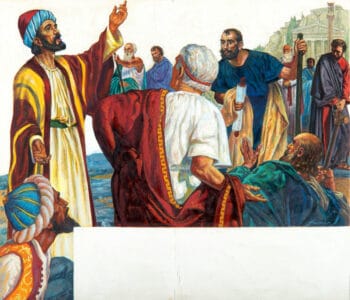
Image © Review & Herald Publishing at Goodsalt.com
Those who went with Paul to Athens returned to Berea with a command for Timothy and Silas to join him as soon as possible (Acts 17:15). Acts 17:16-34 is about what Paul does while waiting for them. He speaks about Jesus in the synagogue, the marketplace, and the Areopagus. He really couldn’t stop talking about Jesus and took advantage of every opportunity to do it.
Read Acts 18:1-11. What does Paul do when he arrives at Corinth and during his whole stay in that city?
Paul went to Corinth during his second missionary journey. Luke informs us that Paul stayed there a year and a half.
As usual, Paul begins his missionary activity at the synagogue (Acts 18:4-6). Acts 17:1-2 mentions that this was his custom. He followed the “to-the-Jew-first” strategy (Romans 1:16, Acts 13:46), just as Jesus had commanded His apostles (see Acts 1:8).
When finally Silas and Timothy joined him in Corinth, he “was occupied with the word, testifying to the Jews that the Christ was Jesus” (Acts 18:5, ESV). During his stay in Corinth, he was busy “teaching the word of God” (Acts 18:11, NKJV). It was in this context, too, that he expressed those famous words that he was “determined not to know anything among” the Corinthians “except Jesus Christ and Him crucified” (1 Corinthians 2:2, NKJV).
|
What can we learn from Paul’s missionary activity in Athens and Corinth? What makes sharing the gospel so challenging in our cities and communities today? How can we share the gospel with success in these difficult places? What strategies can we learn from Paul’s missionary activity about how to best do that? |

I will start today with a bit of geography. Corinth is about 75 km southwest of Athens and Beria (Veria or Veroia) is in the Macedonian region about 400km north of Athens. Of course, these are crow-fly distances, so if you were walking or riding a donkey the distance would be quite a bit more. I like geography – it gives a touch of reality to our study.
Paul usually began his evangelism in the local synagogues. There was a good reason for that, He was Jewish to start with, and secondly a synagogue always had copies of the scripture. But he also opportunistically also engaged with gentiles, often on their own ground.
Paul’s evangelism was very Christ-centred. He had experienced his epiphany with Jesus on the Damascus road and was determined to share Jesus and his resurrection with everyone.
A couple of take-aways from today’s lesson that I believe are applicable to us today:
Paul spoke to the Jews first. Essentially his first mission was to his home church. They were religious people but they needed to hear the Gospel, but it was a stumbling block to them. It may be useful to consider that our mission should begin with ourselves. Is the Seventh-day Adventist message as Christ-centred as it shoud be? Or, are we concentrating on being current-affairs commentators about geopolitics, or religious trends.
In our interaction with our “gentiles” are we caught up with academic arguments when we should be living a Christ-filled life demonstrating the proof of the resurrection.
I am reminded that in the late 1800s, the Seventh-day Adventist Church had a wakeup call and realised that we had been spending too much time on justifying the law and vindicating our view of prophecy. Ellen White spoke of how refreshing it was to hear Christ being preached instead of the law.
Given that the Corinthian church has many parallels with our own, maybe it is time to reconsider how we can focus more on living the Gospel of the resurrected Jesus in our lives today.
If we are truly “living a Christ filled life” we also need to be purposely sharing Christ with everyone we meet either verbally or with a tract, or the best one, hand them a Steps to Christ. A bold verbal testimony will make an impression and a STC will definitely stir their soul if they read it. Any piece of literature when given will remain in circulation and have long range effects.
I have heard from pastors that bold Christian witnessing is “transactional” and should be avoided.
I’m agree that smiling and waving at your neighbor while mowing your lawn is a good thing, but we as a people need to be more intentional in our witness. Souls all around us are perishing. The fruit of the Spirit will flow like rivers of living water to those who have Christ resting in them.
Thank you for reminding us that living a Christ-filled life includes intentional witnessing. Christ always looked for and used opportunities to share the Good News of the Kingdom of God and its nature. If Jesus had just gone about doing good, He would not have met opposition, and He would not have been crucified. It was His teaching that led to His crucifixion.
Preaching or talking about God’s Kingdom does no good and may even be damaging if our lives do not demonstrate the love of God. But even if we love our neighbors as ourselves, they will not discover the character of God and that He wants them to join Him in heaven unless someone tells them. And God depends on us to be that “someone.” Do we fail to share because we are afraid of opposition?
Christianity is not just a philosophy to cope with life and its realities; it is not just opium, as Karl Marx called it. If it were, then we are to be pitied because our beliefs would be pathetic. Paul believed that Christ had been raised from the dead, the firstfruits of those who have fallen asleep. “But Christ has indeed been raised from the dead, the firstfruits of those who have fallen asleep. For since death came through a man, the resurrection of the dead also comes through a man. For as in Adam all die, so in Christ all will be made alive” (1 Corinthians 15:20–22). This was the hope that sustained Paul as he journeyed from Athens to Corinth, knowing that the resurrection of Christ is the foundation of the Christian faith (1 Corinthians 15:14, 17).
In Corinth, Paul found himself not among the intellectual elite but among manual laborers, humble craftsmen making tents. In addition, Paul’s health was not that great. His body had endured a lot in the past few years, and he was in a very, very low place. But Paul knew that God comforts the downcast (2 Corinthians 7:6). He understood that God had allowed his finances to be low, meaning he had to work to sustain himself in ministry. God provided Paul with fellowship, placing him in a shop with a couple who dearly loved the Lord (Acts 18:1–3). The Lord stepped in and provided what was needed, even when what was needed was rest. Jesus told His disciples not to worry about what to eat or what to drink or what to wear, for He provides. “For the Gentiles eagerly seek all these things, and your heavenly Father knows that you need them. But seek first the kingdom of God and His righteousness, and all these things will be provided for you” (Matthew 6:31–33). God knows our needs and faithfully provides in His perfect timing.
According to the United Nations World Urbanization Prospects 2025, 81% of the world’s population lives in cities and towns (urban areas). Sharing Christ in urban areas poses greater challenges than in rural areas. Great thinking under the guidance of the Holy Spirit is required to fulfil the great commission (Matthew 28: 16-20). Paul’s attempt to share Christ in the city of Athens had mixed success. However, the good news is that the seed of the gospel of salvation was sown. “I planted, Apollos watered, but God gave the increase.”(1 Corinthians 3:6, NKJV). Our responsibility is to share Christ faithfully, but the work of conviction and conversion is God’s.
What are some of the challenges sharing Christ in urban areas face?
1. The complex composition of urban areas in terms of cultures, religions, and worldview requires more careful thinking than in a rural setting. Urban areas bring together people of different philosophical inclinations, as Paul encountered in Athens (Epicureans and Stoics). We must learn to respect other people’s views, even as we engage to present the uniqueness of Christ with clarity and grace.
2. Urban life is extremely busy, unlike the rural folks who might have “spare” time to listen to a new teaching. Many urban dwellers feel that they have little need for religion because their physical needs are more pressing than spiritual. Convenient alternative methods need to be used, like small groups, online resources, personal touch, and social media.
3. In urban areas, individualism and anonymity are serious setbacks, unlike the rural setting, where people tend to be more open to one another. It is an irony that in urban areas, millions of people live together and yet are terribly isolated from one another. Perhaps friendship and hospitality can break the walls of individualism and anonymity.
4. In urban areas, the propensity for materialism and self-reliance makes them feel less need for God. It is our responsibility to present Christ as more than our daily bread. Christ is more than physical needs – purpose, hope, peace, love, joy, happiness and eternal life. We must demonstrate that we ourselves have all these first before we can make an attempt to sell them to others.
5. Life in urban areas can cause more moral and cultural pressures than in rural areas. Urban lifestyles and choices are more likely to be in conflict with biblical teachings and hence less appealing. We have been admonished to share Christ with compassion, humility and love. We must emulate Christ in all our efforts to Him and to others.
“For I am not ashamed of the gospel of Christ, for it is the power of God to salvation for everyone who believes…” (Romans 1:16, NKJV)
How many of us live in urban areas? How many of us know our neighbors? Do we interact with our neighbors? When was the last time we shared Jesus with our neighbor?
Last Friday evening, a neighbour two doors over was robbed while the family slept. She went to a couple of the neighbours to warn us about the situation. She was really stressed. We chatted and while holding back tears, she told me that she had been bought up a Catholic. I felt impressed to give her the “Two Week Challenge” – spend 10 minutes each day reading and meditating on the Gospel of John and ask God to reveal Himself more fully. She said she would do it, and I said I would be praying for her each day during this time. Her name is Lyn.
There was a time that I believed I needed to lead someone like that to the Adventist church. Not anymore – they need to be led to Jesus. The building is irrelevant.
For so long, I felt like I needed to lead someone to a church, when in reality, it’s Jesus we need to try to lead people to. For it is JESUS alone who can save us, no denomination, no building.
We are hesitant to share the gospel because we feel no one needs it. However,there are multirudes out there who are hungering and thirsting for the word of God. If we would be courageous to persist,we would meet those who need the gospel. Meeting people who need the gospel motivates us; however, unles we keep sharing with anyone, we will not find those who need the gospel.
The author of our Lesson Study pointed out that it was Paul’s custom to begin his missionary activities firstly at the synagogues.( Acts 18:4-6, Acts 17:1-2)
I would like to elaborate on that powerful strategy. As one who grew up in the Adventist Church, I have often wondered at the significant number of my peers as well those slightly older or younger who have left the church.
My premium belief is while we admonished to keep the commandments of God: we were not taught to obey through “the faith of Jesus Christ” – ” Here is the patience of the saints: here are they that keep the commandments of God, and the faith of Jesus.” Revelation 14:12 KJV
Another area we seem to be oblivious to is the potency of our life-style as Christians. It is wonderful and applaudable to be able explain the doctrines concerning the Mark of the Beast, the 144,000 and the Investigative Judgement. However strangely enough ; mercy, empathy , forgiveness and genuine concern for the welfare of others are generally more potent in convincing persons of the genuineness of our Christianity and the credibility of our Faith.
If Christ is abiding or resting in our soul we will not have to force ouselves to be loving and kind; Christ’s love will naturally flow out “like rivers of living water”.
We will hunger and thirst for souls; we will be fishers of men using all the “lures” we can imagine.
We may not go through simular questioning as Paul had with Epicurean and Stoic, Acts 17:18, just the same we can take a lesson. If we don’t know the answer we can say, I will have an answer for you next week, assuming we are going through Bible studies weekly with an interest. Or may I bring my pastor with me next week. Or may I text you a link of a sermon that answers your question. Paul was given the opertunity and was capable, delivering to all interested, more than babble at the community center(The Areopagus also known as Mars Hill).
Paul preached the ‘Word of God’! Acts 17:16-34 is a monumental record of his testimony to the Greeks about their ‘unknown god’. The Greeks had set up statues just in case there is an ‘unknown’ god that deserves worship. This is quite remarkable. God truly works in mysterious ways, and Paul took advantage of their open-mindedness and preached fearlessly the Gospel of Jesus Christ to all.
Paul was ready to use this unexpected opportunity to introduce everyone who wanted to listen to this ‘unknown God’ – the God of the Jews and Gentiles; they just needed someone to introduce Him to them. There is no doubt in my mind that God prepared the Way for Paul to introduce the Father and the Son Jesus Christ to Jews and Gentiles alike.
Acts 18:5-7 shares that Paul did not lose time with those who rejected the ‘Good News’. What an opportunity God gave him to be able to introduce the ‘Word of God’ to a whole new group of people. Though God does not discount the rebuke we might encounter, He wants us to be strong and encourages us to stay the course as He continuous to work in truly mysterious ways – Isaiah 55:8-9; Rom.8:28.
We are more successful at what we do when we are in love with it. Teaching something unknown is not going to teach many. Collect experience, and teach whatever we’ve got: we’ll certainly get more efficient! That is the same with the gospel. Do we live Christ? We’ll be efficient in spreading God’s love.
JC Zielak; 100%…!!!
I know that I will be inspired by Paul this quarter because He was a man on a mission, with a purpose for the mission, which was to share the Good News of “Jesus Christ, and Him crucified” to as many people as he could. He is demonstrating to us that this should be our Mission as well.
When I first converted to SDA almost 44 years ago (at 19-year-old), our churches would teach the members how to witness for Jesus Christ, how to give Bible Studies and/or distribute literature to the surrounding communities, or just to serve God in whatever giftedness they had. I don’t know what happened to those days. But I know that I’m going to be on a Mission like Paul to share the Good News of Jesus’ Second Coming to all that will listen. I will continue to work with my church’s evangelism program, but if they decide to continue in inactivity, I will go on the Mission anyway.
We need to look at our Mission (the Gospel Commission that Jesus gives to all of His Disciples) as if we were telling the people of the world “how to get Rich”. It always baffles me how these modern-day philosophers are writing books and hosting workshops all around the world on “how to get Rich”. They have made their wealth not by doing the actual activity, but by “telling others how to do the activity”. THIS IS WHAT WE ARE SUPPOSED TO DO, “TELL THE WORLD ABOUT JESUS CHRIST”; sharing what HE has done for us, and why you believe that he is the Christ.
If you know that a MAN was giving away $500 to anyone that come to HIM, would you go to receive the money for yourself, and then tell others to go receive their $500 as well? Jesus is that MAN; He holds everything we need in HIS HANDS! Why are we keeping God’s Gift, eternal life through Jesus Christ, a secret? I had decided that I will not keep quiet, that I will tell as many people as I can about “Jesus and Him crucified”.
Have a Blessed and Safe Summer!
God bless you, Toni! That’s the spirit God wants to see in each one of us. You wrote:
We were just reading a chapter in Testimonies to the Church, Vol. III this morning, entitled Tithes and Offerings. In this chapter, Ellen White referred to the parable of the talents, interpreting it to mean that if we do not use our talents/opportunities/time/money in the service of Christ, we are doing the same as the man who buried his “talent.” The Lord said, “Cast ye the unprofitable servant into outer darkness: there shall be weeping and gnashing of teeth.” (Matthew 25:30)
If we truly appreciate what Jesus has done for us, we will do our best to fulfill the mission He gave us – to “preach the gospel” to all. We need wisdom to do this, and He is willing to give it to us. The thing is that the only way we can experience joy in the Christian life is to continually share what He gives us. He has designed us so that we can only be happy when we serve Him and join Him in His mission.
By the way, I think we underappreciated the Testimonies to the Church, because it is only our second reading in over 60 years! I am surprised at how fresh and relevant the readings appear in Volumes II and III. (The first volume is more historical, with references to the beginning of the work.)
God bless you, Toni, as you follow the flame God has planted in your heart to share the good news of the gospel.
Our lives should be a testimony to our neighbours. We should teach our children to be kind as well to everyone. When we live with love, compassion, and integrity, people will notice the difference and become curious about what makes us different. That opens the door for us to share the hope we have in Christ and introduce them to Him through both our words and our actions.
In Paul’s time his challenge to sharing the word of God was them him getting caught and beaten and also major of the towns he went to worship idols and also distance was also a major issue. So my question is in our time what is the challenge we are facing to sharing the word of God.
The thing about Paul is focus! He was super focused. And frankly this is our problem! I guess it originates from a lack of clarity on what our individual calls are! Let it be clear here! The call is to all; go ye therefore! Paul seized every opportunity to preach Christ, the centre of his life! Clearly, his mission was cut out for him because of his conscious decision to know only Christ and Him crucified and nothing else!
No wonder he was first attracted to faith gatherings! His forceful approach was bound to attract even strangers who might get to hear about his arrival through curious members of the faith gatherings!
But Paul was new in town and he might have been tempted to discover other aspects of the vibrant city first and may be wait to visit the synagogue on Sabbath! Not Paul!
But is that not what we do? Be tourists first and devotees later? We should emulate Paul on the matter of focus and devotion to the Lord!
There is one thing I noted about his visit to Athens! Perhaps it was because it was not in his original itenirary.
After the Aeropagus, there were various reactions to his speech introducing the unknown God-Christ-a perfect opportunity. Nothing unusual; some believed, others dismissed the babbler! My interest is in the segment which included sceptics who expressed interest in engaging Paul some more, later! Paul appears to have departed Athens without making arrangements for a return to engage them! Could this be the reason we not do hear of the ‘Church at Athens’ like we do of Ephesus and Corinth? Was it an opportunity lost? Was Paul discouraged by the all too superstitious population?
Glory to God!