
Wednesday: The Resurrected Body

Daily Lesson for Wednesday 19th of August 2026
In 1 Corinthians 15:35-39, Paul turns to a brief discourse on the resurrected body. He begins this section by positing two questions: “ ‘How are the dead raised up? And with what body do they come?’ ” (1 Corinthians 15:35, NKJV). These questions are answered in 1 Corinthians 15:36-49.
Read 1 Corinthians 15:36-41. How does this passage answer the questions in 1 Corinthians 15:35?
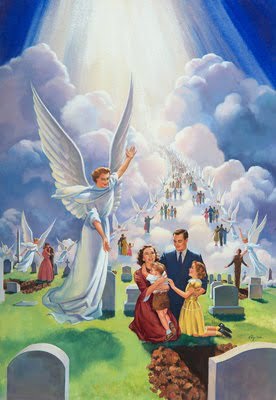
Image © Review & Herald Publishing at Goodsalt.com
Paul applies three analogies to help his readers understand what happens in the resurrection. The first analogy (1 Corinthians 15:36-38) remarks that the body is like a seed that must first die (or cease to be a seed) in order to miraculously become a plant. The teaching is clear: resurrection is a miracle of God. Second, the analogy of the bodies (1 Corinthians 15:39-40) highlights that, in this world, God provided different types of bodies for animals and for humans appropriate to the current environment. Likewise, our bodies will be suitable for the new circumstances in the heavenly world. This idea is taken a step further with the third analogy of a glorious body (1 Corinthians 15:40-41), which emphasizes that the glory of the resurrected body enormously exceeds that of the body that came before, our earthly fallen ones.
This idea can also be seen through four contrasts between our earthly body here and now, and the resurrected body. The former is terrestrial, perishable, weak, and natural. In turn, the latter is heavenly, imperishable, powerful, and spiritual (1 Corinthians 15:40-44). This does not mean there is no continuity between the two. Paul’s use of the Greek term sōma (“body”) for both the buried body and the resurrected body shows continuity. Conversely, the four contrasts above also show discontinuity. Our new bodies will not be the same as the decaying ones we have now (thank the Lord).
Paul does not relate the term “spiritual” to an immaterial existence. Elsewhere, he says that Jesus “will transform our lowly body to be like his glorious body” (Philippians 3:21, ESV). We will have real bodies, but they will not wear down or decay. Because all we know now is decay, sickness, and death, it’s hard to imagine life without these things, but that is what we are promised in Jesus.
|
How does the assurance that our bodies will be transformed into perfection help us be resilient regarding our physical limitations today? |

At creation, God created us with physical bodies and in the resurrection, God will give us glorious physical bodies. There is a continuity of physical form. In the resurrection, God is not making us spirits. Possibly, what is the reason? God is not rescuing us from being human, but He is redeeming us into the fullness of what He wanted us to be at creation. Sin is a spoiler. It distorted God’s creation. Jesus is coming to restore God’s original creation. God declared what He created to be “very good” (Genesis 1:31), but sin brought corruption. Sin will not make God abandon His master design plan. In the resurrection, God will implement His original master design. God is a Restorer of all good things. There are things in our lives that are damaged beyond repair, but when Jesus comes, all will be redeemed to perfection.
In the resurrection, God will not only give us glorious bodies but also transform us. “Our bodies are buried in brokenness, but they will be raised in glory. They are buried in weakness, but they will be raised in strength” (1 Corinthians 15:43, NLT). This is truly encouraging. We struggle so much with our current bodies, but in the resurrection, God will give us spiritual bodies. We shall never struggle with how to use our eyes, mouth, hands, sexuality, energy, emotions, feelings and thoughts.
Perhaps another lesson to learn from God intending to resurrect embodied human beings is to treat our bodies more honourably. “Your body is a temple of the Holy Spirit.” (1 Corinthians 6:19). We will not go to heaven minus our bodies. That is why Paul strongly entreats us to commit our bodies as a holy sacrifice to God. “Present your bodies as a living sacrifice.” (Romans 12:1). Our bodies must be part and parcel of our discipleship. Bodily resurrection is very personal. We should train our bodies to desire to see God.
“After my skin has been destroyed, yet in my flesh I shall see God.” (Job 19:26)
Resurrection… struggle with current bodies..great insight and foresight…omwenga! From Bunyan to you…mansoul.. beloved of me..I have taught the to watch..to..fight..to pray and to make war against my foes….I lay none other burden upon thee than what thou hast already..hold fast till I come! The holy war ..and taking again of the town of mansoul. Book by john Bunyan. Blessings from reneanne Anderson.
Beautifully and logically explained. Appreciate this very much Omwenga. I’ve been reading your comments and they’re always clear and helpful. Thanks very much. You’re obviously guided by then Holy Spirit. May you be blessed.
I once knew an old farmer who owned an IXL pocket knife. He had been given it as a teenager and insisted it was the same knife despite having replaced the blade 4 times and the handle twice! We may laugh at his story but when we think about it, we are not the same substance we were ten years ago. We replace most of the atoms in our bodies over that period. I must have replaced myself about eight times over my lifetime. Even people who have not seen me for twenty years or more look at me and say, “You are Maurice Ashton, aren’t you!” I admit that some of the replacement has not gone well. The molecules that colour my hair seem to have lost the plot, but I am still essentially the same person I have always been, despite being replaced about eight times. The farmer’s story about his knife is not as silly as it sounds.
That raises the issue of our relationship to our physical body and gives rise to a whole philosophy about what existence really is. One thing that is clear is that we are more than a collection of atoms and molecules. Richard Feynman thought of life as a “dance of atoms” or a pattern instantiated in atoms. He was an atheist and stopped short of thinking about eternal life. But the idea that we are a pattern and that pattern can be instantiated may have some relevance to our idea of the resurrection.
I am not proposing that I have a physical explanation for the resurrection. It is just a thought bubble to explore and remind ourselves that God will hold the pattern for us when we are resurrected. (I just hope he uses the dark-brown hair version of me that I had 60 years ago)
Now the really important bit is that we are invited to be part of Christ’s resurrection – his pattern in us. I think the hymn “He lives!” captures this idea well:
The historic risen Saviour is dead if he does not live in our hearts. He wants to be part of our pattern.
Maurice – you quoted the refrain from one of my favorite songs which I carry in my soul continuously. Thanks! 😊
Considering your last sentence – is Truth not found when saying this the other way around – that we are dead should we not have our Savior live within our heart? Does he want to be part of our pattern, or do we want to be part of His pattern?
Isolating the so-called “spirit”, which apparently “goes to heaven or hell”, from the “body”, which ends up in the grave presents a confusing concept of resurrection where the “spirit” and “body” unite once again. If that’s what happened to Jesus, the Bible is strangely quite about what happened to His “spirit” during the days His body was in the grave.
I like the New Testament’s insistence that those who accept the invitation, get a glorified physical body at the resurrection. Jesus physically appeared to the disciples after the resurrection with a real tangible body they could physically touch.
The New Heaven and New Earth is not some ethereal waft that dances just out of reach, it is real, earthy, and touchable – like everything else in the Bible. A book of real people with real, relatable experiences, and a real God who stepped into our real reality…
The Bible is not “quiet” about what happened to Jesus’ spirit. Eccl. 12:7, and Luke 23:46, to name 2 verses which state plainly what happens when man dies. We must dig, as for hid treasure to know all of what God says on a given subject. We are indoctrinated from birth with false teachings about ourselves. Only God has all the answers.
Thanks for the challenge – you’ve picked me up on at least a technicality and a couple of my own assumptions, which is a good observation.
Without going into too much detail, I will make a couple of observations and suggestions of my own which I hope will be helpful to myself, as well as anyone reading this later.
Given the context of the topic, suggesting that someone has been indoctrinated from birth is an assumption based solely on the conclusion, which usually isn’t helpful when trying to wrestle with Biblical truth – but I get your point.
While it is true that “[o]nly God has all the answers”, he does invite us to “dig… for hid treasure to know all of what God says on a given subject.” This suggests that we may not all see “Biblical Truth” the same way. I believe this is a good thing because it reveals hidden pride while exposing our own ideas and conclusions to scrutiny – both of which are vital to reflect God’s character.
We don’t have to have the same answers on all topics to reflect the character of God. The wrestling of ideas is the cauldron God gifts us to BEST reflect His character – usually we fail… A sideways glance of the tribalism playing out in the world today should be enough to make this clear for Christians!
On this subject, our conclusions depend on what the Bible means by “spirit”.
Just looking at the text, the Bible is quiet about what His “disembodied spirit” was doing during the three days his body was in the grave. It doesn’t say that He died, then His disembodied “spirit” rejoiced to be with the Father, and all the heavenly beings – which is what many people believe happens to disembodied spirits at death.
To me, this raises some obvious questions, especially in relation to John 20:17. It also ties directly into what Jesus/God accomplished on the cross, which is a deeper theological concept. For example, if He “paid off” Satan in some way, did His disembodied “spirit” spend a couple of nights in “hell” picking up the tab?
I believe that many of these concepts have been introduced into Christianity from other belief systems and bear little to no resemblance of the subject when studied across the whole Bible. And yes, I have examined the champion texts on the other side of the argument.
One book I found particularly helpful on the subject was: “The Fire That Consumes: A Biblical and Historical Study of the Doctrine of Final Punishment.” By Edward William Fudge (non-Adventist). There is also an interesting and respectful discussion with Kirk Cameron (of Growing Pains fame – also a non-Adventist) that deals with both sides of the discussion on youtube at: https://www.youtube.com/watch?v=Ds3UbUsIaQs
I have always been an active person, and still am. As the years have gone by my capacities have reduced somewhat. I can’t even begin to imagine what life in a glorified (non-mortal) body would be like. Having no physical or mental limitations seems like a fantasy. Yet this is only one of the unfathomable things that are promised to those that love the Lord. (1 Cor. 2:9) That by itself is too much to process, yet there’s more.
To trade away an eternity of limitless living for this finite, limited, and way too short existence is really a foolish thing to do. This life and world are greatly overrated, especially when compared with what’s coming. May none of us miss out on it. Heaven will be more than worth every drop of blood, every drop of sweat, and every tear shed here in this life. (Romans 8:18)
Tim, I too can’t fathom an existence that has no end. At the same time, thinking about my mortality without the assurance of the resurrection is frightening.
The concept of resurrection still sounds strange to us. We imagine how an individual can have a physical body that will not die and decay after transformation. This can only be imagined however, it should spur our faith as adventists.
Our bodies are our first “home”; thus, taking care of them could be a priority. At this present time, a lot of work can be done to help our “home” be the best it can be for the glory of its Maker. May the gift of our bodies be a voluntary and happy living love sacrifice for the Lord.
1 Corinthians 15 points us to the resurrection, when our mortal, corruptible bodies will be raised incorruptible, glorious, and immortal. God will remove the effects of sin without erasing our individuality.
Revelation 7:9 shows the redeemed coming from “all nations, and kindreds, and people, and tongues.” Heaven will therefore not be defined by uniformity, but by perfect unity in Christ.
What a lesson for us today! Our differences should never become barriers to love, fellowship, or Christian mission. We should learn to appreciate and celebrate the diversity of God’s human family rather than allowing it to divide us.
Heaven will be a place where diversity remains, but division is gone. Let us begin practicing that heavenly unity now.
I believe that we will not have the same material or composition but our spirit kept in dormancy by God till we are resurrected well give us the same individuality and character will be given back to us, with different material composition as if creating us again from the dust of the earth to a wonderous composition of material. This mystery is unfathomable to me. Just the same something to look forward to. Yes, just a little thought of the perfect life without disease and suffering great or small, thrills our souls. We are told we will remember this earth for the simple reason of saying it is worth it all. We shall be known as we are known. Reference: I have paraphrased and added my thoughts to the Ellen G White Sabbath School helps I clicked on in the Sabbath School app I use separate from ssnet.org
Don’t get me wrong or Ellen White wrong even the Spirit that God preserves for us has no, no life. In other words, our spirit is not floating around looking at others it is sleeping as Chrit put it. Similar to when I was put to sleep with propofol for colonoscopy. Absolutely no awareness of anything, no dream. Just out like a light bulb and back in when the switch is turned on again. The only difference is my breath did not go out and was I not in need of resurrection.
Also, we are told that we will not be indolent. We will be active. God is a worker, angels are workers, we will be working. Reference: The book Heaven, page 65, paragraph 1, found also at the app EGW 2 or on Kindle.
There you go Tim, no work for our salvation, yet work for our Master, which is also working for others, I am sure you know, but just pulling our legs on the issue of, “imitating Christ, as almost righteousness by works.” 😃. God bless all, you too, Jocelyn.
https://egwwritings.org/read?panels=p36.268&index=0
I think what makes us, us, is really our personality and character. But I think our resurrected bodies will retain many other things. If Jesus is the example of a glorified body, we know He was recognized. Mary recognized the particular way He said her name and so His voice must have been similar to before.
I think we will look much like we do now but without all the flaws.
Beautiful illustration of what God has for us IF we are faithful!
1 Corinthians 2:9 But as it is written, Eye hath not seen, nor ear heard, neither have entered into the heart of man, the things which God hath prepared for them that love him.
That includes our wonderful resurrection bodies 🙌🏾