
Tuesday: Christ, the Firstfruits

Daily Lesson for Tuesday 18th of August 2026
If Jesus were not alive, any expectation about the future would be only delusion (1 Corinthians 15:12-19). “But in fact Christ has been raised from the dead” (1 Corinthians 15:20, ESV). His resurrection is a historical event. Consequently, we can be sure that all who have died in Christ will be resurrected at His coming (1 Corinthians 15:20-23).
Read 1 Corinthians 15:20-23. What does it mean to say that Jesus is the “firstfruits”?
The end of the present evil age will be marked by the bodily resurrection of those who died in Christ (1 Corinthians 15:22-23; Revelation 20:5-6). As the last Adam, Christ will deliver the kingdom back to the Father by bringing the rulership of this world back to Him (1 Corinthians 15:25-28). Christ’s subjecting Himself to God (1 Corinthians 15:28) must be understood in terms of how Adam and Christ are depicted in relationship to each other. As the ultimate Adam in the plan of redemption (1 Corinthians 15:45), Jesus submits Himself entirely to the will of the Father, something that the first Adam failed to do.
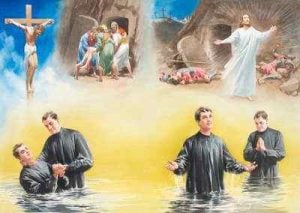
Image © Review & Herald Publishing from GoodSalt.com
In 1 Corinthians 15:29-34, Paul resumes his thought about the foolishness of denying Christ’s resurrection. He uses the illustration of baptism because it is itself a symbol of a believer’s union with Christ in His death and resurrection (Romans 6:3-4; Colossians 2:12); it makes no sense to deny the reality of the Resurrection. What is difficult to grasp, however, is what Paul meant by the expression “baptized for the dead” (1 Corinthians 15:29).
“Different suggestions have been offered, but it is better to interpret the expression as referring to the decision of some to be baptized so that they would be able to be reunited with dead loved ones at the resurrection. It could also be that the decision to be baptized was a response to the exemplary life of those who had died in Christ. This case would refer to people not being baptized in place of the dead but because of the dead.”—Carl P. Cosaert, “1 Corinthians,” Andrews Bible Commentary: New Testament (Berrien Springs, MI: Andrews University Press, 2022), p. 1652.
Second, risking death would be pointless if there were no resurrection (1 Corinthians 15:30-32). It would be better, instead, to delight in the pleasures of this world (1 Corinthians 15:32).
|
Reflect on Paul’s words in 2 Timothy 1:12. How could he be so sure about the future? How can we? |

1 Cor 1:29 is an isolated reference to baptism for the dead. They are no other scriptures that even remotely suggest the practice. It raises a couple of questions:
In answer to the first question, yes, it was practised but was restricted to fringe groups. It was never part of mainstream Christianity. Mostly it was practiced inside groups who had gnostic leanings. The Marcionites were one such group and apparently it started as a practice for proxy baptising converts who died before they were baptized. To a large extent it was condemned by mainstream Christianity. Most early church writings condemn the practice; one leader called it a farce.
Why did Paul mention it? It is interesting that Tertullian (155-20AD), an early church theologian, dismisses it as simply a reference to washing the physical body so it would be ready for the resurrection rather than a proxy ritual for the deceased. There are also indications that Gnosticism was starting to develop and may have been a problem in Corinth.
In modern Christianity, most Christian Churches condemn the practice on the basis that once a person is dead their time is over, and they face the judgement. The only modern church that practises proxy baptisms for the dead, is the Church of Jesus Christ of Latter Day Saints. This has led it to become one of the largest repositories of ancestral and genealogical information in the world.
And that brings me to a couple of other references in Paul’s epistles:
…and maybe that just provides the balance we need to understand this outlier statement in 1 Corinthians.
The Roman Catholic doctrine of purgatory also uses the idea that you can do something for the dead. Souls doing penance in purgatory may have their suffering relieved by the good deeds of the living. This idea has no basis in scripture and has been abused in the past. It was one of the issues that helped trigger the reformation.
My Andrews Study Bible has a title over 1 Corinthians 15:29 that says: Effects of Denying the Resurrection. The Andrews study Bible goes on to give me basically the same message as found in 1 Corinthians 15:14. Maybe that is what Paul was thinking. So what are we going to do about it?
On the positive side our best is to do something for the living. Why, because we can do nothing for the dead? Our parallel best is to also avoid gnostic behavior. Our other parallel best is to connect with the One who made resurrection into immorality possible, when He comes the second time to rescue His people. Now, I am glad someone makes us aware of history. History tends to repeat itself. Through the power Paul talked about in 2 Timothy 1:7, and the power Christ talked about in Luke 10:19-20, there is power to avoid pagan ideation, available to us now for the asking.
Thank you for the detailed overview you provided, Maurice. I can understand the argument that “baptism for the dead” is being baptized because you want to see your loved one again, but somehow it’s not convincing to me. I think what you are saying about Gnosticism making some inroads into the church makes a bit more sense.
If Christ did not appear to His disciples after resurrection from the dead they wouldn’t have believed that He resurrected, Thomas would have been quick to dismiss such news for lack of evidence.
We did not see Him physically before or after resurrection but we believe and that singular act has earned us His grace, assistance and assurance of salvation into the new kingdom He came to introduce. His resurrection marked the first in the new dispensation assuring us that there is hope for those who died in Him going forward.
We may not see Jesus physically now but by believing in Him, He reveals Himself to us through inspirations, answered prayers and other unusual means and encounters, I have numerous evidence to substantiate this, even this morning He helped me through an issue that has given me sleepless nights for sometimes now.
We have a duty to instead of denying His resurrection, reveal Him to the world by our conducts and quoting His inspired words always to bring comfort and solution to people’s predicaments and we will find evidence of His resurrection in the happiness of those whom we have reached.
Let’s keep on keeping on and with the help of the Holy Spirit we will overcome as our Savior did.
Let’s hope on a little longer!!!!!!!!
Paul leaves no uncertainty about where we are to place our hope and fix our trust: in the risen Christ. The gospel does not fall short in any way, because at its very heart stands this glorious truth: “Christ died for our sins” and “was raised to life for our justification” (Romans 4:25). In 1 Corinthians 15, Paul declares that if Christ has not been raised, then our faith is futile and we are still in our sins; but he immediately gives the triumphant answer: “But Christ has indeed been raised from the dead, the firstfruits of those who have fallen asleep” (1 Corinthians 15:20). The word firstfruits is crucial. In the Old Testament, the firstfruits were the first portion of the harvest offered to God as a sign and guarantee that the greater harvest was still coming. In the same way, Christ’s resurrection was not an isolated miracle—it was the beginning and guarantee of the great resurrection harvest that awaits all who belong to Him. Jesus Himself declared, “Because I live, you also will live” (John 14:19).
Paul therefore exposes the hopelessness of those who deny the resurrection of the dead. If Christ has not been raised, then, as Paul says, “our preaching is useless and so is your faith” (1 Corinthians 15:14). And if our hope in Christ is limited merely to this present life, “we are of all people most to be pitied” (1 Corinthians 15:19). Christianity would then be nothing more than a beautiful illusion, and believers would have spent their lives trusting a lie. But Christ has been raised! His resurrection was witnessed by His disciples and by many others (1 Corinthians 15:3–8). His empty tomb and appearances established the reality of His victory over death. Paul then makes the connection unmistakable: “For since death came through a man, the resurrection of the dead comes also through a man. For as in Adam all die, so in Christ all will be made alive” (1 Corinthians 15:21–22). Adam represents humanity under the reign of death; Christ represents a redeemed humanity destined for resurrection life. Those who belong to Christ—those who have repented of their sins and placed their faith in Him—will share in the resurrection that His own resurrection guarantees.
Therefore, Scripture gives us a hope that cannot be shaken: “Christ has indeed been raised from the dead, the firstfruits of those who have fallen asleep” (1 Corinthians 15:20). This is no wishful thinking, no fragile optimism, and no desperate attempt to comfort ourselves in the face of death. The empty tomb is the foundation of our hope. Because Christ lives, death does not have the final word. Because He conquered the grave, those who belong to Him will also be raised. Paul concludes with the magnificent assurance that “the dead will be raised imperishable, and we will be changed” (1 Corinthians 15:52). The resurrection of Christ is God’s guarantee that our resurrection is coming. We can therefore stake everything on Jesus. We do not need another foundation, another guarantee, or another hope. Christ is risen, Christ is the firstfruits, and because He lives, those who are in Christ will live also. As Jesus proclaimed, “I am the resurrection and the life. The one who believes in me will live, even though they die” (John 11:25).
Elder Montanya this is very powerful comment
Hi people voice 2027 on spiritual resurrection..from Ellen g to thee…..desire of ages…give ye them to eat chapter. Jesus..give ye them to eat. Whence shall we buy bread that these may eat?….
Philip..two hundred Pennyworth not even enough…
Andrew..five barley loaves and two small fishes.
Philip.. negative..no foresight.
Andrew.. positive.. foresight.
Jesus..seat people so that all may witness.
Me..voice 2027 rests on vision 2027.
Blessings to all.reneanne Anderson.
Jesus was not the first to be resurrected from the dead, as seen in both the Old and New Testaments. But Jesus’s resurrection was unique and special. All those others who were resurrected from the dead were raised to mortality, that is, to die again. However, Jesus was resurrected to immortality, that is, never to die again. When Paul describes Jesus’s resurrection as “the firstfruits of those who have fallen asleep” (1 Corinthians 15:20, NKJV), he is making a profoundly important statement whose reality is the blessed hope of the church (SDA Fundamental Belief 25). Paul is simply saying that the great resurrection harvest has begun. Paul was simply proclaiming that a great resurrection is coming, and Jesus had initiated it. Jesus is the “Underwriter/ Guarantor”. The second coming of Jesus Christ is not simply a promise, but a certainty.
In our time, we, the Seventh-day Adventists, “the Firstfruits,” are immensely personal. What hope does one have standing by the grave of a husband, wife, brother, sister, child or a friend? The comforting answer is in the “Firstfruits”. The resurrection of Jesus Christ is a pledge that death will not have the final word for our loved ones who have slept in Christ. Our future is guaranteed beyond the grave. My dad passed away a few years ago; I really miss him a lot. I am comforted by “the Firstfruits”. This has changed the perspective of the whole drama of death. Because Jesus is the firstfruits, I will see my father if my faith remains steadfast in Jesus Christ.
In my writing for Monday, I gently warned myself and perhaps someone else, “This lesson is not simply a reminder that Jesus died and rose to life again, but a warning to examine ourselves and make sure that all is well with God.” I wish to continue reminding myself and someone else, “let us not commit the second coming of Jesus Christ as merely sweet prophetic information.” We, the Seventh -day Adventist Christians, are massively gifted with Daniel prophecies, Revelation prophecies, the signs of the time, the sanctuary doctrine, the Sabbath, the state of the dead and the three angels’ messages. Above all these, let us never forget that Christ is risen and He is coming soon. Let everything that we do be completely influenced by this conviction. We are “Adventists Christians”
“For the grace of God has been revealed, bringing salvation to all people. 12 And we are instructed to turn from godless living and sinful pleasures. We should live in this evil world with wisdom, righteousness, and devotion to God, while we look forward with hope to that wonderful day when the glory of our great God and Saviour, Jesus Christ, will be revealed. He gave his life to free us from every kind of sin, to cleanse us, and to make us his very own people, totally committed to doing good deeds.” (Titus 2:11-14, NLT)
Amen
[Moderator Note: We do not usually publish simple agreement. That’s what the “Thumbs up” button is for. We are making an exception because you are new here. Welcome to our blog!]
I stand to be corrected. I want to see the below verse in a different light. If Jesus were not resurrected, of what relevance will our baptism be? where dead is mentioned in the verse, use Jesus Christ not raised from the dead.
1 Corinthians 15:29 Otherwise, what will they do who are baptized for the dead, if the dead do not rise at all? Why then are they baptized for the dead?
Thanks, Sarah. That is how I have always read the passage. So let’s rewrite the text thus:
Paul also teaches that we are baptism represents burial with Christ and resurrection as a new being. So I think this fits. The Greek preposition translated “for” can also mean “because of,” as I understand it.
However, commentaries point out that Paul uses the word “they” in reference to those “baptized for the dead.” So he may have been referring to a practice others were following, using it as an example of the widespread belief in a resurrection. That also makes sense.
What is clear is that it cannot mean proxy baptism, because nothing changes in a person’s spiritual condition after death.
Many thanks sisters Sarah and Inge for your enlightening and clarifying comments.
In response to the author’s question – how can we be sure of the future ? How can we be sure that we will eventually be saved in God’s kingdom ? After all, we do not believe in “once saved, always saved.”
For years I have comforted myself and reassured others with this illustration. Some of the money by which I live; that is, with which I purchase my goods and services is sent directly to my account in the bank. The rest is what I personally place into my account.
The bank keeps my money for me and even from time to time of itself places money into my account which is referred to as interest. On this basis I am telling God;
“Dear God, I am banking my life in Christ with you. I know that for my Soul to remain in my heavenly account I have to make consistent deposits of “money” coming into my account ( Prayer and Bible Study which results in Witnessing). When I visit my earthly bank with whom I have been making consistent monetary deposits; money is always present. Oh Divine Banker of my Soul, I know for sure that your Bank would not be less efficient.”
Meet the conditions is the short answer. Now how you meet the conditions is entirely up to you. However, God wants you to totally rely on Him. Mnemonic is TR, OH
Resurrection is the catalyst in our lives to live righteous life and proof that Christ indeed resurrected, let’s havail ourselves this immense power but still there are those who walk contrary to scripture and make skepticals confirm their unbelieve.
If I have the faith that the Father is taking care of me today, and I recognize that, why would I doubt that He will continue to do so in the future? God is the same, always! Christ paid the price for the entire human race, and through Him we can all inherit His victory!