
Tuesday: Changing Plans for Love

Daily Lesson for Tuesday 25th of August 2026
We saw that some in Corinth doubted Paul’s intentions and love. Today, we will look into one particular reason: his changing travel plans (2 Corinthians 1:15-24; 2 Corinthians 2:1-4).
Read 1 Corinthians 16:5-7. What was Paul’s original travel plan?
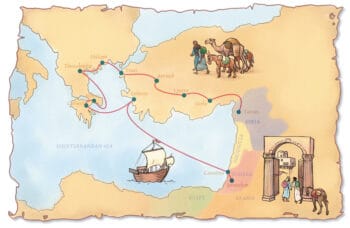
Image © Bible Adventure Collection at Goodsalt.com
Paul had been in Corinth before. According to 1 Corinthians 16:5-6, he planned to pass through Macedonia on his way back to Corinth and, perhaps, stay in Corinth for the winter. From Corinth, he would go to Judea with the offering collected for the poor in Jerusalem not only in Macedonia, but also in Achaia, Galatia, and Asia. However, he changed his plans because of a bad report brought by Timothy from Corinth (1 Corinthians 4:17, 1 Corinthians 16:10, 2 Corinthians 1:1).
Paul intended to go straight from Ephesus to Corinth and there address the issues reported by Timothy. The new itinerary would be Ephesus—Corinth—Macedonia—Corinth—Judea (2 Corinthians 1:15-16). He went from Ephesus to Corinth, but then he returned to Ephesus. His plans changed. He didn’t go back to Corinth as planned, at least not immediately, because his latest visit did not go well. So, he returned to Ephesus and wrote to them instead. He would rather send a letter than risk worsening things with another visit (2 Corinthians 2:1,3).
Paul’s intentions on the last visit were misinterpreted. Some in Corinth said that he was unreliable and that he did not love them enough (2 Corinthians 1:17). In his response to the accusations, he moved the Corinthians’ eyes to the gospel of Christ. He was faithful to his intentions to visit the Corinthians at the best opportunity, just as God had been faithful in fulfilling His promises to them through Christ (2 Corinthians 1:18-22).
“For all the promises of God in Him are Yes, and in Him Amen, to the glory of God through us” (2 Corinthians 1:20, NKJV).
Thus, his response was not a confusing mixture of “yes” or “no” dependent on the circumstances, as they said, but was “always Yes,” just as God’s work in Christ is “always Yes” (2 Corinthians 1:19, ESV).
Therefore, the reason Paul wrote a letter to the Corinthians instead of visiting them was his sincere love for them, not the opposite (2 Corinthians 2:4). Another visit right after the painful visit would bring them further pain, not the joy he intended to cause with his presence (2 Corinthians 1:24, 2 Corinthians 2:3). How easily his good intentions were misinterpreted.

I experienced “changing the plans for love” earlier this year. I won’t go through all the details here but we had planned a 15000km trip with our daughter and her husband to Darwin and back, sightseeing on the way. Circumstances ambushed our plans and we did not make the trip. Instead, we spent most of that time looking after our bachelor son who had heart problems and needed multiple hospital transfers, and someone to look after his “ratbag” cats. Then Carmel suffered from acute back and leg pains and I had to look after her as well. We were disappointed we did not make the trip. I have no idea how much all the cancellations cost us and I am not counting. The most important issue was looking after our loved ones. That is what you do.
Paul had to change plans but he left the Corinthian Christians in no doubt of his love for them. That begs the question; Are we willing to change our plans, even when cost is involved to share Jesus’ love for us? The Gospel message is centred on love and it must be an action love. As I said on Sunday’s study it should be a “moved in the gut” love.
This is not about pure doctrine or good feeling, but cost-ignoring active love inspired by Jesus’ selfless example.
There was an upside to all of our problems earlier this year. Our son’s “ratbag” cats who used to hide under the bed when we visited now trust me and will curl up on my lap and let me stroke them.
Church issues and relationships can be very intricate to navigate without causing misunderstandings and hurt. I have witnessed how very innocent and genuine words, spoken in good faith, can cause serious uproar and create great “fires” that take years to quench. Our churches are not so different from the Corinthian church. Paul did not visit the Corinthian church as he had earlier planned (2 Cor. 1:15–16) because he considered it an act of pastoral care and spiritual wisdom. Yet, his decision was seriously misconstrued as a lack of love and care. Unfortunately, in the church, small and innocent matters can easily be blown out of proportion. What began as a wise decision not to visit eventually became a basis for serious accusations against Paul. He was accused of being unreliable and indifferent toward the Corinthians.
Paul changing his plan not to visit the Corinthian church offers valuable lessons.
1. Accomplishing God’s mission at times can require a change of plan. A change of plan and timing does not mean a change of mission. Circumstances may require a change of tactic for effective realisation of the mission objectives.
2. God is not so rigid as long as His character is not misrepresented. God is sovereign; He is not held captive by time or circumstances.
3. A good leader, as much as possible, should avoid confrontation.
4. Doing what is right always comes with a cost. Paul was willing to be misunderstood for the love of the Corinthians. We must have the courage to do good even at the cost of personal reputation.
5. Good leaders should not avoid dealing with difficult people. Paul did not abandon the Corinthians even though they caused much grief to him.
“A soft answer turns away wrath, But a harsh word stirs up anger.” ( Proverbs 15:1, NKJV)
Humility!!
Sincerity and integrity are by-products of humility which is the opposite of arrogance. Humility is expected to be the distinguishing trait of every Christ follower, and we need to conduct an ‘attitude assessment’ to know if we are truly representing Christ well in this regard or have our closeness with God made us to disregard or distance ourselves from the rest members or non-members?
Having served in leadership positions I can categorize inherent arrogance into two; ‘intense arrogance’ and ‘polite arrogance’ intense arrogance is when people are scared of you as their leader while polite arrogance is when you are not happy with a decision that is not favourable to you and you subtly work against it.
Most times in leadership you may not be aware of the development of arrogance in your life, you just feel it’s normal. If you don’t check it as to nip it at the bud, arrogance whether intense or polite will destroy your relationship with friends and family members.
Jesus Christ is our example when it comes to humility and He advices us to serve and not to be served wherever we find ourselves as a leader or a led.
Paul celibated for the sake of the gospel, worked to fund his ministry, suffered more than the rest and would later be martyred, how was he not simple and sincere enough?
In today’s lesson he is humble enough to reply his critics knowing that his explanation will help clear their distrust, strengthen them in the faith and build their trust in him and in the Lord Jesus Christ who is the Supreme Leader and master of all.
He wouldn’t have said “imitate me as I imitate Christ” if he was not sure of himself!!!!
Just like Paul’s case, there are times when things happen that are beyond our control, forcing us to change our plans. In 2 Corinthians 1:15–24, Paul explains why he changed his intended visit to Corinth, making it clear that his change of plan was not a sign of instability or that the Spirit was absent from his ministry. His opponents interpreted the change as evidence that he made decisions “according to the flesh” (2 Corinthians 1:17), but Paul shows that his motives were shaped by love and a desire for the spiritual well-being of the believers (2 Corinthians 1:23–24). This reminds us not to be unnecessarily harsh with ourselves or with others when plans change. While we should plan carefully and responsibly, we must also leave room for unforeseen circumstances and recognise that “a man’s heart plans his way, but the LORD directs his steps” (Proverbs 16:9).
Whatever my natural character or tendency toward planning, Paul’s experience is deeply valuable to me. It teaches me that planning is important, but surrendering my plans to God is even more important. Paul could change his itinerary without abandoning his calling, because his ultimate commitment was not to plan on his own but to submit to God’s will. Proverbs 19:21 reminds me, “Many are the plans in a person’s heart, but it is the LORD’s purpose that prevails.”Therefore, whether my plans work out exactly as I expected or circumstances force me to change direction, my responsibility is to remain sensitive to God, trust His purposes, and allow Him to direct my steps.
I am usually a planner. I love to plan my things and want them to go exactly how I have planned but I am now learning that change of plans can happen and that surrendering these plans to God is also a very important part of the planning process. I am work in progress, but I must admit I have come a long way.
Praise God for the lesson writer!
Hi people.
I planned to study at Andrews University to do the master of arts in theology when I studied education at Avondale college. Fortunately Andrews University came to me when I discovered that I could do the MA theology at Avondale through accreditation from Andrews. The overseas lecturers gifted us with the Andrews experience on home ground. Both degrees grounded me in the faith and I am ..at home now.. heavenly home ground in the tomorrow.
I have a question why actually did Paul refused to go back to Corinthians early, what would be the consequences of going there?
As a parent I have had this experience . It’s like when you can hear some children in another room having a heated argument . So you call out to them to settle their differences and be respectful to each other. It’s only when they can’t sort things out for themselves that you go in and personally intervene.
Maybe this is why Paul did not go to them straight away , he sent the letter, as a kind of first step , giving the Corinthians a bit of respect and the benefit of the doubt , that they had enough wisdom and Faith to resolve the situation without Paul having to take the heavy-handed step of visiting in person
Also travelling was not so easy in those days , he couldn’t just skip over to Corinth to sort things out
This answer is given from Bible Hub.
“Paul refused to return to Corinth immediately because he wanted to “spare” the church from a severe, painful confrontation (2 Corinthians 1:23–2:1). He had recently made an emergency “painful visit” to address rebellion and immorality, which left both him and the congregation deeply grieved. Rather than arriving immediately in anger, he intentionally delayed to give them time and space to repent voluntarily after receiving his harsh follow-up letter (the “Severe Letter”).”
Thank you so much for this answer. It makes a lot of sense to me now. God bless.
What makes Paul inspiring is how he balanced a powerful personality with deep love for the church. He was not afraid to be blunt, direct, and confrontational when defending the truth. However, his strength was always paired with real affection, patience, and tears.
This balance highlights a vital rule for leadership: People accept correction much better when they know you truly care about them. If they feel your love, they understand you want to help them, not hurt them.
For naturally strong or forceful people, Paul shows a better way. The goal is not to hide your strength, but to let Christ and unconditional love control it. When you do this, your passion becomes a helpful tool to build people up, rather than a weapon to tear them down.
Am I the only person who gets fed up with Paul’s wordiness? Why doesn’t he just keep it simple and come out and say what he wants communicated instead of writing in circles? In my opinion, he needed an editor.
I’m glad the lesson-writer was able to figure out this section about his itinerary.
I can understand your frustration. Even Peter expressed that feeling at times. Paul’s letters are sometimes like a multitasking computer, carrying several ideas at once. It helps if you read it in a modern-language paraphrase. I have mentioned several times in this discussion how helpful it has been to me to read the whole of an epistle in one or two sessions. There have also been a couple of videos mentioned earlier in this series that detail the structure of these epistles. I will go back and see if I can find one of them and list it here.
Here it is: https://bibleproject.com/videos/2-corinthians/
Last summer was a memorable one for our household. It began to come unraveled on July 24, 2025, when I was involved in a serious bicycle accident. Two weeks later it was followed up by my beloved wife tripping on the hose as I was powerwashing our driveway. Her resulting fall caused her to fracture her left kneecap, badly bruise her right knee, and suffer a series of facial bruises as she face planted on the concrete driveway.
Her recovery was slower than mine and resulted in her needing to use a walker and wheelchair, help being toileted, meals prepared and served, etcetera. In the begining I, myself was still healing from two fractured wrists. It was quite the ordeal. Then as her wounds were mending and the kneecap was healing, she developed neuropathy in her legs and feet. This further laid her up for several months, nine to be exact. We had already planned an itinerary to winter in Florida, in our motorhome, complete with reservations. When the date for our departure arrived she still wasn’t “road ready” to travel. We decided to start canceling reservations a little at a time in hope that she would be able to travel eventually before the winter had passed. It didn’t happen in time to save any of our itinerary. She encouraged me to go alone to save some of the itinerary and the associated cancelation fees, which were significant. How could I leave her alone, partially ambulatory? I couldn’t. The entire trip ended up being canceled. The one saving grace was that I appealed the cancelations on account of a unforseen medical condition, which thankfully resulted in half of the cancelation fees being refunded.
The point is, sometimes love is costly. Life situations and circumstances can change in an instant which test the genuineness and depth of our loving commitment to others. True love will sacrifice at any cost, for the benefit of others. That principle is woven throughout the scriptures from Moses, to Jesus, to Paul and many others in between. Love considers the cost and bears the loss, because that’s what true love does. Our love for Christ is a small token of His immense love for us. It may cause us to suffer loss but we should consider the loss as gain, because of love. That’s what love does. It’s willing to suffer loss so that others may experience gain, even through our own pain.
So glad you recovered! Stay safe!
Changing plans for love…
Many of us have futures we cannot see…
This scares all of us but God can see…
God has our life planned for all of us…
Alison Willis excerpt from her poem.. The safety light.. booklet.. entitled word pictures..poems from ’89.. Avondale creative writing class.
I knew Alison briefly..
Both voice and vision that speaks to us now.
Thank you for sharing your story so we can better understand God’s lesson. Blessings to you and yours!
God changes our plans out of love to protect us from hidden harm, correct our direction, and bring us toward a much better future. When life takes an unexpected turn, it can feel painful or confusing. However, faith teaches that these sudden disruptions are often acts of deep divine care.
please share the poem
As iron sharpens iron people…partly of iron and partly of miry clay. That is us all sometimes unbending sometimes besmirching ourselves…microcosm of state of nations today.
And in these days…..
Thy kingdom come.
Little babies cry because they lack experience. Sometimes we are like little babies: we cry because of a situation we may even have chosen to be in. But God, as a merciful Father, helps us to understand the meaning of suffering in this world. When we gladly accept His will, we start to trust Him more and mature.