
Wednesday: Sufferings for the Sake of the Gospel

Daily Lesson for Wednesday 16th of September 2026
After exposing the false teachers as agents of Satan (2 Corinthians 11:1-15), Paul now “plays” their game by boasting a little as a fool might (2 Corinthians 11:16-21) so that the Corinthians could see how senseless it was to give ears to the false teachers’ speech. If the Corinthians held them in high regard, Paul deserved higher consideration. His sufferings for the gospel show that he was a faithful servant of Christ (2 Corinthians 11:22-23).
Read 2 Corinthians 11:22-28. What point is Paul making here?
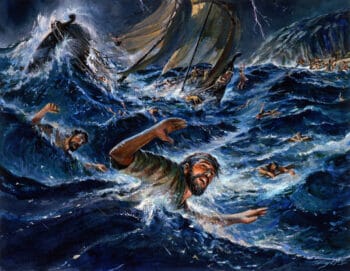
Image © Lifeway Collection at Goodsalt.com
While Paul’s Jewish credentials are identical to those of the false teachers (2 Corinthians 11:22), his service to Christ surpasses theirs (2 Corinthians 11:23). “Are they ministers of Christ?” he asks. The answer is “I am more.” His labors were more abundant; his imprisonments, more frequent; his beatings, more severe.
But this is not all. His list of sufferings also includes five instances of thirty-nine strokes (2 Corinthians 11:24), beatings with rods, stoning, shipwrecks, danger in deep waters (2 Corinthians 11:25), danger at journeys, danger from rivers, danger from bandits, danger from countrymen, danger from Gentiles, danger in crowded cities, danger in desolate country, danger at sea, danger from false believers (2 Corinthians 11:26), strenuous labors, exhausting toils, sleepless nights, hunger, thirst, food shortage, cold, and nakedness (2 Corinthians 11:27). As if that weren’t enough, he still had to deal with mental anguish because of his deep anxiety for the churches (2 Corinthians 11:28).
Only a true servant of Christ would be willing to suffer like this for the gospel. If Paul were really to boast about his sufferings, he had much to say. However, the next section of the letter shows that the reason for his boast was based not on what he did for Christ but on what Christ had done for him. Paul knew that God’s power is more visibly displayed in human weakness (2 Corinthians 12:9-10). By giving him a thorn in the flesh (2 Corinthians 12:7), God protected Paul from boasting about his accomplishments. This kept him humble, aware of his weakness, dependent on divine power, and in the condition of receiving more of God’s grace and mercy.
|
Have you also been suffering for the sake of the gospel? What have you learned from this experience? How can the way Paul dealt with his sufferings help you deal with yours? |

In 2 Cor 10 and 11, Paul defends his role as an authentic apostle by listing his suffering, persecution and weakness, in contrast with the eloquence and social standing of the apostolic pretenders. I struggled a bit with this argument because (a) it seems as though Paul is boasting of his suffering and (b) I don’t seem to be suffering at all. And that makes it rather hard to apply the lesson to a twenty-first century Christian.
As modern Christians we are commissioned to spread the Gospel:
This was not just an instruction to the 12 disciples but to all Christians. We are all called to be apostles (apostolos — Greek — sent ones). Most of us cannot claim to suffer anywhere near as much as Paul and consequently we must establish our apostolic authenticity in a different way. Here are a couple of things you may like to consider.
False teachers often include these markers as evidence of the blessing of God. In contrast our authenticity is our humility, self-sacrificing lifestyle and ignoring the building of social capital.
We do not need to be envious of Paul’s “suffering”. God has given us a range of instruments to establish our authenticity as modern apostles.
Paul had a remarkable and strange way of boasting. He was boasting about his vulnerability. He was boasting about his weaknesses. He was proud of his weakness, so that the power of Christ may be manifested in him (2 Corinthians 12:9-10). This is an unorthodox way of boasting because people are naturally proud of their successes and not their failures. People want the whole world to know their strengths and not their weaknesses. People want to broadcast their victories and not their defeats. People want their neighbours to know how rich they are and not how poor they are.
What spiritual lessons can we learn from Paul?
1.When we admit our human inadequacies, it is much easier to receive God’s grace. In essence, Paul was not boasting about his own shortcomings; he was boasting about what God could accomplish through him so that he could not take credit.
2.We must not be ashamed to tell God our failures because He already knows them. Accepting our failures is a crying call for mercy and grace. God works through our liabilities to refine our character.
3. God’s grace and mercies are not put off by our many deficits. It is truly remarkable how God responds to admission of our failures. “My grace is sufficient for you, for my power is made perfect in weakness.” This is our God who rescues us while we are in sin (Romans 5:8).
4. God can use our limitations to protect us from pride. For instance, God may not give you riches because He wants to preserve you from becoming proud. God knows that some people will simply not handle riches. Riches will easily destroy some people. In God’s mercy, He denies riches to some.
5. God can use weak people for His glory. God’s power is magnified through those who admit that they are weak. Paul says, “For when I am weak, then I am strong”.
6. Vulnerability can produce humility. Human beings quite often are humbled by circumstances. Paul had a thorn in the flesh. Each one of us has a thorn in the flesh; otherwise, we are inherently proud beings.
“We now have this light shining in our hearts, but we ourselves are like fragile clay jars containing this great treasure. This makes it clear that our great power is from God, not from ourselves.” (2 Corinthians 4:7, NLT)
Sharing the gospel continues to be a hazardous task, as those who are in rebellion against Christ often hate to be reminded of the truth of the gospel. Paul, says “For it has been granted to you that for the sake of Christ you should not only believe in him but also suffer for his sake, engaging in the same conflict that you saw I had and now hear that I still have” (Philippians 1:29–30). Paul knew that his Saviour suffered and that, as His servant, he too would suffer. Yet suffering did not mean that his ministry had failed. In fact, Paul described his experience in 2 Corinthians 4:8–9: “We are afflicted in every way, but not crushed; perplexed, but not driven to despair; persecuted, but not forsaken.” His suffering became part of his testimony and demonstrated that the power of Christ could sustain him even in the midst of intense opposition.
The gospel of salvation remains a powerful and wonderful message, and as God’s people, we must faithfully share it with others so that they too may be saved and become partakers of eternal life. Therefore, when we encounter hostility or persecution for the sake of the gospel, we should not immediately conclude that we are on the wrong path; sometimes, opposition is evidence that the message is being heard and that people are responding to it (2 Timothy 3:12). Paul found encouragement in knowing that, although some people opposed and actively persecuted him, others were eagerly listening and coming to know Christ. This made his suffering worthwhile. As he declared in 2 Corinthians 12:9–10, Christ’s grace was sufficient for him, and he could therefore say, “For when I am weak, then I am strong.” Paul’s suffering did not silence the gospel; instead, through his weakness and perseverance, the power of Christ was displayed, making his suffering fruitful for the advancement of the gospel and the salvation of others.
Hi people
Edward Lear did suffer for his commitment to the gospel and the creative way he expressed that commitment.
I’ll share a few stanzas of his coping strategy. The criticism and critics meant nothing to him. And certainly not to his Christian friends.
How pleasant to know Mr Lear! Who has written such volumes of stuff!
Some think him ill tempered and queer, but a few think him pleasant enough.
His mind is concrete and fastidious, his nose is remarkably big. His visage is more or less hideous, his beard resembles a wig.
He has ears, two eyes and ten fingers, leastways if you reckon two thumbs.
Long ago he was one of the singers. But now he is one of the dumbs.
He has many friends, laymen and clerical, old foss is the name of his cat; his body is perfectly spherical, he weareth a runcible hat.
When he walks in waterproof white, the children run after him so!
Calling out: he’s come out in his nightgown, that crazy old Englishman, oh!
Well people
that speaks volumes, oh!
Reneanne Anderson
I can never understand why people boast (especially Christians) in their accomplishments etc.
Sure you want to celebrate wins in your lives but to take it to the extreme of boasting should never be a part of the Christians experience.
In fact, Paul puts it this way, “May I never boast except in the cross of our Lord Jesus Christ, through which the world has been crucified to me, and I to the world”.
May God give us the grace to remain humble till He comes!!!
We need leaders like Paul who are willing to lay down their lives for the flock. Those who are not afraid to point out wrong and call it out. Who love God’s children and are willing to defend them because they want the brethren to live holy lives consecrated to Christ Jesus that’s why Paul encourages the flock to follow him as he followed Christ. Paul did not seek “followers” for himself but followers of Christ.
It is ironic and almost humorous how Paul calls out his detractors by comparing his “resumè” to theirs saying he is more qualified than they were. He was a “Pharisee of Pharisees,” and goes on to list his many sufferings as further proof. The enemy camp and the Pharisee camp had lost one of their best and brightest when Saul went from persecutor to promoter of “the Way.”
Judging by how much Paul suffered for the gospel it’s evident that Paul was a big threat to the kingdom of darkness. Satan and his minions had lost one of their Champions when Saul was converted and became Paul, and they weren’t going to simply let him walk away without suffering.
Paul’s suffering would have made most believers “throw in the towel” and give up. Yet Paul soldiered on in spite of his sufferings, remembering that Christ had suffered more. Many times Paul could have been killed, yet Christ preserved his life. Proving to me once again that “we are immortal untill our mission is complete.”
Most Christians today probably wouldn’t endure to the end the path that Paul had to walk for the sake of the gospel. We have gotten soft and complain if we don’t have padded pews to sit on. Don’t expect the world to applaud you for being or becoming a Christian. To them you are a fool. If I have to choose between being a fool in the world’s eyes or God’s eyes I pray that I would choose the former and not the latter every time. Let the world think we are fools, then we are God’s own “fool” where God’s Holy Wisdom is foolishness to man. “Come be a fool as well!”
If I must boast, I should boast in my sufferings like Paul did and not in my accomplishments.
LORD help me to boast in Jesus and him crucified.
The question comes to mind : if suffering is part of the Christian experience; is it really worth being a Christian?
Maurice shared with us, that generally speaking, few if any of us in this era suffer like the Apostle Paul. However we do suffer, and I think from my personal experience, especially as Seventh-Day Adventists.
I know some of you reading what I am presently writing, are saying to yourselves, why is’nt he thinking of Heaven and the eternity we will spend in the earth made new?
I am presenting to you some really unique and significant benefits to be derived from being a “suffering” Christian, presently, on planet Earth, “a steal of a Deal”.
Benefit No.1- Christians have the capacity to love. “….and everyone that loveth is born of God, and knoweth GOD.” 1 John 4:7 KJV. see also Galatians 5:22
Benefit No.2 – Christians have a peace that the world cannot give. “Peace I leave with you, my peace I give unto you: not as the world giveth, give I unto you….” John 14:27 KJV. see also Philippians 4:7.
Benefit No.3 – Christians benefit from Divine Guidance -John 14:26 and John 16:13 records Jesus’ promises that the Holy Spirit will teach believers, remind them of His words, and guide them into all truth. See also Romans 8:14 and James 1:5
Benefit No.4 – Christians benefit from Divine Protection- ” But the Lord is faithful and He will strengthen you and guard you from the evil one.” 2 Thessalonians 3:3. see also John 10:28-29
Benefit No 5 – Death is not the end. We don’t die we sleep, to be resurrected when Jesus comes again.- “Our friend Lazarus has fallen asleep: but I am going there to wake him up.” John 11:11 NIV see also 1 Corinthians 15:52.
My closing argument is this: all peoples suffer on planet Earth. Based on the benefits that Christians derive whilst living on planet Earth,{ taking into consideration they also have “a ticket” for Heaven and for the Earth made new} of which Group would you prefer to be a member?
Pretty aware that this is not the right platform but I desperately need prayers for my little boy, it’s been one trial after another and I’m deeply shaken to the extent that I can’t even pray for myself. My boy’s name is Marko.
Hello Vanessa! This is an online Sabbath-School website. Just as in an in person Sabbath-School class where we receive and pray for urgent requests, so too here we can do the same. It is in times like this when we are beaten down and battle weary that we need others to intecede on our behalf. Therefore, I invite the members of this forum to lift Marko and yourself up in prayer. May you be helped and God be glorified. Hang in there. The Prayer force is on the way to provide prayer support.
Prayers from Northern Nevada Vanessa , strength and peace for you and God’s loving care for Mario. God knows our needs and answers even before we call!
Dear GOD, your daughter Vanessa brought a request concerning her son Marko. Whatever may be the case is not above you, please intervene and let all the glory be yours and our faith strengthened in you. Amen.
Dear brothers and sisters in Christ,
Marko and I are immensely touched and grateful for not taking our toll lightly and for the blessing of being a part of this family!
Vanessa!
May the mercifully Lord God almighty, our Father, hear your prayers!
May Our Lord Jesus Christ extend His helping hands to your and the little boy and we all know and believe that He loves children!
May the Holy Spirit strengthen you and comfort you!
Suffering may be one of the most efficient means for Christian growth.