
Wednesday: Women Prophets

Daily Lesson for Wednesday 14th of October 2026
Read Exodus 15:20, Judges 4:4, 2 Kings 22:14, and Nehemiah 6:14. What do these texts also teach about the prophetic role?
There is abundant evidence in Scripture that God called women to be prophets. (See the use of the Hebrew word nevi’ah [Exodus 15:20] and the Greek word prophētis [Luke 2:36].) In Micah 6:4, Miriam is listed with Moses and Aaron as those sent to the people. Miriam is presented as a prophetess who sang a song of victory when the Israelites crossed the Red Sea (Exodus 15:20-21). Yet, this prophetess, like her male counterparts, was not without fault, as her shameful attitude toward Moses and his Ethiopian wife reveal, actions for which the prophetess had been duly punished (see Numbers 12:1-10).
We can see the work of another prophet in the story of Deborah, who served as a judge in Israel (Judges 4:1-4).
In fact, there is clear evidence that Deborah (Judges 4:4) received revelation from God (Judges 4:4-9,14-22). Her song of victory (Judges 5:2-31) is an acknowledgment of God’s intervention and had deep theological significance for the nation at that time in history.
Read 2 Kings 22:11-14. Why did King Josiah’s men go to Huldah? What should this tell us about her important role in the nation?
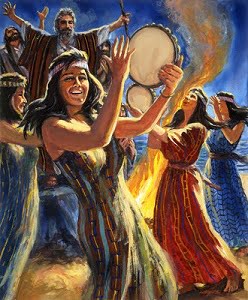
Image © Lifeway Collection at Goodsalt.com
Huldah “the prophetess” was consulted by the top men of King Josiah’s council (2 Kings 22:14, 2 Chronicles 34:22) after they read the words of the “Book of the Law” (2 Kings 22:8, NKJV) (believed to be Deuteronomy) to the king, who, in response, “tore his clothes” (2 Kings 22:11, NKJV). This was obviously a very serious matter, and the king took it that way, which is why his men went right to Huldah. She had received a message from God regarding the impending judgment of Judah. Josiah’s reforms resulted from Huldah’s prophetic messages and averted God’s judgment on His people.
|
Men prophets and women prophets, though called of God, were also sinners in need of grace. What hope can you take from their stories? |

Interestingly, Huldah was a contemporary of both Jeremiah and Zephaniah. It begs the question why she was consulted to validate the Book of the Law. Some suggest that it was simply a matter of proximity. The Bible records that Huldah lives in the second district (near the Temple and Royal Palace). Her husband was part of the royal court. The Talmud also notes that Huldah and Jeremiah were relatives, possibly cousins. The fact that Huldah was consulted on the authenticity of the Book of the Law indicates that she was well educated.
The Torah, in its written form had been lost, probably through neglect during the reign of Manasseh. In those days you did not call Amazon and ask for another copy. However, we must remember that Jewish education was largely oral with a strong emphasis on learning and reciting the Torah. This was typically the responsibility of the mother in the family. It is quite conceivable that given her family connections Huldah had committed the Torah to memory and that she had gained a reputation for her recall and recitation. When the Book of the Law was found, Hilkiah, the priest, took the book to her to see if the written book matched her oral memory. Huldah was able to authenticate the book as genuine.
This account is a reconstruction, connecting the limited information we have from the Bible, the Talmud and Jewish culture. Importantly, the circumstances led to Huldah emphasising the message of the Torah and initiating an important national reform.
Wednesday’s lesson has the push for women’s ordination written all over. By definition, a prophet is the spokesperson for God. Receiving a message from God did not automatically elevate an individual to the priesthood ministry. Jesus was very particular in choosing the twelve apostles. When the time came to replaced Judas, there were one hundred and twenty men and women filled with the Holy Ghost. Jesus could have chosen a woman who was filled with the Holy Ghost to replace Judas. Why didn’t He? Let’s be careful not to interject nor infer principles that aren’t presented in scripture.
Hi Mark, you appear to be reading either a different lesson to the one I am reading above, or you are using special glasses that show deep hidden meaning that I cannot see. Firstly, I don’t see the word “ordination” or its derivatives or synonyms anywhere in today’s lesson. Secondly, it documents three of the four women identified as Prophetesses in the Old Testament: Miriam, Deborah, and Huldah. (Isaiah’s wife is also called a prophetess but only mentioned in passing in the Bible) These women are integral to the story of Old Testament prophets, and leaving them out would leave out a signifant part of the story.
This has nothing to do with women’s ordination or setting women apart for leadership roles. This is not a forum for promoting, denying or debating women’s ordination. Let’s be careful not to interject nor infer the lesson is saying something that is not there.
Hi Mark,
In addition to what Maurice wrote, I note you that you appear to equate the ordained ministry with the priesthood, which is what the Roman church does.
But we believe that there is one Mediator between God and man, and that is Christ Jesus. (See 1 Timothy 2:5) In another sense, we believe in the “priesthood of all believers” because we are all commissioned as ambassadors for Christ.
In that spirit of the “priesthood of all believers” we engage in conversation about the Sabbath School lesson on this blog. We believe we can minister to each other and learn from each other.
You are welcome to engage in such conversation.
Last week’s lesson, “God Calls a Prophet,” clearly established that prophecy is not a career choice; rather, it is God, in His sovereignty, who appoints individuals to the office of a prophet. God does not appoint anyone to this office on the basis of gender or any other human attribute. Nowhere in the Bible do we see God displaying gender bias.
“Then, after doing all those things, I will pour out my Spirit upon all people. Your sons and daughters will prophesy. Your old men will dream dreams, and your young men will see visions. In those days I will pour out my Spirit even on servants—men and women alike.” (Joel 2:28–29, NLT).
Male and female believers share the same standing in Christ. Neither sex has a superior claim to spiritual calling or inheritance in God’s promise. The fact that there are more male prophets than female, it does not make female prophets any lesser or their prophetic messages.
“There is no longer Jew or Gentile, slave or free, male and female. For you are all one in Christ Jesus.” (Galatians 3:28, NLT).
In the world today there are some people who look at women’s spiritual office less favourable. To do so, is to find an excuse not believe, “So God created human beings in his own image. In the image of God he created them; male and female he created them.” ( Genesis 1:27,NLT).
The proponents of women’s ordination have now resorted to using the sabbath school lessons to relentlessly promote their agenda after it had been voted down by the world church several times. How is this “unity?” How does this discord fit into “one voice 27?”
Joel 2:28-29 was fulfilled on Pentecost and will be repeated before the appearing of our Lord Jesus Christ. In Acts 1:15 there were one hundred and twenty men and women all filled with the Holy Ghost. Why didn’t Jesus choose a woman to replace Judas? After all, they were all (male and female) “filled” with the Holy Ghost in that upper room.
A prophet is a spokesperson for God. The great commission authorizes ALL who believes to be a spokesperson for God. “Go YE” is in the plural context. Are all prophets? no. Are all apostles? no. Why have the proponents of women’s ordination allowed themselves to be bamboozled by the onslaught of the feminist movement? The next stage in this hidden trap is ordination of same sex. Wake up!
Hello Mark! It appears to me that you are making a false equivalency here. The topic is women used as prophets, not women’s ordination. They are separate and not comparable.
As a Sabbath-School leader in my church, my role is to guide and direct the discussion, and when it strays off course into an unrelated tangent, to get the discussion back on track.
I see nothing related to the tangent of women’s ordination so I will kindly request that others not follow you down that “rabbit hole”.
God called women to serve as prophets just like He called men to pass His message. He entrusted them with His message to guide, instruct, encourage, and correct His people at crucial moments in history. Miriam is remembered and recognised as a prophetess who led Israel’s women in praise after God delivered them from Egypt (Exodus 15:20–21). Deborah was called to serve as both a prophetess and a judge, providing spiritual direction and courage to Israel during a time of conflict (Judges 4:4–9). Huldah was consulted by King Josiah’s representatives, and she faithfully communicated God’s message concerning the Book of the Law and Israel’s future (2 Kings 22:14–20).
These accounts show that God’s call to prophetic ministry was not limited to men; God also chose faithful women to serve as His spokespersons at decisive moments in the history of His people. With different women prophets serving in different circumstances, yet each was entrusted with a divine message and responsibility of leadership, instruction, encouragement and correction of God’s people. The ministries of women prophets were recognised and respected, demonstrating that prophetic authority came from God’s calling rather than human position or by gender. Through these women, God revealed His willingness to use anyone He chose to accomplish His purposes. This truth is further affirmed in Joel 2:28–29, where God promised to pour out His Spirit on all people, declaring that both sons and daughters would prophesy. The women prophets remind us that those called by God must remain faithful to His word, courageous in delivering His message, and humble in carrying out His will, regardless of the time and challenges they may face.
Women have always been called to service in the great plan of Salvation. It is a pity that some would seek to denigrate their service and limit them to certain roles.
The Bible is clear, however, on the role of women, and anyone for that fact, in the work of building up His Kingdom!!!!
Acts 10: 34-25: “Then Peter opened his mouth and said: “In truth I perceive that God shows no partiality. 35 But in every nation whoever fears Him and works righteousness is accepted by Him.”
God did not give the prophetic gift primarily to men because women were spiritually less qualified to receive it. I believe that the predominance of male prophets may partly reflect the cultural and practical circumstances in which prophetic ministry had to operate. Public travel, confronting kings, appearing before governing authorities, preaching publicly, and sometimes living as itinerant messengers would generally have been more accessible to men in those societies.
Whenever God chose a woman, however, Scripture presents her prophetic calling as genuinely divine and authoritative.
That principle also makes Ellen White’s calling entirely consistent with the biblical pattern: the question is not whether the messenger is male or female, but whether God has called the person and given that person a message.
After a week long hiatus and motorhome expedition filled with beauty, adventure, and some minor irritating mishaps, to visit family, and experience the fall colors of the upper lower peninsula of Michigan, I am back home and present on this forum. I mentioned that only because I am sure that a few wondered if I had fallen off of the earth. 🤔😉😊
The issue of women being called to the prophetic role and possessing the prophetic gift is in many ways a rhetorical issue. Of course, women can be, have been, and will continue to be used of God for a special purpose. Why not? They were made in the image of God as much as man was, and yet possibly more. The scripture says that God made man, but that he “built” women. Which tells me that a little extra thought, purpose, and detail was employed for her creation. I am not speaking merely physical or anatomical. I am speaking intuative, emotional, relational, and spiritual. Who carried us in their womb and through great travail birthed every male prophet that ever existed? A woman! Woman have played a key role in every part of life on this planet.
It has been said that; “the hand that rocks the cradle rules the world.” We are born recognizing her voice. Our mothers were our first teachers, providers and protectors. Even though she was first to fall into sin, never forget that she (Eve) was deceived. Man, (Adam) however, followed her into sin with his eyes wide open. Of course God has and will continue to use woman as He sees fit. However, may we never elevate the messenger above the message or above the One that equipped and called them into their unique ministry. God is not xenophobic but an equal opportunity employer.
In reading all the text related to today’s lesson and being in our church for all my life, I know both sides of the women and men in church positions. I have no problem with women being prophetess or pastors. Way back in the 80’s and 90’s there were two women that were elders of the Seventh-day Adventist church we belonged to until we moved. I had no problem looking to them with respect.
It appears to me after reading above and below 2 Kings 22:11-14, there may not have been a righteous man with the Book of the Law on their hearts, and or willing to be made willing to take the call like Ellen White was. Huldah certainly fit these qualifications to be a prophetess for the God of the universe, the One and only true God. She certainly spoke with a message from the Lord, consistent with the Books Of the Law. 2 Kings 22:15-20.
The fact that there were Baal idols in the temple of the Lord, and wooden images of other gods, gives me the evidence that there were very few men of the time who were fit for the prophet duties. Josiah with the message from the Lord given by prophetess Huldah made a drastic change of Israel for the better. 2 Kings 23:4-5, 6-7.
There were other prophets in the time of Josiah, however, as Maurice noted. Probably Josiah could have gone to them.
I don’t like the way we often act like God “had no choice” but to use a women in the cases of prophetesses. That is a subtle way of putting down women. If a man was best or necessary, God could have found a man.
John, both Jeremiah and Zephaniah were contemporary with Huldah. Their writings became part of the Jewish Canon. As mentioned above, I think Huldah had special skills and proximity that made her eminently suitable for authenticating the Book of the Law. She was the best person for the task.
Pastors, Bible workers, Elders, and Prophets, men or women.
God calls men and women to be prophets.
https://egwwritings.org/read?panels=p118.1737&index=0
Prophets are humans, like everyone else (James 5:17, Acts 14:15). This means that a saint is someone who believes (Romans 1:7, Ephesians 1:1), whether or not they are a prophet (1 Corinthians 12:29). On the other hand, any believer can become a prophet (1 Corinthians 14:1, 1 Corinthians 14:31) if this is God’s will (1 Corinthians 12:11) and the believer’s (1 Corinthians 14:39).
The last question in today’s lesson misses the point of the lesson. Why focus on a person’s mistake in the prophetic gift? We all are saved by grace. While that theological premise is true for all humans, framing a lesson end specifically titled “Women Prophets” around their flaws—and using Miriam’s “shameful attitude” as a primary illustration—unintentionally dilutes the profound reality of their leadership. It shifts the focus from God’s radical inclusion of women in a patriarchal culture to a generic lesson on human brokenness.
How about end with a question like this:
“What does it tell us about the character of God that He actively bypassed patriarchal cultural norms to place the spiritual and political destiny of His people in the hands of women like Deborah and Huldah?”
or
“When Micah 6:4 names Miriam alongside Moses and Aaron as co-leaders of the Exodus, how does that expand our understanding of how God structures ministry and leadership?”
Women’s ordination might be an agenda of some but a prophetise is a clear, supernatural manifestation of God in giving direct messages to His church. Women’s ordination is man’s decision/recognition who ministers and not connected with the office of prophetise/prophet. BTW, I don’t think prophetise’s were ordained. Also priest and prophet are two totally different roles before God. Neither has jurisdiction or control of the other. Both minister before God in the capacity He has called them to perform.
I’m glad our church recognizes the role of women prophets and that we accepted this ministry in the development and establishment of our church. She didn’t hash out our theology by herself. God used the men who studied and then He gave her visions to help us understand the scripture.
You make a fair point, Daniel.
There were some pretty flawed male prophets as well – one that we never talk about is the unnamed prophet in I Kings 13 who messed up so badly he ended up killed by a lion!
Miriam made a big mistake, but her brothers did too at different times. In the end, everyone who serves God has some flaws.
It is beyond clear based on the scripture references that God called women to serve in leadership and as prophets. He has and continues to speak through women and has poured out His spirit on all that Joel mentions. It is also abundantly clear that those roles did not include priesthood.
The only priest we recognise in this time is Jesus. He is the ultimate advocate. Some churches call their ministers priests in the belief that we need another layer of advocacy between us and God. Our ministers do not fulfil that role.
Something that has troubled me about “The Prophetic Gift,” since I became a “Seventh Day Adventist,” 54 years ago, is how in the “Old Testament,” and even in the new one in “The Book of Acts,” there were always “More than just one prophet,” and they were “Alive and living during their Prophetic Ministry.” But in my 54 years in my “Adventist Journey,” we only have “One Prophet,” and she has been dead for about 106 years now, with only “Her Writings,” to refer to.
Your troubles may be based on this mistaken assumption:
I’ll deal first with the second assumption because it is the simplest: The prophetic ministry of biblical prophets did not end with their death. We still study the prophecies of the OT and NT prophets, particularly Daniel and John the Revelator. Our faith in Jesus is also confirmed by the prophecies of various Old Testament prophets.
But you also assume there were living prophets throughout the OT and NT. On what do you base that assumption?
What prophets are mentioned before Enoch?
What prophets are mentioned in the approximately 500-year interval between Enoch’s disappearance and Noah’s preaching?
Where are the prophets between the death of Noah and Abraham’s call?
Where are the prophets in the roughly two to four centuries between Joseph and the call of Moses?
And where are the prophets in the approximately three centuries between the death of Moses and the call of Samuel? (1 Samuel 3:1)
Many more gaps exist between named prophets in the Old Testament period, even without considering the four centuries between the ministry of Malachi and John the Baptist.
So you see that God has spoken directly to His people through prophets at various times, and He has expected the writings of the prophets to “speak” in intervening times which sometimes lasted several centuries.
So it seems to me that ignoring the writings of the prophets is ignoring the voice of God to us.
You forgot Deborah who was identified as a prophetess in Judges 4. Otherwise, you are right that there appears to be gaps. However, I’m not sure we can absolutely know this. It does seem some prophets have more local ministries than others. Balaam, though eventually becoming corrupt, was a prophet, for example.
When we look at the Old Testament (and the New for that matter), I don’t think we can make the case that God only spoke through prophets. God spoke to many people in the Bible that I wouldn’t call prophets (though perhaps some were) – Hagar, Laban, Joshua, Gideon, Manoah and his wife). In the New Testament, He spoke directly to Ananias. I suppose we could make the case that he is a prophet, but beyond him being called to restore Paul’s sight, we hear no more about a potential prophetic ministry.
Based on this, I don’t think God has ever been limited in being able to speak directly to people. He can speak directly to people. What makes prophets different is that they receive a message from God that is meant for a larger audience rather than an individual’s needs. And I think it actually seems that prophets are most needed when people are not connected to God and not listening to Him. God then needs a go-between even more so. I believe Ellen White said that if the people had fed on the Bible as they should have, she would not have been necessary.
I understand what you are saying about letting the writings speak beyond the time they existed, but many of the Old Testament and new Testament prophets did not write down their messages. Perhaps some of it was passed down to the future generations, but for whatever reason God did not intend it to be Scripture. The same is true for all prophets since the Bible was completed, including Ellen White. Certainly their ministry has value, but it is very easy to start to treat it as supplementary scripture. And there is a lot of danger in going down that path.
Thanks, Christina, for supplementing my comment.
Indeed, God is not limited. I was replying to Pete’s assumption that there is something wrong because the whole church is not recognizing any modern prophet since Ellen White. I built this out more in my comment under Thursday’s lesson.