
Sunday: The Call to Write

Daily Lesson for Sunday 1st of November 2026
The earliest method that God used to convey messages to humanity was through direct oral communication, such as audible voices, or dreams, or angels. It was not until the time of Moses that Scripture records the first divine instruction regarding these experiences, which was to write in a “book” what God had spoken.
What is the first mention of writing in the Bible? Read Exodus 17:14.
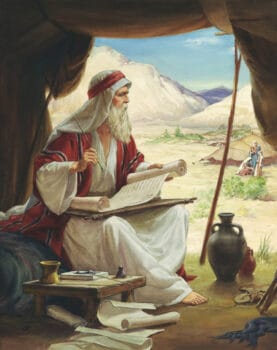
Image © Providence Collection at Goodsalt.com
In the Old Testament we find multiple examples of God’s giving directions to His messengers to preserve His words for His people. Like Moses, Jeremiah was told, “ ‘Take a scroll of a book and write on it all the words that I have spoken to you against Israel, against Judah, and against all the nations, from the day I spoke to you, from the days of Josiah even to this day’ ” (Jeremiah 36:2, NKJV).
He was also given the reason he was to write out the prophecies: “ ‘It may be that the house of Judah will hear all the adversities which I purpose to bring upon them, that everyone may turn from his evil way, that I may forgive their iniquity and their sin’ ” (Jeremiah 36:3, NKJV). The predictions were given to lead the people to salvation, rather than for the sake of curiosity about the future.
God’s messengers wrote under a great variety of circumstances. Moses wrote the first five books of the Bible while in the desert. David composed several of his psalms while being hunted by Saul (see Psalms 52:1-9; Psalms 54:1-7; Psalms 57:1-11; Psalms 59:1-17). Daniel wrote his visions while serving in the courts of Babylon and Medo-Persia. In contrast, Paul wrote his letters to the Ephesians, Philippians, Colossians, and Philemon while he was in prison, and John wrote Revelation while exiled on Patmos. It is evident that when God’s messengers were impressed to write, they were empowered by the Holy Spirit regardless of their circumstances.
Interestingly, all the preserved teachings of Jesus come to us in written form through persons God chose to entrust with those treasured truths. This shows us the confidence God has that divine messages would be faithfully recorded and preserved by His messengers.
|
How would you answer someone who says that we cannot trust the Bible because we do not have the original manuscripts? Why is that, really, a weak argument? |

The call to “write things down” needs to be understood in it’s ancient context. We lose some of the meaning in our modern world where pens and paper are ubiquitous artifacts of our modern society, (Although for some of us even paper and pens are less important than they used to be,) In ancient times, writing had to be chiseled into rocks, or pressed into soft clay and baked into an oven. Papyrus had to be prepared and dried properly before it could be used, and ink had to be prepared from soot and gums before it could be used. If you thought you needed parchment for your document the first instruction was to find and kill a clean skinned goat.
The skill of writing something down involved craftsmanship. Secondly the act of writing something required the skill of a scribe, and before general education was available, scribes were a guild of specialists. Then on top of that we also need to understand that written material was not generally readable by the general populace.
In Paul’s time there were more educated people who could both read and write, but they were not universal skills. We know that he often used scribes to write his epistles but there is also some evidence that he wrote some parts himself.
My point is that when God wanted something written down, it must have been important and a whole team of workers were involved in the process. And for many people the only way they would receive the message was when it was read to them.
It helps to know that the act of writing things down was something that was intentional and not just a note with a lifetime of a few days pinned on the refrigerator in the kitchen with a magnet.
It truly was a ‘gift’ then and now, it’s taken for granted. Sad
Thank you Brother Maurice.That was very informative n profound as always.
I appreciate your reminding us that when God said to write things down, it meant this was important.
It just occurred to me that writing things down today also has a manufacturing history: Trees have to be felled, trucked to a sawmill, the chips loaded and trucked to a papermill where the chips are further broken down, bleached, rolled into paper and dried. (I probably left out a few steps.)
Fortunately, we don’t have to do all this ourselves. And I suspect that fairly early in humanity’s writing history, people specialized in preparing writing materials, and writers paid for them rather than having to find and kill a goat. 😉
Before creation, God had the entire spectrum of humanity in mind. The Bible says that the plan of salvation was put in place before the foundations of the world (Ephesians 1:4). Whatever God did for every generation, He looked ahead even to our time. The plan of salvation is futuristic in character. Whatever was written in past was not only for the benefit of the immediate generation, but for all the generations (Romans 15:4). God’s plan of salvation was never an afterthought, nor was it designed exclusively for one generation. It was conceived in the eternal wisdom of God, progressively revealed throughout human history, and ultimately fulfilled in Jesus Christ. In essence, therefore, God called His prophets to write prophetic messages, to preserve divine revelations to instruct, warn, encourage, and prepare every generation, including our generation till Jesus comes.
Our God is a God of the past, the present and the future. Written prophetic messages are not mere historical information, but a depository gold mine from which every generation can withdraw lessons for instruction, warning, guidance, comfort, and encouragement. It is a resource which is very useful and relevant to every generation.
A quick examination of the written prophetic messages provides some very useful spiritual nuggets:
1. Written prophetic messages preserved God’s messages for future generations (Isaiah 30:8).
2. Written messages make it possible for the same messages to be repeatedly read, proclaimed and reflected upon (Jeremiah 36:6)
3. Written prophetic messages became a standard upon which later claims were to be verified or tested (Daniel 9:2)
4. Written prophetic messages made it possible for the immediate significance to be extended beyond their historical context (Daniel 12:4).
5. Written prophetic messages made it possible for the message to be corporate and intergenerational (Deuteronomy 31:24–26).
If God caused these prophetic messages to be written centuries ago with our generation also in view, are we allowing those messages to accomplish in our lives the very purpose for which God preserved them?
Being a prophet was not a career that men and women could volunteer for or choose for personal recognition. Rather, it was a divine calling in which God deliberately selected them to be His messengers and mouthpieces, entrusting them with spiritual insights and important messages for His people. This calling also extended to the responsibility of documenting and preserving God’s messages in writing. Amos clearly expressed this when he said, “I was no prophet, neither was I a prophet’s son; but I was a herdsman, and a gatherer of sycomore fruit. And the LORD took me as I followed the flock, and the LORD said unto me, Go, prophesy unto my people Israel” (Amos 7:14–15). Amos was simply saying that he had neither pursued nor trained for a professional prophetic career; he was an ordinary man whom God had called and commissioned.
Responding to God’s call was not easy, particularly when it involved writing down and delivering messages that people did not always want to hear. The prophets carried deep emotional burdens and often faced sorrow, rejection, ridicule, and misunderstanding. They were required to communicate difficult truths about sin, injustice, judgment, and repentance, even when their messages were unpopular. Jeremiah, for example, experienced ridicule and persecution because of his prophetic ministry (Jeremiah 20:1–2, 7–8). Others were beaten, imprisoned, stoned, and even killed for faithfully delivering God’s messages (Hebrews 11:36–37). Therefore, accepting the responsibility to communicate and document God’s messages was never an easy decision.
Despite these difficulties, the prophets remained committed because their calling came from God Himself, not from personal ambition. Even the responsibility of writing was part of God’s divine instruction and purpose, as seen when He commanded Jeremiah, “Write thee all the words that I have spoken unto thee in a book” (Jeremiah 30:2; see also Habakkuk 2:2). They were not simply recording personal opinions or experiences; they were preserving messages entrusted to them by God through the Holy Spirit. As Peter explains, “Holy men of God spake as they were moved by the Holy Ghost” (2 Peter 1:21). Their experiences remind us that writing Scripture was not merely a human initiative but part of God’s own plan to communicate, preserve, and transmit His truth to generations.
I can’t imagine not being able to grieve the death of a loved one, humiliating myself in front of hundreds or thousands of people and so on. These chosen men ( and women) of God were committed to the very depth of thier souls. I know I could never do this, weak as I am. But amazingly God gave them strength and power to administer His warnings and His promises. Thank God for them.
My Mom loved her Bible, and throughout my lifetime I observed her underlining, writing notes in different colored pens, and inserting cross-reference texts. I remember as a little girl trying to copy her without true understanding, and underlining in my Bible when she was. She’s only been gone a couple months, but it already feels like an eternity to me; I treasure having her Bible so much.
Through her beautiful, flowing handwriting, I keep having new revelations. The other day I saw that she had written down John 8:11 in the back of her Bible. Over the phrase “neither do I condemn you” she’s written “justification” and over the phrase “go and sin no more” she’s written “sanctification”. That was a little aha for me. I’d never before seen the whole process of salvation in that one sentence from Jesus. How much more precious that I’m receiving this teaching through my mother’s own unique notes. It’s like she’s still here sharing with me.
Thank you for sharing this glimpse into your life and the heritage your mother left you. I appreciate you sharing how her underlining and making notes in her Bible is now a blessing to you. Perhaps it can encourage others to truly use their Bibles in this way. The underlining and writing help fix words in our minds – to “hide” them in our hearts. It’s a good practice for all of us.
We are happy to see you taking part in our discussion again.
Thank you, dear Inge. I’m outside right now looking at all the fallen leaves, some in great windswept piles, and seeing them as words. So many words. So many words that we step on them without thinking and take them for granted. And yet God means every word to proclaim His love. I just read how three times in a vision, the angel tells Daniel that he is greatly loved by God (Dan. 9:23; 10:11, 19). 🥹🙏🏼❤️ The Word is intimacy and relationship.
Being able to write has always been a joy to me. Reading also. I think it’s very astonishing the ancient writings of God’s word and all the authors who took the time to write down what the Lord gave them through the Holy Spirit. Just as Sister White did. I also a, grateful for God’s Holy Scriptures and the Writings of Sister White as she was given all of them through our Lord and savior. What a Blessing it is that God chose this church to be the caretakers of his Spirit of Prophecy. Thank You Jesus!
If we believe that God is all-powerful, why should we doubt His ability to preserve the accuracy and integrity of His written Word? Are we prepared to believe that He could inspire His Word but was unable to preserve it through succeeding generations?
The question is not whether we possess the original parchment, but whether we trust the God who inspired the Scriptures and assured us that His Word would endure forever (Isaiah 40:8; Matthew 24:35).
There are archaeological proofs that parts of the Bible have been preserved for a long time. But ultimately, it’s a matter of faith. When you compare the Bible’s narrative with history, you can see how accurate and remarkable it is. As it can be for anyone who studies it.