
Wednesday: Literary Sources

Daily Lesson for Wednesday 4th of November 2026
“And moreover, because the Preacher was wise, he still taught the people knowledge; yet, he pondered and sought out and set in order many proverbs. The Preacher sought to find acceptable words; and what was written was upright—words of truth” (Ecclesiastes 12:9-10, NKJV).
This passage can be read to show that Solomon did not originate all the proverbs that he recorded. Under the inspiration of God, he “sought out” many sayings and searched to find “acceptable words.” In fact, the oft-quoted description of the virtuous woman in Proverbs 31:1-31 is attributed to the mother of an otherwise unknown King Lemuel, not Solomon (Proverbs 31:1). Evidence points to the influence of Egyptian literature on Proverbs as well.
Similarly, the inspired historians of the Old Testament tell us that they referenced archives and other historical annals to narrate faithfully the story of God’s people.
Read 1 Kings 11:41; Luke 1:1-4; and Jude 1:14-15. What do these verses tell us about how the inspired writers at times used non-biblical sources?
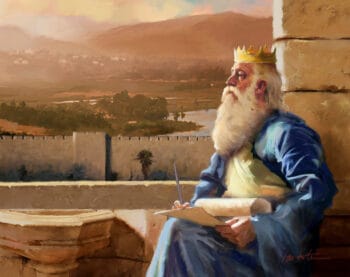
Image © Lars Justinen at Goodsalt.com
Ezra and Nehemiah are other examples of Bible writers who relied upon historical records to document their accounts. Ezra includes copies of letters and royal decrees regarding Jerusalem and Persia (see Ezra 4:1-24; Ezra 5:1-17; Ezra 6:1-22; Ezra 7:1-28), and Nehemiah tells us about genealogical registries that he found and incorporated into his narrative (see Nehemiah 7:5-72).
This principle appears in the New Testament as well. “It is clear from Luke’s experience that Inspiration functions in a manner consistent with the natural operation of the mental faculties and does not set them aside. Here is an inspired writer who was led by the Holy Spirit to give diligent study to the available oral and written source materials on the life of Christ, and then to combine into a connected narrative the information thus gathered.”—The SDA Bible Commentary, vol. 5, p. 669.
Jude seems to be quoting from 1 Enoch 1:9—a noncanonical, intertestamental Jewish work. Without mentioning their names, Paul also quoted from Greek philosophers (see Acts 17:28 and Titus 1:12).
|
Though the biblical writers were often guided by direct revelation through visions and dreams, this did not exclude the Holy Spirit from also inspiring these messengers to select material from other sources. Why is this an important concept for us to remember? |

It is truly remarkable to see how God inspired men and women to use the world around them to bring His holy Scripture into existence. God alone is completely sovereign; He used different people, experiences, historical records, poetry, songs, genealogies and even sources outside the recognised Scripture to accomplish His purposes. God is not limited by the origin of the material He uses to communicate His truth and accomplish His will. In fact, He created all things, and He can use them to fulfil His purposes. Even though biblical writers might have used information from existing sources, the Holy Spirit guided the process so that what was included in Scripture served God’s purpose. God can orchestrate the use of information outside Scripture as long as it is useful for the salvation of mankind.
On a practical note, not all things outside the church are evil for God’s use. God can use a non-Christian politician to introduce policies that protect religious freedom. God can use a secular government to provide funding to advance God’s cause. God used King Cyrus, a pagan king, to fulfil His purpose. There are some essential spiritual lessons to learn from God using diverse literal sources in Scripture.
1. God can use so-called “worldly knowledge” without endorsing worldly values.
2. God’s truth transcends cultural, historical and literary boundaries. God is not biased towards a section of humanity. He uses all people and all sources that are appropriate for His purpose.
3. The Holy Spirit is the key driver in Scripture.
4. Christians can engage with secular literature, philosophy, science and culture without compromising biblical truth.
5. We must not be quick to reject people or information because it is not explicitly canonical.
“Oh, how great are God’s riches and wisdom and knowledge! How impossible it is for us to understand his decisions and his ways! (Romans 11:33, NLT)
I wanted to ask if there are limits to the things which are not inspired by God but became good and acceptable for humans salvation
Are there boundaries to what God can use? My strong answer is yes; God can use things that did not originate from an explicitly Christian or biblical inspiration. God can use things that did not originate from Christianity, but this does not mean that everything God can use is acceptable to Him. God is sovereign enough to use anything or anyone to accomplish His purposes. However, His ability to use something does not establish that the thing itself is morally good, divinely inspired or approved by Him. For example, God can use a corrupt politician to introduce a policy that protects His people. This does not mean that God is in favour of corruption. However, God can use anyone to bring His purpose to pass.
Indeed. The Bible record shows He can even use a donkey to give a messsage. 😉
More often the bibilical writers received direct revelations from God through visions and dreams, the Holy Spirit also inspired them to draw from other sources when communicating divine messages. Inspiration did not mean that every prophet received information exclusively through supernatural visions; God could also guide them to use historical records, personal experiences, eyewitness accounts, existing writings and other available materials. For example, Luke acknowledges that he carefully investigated earlier accounts and eyewitness testimonies before writing his Gospel (Luke 1:1–4), while Jeremiah dictated God’s messages to Baruch, who recorded them in a scroll (Jeremiah 36:4). These examples demonstrate that the Holy Spirit worked through different human processes and literary sources without compromising the divine authority of Scripture. Indeed, prophetic writings employ diverse literary forms, including history, narratives, poetry, laments, symbolic accounts and letters, reflecting the unique personalities, cultures and backgrounds of God’s chosen messengers.
Ultimately written prophecies were not intended merely to satisfy human curiosity about future events but to strengthen faith, develop patience and provide comfort and enduring hope in God’s redemptive plan. Paul reminds us that whatever was written in Scripture was intended to teach us so that through endurance and the encouragement of the Scriptures, we might have hope (Romans 15:4). Therefore, when approaching difficult or complex prophetic passages, we should not interpret them in isolation or rely on personal assumptions. Instead, we must examine their historical settings, understand their literary forms and consider the broader context of Scripture. As Isaiah 28:10 illustrates, understanding God’s message requires careful attention to the relationship between different portions of His Word. Scripture must therefore be allowed to interpret Scripture, ensuring that our understanding of prophecy remains consistent with the overall testimony and redemptive message of the Bible.
I remember the story where he asks a man how readiest though? all the people who were objecting the construction of the temple of God and its walls were using the written words as evidence. The history was in operation. To us currently, what is must be applied is that we can learn from the history that is true, but the will of God should always prevail as what King Darius did. Remember history is the best teacher and Ecclesiasts states that there is nothing new under heaven.
Luke 10:26-38. I think this passage is important; author of commentary, because English is not his native language, wanted readers to see the importance of that question as well.
God desires to work with human beings, so they not only feel more connected to His messages, but their active participation also makes things even more creative.
Q1 1 Kings 11:41; Luke 1:1-4; and Jude 1:14-15. What do these verses tell us about how the inspired writers at times used non-biblical sources?
Kings shows historical acknowledgement doesn’t affect inspiration. Luke shows that investigation is compatible with inspiration. Jude shows truth from other sources can be used without full endorsement of the other sources.
Q2 Though the biblical writers were often guided by direct revelation through visions and dreams, this did not exclude the Holy Spirit from also inspiring these messengers to select material from other sources. Why is this an important concept for us to remember?
If the prophets were just transcribing what God dictated, the whole Bible would sound the same. It doesn’t. They were men, under the influence of the Holy Spirit, moved by the Holy Spirit.