
Tuesday: Literary Assistants

Daily Lesson for Tuesday 3rd of November 2026
Read Jeremiah 36:17-18 and Romans 16:22. What do these verses tell us about the Bible writers’ use of literary assistants?
Presumably, Jeremiah could have written his messages, but instead he relied on a trusted scribe to record his prophecies faithfully and to share them with the nation’s leaders. Jeremiah is not the only example in the Bible where prophets used the services of a literary assistant to communicate the divine message.
In the New Testament, even though Tertius says that he “wrote this epistle” (Romans 16:22), it is evident from the beginning of the book of Romans that he was writing only what Paul wished to say. Tertius was his amanuensis, or secretary—a literary assistant who put Paul’s words into written form.
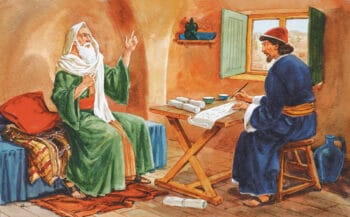
Image © Review & Herald Publishing at Goodsalt.com
This practice was not unusual for Paul. At the conclusion of his letters to the Colossians and Thessalonians, Paul makes a point of adding his salutation with “my own hand” (Colossians 4:18, 2 Thessalonians 3:17, NKJV) as a way of authenticating the entire letter. This suggests that he relied upon someone else to pen the letters for him. Because this reality might raise doubts as to whether the letter correctly represented him—or worse, that it wasn’t from him at all—Paul provided his own handwritten note at the end so that there would be no doubt about the genuineness of his epistle.
Many commentators attribute the variation in literary styles found among Paul’s letters to his use of literary assistants. The same is suspected regarding Peter’s two letters: “Although it is a fact that the style of language of 2 Peter is different from that of the first epistle, this may reasonably be accounted for by the probability that Peter . . . employed secretarial aid in phrasing an epistle he was writing in Greek. If Paul, who was fully at home in Greek, used secretaries, as he quite evidently did, it is even more logical to think that Peter, whose native language was Aramaic, would have done so, and that these secretaries would have exerted a definite influence on the wording of his letters in Greek.”—The SDA Bible Commentary, vol. 5, p. 186.
This suggests that, while remaining faithful to the thoughts and meaning of God’s messengers, the vocabulary and sentence construction might reflect the varying literary abilities of the assistants they employed. It’s the thoughts that are inspired, not necessarily the specific words used to express those inspired thoughts.

Some years ago, I scanned some of Ellen White’s handwritten letters held in a collection in the E G White Research Centre at Avondale University. The paper was pretty fragile, and we had to take great care in handling the documents. I still have those scans and just looking at them again, reminded me that most of Ellen White’s work was written in cursive by hand. She used a steel-nibbed dip-pen until the mid 80s, when she started to use a fountain pen.
Her penmanship was very variable, depending on whether she was writing when bright and fresh, or tired. It must be remembered that Ellen White only had formal education until she had her accident at about 9 years of age. Her spelling was not the best, she split her infinitives, used capitalisation in the wrong places, left sentences unfinished, and to make things more difficult would interline corrections and cross things out. James White in a letter to William White admitted that her work needed the editor’s pen.
Originally her longhand manuscripts were cleaned up and sent to the platemakers for creating tracts and broadsheets. Later, when typewriters became readily available she had secretarial staff who would type up her manuscripts. This required some editing to ensure that the sense of what was written came through. Interstingly the typewriters used to wear out fairly quickly because very early on they realised the importance of making copies and would use carbon paper to make up to 6 copies at a time. The secretaries were heavy handed to ensure that the last copy was still readable. (I know I show my age when I mention that I am familiar with this process. Photocopiers were still to be affordable when I started teaching.)
The lesson today has mentioned the use of “secretaries” in Biblical times. The big difference between the Biblical examples and Ellen White’s time is that in the Bible we only have the finished product. In Ellen White’s case we often have the holograph (original handwritten document) and the final published product. There are differences for all to see. For those who believe in verbal inspiration this poses a serious problem. It is not a problem if you believe that inspiration is less restrictive in its expression.
The Bible is explicitly clear that its entirety was inspired by God (2 Timothy 3:16, 2 Peter 1:20–21, 1 Corinthians 2:13). The inspiration of Scripture is not determined by who physically held the pen, but by God’s involvement in the production of the message. God CANNOT abandon what He starts. God faithfully supervised the production of His Word. The entire process of bringing Scripture into existence was under divine inspiration. For this reason, the Word of God is described and holy and pure (Romans 1:2, Psalm 12:6).
God deemed it fit to partner with human agents to bring His holy Scripture into existence, and therefore, we have every confidence and faith to trust the Word of God to lead us to salvation. The credibility of the Bible is not based on the human hands that God used but on the One who inspired it. From time to time, God has used imperfect humans to bring His purpose come to pass. Therefore, in God’s hands, humans can very useful tools to facilitate God’s kingdom here on earth. Let us me willing to be used by God for the salvation of mankind.
“The inspiration of Scripture is not determined by who physically held the pen, but by God’s involvement in the production of the message” Thanks Brother Mwambi 🤝🤝.
Been asking myself recently how we came up with a 66 books Bible,and have noted that many individuals/ councils were ” to say” too used/ inspired/ driven by the Lord’s Holy spirit in evaluating scripture to know what was useful for our spiritual life /growth/ Nourishment hence coming up the 66 books( 39 Old Testament and 27 New Testament) and discarding some books due to certain reasons.
I believe this is the crux of the matter:”The inspiration of Scripture is not determined by who physically held the pen, but by God’s involvement in the production of the message. God CANNOT abandon what He starts. God faithfully supervised the production of His Word.” The authority and credibility of Scripture rest not on the human agents through whom it was written, but on God, who inspired the message. Human involvement does not diminish divine inspiration. Rather, it demonstrates God’s willingness to work through imperfect human agents to accomplish His purposes. Our confidence in Scripture must ultimately rest in its divine Author, not merely its human authors.
God the chief communicator is interested in involving all in passing His message, that is why He allowed other people to assist in the recording and communication of His message. In Jeremiah 36:4–6, Jeremiah dictated the words of the Lord to Baruch, who faithfully wrote them on a scroll. Similarly, in Romans 16:22, Tertius acknowledges that he served as Paul’s scribe in writing the letter to the Romans. Peter also mentions Silvanus as his helper in writing his first epistle (1 Peter 5:12). These examples provide and demonstrate that as far as the message originated from God Himself, its recording and communication involved the teamwork and cooperation of other people.
This same principle is also evident in the ministry of Ellen G. White, who acknowledged receiving literary assistance from copyists and editorial helpers. These assistants helped improve grammar, arrange materials, remove unnecessary repetition and organise written sections without claiming ownership of the spiritual messages. Their contribution reminds us that divine inspiration does not necessarily eliminate human involvement, skills or cooperation. Rather, God uses different people and their abilities to ensure that His message is communicated clearly and effectively. The central and most important aspect is that while the message originates from God, He can use human hands, minds and skills in the process of communicating His Word.
In the same way He used gifted artisans to create and build His Holy Temple! So why wouldn’t He use various talented individuals to work together as one to deliver His message in a way all could understand. 🙂
“The Bible is not given to us in grand superhuman language. Jesus, in order to reach man where he is, took humanity. The Bible must be given in the language of men. Everything that is human is imperfect. Different meanings are expressed by the same word; there is not one word for each distinct idea. The Bible was given for practical purposes.” – Counsels on versions of the Bible, p. 3.
“The Bible is written by inspired men, but it is not God’s mode of thought and expression. It is that of humanity. God, as a writer, is not represented. Men will often say such an expression is not like God. But God has not put Himself in words, in logic, in rhetoric, on trial in the Bible. The writers of the Bible were God’s penmen, not His pen. Look at the different writers.”—Manuscript 24, 1886
Knowing the Greek language, I disagree with those who say the Bible is very clear to our understanding. If we say that the Bible is very clear, it is most probably because we are taught or brought up in a certain way, or our presuppositions are at their very best or all of the above. The Bible was written in a culture and time we do not fully understand. Just as God partnered with weak human beings throughout history in bringing salvation to mankind, the Bible, which is the product of God’s partnership with frail humans, has its limitations. That is why we seek the Holy Spirit’s guidance while opening the Bible. And again, that is why we have a beautiful branch of study called Hermeneutics and a significant part of our worship services is allocated to something called Preaching. If the Bible is so clear to our understanding, then our preaching services will be like what Christ Jesus did in Luke chapter 4: stand up, read a passage, almost say nothing and sit down.
Apart from the language limitations, lack of historical and cultural knowledge, and careful hermeneutics, there should be an element of humility in our interpretations. Peter recognises that Paul’s letters are hard to understand(2 Peter 3:16), if for someone from the same culture, contemporary and an apostle finds hard to understand, we shouldn’t slight off the hardship at hand. God does not force us to believe the truth, but waits for us to switch off the noises in our minds, to a humble mode of receiving; then we hear his voice. Otherwise, what we hear is not God’s voice but our own noises.
Just as the divinity of Jesus shone through the weak human form, amidst the weaknesses of human work, God shines through His Spirit. This is my humble admonition. God’s wonderful blessings.
Jay, I agree with you that the Bible is not “easy” to understand. That being said, I think we can scare people into thinking only scholars can understand it. I believe lay people can understand the Bible if you put in the effort to read carefully, look at books as a whole, and compare scripture to scripture. It is definitely not an easy task, but if you put in the effort, your understanding will grow.
The cultural factor is very real and we do need to learn as much as we can about the culture of the Bible. However, God knew that Scripture would come from a particular culture and He also knew how long time would last. It would be unfair if He made the Bible incomprehsible to us and I don’t believe it is.
I am fascinated that God would humble Himself to communicate His messages to mankind through such an intricate ; and from my perspective, such a “less than pristine” process as the production of the Bible by human beings.
Clearly God can write. He wrote the Ten Commandments twice on tables of stone. He also wrote on the wall at Belshazzar’s feast. Why would He allow the Scriptures, such a vital literary document, to be written by sinful, erring human beings? Why did’nt he allow the angels to write it. Some of them are definitely writing all the time; making and keeping records of our deeds and words. (I confess that I am using the word “writing” with some degree of caution; since we have Voice Recorders that we place in our clothes pockets)
What was the point He is trying to make to persons like myself who in the year 2026, would be looking on with consternation at such a rough, unpolished methodology of communicating to mankind ?
Without pretense, I give Him two “thumbs up” for sending Jesus to planet Earth to live amongst us and to show us who God is like. Could it be that the best way to understand sacred Scripture is through “the lens of the Emanuel” ? Could that be the “genius technology” that will span the ages?
This comment touched my soul’s search for understanding of bible writing. In the beginning after losing face to face contact with GOD; GOD immediately made provisions to keep us and to restore us. Through us, his higher created being he gave the Gifts. The ability to think and receive spiritual thought processes allows us to effectively learn and spread the good news of Jesus.
I think that the Spirit is prompting me to expand on that term ” the lens of the Emmanuel”.
It was said of Him -” He grew up before him like a tender shoot, and like a root out of dry ground. He had no beauty or majesty to attract us to him, nothing in his appearance that we should desire him. He was despised and rejected by mankind, a man of suffering, and familiar with pain. Like one from whom people hide their faces he was despised, and we held him in low esteem.” Isaiah 53: 2-3 NIV
My beloved brethren I see myself in the mirror. Just as they despised the Man due to his appearance similarly I despised the process through which we received the Bible
Yet the charisma of that Man is mirrored in the Book. The charisma that triumphantly declares-“And I, when I am lifted up from the earth, will draw all people to myself.” John 12:32 NIV.
Matthew, Mark, Luke and John all have words from Jesus. He was not the author but His message has continued throughout the years. May we each look to the message with thankfulness.
The use of literary assistants is nothing new and is still done today. The important thing is that the message was accurately conveyed. This was of utmost importance. It’s not like they were given literary license to fabricate things. Literary assistants work very closely with the people they are writing for and they are or were followed up by the story teller.
Today we have word processing programs with spelling and grammer checking, talk-to-text, “ghost writers”, proofreaders, and editors to help in publishing an article, or book. While they are types of literary assistants and may suggest edits, the goal is to best convey the message or story in an understandable fashion as possible. Personally, I don’t prefer perfectly polished prose as it seems to lose the personality of the writer.
I have no problem with knowing that some authors of scripture, or even Ellen White herself used literary assistants knowing that they were working under the supervision and approval of the author, who were guided by the Holy Spirit.
Thinking about the written, oral, and physical forms of transmitting God’s messages: there still remains the essential aspect of translating/understanding His Message. No matter the sophistication of the assistant, mere Pen and paper cannot do that by itself. Jesus is recorded saying:
John 16:7-14
”Nevertheless I tell you the truth; It is expedient for you that I go away: for if I go not away, the Comforter will not come unto you; but if I depart, I will send Him unto you.
And when He is come, He will reprove the world of sin, and of righteousness, and of judgement:
Of sin, because they believe not on me;
Of righteousness, because I go to my Father, and ye see me no more;
Of judgment, because the prince of this world is judged.
I have yet many things to say unto you, but ye cannot bear them now.
Howbeit when He, the Spirit of Truth, is come, He will guide you into all Truth: for He shall not speak of Himself; but whatsoever He shall hear, that shall He speak: and He will shew you things to come.
He shall glorify me: for He shall receive of mind, and shall shew it unto you.”
I support Jay’s finding that, no matter the vehicle used, the Bible is not ‘clear’ at all when read without the guidance of the Holy Spirit. I agree with Him when He suggests that He [God] waits for us to: “switch off the noises in our minds, to a humble mode of receiving; then we hear his voice.”
A message exciting and leading one unto righteous living can be scoffed at and dismissed as unimportant or even false by others. No matter by which vehicle God chooses to reveal Himself and His Truth, the only true, spiritual “literary assistant” is HIS Spirit of Truth who prompts His Truth to our heart and mind – Cor.2:10; John 14:26.
The good thing about God is that He respects people’s styles. He wants them to help color the ideas He has for them! God is amazing and created every human being differently, showing how creative He is! God is happy when humans join their strength with His.