
Monday: The Authority of Jesus

Daily Lesson for Monday 30th of November 2026
What was the basis of Jesus’ authority? What was the evidence of this authority? See Matthew 21:23-27 and John 17:2.
While Jesus was teaching, the priests came to Him and demanded to know who had given Him the authority to do this ministry. After all, Jesus had not graduated from any of the local schools, nor had He received training in the traditional schools of the rabbis. Rather than answering their questions, Jesus pointed the way to the answer, asking His interrogators about the unmistakable authority exhibited by John the Baptist. By refusing to answer, they not only rejected the power of God that crowned the ministry of John but also the authority of Jesus who, like John, was also sent by God.
What do the following verses also tell us about Jesus’ authority? Matthew 7:28-29; Mark 1:21-27; Luke 8:22-25; Luke 9:1; John 5:25-27; and John 7:38.
All authority belongs to Jesus as humanity’s Creator (John 1:3) and Savior (Romans 3:24). He is the Word of God. The divine authority possessed by Jesus during His earthly life and ministry could not be imitated or self-generated by anyone. Jesus’ teaching astonished listeners because He taught as One having authority (Matthew 7:29).
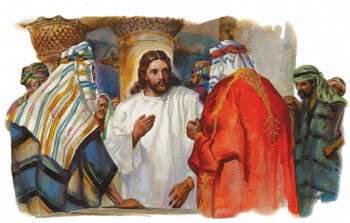
Image © Review & Herald Publishing at Goodsalt.com
All the Gospels record Jesus’ otherworldly prophetic authority. Jesus forgave sins (Mark 2:10-11), drove out demons (Mark 3:15), and knew what people were thinking (John 2:24-25). He raised the dead and offered eternal life (John 10:28). While on earth as our Redeemer, Jesus exercised authority given to Him by God the Father (John 17:2), and He depended on and cooperated with the Father (John 5:19) at all times, often referring back to the Scriptures, which, He claimed, testified about Him. Jesus also possessed absolute authority and could delegate that authority to His disciples (Mark 6:7). As the Word of God, His testimony also came to the prophets through whom He spoke (Revelation 19:10).
|
Even with all the evidence Jesus gave, some people still rejected Him. How can we be careful not to fall into the same trap of unbelief, given all the reasons we have to believe? |

If you want to practice medicine in Australia. You need to satisfy the authorities that you are qualified and registered to practice in this country. You have to satisfy the registration board that you have done an approved medical degree and done the supervised residency requirements. Sometimes it is hard to get approval if the study and residency has been done overseas and nobody here knows whether the training has met the requirements of the Australian authorities. There have been cases where overseas medical practitioners have come here and set up practice without registration. Typically, something goes wrong and then there is a big enquiry.
The chief priests and temple scholars had a problem with Jesus. They were the committee that had studied the law and knew all about power and authority in the church. They were the authorising body and were asking Jesus for his papers of authority. He had been healing and teaching people and was becoming quite popular and that rattled the committee quite a bit. They were also a bit devious because they had heard him talk about hypocrisy and corruption, so they thought they could catch him out and prove he had no authority.
Jesus used a classic Jewish response. He answered their question by asking them a question. Oops. They quickly realised that either answer was going to implicated them and so they refrained from answering. I understand their predicament. I found myself in a similar situation in social circumstances with my doctoral colleagues where I was asked a question about an embarrassing situation that had arisen. I answered by saying to the group that I reserved my judgement. But I did work behind the scenes in private for a good outcome.
Jesus chose not to enter a public debate at that time. But in different circumstances he stated clearly his relationship with the Father. The Gospel of John almost has that as its theme, and differs markedly from the Synoptic Gospels in that respect.
On thing that is clear in the Gospels is that Jesus let his actions show his authority. Mark 2 tells the story of the paralytic man who was let down through the roof by his friends. Jesus. Jesus first words were:
What a challenge to the religious authorities! Jesus asked which was harder: to forgive sins, or to heal the paralytic? Then he healed him, letting his actions speak for themselves. And once again, the religious authorities were facing a dilemma.
Is there a takeaway from all of this for us? Maybe it is as simple as letting our actions show who is our authority on spiritual issues.