
Thursday: “Hold Such Men in Esteem”

Daily Lesson for Thursday 29th of January 2026
Read Philippians 2:25-30. How does Paul describe Epaphroditus? What specific attitudes and actions of this Christian worker reveal his character?
Epaphroditus is mentioned only in this letter, but we learn quite a bit about him from the few brief mentions that appear. Judging from his name (which refers to the cult of Aphrodite), he was converted from a pagan background. Calling him a “fellow worker” suggests he was active in ministry, perhaps working alongside Paul in Philippi. Being a “fellow soldier” (compare Philippians 1:27) probably refers to conflict Epaphroditus faced in spreading the gospel, willing even to risk his life (Philippians 2:30).
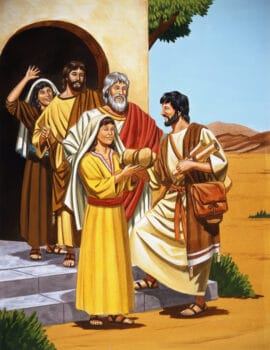
Image © Lifeway Collection at Goodsalt.com
As the “messenger” (Greek: apostolos) appointed by the church in Philippi, Epaphroditus is sent to minister to Paul in prison and to care for any other needs he may have (Philippians 2:25). He was the one the Philippians entrusted with their financial gifts for Paul (Philippians 4:18). These offerings were critically important because whatever food, clothing, bedding, or other necessities Roman prisoners might need would have to be purchased at their own expense or brought to them by family and friends (compare Acts 24:23). Near the end of his second imprisonment in Rome, Paul asked Timothy to “do your utmost to come before winter” and “bring the cloak” left at Troas (2 Timothy 4:13,21, NKJV). Paul would apparently need this thick woolen overcoat in his cold stone cell. It was also Epaphroditus who was entrusted with carrying this epistle back to Philippi (see Ellen G. White, The Acts of the Apostles, p. 479).
Perhaps because of the problems in Philippi (see Lesson 4), Paul “considered it necessary” to send Epaphroditus back sooner than anticipated, and thus urges the Philippians to “welcome him in the Lord with great joy” (Philippians 2:29, NIV). Paul wants to make sure they do not worry about his own situation in jail. He also underscores that Epaphroditus is the kind of person Christians are to hold in high esteem, not because of their wealth or social status but because of their sacrificial spirit in following the example of Jesus (Philippians 2:6-11,29-30; compare Luke 22:25-27). The Greek word for esteem or honor appears only a few times in the New Testament: for the centurion’s servant who was “valued highly” (Luke 7:2, NRSV), for those who are shown honor by their placement at a feast (Luke 14:8), and of Jesus as the “precious” cornerstone (1 Peter 2:4,6). For Epaphroditus to be included in that group, he must have been, indeed, a faithful man.

When you read Paul’s letters, apart from his Christ-centred message, notice the importance of the Christian community. He mentions people by name, often mentioning their helpfulness and asking the community to uphold them. In Philippians, he mentions Timothy, Epaphroditus, Euodia, Syntyche, Clement, and another un-named fellow worker. Collectively, he mentions the Elders and Deacons as well as the congregation at large. He also mentions the believers in the household of Ceasar.
He praises some and asked others to learn to get along. He encourages the congregation to get alongside those who are in conflict. Paul understands that the Gospel has to be active within the matrix of human social relationships. This was not a letter of dry theology but a recognition of the importance of human relationships in fostering spiritual growth.
I have mentioned that I am active in the local U3A movement, U3A is a world wide secular movement with the aim of keeping older people socialised and interested in learning and developing their skills. It is delightful to interact with these folk as we go on outings together, learn to play ukuleles, observe birds, take part in exercise and relaxation programs, and so on. They all look out for one another and support one another. One 92-year-old lady lost her driver’s licence and could not drive to her Balance ‘n Bones exercise class. There were many volunteers who gladly drive her to and from her class every week.
It has been a great model to follow and I am glad our Church is starting to see the importance of social interaction too. Spontaneous small special interest groups have formed in our local church, providing us with opportunities to get to know one another better. This is where love can shine and where prayers can be listened to and answered. Theology is not knowledge in a vacuum. It is threaded through the network of human interaction.
Reread Philippians and observe how important people and their relationships are to Paul. Then, think of your own church community and ask yourself, are these people just Sabbath acquaintances?
[Just out of interest, I surveyed Colossians as well for its people-mentions. The list is even longer: Timothy, Epaphras, Tychicus, Onesimus, Aristarchus, Mark, Barnabas, Justus, Luke, Demas, Nymphe, and Archippus.]
Society is fond of celebrities on whom valuations and comparisons are made. Society esteems them so highly that at times these celebrities have become something of a scorecard for others. For Paul, when he advised honouring these men, his perspective was not that of “honour” given to celebrities, but rather an honest description; for example, he explains Epaphroditus’ sickness and says that he “nearly died” (Philippians 2:27). The exact same phrase is used in verse 8 to describe Jesus becoming obedient to the point of death (Philippians 2:8).
Time being relative, the Philippians might have felt that Epaphroditus had taken a super long time to reach Paul, as there was no confirmation whether the gifts, including cash, given to Epaphroditus reached Paul, and coincidentally Paul has not made such confirmation (Philippians 2:25–26). These were moments when the Philippian church wondered: What happened to Epaphroditus?
The truth is that not all of us will suffer a terrible sickness as Epaphroditus did. Not all of us will be imprisoned for our faith as Paul was—but all are encouraged to imitate these men as they imitated Jesus Christ (Philippians 3:17). All these men have parallels to the life of Christ as described in verses 4–8 of this same chapter (Philippians 2:4–8). Jesus himself looked not to his own interests, but to the interests of his Father and the need of his people. He was obedient unto death and sacrificed himself willingly on the cross to take away the sins of the world.
In Epaphroditus Paul propagates still the themes of faith proven characters, lights shinning in the dark, living sacrifices of faith that run through this weeks lesson. In bright colors Paul paints Epaphroditus as one concerned of his brothers back in Philipi than his own health that went low to near death. The bottom line of Epaphroditus is faithfulness under test and unbecoming life circumstances. There is a lesson for us in Epaphroditus.
Epaphroditus was sick unto death but God in his mercy healed him. Paul mentions that this healing blessed him or rather relieved him of “sorrow upon sorrow.” A blessing on one amongst us has ripple effect on many around him/her.
Example. That’s what we are. Because of our ancestors’ choices, we became the “streaming” of the Universe. Other worlds are probably watching the Earth’s stage development. This novel is close to its end. Jesus is about to come for the second time, and all the planet’s drama will close. Our primary role is to be prepared and let others know about God’s love for humanity.
Like Thimoty, Epaphroditus was a young man dedicated to the ministry. He was reliable and trustworthy to be chosen as the liaison between Paul in prison and the church. As a prisoner, Paul depended on him for his supplies. We thank God for Thimoty and Epaphroditus as well as others like them.
Philippians 2:25–30 reminds us that the deep care early believers had for one another wasn’t just a happy accident; it was a result of how they lived out their faith. Look at Epaphroditus: he nearly died in service, yet his biggest worry wasn’t his own health—it was the fact that his church family back home was worried about him! That kind of love is because of shared sacrifice, a common mission, and our identity in Christ.
So, how do we get to that same place today?
It starts when our walk with God shifts from being about “me” and starts being about “us.” When we truly see ourselves as one body—not just people who happen to sit in the same pews—care becomes a part of our identity rather than just an occasional thing to do. This mindset comes about when together we labor for the Gospel, pray,, and carry each other’s heavy burdens. Mission doesn’t just unite us outwardly; it greatly increases our love for each other.
The early church was close because following Christ cost them something. It’s a sad truth, but as our comfort increases, our care for one another often decreases. Recognizing this, we have to intentionally re-center on Christ’s mission and adopt His “self-emptying” mindset, and that deep love will begin to grow again. When we do have this experience, we aren’t just being nice; we are reflecting the very mind of Christ.
Why was Paul so gracious in describing Epaphroditus, according to Philippians 2:25-30. Paul’s words about Epaphroditus are not mere throwaway compliments. The words are pastoral and highly spiritual. Let’s take note of how Paul affectionately refers to Epaphroditus:
– “My brother” – Paul places Epaphroditus on equal footing and not a subordinate assistant, but part of his family.
– “Co-worker” – Paul says that Epaphroditus isn’t just a helper, he is a partner in his mission and labour.
– “Fellow soldier” – Paul says that Epaphroditus is at the warfront with him and not just an errand boy
– “Your messenger and minister to my need” – Paul’s is telling the Philippians that Epaphroditus represented them well, and his service to him was meaningful and complete
What spiritual lessons can be learned from Paul’s generosity of words for Epaphroditus?
1. Paul teaches us that good service should be acknowledged and appreciated.
2. Paul teaches us that faithfulness is important to produce unity, which is critical in the gospel mission.
3. Paul teaches that there is always a risk when we step forward for mission.
4. Paul teaches us that we should tell good things about others loudly and on record.
Paul is not simply praising a man but giving an illustration of those who have stepped forward for Christ’s sake. They do not cling to their safety; they humble themselves, and they risk their lives for others.
Let recognition be given to first those who for all dedicate their services to GOD just like Epaphroditus and not some wealthy folks.