
Tuesday: Head of the Body (the Church)

Daily Lesson for Tuesday 17th of February 2026
Read Ephesians 1:22 and Colossians 2:10. What does “head” mean in these passages? What does Paul mean when he calls Jesus the “head of the church” (Ephesians 5:23)?
It is natural to speak of the head in a metaphorical sense in reference to a leadership position, as reflected in countless languages across the globe. We find similar use throughout the Old and New Testaments. Notice how “head” is used in the following verses:
-
Exodus 18:25—Moses chose “able men out of all Israel, and made them heads over the people, rulers of thousands, rulers of hundreds, rulers of fifties, and rulers of tens.”
-
Numbers 31:26—“the heads of the fathers’ houses” (ESV).
-
Deuteronomy 28:13—God will make Israel “the head, and not the tail” if they will obey Him.
-
Isaiah 7:8—“For the head of Syria is Damascus, and the head of Damascus is Rezin.”
-
Hosea 1:11—“The children of Judah and the children of Israel shall . . . appoint for themselves one head” (NKJV).
-
Micah 3:9—“You heads of the house of Jacob and rulers of the house of Israel” (NKJV).
-
1 Corinthians 11:3—“The head of every man is Christ.”
Thus, Christ as the head of the church provides leadership, guidance, and nourishment for the church’s unity and growth (see Colossians 2:19).
Read 1 Corinthians 12:12-27. Here also Paul describes the church as a “body.” What other aspects of the church are conveyed by this metaphor?
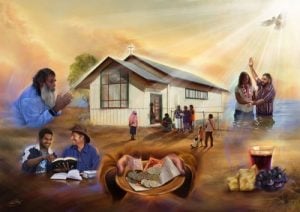
Image © Phil McKay at Goodsalt.com
Just as the body cannot live without the head, when a part of the body is lost or injured, life can be much more difficult. We often don’t recognize how important something is until we lose it.
|
If you had to give up a limb or an eye, what would you choose? What does this tell you about how vital each person is as a member of the church? |

Very early in my teaching career I taught at the Hawthorn Adventist Highschool in Melbourne for three years. Then I taught at Lilydale Adventist Academy for six years. Becoming weary of all the extra duties of academy life, I asked for a move and was transferred back to the Hawthorn School. After six years the whole staff and student body had changed, but it was uncanny that so much felt unchanged. I remarked at the time that even the arguments in the staff meetings were still the same ones we had argued about six years earlier.
Until then, I had never thought of organisations as “living creatures”, with a mind of their own. But subsequent observations over a lifetime of teaching in institutions has convinced me that this is true. I have also noticed that they also die, but that is another story.
So, the idea of the Church as a living creature with a head and body parts is quite apt. And if we extend the idea a little bit, a living creature can typically move, respond to its environment, interact with other creatures (institutions), and I think we also have to consider that it can suffer from disease and require medication.
Today’s lesson highlights the importance of Christ as the head, and ultimately the life force of the Church. In this context, there is another parallel that I would also like to consider. Most of us have never seen the functional part of our head, the brain. It is hidden away behind our skulls. We recognise we have a brain because we see the visible parts of the body functioning in a coordinated and responsible way.
The spiritual analogy is that Jesus is not physically visible to us today and the evidence that he is the head (brain) of the church is that the body functions in a coordinated and responsible way. In our discussions, we often emphasise personal spiritual experience. That is important, but evidence that Jesus is our head must be in the function of the body.
That is one reason why we need to read Paul’s epistles as pastoral care letters. He is teaching us how to care for “the body”.
A writer wrote,”God is dead and we killed him”.he tells people to figure out living in a world without God.and my friend has bought the idea ,,how can i help a friend out??!
Have you read anything of Nietzsche, the author of the above quote? The God that he said we killed probably deserved to die. Nietzsche maintained that the God of religion was in a master-slave relationship with us. If we want help people understand the real God, we have to show we have a relationship with a loving, caring God. We cannot show that we are in a good marriage by showing people the paperwork. It’s the relationship that speaks the truth.
Jesus is the founder and builder of the church. “I will build my church, and the gates of hell shall not prevail against it” (Matthew 16:18, NKJV). The church belongs to Jesus Christ because without Him there is no church. This is the assembly of believers who trust in the salvation of Jesus. It an assembly of the redeemed sinners joined together by the Holy Spirit. The church is not a human invention. It is a spiritual entity that is assembled for divine purpose. The church is holy as its founder and builder. This is a sanctified institution which no one should corrupt. How can the church of God be corrupted?
1. It is sad to note that the sanctity of scripture is replaced by human opinions and mixing culture with the gospel truth. Sin is being redefined.
2. The abuse of power and manipulation of leadership is quite prevalent among many congregations. Greed, financial scandals, authoritarian control and intimidation are some of unethical practices in congregations.
3. In some quarters the church has become a commercial enterprise rather than a spiritual enterprise. Financial gain is more championed than saving souls.
4. In some congregations, the church has become a platform for promoting tribalism, sectionalism, politics, elitism, and materialism.
5. The mission of the church (evangelism) is replaced with other agendas such as entertainment, comfort, social activism, material prosperity and politics.
It is time we seriously reflected what is our individual roles to this institution which Christ die for. Am I an enabler or an hinderance?
A Case For The Children’s Church.
Jesus Christ is also the Head of the Children’s Church.
The Children’s Ministry of the Seventh-day Adventist Church is well structured to provide for the spiritual needs of the children, according to their age groups.The ministry oversees the children and youth church and they have different classes ranging from, Beginner – Age 2, Kindergarten – Ages 3-4, Primary – Ages 5-9, Junior PowerPoint – Ages 10-12, Real-time Faith – Ages 13-14, and Cornerstone – Ages 15-18. The whole arrangement is to help nurture the children properly and integrate them easily into the adult church.
But how have we cared for them?
Are they worshipping in a conducive environment?
Have we given them well trained teachers – teachers trained in our 28 fundamental believes and doctrines?
How often do we provide study materials for them?
Have we provided learning gadgets for them?
How often do church leadership visit them?
How seriously do we take their many questions?
Many years ago I served as Children Ministry’s leader both in the local church and the district, the experience then was a mixture of both intrigue and suffering – a situation where there were no conducive halls for worship and anytime it rained we either quit or get drenched.
Let me make this assertions convincingly;
1. I have felt the presence of the Holy Spirit when the children worshipped.
2. You can find pure love and kindness in the Children’s Church.
3. We can discover leadership experts in the Children’s Church.
4. We can discover ministers in the Children’s Church.
5. If we care for them adequately, provide their study materials often and answer their many questions with facts and eagerness, we will see less flight of our children from the church.
“And those members of the body which we think to be less honorable, on these we bestow greater honor; and our unpresentable parts have greater modesty,”
“but our presentable parts have no need. But God composed the body, having given greater honor to that part which lacks it” – 1Cor. 12:23,24
Jesus Christ is also the Head of the Children’s Church.
I hear you about the value of children and the necessity of ministering to them.
But I confess I am skeptical of “Children’s Church,” which separates children from their parents during the church service. Apart from that, separate “Children’s Church” is usually only an option for large churches with multiple pastors. (We were counseled to form smaller churches, rather than to congregate in large ones.)
I think we need to take a nuanced approach to “Children’s Ministries.” Pastors need to remember the children in their congregation and use illustrations that children can understand – just like Jesus did. If the pastor sees that children aren’t paying attention, he needs to draw them in. I know some pastors who use handout worksheets for the children before each service. (The value depends on how the sheets will be integrated with the sermon and how well they engage the children.)
Small churches do not have the resources to offer multiple age-based children’s Sabbath School classes, and I’m not even sure that’s always the best idea. Children from the age of 12 on up are perfectly capable of understanding spiritual truths directly from the Bible, providing the Sabbath School lesson facilitator keeps the young ones in mind, asking questions to engage them. (Sabbath School lessons should NEVER be presented as lectures.)
In small churches, all children under 12 can be taught in one class (that was the case when I was young), with the leader adapting the presentations and questions to those present. Older children, including 12-year-olds and older, can be tasked with various ways of ministering to the younger ones, mentored by an adult leader.
In other words, our churches need to become more focused on ministering to children, rather than relegating the job to separate “Children’s Ministries.” This also helps integrate children into the church body by giving them tasks such as Scripture reading, prayers, and special music. And let’s not forget that 12-year-olds and above are capable of organizing and presenting a full church service.
Integrating children with the adults in church can prevent what too often happens now: Children who age out of the entertaining “Children’s Ministries” find adult services boring and simply stop attending as teens.
Truth be told, too many adult services really are lifeless and boring, and we can’t blame the youngsters. We need to be ready to break out of dead forms to allow new life to thrive in our churches.
I agree. Children’s church is okay as a treat, but I don’t like to see it regularly, even in churches that are big enough to have it. I’m glad that I was part of the church service as a child and I’m also thankful for the pastors who really tried to reach children. Pre-school children probably don’t get much out of the sermon, but school age children can if there are interesting illustrations. The fact that many pastors now use powerpoint also helps – having something to look at is beneficial.
I don’t deny that there is a need for age groups to be together, especially as we need to connect our teens and young adults. We want them to find godly spouses after all! But I do feel there is always the danger of everyone being in silos. Yes, have special ministries, but the larger church should be most important to everyone. We need each other. And we benefit from interacting with people who are different from us.
Many years ago my husband introduced to the church board the possibility of a Children’s Church. It was voted down with not much consideration by several men who were Elders at the time. “ I will not withdraw my kids from the main service”. Ten years later these kids who are now young adults are all gone from our church and are not practicing any religious beliefs they supposedly learned in the main service. We have to do whatever it takes to engage the children in worship.
I agree totally that “We have to do whatever it takes to engage the children in worship.” Children’s Church can fill a role in larger churches. However, in all churches, we need to become more aware of the children and their needs. Jesus was only 12 when He engaged the teachers in the temple. Are we respecting our 12-year-olds enough to recognize that they are capable of thinking and engaging in discussions on spiritual topics?
Jesus taught at a level that children could understand. We need to do the same.
Wow! Preach on. This is unfortunately so true.
The head and body are profoundly dependent on each other, as no one desires a bodiless head or a headless body. The head organizes and structures the body to function; it orients the body and gives it direction. Thus, plainly speaking, the head gives purpose to the body and empowers the rest of the body to function as expected. In the same way, the direction, strategy, and behaviour of Christians must be mandated by Christ our Head. As it is written in Colossians 1:18 (KJV), “And he is the head of the body, the church: who is the beginning, the firstborn from the dead; that in all things he might have the preeminence.”
The Church must not create its own direction independent of Christ; rather, the Church must seek His will in all decisions, plans, and actions. Just as the body functions properly by receiving signals from the head, so the Church cannot function effectively without submission to Christ’s will. This calls us to align with Him through His Word, prayer, and obedience, recognizing that true growth and unity come from Him. Scripture affirms this in Ephesians 4:15–16 (KJV): “But speaking the truth in love, may grow up into him in all things, which is the head, even Christ: From whom the whole body fitly joined together and compacted by that which every joint supplieth… maketh increase of the body unto the edifying of itself in love.”
By His resurrection, we know that Christ is not a passive Head, but living and active, empowering every member to realize and fulfill their purpose. Therefore, Christianity is a call to commitment—to reflect His character, follow His direction, and uphold His preeminence in all aspects of our lives. Christ alone orients the Church, giving it clarity of purpose, unity of mission, and the authority to function effectively under His lordship.
If the head is separated from the body, neither survives…
Christ is the head of the Body(Church). This means that;
a).He-Jesus has authority over the church and therefore,any thing done in the church must drive authority from Him. He is the one leading and guiding the church. Sadly enough,many churches currently are not just doing their own things .
b).He is the one that nourishes( feeds) the church: any doctrine should be rooted in the Bible and directed by Jesus. Surprisingly,many churches have dug their own wells. Their teachings contradicts what Christ directed.
c). He saves- we only get saved by Him. No any other name that we are saved through.
d). He leads the church: he is the good shepherd. He leads the church to the fountain waters.
f).He loves His church to the point of giving His life for her.
Christ — Head of the Body
If I am to give up a Limb or an Eye……
The question feels very uncomfortable.
Why?
Because I don’t want to lose either and each serves a unique function.
The loss of one permanently changes the body.
An eye gives vision.
A hand gives ability.
A foot gives mobility.
I might survive without one, but I will not function the same.
Thus teaching is that the in the Church….
No Member Is Disposable
In 1 Corinthians 12:21 Paul says:
“The eye cannot say to the hand, ‘I have no need of you.’”
In Christ’s body:
The visible and invisible members matter,The preacher and the quiet intercessor matter,The leader and the faithful supporter matter, Just because a part is less visible does not mean it is less vital.
Any kind of loss affects the whole body, When one member withdraws, suffers, or is wounded:
The whole church feels it.
The mission weakens.
The harmony shifts.
Paul even says:
“If one member suffers, all suffer together.”
There is no isolated Christianity. Therefore the head determines function, the body is instructed by the head.
As Head of the Church:
Christ supplies life,
gives us direction and
assigns roles.
Finally I can’t choose between losing an eye or a limb, why because every part is precious, they are it part of me.
In the same way, every believer is precious because they belong to Christ. I therefore cannot afford to despise small roles, I must not idolize visible roles, I must protect unity and must care for wounded members.
Because harming a member is harming Christ’s body.
Just as Jesus said to Saul:
“Why do you persecute Me?” (Acts 9:4)
Persecuting believers was persecuting Christ Himself and that is how deeply connected the Head is to His body.
The same way I would be so grieved of I lost a limb,is the same way Christ is grieved when a member is lost, let’s learn in Christ to remain as one.
Diversity,equity, and inclusion prevail in the kingdom of God. Children of God come from diverse backgrounds,with diverse abilities and talents but under God, they are all included equally to serve in their unique ways in God’s kingdom.
If I had to give up one limb, I’d choose the one I could most realistically adapt to losing, because medical advances like prosthetics have made it possible for people to still live full, active, and meaningful lives. Many individuals with limb loss continue to work, run, serve, and accomplish incredible things. While a prosthetic can’t fully replace what was lost, it can help restore function and independence in remarkable ways.
Spiritually, this brings to mind how Scripture describes the church as one body with many members (1 Corinthians 12:12). At times, however, the church can function like a body compensating for missing limbs—depending heavily on a few faithful members while others remain distant or only loosely connected. Outward involvement may be present, but without true commitment, accountability, and spiritual connection, the body does not function as God intended.
The church was never designed to rely on a handful of people doing all the work. God has given each believer a measure of grace and a role to fulfill (Ephesians 4:7). Just as every part of the human body has purpose and value, every member of the church is needed for it to be healthy and whole.
When only a few are actively serving while many stay disengaged, the body grows weak and strained. The goal is not a display of surface-level faithfulness, but a living body made up of members who are genuinely connected, committed, and working together in unity.
Unfortunately, as human beings, we may not value things as we should. And the feeling of loss can be piled on as one more. Thank God, His plans for us are for gain! He offers us peace through an infinite force of LOVE.
I am guessing the last question was meant to cause us to squirm and wish to never have to make that choice.
If it was one eye, I would give up the eye. But if it was both eyes, I’d sacrifice a limb.
Yes, we can survive without either, but there would always be a deficit. The same is true in the body of Christ.
https://ssnet.org/blog/how-a-proper-understanding-of-the-heavenly-trio-keeps-families-and-churches-from-falling-under-a-dictatorship/
This blog really emphasises how headship of Christ interpretations can make or break our family/church communities
I would give up one of my eyes, so I could still run or walk to show or teach others the way through Christ….
Please carry your bibles with you, be prepared for questions and do your best answering them, and when in doubt, go to the White writings available on line, type the question or concern or emotion or whatever in the search engine….knowledge is available
And all things are possible through God.
I’m blessed to be alive and texting this comment, sending love to all my sisters and brothers in/through Christ….we must all love each other and keep moving forward day by day, sometimes minute by minute….thank you for commenting and making me feel less alone in a dark world
Matthew 16:18
[18]And I say also unto thee, That thou art Peter, and upon this rock I will build my church; and the gates of hell shall not prevail against it.
Church belongs to Jesus. Without him no church.