
Thursday: Commandments of Men

Daily Lesson for Thursday 5th of March 2026
Read Colossians 2:20-23. How do you understand Paul’s admonitions in light of the other elements discussed in this chapter?
As in his epistle to the Galatians, Paul characterizes the concern over keeping Jewish ceremonies as “the basic principles of the world” (Colossians 2:8,20, NKJV; compare Galatians 4:3,9). In other words, like the earthly temple, these things belong to the earth, but our citizenship is in heaven. We need not be encumbered with the ceremonial law because it merely foreshadowed the reality that we now enjoy through Christ. That is, even though originally given by God, these ordinances, having served their function, are no longer needed.
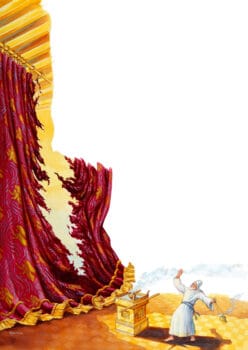
Image © Review & Herald Publishing at Goodsalt.com
Because all these regulations were done away with at the Cross, as indicated by the divine hand rending the temple veil (Matthew 27:51; compare Daniel 9:27), Christians (including Jewish-Christians) are not subject to these regulations. By submitting to them, we would actually be identifying ourselves with this world, which is passing away, in contrast to the new world promised us in Christ.
After all, we look forward to “new heavens and a new earth, wherein dwelleth righteousness” (2 Peter 3:13) and not merely a renovation of this old one.
Besides the fact that Pharisees and scribes had added additional human requirements on top of the Mosaic regulations (see Mark 7:1-13), the perpetuation of Old Testament ceremonies, which had been fulfilled by Christ, could no longer be considered divinely required, but only as humanly imposed duties. Indeed, it seems that they were becoming a burden to faith, as opposed to something that would enhance it. It’s so easy to start to look at doing all these things as not only making oneself superior to those who don’t, which is bad enough, but also perhaps even subtly as somehow being meritorious for salvation, a trap into which we don’t want to step.
Throughout Christian history, Bible experts have succumbed to the temptation to make religious pronouncements, usurping the role of the Holy Spirit in guiding believers as to what the text means. Christ Himself is the fountain from which springs the truth of the Scriptures as taught by Paul and the other Bible writers.
|
How can we make sure we understand that our only foundation for salvation is from what Jesus has done for us, outside of us, in place of us—regardless of whatever He does in us? |

I need to say this very carefully or you will get the wrong idea. Hopefully by the end of this comment, you will understand what I am saying.
In science we sometimes have to ditch old ideas and explanations as we get more information and better understanding. For example, initially when people first started thinking about matter, they thought it was continuously divisible. Then as we learned more, we found that matter was best described as atoms. Later still we learned that atoms comprised heavy nuclei surrounded by space occupied by electrons. Now-a-days we have a whole zoo of quarks, bosons and others that make up matter and better explain what we observe. Scientists don’t give up a good working model easily and the battles between our understanding make for interesting reading.
The history of Judaeo-Christianity spans a similar revolution in thinking. When we really understood the mission of Jesus, the old legalistic approach, which did serve a purpose in developing our understanding was no longer necessary. The life and teaching of Jesus shrugged off the ceremonial teaching metaphors and focused on the love of God and the building of relationships between him and one another. This was what we mathematicians sometimes call a singularity. In maths a singularity is a point where something happens which we cannot really define, but we know what leads up to it and what comes after it.
It is probably a bit simplistic, but legality led up to the cross and love followed it. I must quickly add that description is about our understanding – it was not a change in the way God works. In the science model I used earlier, matter did not change as we developed new ways of describing it. It was our understanding that changed.
Sometimes we confuse ourselves and we want to hark back to the legality bit while we are living in a loving relationship experience. I believe this is what Paul is saying in Colossians.
Listen to this:
… and again:
At this point, it is probably worth asking ourselves, how much of our spirituality is associated with conformity (legalism) and how much is involved in sharing and spreading the love of Jesus to one another (relationships)?
It is ironical to note that those who claim to know the commandments of God are the ones who put in place the “commandments of man”. For instance, the Pharisees of the old, claimed to be the custodian of God’s law and yet they went a head and formulated the “commandments of man”. Anyway, what are the “commandments of man”? These are man-made religious rules and regulations which are uplifted to the point of divine authority. They are created by man, and they are treated as if they are required for salvation. They are not ordained by God in scripture for salvation. Why is it that those who know the commandments of God, are the ones who put in place the “commandments of man” (Colossians 2:20-23)? What is the danger of the “commandments of man”? What are the examples of the “commandments of man”, in our time?
Let it be noted that the “commandments of man” are not essentially wicked in themselves. In many times they are put in place to instil some sense of human behaviour, control, discipline, morality and prevent sin. However, Paul says that they only have “an appearance of wisdom” (Col. 2:23) and they lack power to transform the heart. They can change outside behaviour but not the inside. Paul cautions that the “commandments of man” have inherent risks:
1. They become the center of focus and not Christ. In a very subtle way they swift attention from Christ to man-made laws.
2. They tend to promote legalism as they are treated as divine and as standard for salvation.
3. They promote pride to those who observe them and a sense of alienation or despair or guilt to those who fail to observe them.
4. They only focus of external behaviours and “of no value in stopping the indulgence of the flesh” (Colossians 2:23).
The “commandments of man” appear in our day in different ways; dress code, dietary practices, worship styles, cultural practices, religious rituals (fasting), and church traditions. Let it be reiterated that these rules are not evil in themselves but by the moment they are elevated to divine authority and presented as necessary for salvation, they cause a problem. Paul’s message to the Colossians and by extension to us today is that Christ is sufficient (Col. 2:10). Jesus warned against the “commandments of man”.
“Their worship is a farce, for they teach man-made ideas as commands from God. For you ignore God’s law and substitute your own tradition.” (Mark 7:7-8).
How do we draw a line between cultural practices and Christian decorum? For example, in my church, the elders and pastors wear a suit and a tie when they officiate during the worship service. Someone who shows up with jeans will not be allowed to serve as a presenter in the service. Is this tradition or divine? Other examples are jewelry, alcohol, coffee, consumption, smoking, etc. Where do we draw the line without judging? Or do we say nothing?
Dear Melvin,
Not all church rules are wrong. Communities need structure and order. The Bible affirms discipline and order. Helpful guidance is essential is promoting fellowship and discipleship. It is also important to note some church rules promote an environment for spiritual growth and reverence. The problem only comes when these rules become a measure of spirituality and holiness. However, if we [have] Christ as the center of all that we do in our church practices, we will easily strike a health balance and a sense of discernment for what is right and what is not right. Having Christ as the center of all that we do means, we are being led by the Holy Spirit who will guide us into every truth.
I think if you are connecting wearing jeans with alcohol and smoking, you are making the mistake of making all standards and rules equal. I think there is a vast difference between wearing jeans at church (cultural shapes acceptable dress) and alcohol (which numbs our brain, is damaging to our body and has the potential of hurting others).
I don’t think it’s necessarily bad to have standards for how a worship service is conducted. However, we should avoid making these standards commands of God. When we do this, we are heading towards the same problems that existed in Colossians 2.
Thank you for your responses Christina, Omwenga. The questions that I raised are samples of what some of our young, and not so young people ask. In many instances, the questions are either not answered or they are not answered properly. These are real issues, affecting real people, people who Jesus came to save from sin, and who fall within our circle of influence, and who are the focus of the gospel commission to, “go into all the world and preach the gospel….baptizing…. and teaching them to observe all things…..”
I agree that these are difficult discussions. Could we have more interactive discussions about issues such as these? That is, applications on how the daily lesson relate to real life issues that are germane to our every day life. Comments on the lessons are good, but on occasions, many of the comments are repetitive of the same issue.
The greatest problem of all time remains man-made traditions that seek to overshadow Christ. The truth is and has always been our traditions can’t save us or make us acceptable before God, it is only Jesus who makes us right with God. What truly matters is a relationship marked by love, trust, and obedience. There are people who believe in God and also in a fixed moral law, and there are those who disagree. Yet the standard we use to measure truth must be the one given by Christ, not one created by ourselves.
Jesus did not say things people wanted to hear. He spoke about hypocrisy—about people who wore masks, acting differently from what they claimed to believe. In Book of Isaiah 29:13, it says: “These people come near to me with their mouth and honor me with their lips, but their hearts are far from me. Their worship of me is based on merely human rules they have been taught.” The problem was not worship itself, but worship shaped by man-made commandments rather than God’s truth.
Traditions are necessarily not bad. However, any tradition that competes with God’s Word or conflicts with what God says must be considered wrong. Traditions that obscure God’s Word become, at best, human commandments that major on minors and miss what truly matters. As Jesus said in Gospel of Mark 7:8, “You have let go of the commands of God and are holding on to human traditions.” Salvation is not found in preserving traditions, but in faithfully following Christ with sincere hearts.
Now we get to the vast mistake that the Israelites made 400 years after the last book of the Old Testament was written, which was prophesied long before Christ died, and that moment the veil of the temple in Jerusalem separating the Holy from the most Holy was rent from top to bottom by an unseen hand. The invisible hand of the Angel of the Lord had spoken. At the very time Christ said, “it is finished”, this took place. As we can see in the picture the High Priest was terrified. This rent of the veil symbolized the sacrificial shadow was no longer needed. I do believe that it was at this time the High Priest had the knife in his hand to kill the lamb on the alter, the renting of the veil interrupted him, just like Abraham’s, knife in hand was to kill Isaac, the Angel of the Lord stopped him. Genesis 22:10-11.
This is what Paul was talking about in chapter 2. In AD60, when he wrote the book of Colossians in Rome while in prison there.
We are complete in Christ so do as Christ did while He traverse earth He went about doing good. Live as Christ lived between the mountain and the multitude. Talk as Christ talked He taught the people. There will always be a standard of righteousness for Christians but we are not the standard. Christ is, follow Him.
Can the Five Solas which were at the heart of the Protestant Reformation be helpful to us today as we contemplate this matter?
Sola Scriptura (Scripture alone), Sola Fide ( Faith alone) Sola Gratia (Grace alone),Solus Christus (Christ alone) and Soli Deo Gloria (Glory to God alone).
The question therefore arises, what part do we have to play in this salvation process. The part that we have to play on a daily basis is to spend time with Jesus. Yes, it is important that we are enabled to intelligently articulate the reason for our faith ; but more importantly grew to know and love and trust the Man – Christ Jesus in whom we have placed our faith. This is the “secret” of our power to live holy lives in hard times. This is what St Paul meant when he said ” The righteous will live by faith” Romans 1:17 NIV
Human traditions can easily replace Biblical and Godly worship when God and the Bible become the means for people’s nefarious purposes rather than the means to know and do God’s will.
I cannot hide anything from myself, nor from God. So I have to be honest with Him, as I have to be honest with myself. The best I can do is be happy with God’s love for me, because He sent His Son to die and to rise again, thus making me free.
I am learning. I fear people may think regulations like the church manual are taking up the place of the word of God. Sometimes when people’s sins are pointed out and the church manual is applied, people tend to rationalise it away since some policies are implied rather than directly quoted from the Bible. How can such individuals be reconciled?
Can someone help me understand what they mean by regardless of what he does in us?
“How can we make sure we understand that our only foundation for salvation is from what Jesus has done for us, outside of us, in place of us—regardless of whatever He does in us?”
Hi Isimbi, I think the question is one of those that invites us to do a bit of semantic analysis and we often get ourselves knotted up when we try to do that.
I will use an analogy to try and explain the deeper meaning implicit in this question. It is my wife’s birthday in a couple of days time and I will make a very nice “Happy Birthday” card for her. I could be proud of the work I put into it, and think of it as showing my skill, or, I can remember she loves me so much that I want to do my best for her. Whatever way you look at it, the events are the same: Birthday and Birthday Card. But the motivation is different. I am either showing off, or responding to love. Only I know what is in my heart.
Heart motivation in our spiritual lives is between God and us