
Friday: Further Thought – To Know God

Daily Lesson for Friday 10th of April 2026
Further Thought:
God calls His people to represent His character, but to do this, we need to know Him for ourselves.

Image © Stan Myers from GoodSalt.com
The best way to see Him clearly, despite our sinful human eyes that too often misunderstand His holy and perfect ways, is through searching His Word, the Bible.
“All the paternal love which has come down from generation to generation through the channel of human hearts, all the springs of tenderness which have opened in the souls of men, are but as a tiny rill to the boundless ocean when compared with the infinite, exhaustless love of God. Tongue cannot utter it; pen cannot portray it. You may meditate upon it every day of your life; you may search the Scriptures diligently in order to understand it; you may summon every power and capability that God has given you, in the endeavor to comprehend the love and compassion of the heavenly Father; and yet there is an infinity beyond. You may study that love for ages; yet you can never fully comprehend the length and the breadth, the depth and the height, of the love of God in giving His Son to die for the world. Eternity itself can never fully reveal it. Yet as we study the Bible and meditate upon the life of Christ and the plan of redemption, these great themes will open to our understanding more and more.”—Ellen G. White, Testimonies for the Church, vol. 5, p. 740.
Discussion Questions
|
Summary: From the beginning of Creation, God has desired to be in a close relationship with us. Although our understanding of His character is the target of Satan’s attacks, God reveals Himself to us most clearly through His Word and through the life of His Son, Jesus. Ultimately, having a clear, beautiful picture of God is essential if we want to deepen our relationship with Him.

One of the things that drives my birding activity these days is that I live in an area where there are a lot of species of birds. We have “avian biodiversity” for those who relish big words. I have personally photographed over 150 species of birds on or near the Avondale University Campus. Most people who live in our area know nothing about most of the birds. The really big issue we face is that there is a lot of housing development going on in our area and that is putting pressure on our bird population. So, as often as I can, I publish photographs of our birds on our local community web pages, and I take the opportunity to talk to individuals and groups about our birds and how important they are. Do I make a difference? I think I do. Some people ask to walk with me; others share stories about birds they have seen and helped. Raising the awareness of the bird population among the locals increases the participation rates in environmental care groups. Housing developers know that if they don’t leave green spaces, we will lose our birds. Many just enjoy the photographs, and rejoice that we live in a beautiful environment.
Why am I telling you this bird stuff in a discussion on knowing God? I could keep all my bird knowledge and photographs to myself. Birdwatching and photography is highly satisfying. The Handbook of Australian, New Zealand, and Antarctic Birds (HANZAB) is full of fascinating information about our birds and I could spend a lot of time with my head buried in it. But, there is something challenging and satisfying about using my hobby to make the world a better place for birds, even if the only place I have any influence is the little town where I live.
Knowledge of God can be very satisfying personally. We can learn about him from the Bible and commit that knowledge to memory. But where are we up to in using that knowledge in making a difference in our little bit of the world? How well do we know God? Do we know a lot about him or do we know him well enough to be filled with a passion to share the experience with others?
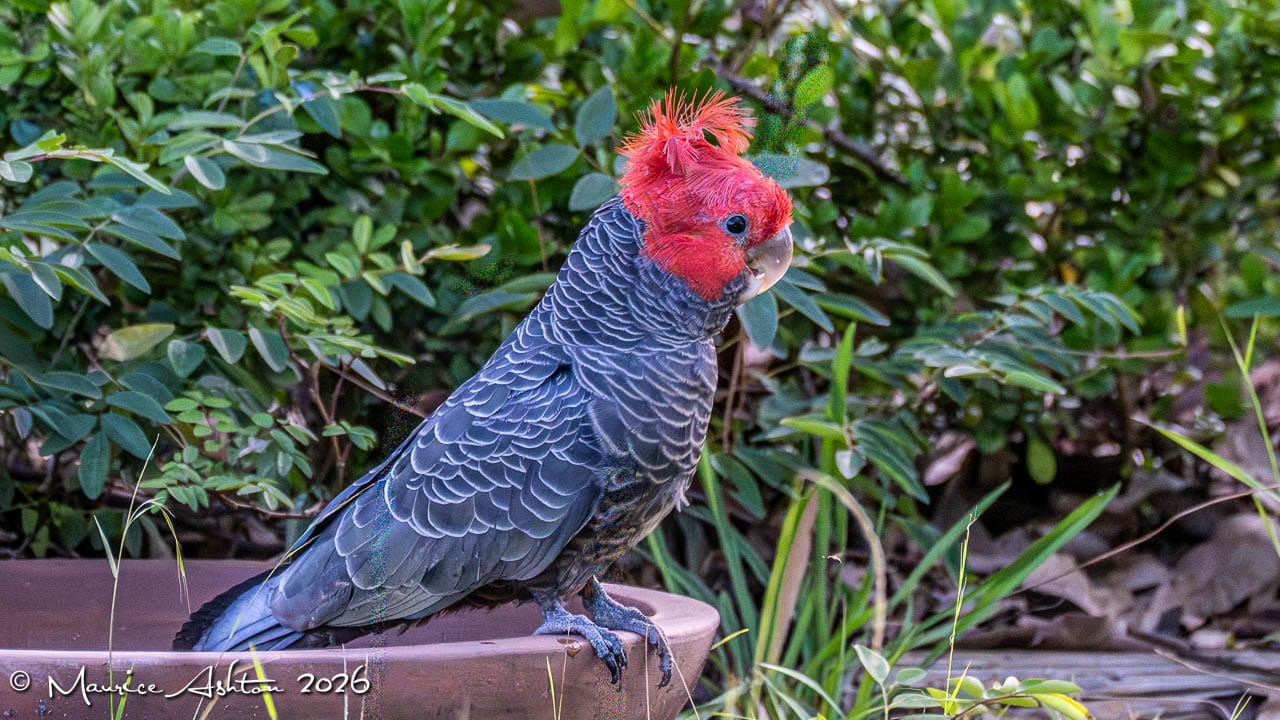
Thank you for sharing.
I assume this is from the parrot family, but what is the cute
little guy
It is a Gang-Gang Cockatoo. There is a flock of about a dozen currently visiting our area. The Liquid Amber trees seeds are ripe and they are gourmet food for the Gang-Gangs.
Talking of holiness and commitment to a holy life, a survey carried out recently found that 80% of respondents said they were not “good enough” in almost all areas of their lives, while 75% admitted that they constantly felt “overwhelmed” and pressured to succeed in their careers, find a meaningful romantic relationship, meet other people’s expectations, and maintain a presence on social media; overall, 80% of respondents confirmed that these worries have negatively impacted their sleep and their mental health.
This means that when we focus on acceptance from the world, we might never be good enough. Peter reminds us that God’s acceptance of our condition is not based on our performance but rather upon our relationship as children of God; he therefore calls us to a life of holiness and nothing less. Peter insists that we must live as those who have partaken of God’s divine nature, affirming that God is holy and we must therefore live holy lives, for “just as he who called you is holy, so be holy in all you do” (1 Peter 1:15).
Personally, what comes out clearly is that, as a sinner, I do not naturally gravitate toward godliness, prayer, obedience, Scripture, faith, or even delight in the Lord, for I was conceived in sin, yet God calls me to be holy, which involves total surrender to His will; as a Christian I cannot divide my life into compartments of holiness and sin, meaning those areas of my life which I am struggling with need total surrender to God, and all that I do must be done to the glory and honour of God (1 Cor. 10:31), remembering also that “His divine power has given us everything I need for a godly life” (2 Peter 1:3).
Dear Motanya, thank you for the inspiring comments on today’s lesson. How could an individual achieve the things mentioned in your comments. For example, how can someone “totally surrender to God.” Is it possible to live like this? If this is happening in your life, could you share your experience with us. I am asking this because Hebrews 10:24 says that we should provoke one another to love and good works. Thanks again.
Dear Melvin,
Thank you for your thoughtful question and your s pointer to Hebrews 10:24. I sincerely appreciate your comments
When I speak about “total surrender to God,” I don’t mean that I have achieved perfection or that I no longer struggle in my journey of faith. Rather, it is a daily, ongoing growth journey. For me, surrender starts with recognizing my constant need for God’s grace and intentionally bringing every area of my life before Him daily and thus my thoughts, decisions, weaknesses, and even my failures.
The stories of the rich young ruler and the prodigal son beautifully show that we should never pit God’s love against His holiness.
Jesus genuinely loved the rich young ruler, yet that love alone did not save him because he resisted the holy claim Christ made upon his life. When Jesus asked him to surrender the one thing that held his heart, the young ruler walked away sorrowful. The problem was not any lack of divine love, but his unwillingness to yield to the holiness of God’s kingdom. God’s Love prompted the invitation, but His holiness exposed the condition of the heart that the rich young ruler would not surrender.
By contrast, the prodigal son responded differently. He returned with repentance, acknowledging his unworthiness. The father’s love ran to meet him, but it was a love that restored him into the order and joy of the father’s house. Holiness was not set aside; rather, repentance opened the way for love to fully heal and restore.
These two stories together remind us that God’s love is always reaching, but it never works in opposition to His holiness. Love calls us home, and holiness calls us to surrender. When one is rejected, the blessing of the other cannot be fully experienced.
God’s love towards me is the bed-rock of my self esteem and sense of self respect -” But God commendeth his love towards us, in that, while we were yet sinners, Christ died for us.” His love is that calming influence as I face the future with its uncertainties, some of which I am not presently prepared to meet. If in reality one can ever be fully prepared.
It is the core rationale for my sanity. I hate to sound so extreme ; but without experiencing His love : “a rational choice” would be to jump off a cliff.
Today’s lesson included a quote from Ellen G. White. It reads in part: “You may study that love for ages; yet, you can never fully comprehend the length and the breadth, the depth and the height, of the love of God in giving His Son to die for the world.” May I suggest to accept that our heavenly Father gave us His Son for us to also live in this world?
This week’s lesson focused on knowing the living God. How can we know God if we neglect to apply what we found to be His living message given to us by/through His Son Jesus Christ – ‘knowing’ God will lead us to eternal Life? – John 17:3.
I understand ’knowing God’ is all about living in Christ as we die to self. I consider that learning about the death of Jesus can only bear fruit in the context of ‘dying to self’. If we are reluctant to die to self, we cannot live our life fully in Jesus Christ – Gal.2:20.
Jesus’ ‘dying’ becomes meaningful in the Light of the Father’s call for a resurrected life – 1 Cor.15:20-23; accepting the cross of dying to self. Knowing God means accepting our dying to self and coming alive in Jesus Christ – Emanuel, God with us and within us – being known and knowing God. John 17:3; Luke 9:23; Rom.6:11; Col.3:3; Gal.5:24
God is indeed perfect and infinite. Indeed, His love can’t ever be measured. Indeed, we are very, very far from understanding His nature. But as limited as we are, if we love to the point of sacrificing ourselves for others, that’s probably the closest we can get to the Father. The best way to learn about God is to love those around us.
Christian psychologists say that humans develop their concept of God from their experiences with their earthly fathers. This is why men have such an important role in the grand scheme of things. When a child prays to God the Father, in his mind he is thinking, “Dear heavenly version of my earthly Father.” It’s not fair that the imprint of God in our lives is directly influenced by our paternal parent for they are imperfect. If their father was always busy, then they will have a tendency to view God as too busy for them. We need a better role model for us regardless of how wonderful or terrible our earthly fathers are or were. Many carry a “father wound” that needs healing.
Remember when Philip asked Jesus to show them the Father? What was Jesus’s response? “Whoever has seen me has seen the Father.” (John 14:8,9) One of the many reasons of Jesus coming to earth was to correct the misconception of what our Heavenly Father is really like. “The earth was dark through misapprehension of God. That the gloomy shadows might be lightened, that the world might be brought back to God,…This work only one Being in all the universe could do. Only He who knew the height and depth of the love of God could make it known. Upon the world’s dark night the Sun of Righteousness must rise, “with healing in His wings.”Malachi 4:2. Desire of Ages, p. 22, paragraph 1
This quote explains that before the coming of Jesus, the world was filled with spiritual darkness because Satan had misrepresented the character of God, causing men to view Him as severe and unforgiving.
“According to Ellen G. White, a “misapprehension of God” is the root cause of spiritual darkness, sin, and fear, where God’s character of love is misinterpreted as selfish or harsh, often portrayed as a taskmaster. Satan originated this deception to cause distrust in God’s goodness. The remedy is a revelation of God’s true character of love, mercy, and compassion, shown through Jesus Christ and reflected in the lives of His people.”
Ellen G. White® Estate
It took three decades for the “father wound” in my heart to be healed. It was helped by my father apologizing for his failings, and by my accepting his apology and extending forgiveness to him. I came to realize that he too had a “father wound” in his heart. Hurting people often hurt people.
What is our perception of God? If it’s anything other than Jesus, then we need to spend more time learning about Jesus, because if we have seen Jesus we have seen the Father. In your life, is the Heavenly Father someone to be afraid of, or someone to be a friend of?