
Tuesday: Moses, Humble Servant

Daily Lesson for Tuesday 14th of April 2026
The grand halls of the Egyptian palace boasted of opulence, pleasure, and ease. “ ‘Moses was learned in all the wisdom of the Egyptians, and was mighty in words and deeds’ ” (Acts 7:22, NKJV). A life of power, riches, and popularity were his for the taking; yet, Moses chose something very different. “As historian, poet, philosopher, general of armies, and legislator, he stands without a peer. Yet with the world before him, he had the moral strength to refuse the flattering prospects of wealth and greatness and fame, ‘choosing rather to suffer affliction with the people of God, than to enjoy the pleasures of sin for a season.’ ”—Ellen G. White, Patriarchs and Prophets, p. 246.
What does Hebrews 11:24-26 tell us about why Moses chose a different path and humbled himself?
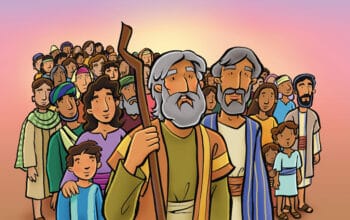
Image © Kim Justinen at Goodsalt.com
Moses’ later humility is remarkable, considering the powerful man he was and where he had come from. Yet, through an impulsive sinful act (Exodus 2:12), he lost his self-confidence and self-sufficiency. With mountains as his classroom walls and with pride swept aside, for 40 years Moses was taught by God what he needed to know to lead a nation out of slavery into the Promised Land. The power and riches of what could have been another life in Egypt paled in significance when Moses considered eternity. God had called him very specifically, and Moses followed.
Perhaps most significantly in light of this topic, Numbers 12:3 tells us: “Now the man Moses was very humble, more than all men who were on the face of the earth” (NKJV). Moses, one of the great patriarchs of the Bible, is known for his humility, his meekness. Consider how different his life and leadership would have been had pride crept into each of these big events in his life: the burning bush, the plagues in Egypt, crossing the Red Sea, manna falling from heaven, talking directly to God, receiving the Ten Commandments, and hearing God’s words after he struck the rock.
|
Reflect back over your life. If someone were to describe you, would they include “humble” or “meek” in the list of adjectives? Why or why not? The truth is that we can’t be humble in and of ourselves. Sin is part of our lives, which is why we need Jesus so much. Listen to, read, or sing the words in the hymn “I’d Rather Have Jesus,” and consider these words in relation to Moses’ life and yours. |

Moses spent the first 40 years of his life in the courts of the Pharoahs. During that time he learned the Eqyptian way of leadership. He ordered people to do things and if they demurred he knocked a few heads together. In a worst case scenario he killed those who did not obey. He got into trouble and disappeared into the desert where he perfected his leading skills on sheep.
Having grown up in New Zealand when there were 3 million people and 65 million sheep, I learned quite a lot about sheep. We had a 200 to 300 sheep, depending on lambing season and if there is one thing I learned about sheep is that you don’t drive them, you lead them. Shouting and sooling barking dogs on to sheep only causes them to scatter. You have to call your sheep and a good sheep dog does not bark.
God called Moses to lead the children of Israel after he had practiced on sheep for 40 years. From being a prince in a royal court, to a shepherd minding flocks in the wilderness. It must have been a humbling experience.
The true humility of Moses is seen after the Golden Calf episode. God wanted to destroy this ungrateful stiff-necked grumblers who hankered after the onions and garlic of Egypt, and start a new nation with Moses.
In the aftermath, Moses made this request:
When it comes to salvation are we prepared to offer to give up our salvation so that others are saved?
Paul expresses it this way:
Are we that humble?
Wow, really captivating and powerful.
Amen🙏🙏🙏
Maurice I am trying to grasp your concept of humility in the light of the two examples you presented of Moses and the Apostle Paul. Yes, I am seeing it a bit, however the overwhelming emotion , factor , or even passion is love. The love they had for their own people.
As one who has grown up very much alone ( an only child; never married ; no children) I wrestle with these concepts.
Should we honestly celebrate Moses’s decision not to agree with God to wipe out that stubborn and stiff necked generation of Israelites. Did Paul love God less to pray that he would be willing “to be forever dammned” if his Jewish kinsmen could not be saved. Is there some similarity to the mindset of Adam when seeing Eve’s sinful condition, he rashly ate the forbidden fruit?
The point is this from my perspective (cognizant to some degree of my lack of very deep personal relationships) that our love for each other as wonderful as it is and should be ; should NEVER exceed our love for God.
I just want to address one aspect of your comment. The way I see it, Adam’s decision was essentially based on self-interest. He was unwilling to lose the companion that God had given him. He probably hoped that God would relent and avert the consequences for both of them.
I see the mindset of Moses and Paul as the opposite: Their hearts were so in tune with the heart of God that, if possible, they would have given their lives for their people, just as Christ gave His life for us.
Does that make sense?
Dear Inge to some extent your explanation for Adam’ s behaviour has rationality. As far as Moses is concerned, he was appealing to an angry God ; as was Paul. The question therefore arises – Can a humble person become angry ? Is anger and becoming angry the opposite of humility
? Or is it as I think Maurice is suggesting or even the Biblical advice – “Be angry and sin not” Ephesians 4:26 – part of the wholistic reality of our human personalities which were designed in the image of God.
Thanks for the reply, Steve. Perhaps we should ask why God was “angry” and why we normally are angry.
Is there such a thing as “righteous anger,” and if there is, how is it different from unrighteous anger (which is most human anger)?
I appreciate the perspective you bring to the discussion, Steve. Sometimes we get too forensic with some of these characteristics and try to deconstruct them into components when in fact they work together.
I have a little computer project sitting on my desk at the moment. It’s not working because its in bits. When I put the parts together, it will do what it is supposed to. (and my desk will be a lot tidier) The whole is more than the sum of the parts.
Love, humility, long suffering etc, etc., don’t work in isolation, and together, in the words of another biblical author, are the fruits of the Spirit.
“Now Moses was very humble—more humble than any other person on earth.” (Numbers 12:3 ,NLT)
What made a man who grew up in power, privileges, comfort and honour remember to be humble? Moses was also acknowledged in the New Testament as a man of humility.
“It was by faith that Moses, when he grew up, refused to be called the son of Pharaoh’s daughter. He chose to share the oppression of God’s people instead of enjoying the fleeting pleasures of sin. He thought it was better to suffer for the sake of Christ than to own the treasures of Egypt, for he was looking ahead to his great reward.” (Hebrews 11:24-26, NLT).
Using Moses as a case study for humility, some critical lessons come through:
1. Humility is not simply an attitude, but the choices we make. Moses, when he was of age, deliberately decided to forfeit power, privileges, comfort, and honour to suffer with God’s people. He chose to forfeit luxury and recognition. Humility is not hereditary, but the choices we make in life. Humility comes with a cost.
2. Humility requires that we renounce the things the world clamours for. Moses sacrificed the “fleeting pleasures of sin”. Humility demands personal restraint from immediate gratification. Moses was “looking ahead to his great reward”. We, too, must forfeit the gratification of this world for the sake of eternal life.
3. Moses decided to be defined with the people of God and not as an Egyptian. For us to exercise humility, first we must define who we are. If we identify ourselves as Children of God, we will want to act as our Father who is in heaven. If we see ourselves as the people of the world, our behaviour will be crafted accordingly. As Moses did, we must reject the things of the world.
We must acknowledge that humility is not a weakness, but a strength in submission. This strength is supplied by the divine power of the Holy Spirit. When we know who we are in Christ, fighting for the earthly things will grow strangely dim.
We are called to emulate unreservedly the humility of Moses the great leader. The opposite of humility is pride, so by God’s grace and help we will examine the root causes of pride and how to avoid being caught up in its destructive web especially in Leadership.
HOW TO AVOID PRIDE IN LEADERSHIP
Leader’s roles;
– Decision making when necessary
– Coordinate with others for success
– Supervise implementation of decisions by all
– Review reports and introduce measures for improvements where necessary
– Educate others for growth and success
– Always ready to proffer solutions when consulted
– Discipline those defaulting
– In some cases, “hire and fire” when it’s needful.
How leadership changes us;
– We develop a sense of superiority.
– We unwittingly command and control our subordinates.
– Our body systems gets configured to dislike opposing views and criticism
– We unintentionally develop tendency for arrogance
Pride in leadership;
– Always shutting down opposition
– Exercising unholy authority over subordinates
– Always vindictive
How to avoid pride in leadership;
– We need to always see ourselves as servant-leaders
– By not seeing ourselves better than others.
– We need to always ask Holy Spirit for help to lead without pride
– Bible said that “by beholding we are changed” by beholding Christ and emulating His life I believe we will do better in any Leadership position we occupy.
I have written this based on my experiences having served in various Leadership positions.
let us pray for those occupying leadership positions in our church as whether we know it or not, they are direct targets of the devil.
Moses came to the realization that humility is not pretending to be lower than we are in life, but rather a realization that we are not as mighty as we think we are. When we understand how gifted, loved, and valued we are, made in God’s image, yet flawed, weak, frail, because of sin . We naturally show respect, listen to other people, and remain eager to see those around us flourish. Good leaders like Moses understood that even though they has power, prestige, and position, it din’t mean that he was to be lauded wherever he went. Moses prayed for the people that attacked him, not that God would smite them and prove he was right, but that they would be well. When Miriam was smitten with leprosy, Moses pleaded with God to heal her, saying, “Please, God, heal her!” (Numbers 12:13). He did not use his spiritual authority to defend or vindicate himself; he used it to pray for the healing of the very person who attacked him.
This is the kind of heart God can trust with spiritual authority. Jesus did the same; instead of calling for legions of angels to defend Him at the cross, He prayed, “Father, forgive them, for they know not what they do” (Luke 23:34). When Joseph found himself in a place of power, he used that power to feed the people who attempted to kill him, declaring, “You intended to harm me, but God intended it for good” (Genesis 50:20). The question is: can God trust me to use spiritual authority to represent His true character of love? Choosing to trust God to defend me rather than defending myself is my purpose. Time will prove that mostly I am not as right as I thought I was. Time has shown that I may be right on issues but not on my attitude.
The bottom line remains that I grow and reach where I don’t need to win the argument for the sake it, When will I give up the need to have the last word on issues and arguments, When will I recognize that my irresistible urge to defend myself is most likely rooted in my own pride. May the Lord show me when I need to draw clear boundaries in my relationships, and reveal that I must rely on Him to take care of my reputation. Moses was far more concerned about his detractors’ well-being than his own position and rank. He learned to ignore and answer accusations by praying for healing. May the Lord help me, whenever I get an opportunity, to be used by Him always. May I not hold grudges against my attackers and accusers; like Moses, when attacked by Miriam, may I use every opportunity to pray for the healing of my adversaries and detractors.
There comes a time when a child of God find themselves at the crossroads of submitting to the world for their livelihoods and remaining faithful to the will of God. By the grace of God,the children of God strive to stand for Him. This is my experience and that was Moses’. It is also important that we abide in the Lord continually to keep ourselves from the trap of self righteousness.
Jesus was several thousand years in the future for Moses, so what was “The Reproach of Christ” for Moses then?
I think he was looking ahead to Christ’s day.
I don’t know how Moses was able to do what he did in leading a whining, complaining bunch of Israelites without losing his mind. Well he did that one time when he struck the rock instead of speaking to it. When I read that Moses led the “children of Israel” across the wilderness, in my mind that is what I imagine. One chaperone escorting a nation of kindergarteners on a field trip.
I am amazed that he talked God out of destroying the people and starting over with him as the leader. He possibly realized that then he would litterally be leading a bunch of whining, crying babies. That’s enough to make someone say, “kill me too!”
People misunderstand what true meekness is. It’s not weakness, but strength under control. Moses could have and probably should have knocked some heads together, but instead left it to God to deal with. It’s amazing that the stress and frustration of leading the Israelites to the borders of Caanan didn’t kill him. Or did it? And though he wasn’t allowed to cross over because of his one lapse of control, God had a better plan for Moses. He would allow him to see the land from a high vantage point, let him rest from his labors, and then resurrect him in the real “Promised Land.” God’s plan is always infinitely better than our own. Trust Him all along the way.
Thank you, Tim. You have no idea how much I needed this, right now.
When we accept Jesus with all our hearts, His attributes naturally flow within. The more we get to walk with Jesus, the more His character is inevitably stamped on us. “Tell me who you walk with…”
Let’s be humble servant’s
That is so true’ let ask God to please humble us where are prideful and fill us with HIS PEACE and HIS humility day by day.