
Monday: Scripture, the Authority

Daily Lesson for Monday 20th of April 2026
The Bible’s authority and function are clearly declared within its pages. Read and copy out 2 Timothy 3:15-17. Take note of what these verses tell you about the function of the Bible.
When it comes to personal Bible study, we must be careful not to expect the Bible to serve our purposes or perspectives, which are not always the same as God’s. For example, we shouldn’t use the “close my eyes and point to a text” method, because this isn’t how God wants to communicate with us through His Word. God is not a puppet on a string, waiting to serve our needs and will. His ways and thoughts are so much higher than ours (Isaiah 55:9), and so we should never try to control His words to us. Neither should we pick and choose only the parts of the Bible that feel comfortable to us. Instead, we should see the Bible as a whole package rather than reading the easy, familiar passages and leaving out the confronting or challenging ones. If we truly want God to speak into our lives, we must take the Bible as a whole and use sound methods when we engage in careful Bible study, trusting that God will reveal what we need to hear when we need to hear it.
Image © Review & Herald Publishing from GoodSalt.com
Also, Jesus Himself tells us: “ ‘You shall love the Lord your God with all your heart, with all your soul, and with all your mind’ ” (Matthew 22:37, NKJV). That is, God doesn’t want us to ignore our minds; rather, He wants to inform our minds with His vast reaches of knowledge and understanding, which are revealed, in part, through His Word. We can read many biblical narratives in which God had discussions with such people as Enoch, Abraham, Moses, and Job, in addition to many conversations that Jesus had with people. God doesn’t bypass human reason but invites us to submit it to His Word and wisdom when “working out” our salvation.
Human reason, however, is still human—capable of error and deception. It’s never infallible. It’s possible for human reason to push God aside to try to work things out on our own, which places self as equal to, or above, God when it comes to thinking. People can approach Scripture with an arrogant and critical spirit, thinking they’ve heard it all before and that there is nothing new. It’s when we feel important, confident, self-sufficient, and in need of nothing that we neglect our relationship with God and rely on our own limited knowledge and faulty reasoning.

One of the principles of modern judicial systems in countries such as Australia and the US of A is the authority of common law. It is the idea that the history of cases provides the basis for current judicial systems.
I find the authority of the Bible, more in the sense that is a book of case studies rather than a systematic textbook. Approximately 50% of the Bible is made up of stories about people and their interactions with God and one another. It is messy and sometimes the stories do not end happily. The stories of David, and Peter are typical examples. Some arguments are left open ended (eg Job), Some stories don’t finish with the “They followed the Holy Spirit and found Jesus” ending. The Bible is very much about making choices and having to live with the consequences, rather than giving a list of definitions to follow.
The parable of the Samaritan is a case in point. Jesus was asked a legal question, “Who is my neighbour?” And instead of giving an authoritative legal definition, he tells a story that is interesting and challenging particularly to the Jews. At the very heart of the story is the idea that the questioner has to work out the answer for himself from the case study., and that maybe he has some relationship challenges to think about.
Most of Jesus teaching comes to us in the form of parables or case studies. He gives us examples and expects us to be challenged by them.
It reminds me of my undergraduate physics teacher, who so often use the opener, “Have you ever thought about this …?”, and he would challenge us to think and discuss either a new idea or an old idea in a different way. He understood the importance of thinking rather than just following the physics rule book.
The Bible is more than a rule book. It teaches us how to grow spiritually.
Paul explains it thus:
Authority belongs to the office, while power resides in the person. In the Christian life, this becomes clear when we recognize that our authority does not originate from within ourselves but comes from the Word of God. As Scripture reminds us, “All Scripture is God-breathed and is useful for teaching, rebuking, correcting and training in righteousness” (2 Timothy 3:16). Those who understand this truth rely on Christ and what He says rather than on personal experiences, opinions, creativity, or rhetorical skill. The authority is not in how compelling we sound, but in the divine origin of the message we bear as chritians. When we submit ourselves to God’s Word, we acknowledge that its power shapes both our lives and our speech.
Yet this same principle can be misused. People often quote Scripture selectively, wielding verses like cards in arguments with our children, friends, other believers, or even secular audiences. In doing so, we risk turning the living Word into a tool for personal gain, forgetting that “the word of God is alive and active, sharper than any double-edged sword” (Hebrews 4:12). Instead we must allow Scripture to search our lives and transform our hearts first, most are the times we have twisted the bible to either manipulate others or fit it to our own ideals. We are guilty of mishandling such a sacred truth. The call is for us to develop humility of letting God’s Word correct us before we use it to correct anyone else, and honoring its authority rather than bending it to our convenience.
The authority of the Bible (Scriptures) to us, Seventh-day Adventist Christians, is never in doubt whatsoever. Its authority is made loud and clear by being number one of our 28 fundamental beliefs.
“The Holy Scriptures, Old and New Testaments, are the written Word of God, given by divine inspiration. The inspired authors spoke and wrote as they were moved by the Holy Spirit. In this Word, God has committed to humanity the knowledge necessary for salvation. The Holy Scriptures are the supreme, authoritative, and the infallible revelation of His will. They are the standard of character, the test of experience, the definitive revealer of doctrines, and the trustworthy record of God’s acts in history.”
The authority of the Bible is also seen when leaders are sworn into office; they take an oath (swear) using the Bible. Even in some court jurisdictions, the witnesses use the Bible to swear that they will tell nothing but the truth. When the Bible is used for swearing, it is taken as the ultimate authority in matters of morality, accountability, and the highest level of seriousness.
Acknowledging that the Bible (Scriptures) is holy, supreme, authoritative and infallible in all human affairs, but doing contrary is simply desecrating its holiness. It is no secret that some of the most well-known corrupt leaders were sworn into office using the Bible. Therefore, the authority of the Bible must go beyond mere acknowledgement of its holiness. If we read in the Bible, do not commit adultery, do not kill, do not covet, do not steal, do not have any idols, (and the rest of the other commandments), and if we do the contrary, then the Bible has no authority in our lives. Any legitimate authority MUST be respected and obeyed. We cannot grow in a relationship with God when we defraud His holy Word.
The Bible is the standard of human character, and it reflects the will of God. We cannot bend Scripture to suit our corrupt character. The Bible is a mirror upon which God’s character is reflected for us to see and follow. How can we know what is the way if we throw the mirror away?
“Anyone who listens to the word but does not do what it says is like someone who looks at his face in a mirror and… immediately forgets what he looks like.” (James 1:23–24)
Sometimes it feels good to neatly package a complex thought or concept in a few words believing we have arrived at the final point. When it comes to the authority of the Bible, and the interpretation we place on it, this is sometimes the case. Is it a casebook, or a codebook? When we say, “all scripture”, whose scripture? Does “scripture” include the apocrypha as contained in some communities?
When we start saying the Bible is infallible, exactly what do we mean? Is it the words, the message, the version? If we do contrary to scripture – whose version of “contrary” is the correct one – after all, there are hundreds of professed “Christians”, who believe not only in the Bible, but in the authority of “all scripture” and come to different conclusions as to what “contrary” might mean.
Apologies for appearing divisive. I’m stirring things up a bit and am not suggesting anyone in our chat doesn’t recognise the complexity or nuance of this topic.
To explore this a little more, there are several dimensions in this space that are sometimes subordinated or overlooked.
Firstly, the concept of “progressive revelation” – which relates to God’s desire to reveal truth more fully. This is coupled with the concept of “progressive assimilation” – which relates to our ability to comprehend and apply “truth” (in the multiplicity of dimensions it must be applied).
The final piece is the concept of “priesthood of all believers” reflecting the cauldron in which our understanding of “truth” is developed and presented (sometimes involving robust discussion and “thought” tensions). This not necessarily a denominational body, though it usually is.
These two pieces of the puzzle, when coupled with the idea of scriptural authority provide some insight into as to why there are sometimes diverse interpretations drawn from the same source.
So, what do we do now? Personally, I need to review last weeks lesson and realise just how much pride I have. Secondly, I need to cut people some slack because we don’t all see things the same way.
Honestly, I wish I’d known this when I started my walk with the Lord, it would have saved a lot of needless worry and arguments. But then again, assimilation takes time and patience – fortunately, God is infinitely patient with us (and particularly with me).
Randall – I appreciate your insightful post. You state: “When we start saying the Bible is infallible, exactly what do we mean”? I suggest to consider that it is the Holy Spirit to be the ‘infallible’ component/source of the Bible – the Spirit of Truth providing God’s Truth and helping us with discerning His Truth.
Man’s understanding of God’s Truth may vary, but the spiritual message contained in God’s Truth never changes as all Truth reflects God’s Glory – for us to better understand His Glory. The closer we draw to God, the clearer His Truth contained in His Holy Word, our Scripture, becomes. When it is love for our God which draws us to Him, He reveals further Truth by His Love – John 16:13. If ‘hubris’ or doubt is present in man, He corrects this error through/by His Love as well – Prov.3:11-12.
Brigitte, I was going to say the same thing, but the Holy Spirit led me to view all the posts first. You said everything so beautifully. Thank you for posting, I need not say anymore.
Brigitte – thanks for responding, much appreciated.
The ‘spiritual message’ that ‘never changes’ comes via the Holy Spirit, which you correctly identify as the ‘infallible component/source of the Bible’.
However, just to expand on my post, the ‘spiritual message’ does not appear in a vacuum, it is revealed through God’s creation (usually us) for the purpose of reflecting God’s Glory, which you so beautifully described. God’s glory is His character, and while there are many ways God’s character can be revealed/displayed, it is most effectively displayed here and now through us (his ambassadors/church). This is where the major problem and major opportunity exist – or perhaps more accurately, where the tension exists.
The tension exists because we don’t all see things the same way. I agree that it is the Holy Spirit that provides the ‘infallible’ component to the message, but that message is interpreted and applied through very fallible vessels – namely, us!
God provides the ‘Priesthood of all believers’ (a group of us usually called the church), to wrestle with scripture and each other (not in a bad way), to understand revealed truth and apply it. I believe it is when this group who collectively reveals God’s character to the world does so despite disagreement that the fullest manifestation of God’s character is revealed. This is unusual in today’s tribal culture – which is why I believe it is a ‘God gifted’ opportunity!
The other piece of the puzzle I mentioned was progressive revelation and assimilation which relates to individuals who make up the ‘Priesthood of all believers’ and goes some way to explain why there are different perspectives within that cauldron of “wrestling” we call the church.
While it is true that the principles of truth do not change (as God does not change), the application certainly does because it is related to time and circumstance. Consider the commandment about committing adultery (which also includes at least stealing and lying) – the specific commandment makes no sense to angels yet the principle which relates to self certainly does apply and always will.
Tying this all together and we boil down to pride, which is the sola plexus of Sin (as opposed to “sins”), relating to the false “I am” that wants to dethrone the real “I Am”. Only God through the mighty Third Person of the Godhead can deal with this (John 16:7-11) primarily through individuals, but also through the church because individual development only takes place when there are ‘others’ involved.
Apologies, this is a bit longer than I intended.
Just the mere thought that the Bible is the Word of God should make us see its authority, and that’s why this statement in this day’s study carries so much weight. I quote:
Two things really come out here: 1) Proof-texting or selective Bible reading lessens the essence and power behind the message, opens up an avenue for misinterpretation through eisegesis, and 2) …”speaks into our lives”… proves the Bible speaks to us (I) first – with profitable doctrine to us; to correct us; to reprove us, and to instruct us (2 Timothy 3:17). In other words, read and studied correctly without sanitization, sensationalization, politicization, or for proving a point or for assigning blame, scripture, while speaking to us, should change us, lowering our pride, that brings us so close to God in relationship.
We should remember that the scripture in its original text was not chaptered or versed. The verses and chapters were intended to ease indexing and referencing for the purpose of ease in study. However, modern Bible students have opted for selectivity. There is a danger today, to relegate parts of this complete and comprehensive life tool and turn the same profit into loss. The purpose of each part of the Bible is equally important in telling the “whole”. Daniel and Revelation are not intended to make Song of Songs and Obadiah less important, but the scripture in its entirety modifies our personal attitudes towards God, His people, and all His creation, as we benefit in a closer yet better relationship with God, in our individual capacity plus as a community by extension.
yes it is very true, we often neglect the challenging or long verses in the bible but we should not do that. we should let Gods word speak to us, often we deal our problems on own without God, most of the time we run to God for help when trouble but when we are okay we forget him. thats no how we should behave
If I remember correctly ; I got this idea from Morris Venden – You cannot fight to love someone or trust someone( I am speaking of a personal and intimate manner). Love and trust are not actions of the will; they are the outcome of a relationship.
The Bible is the most effective medium we possess in order to have a relationship with God. The zenith achievement of Bible study is that we have grown to love and trust God and as we continue in the study and meditation of his Word we are growing to love and trust him even to a greater degree day by day.
Doctrines – the teachings of the Bible can be viewed as insights into his personality; the things that please him as well as those things that displease him. Even the ten commandments can be summed up in these words – ” Thou shalt love the Lord thy God with all thy heart, and with all thy soul, and with all thy mind. This is the first and great commandment. And the second is like unto it, Thou shalt love thy neighbour as thyself. Matthew 22 : 37 -40 KJV
The outcome of this relationship is crucial to our christian experience; because only as we love and trust him, we are able to access power to live holy lives. Jesus himself alludes to that reality when he said -“IF YE LOVE ME, keep my commandments.” John 14:15 KJV. Is it is possible that he is suggesting that if we have not taken the time to grow to love and trust him; we would not possess the capacity to keep his commandments?
The lesson author suggests, “Read and copy out 2 Timothy 3:15-17.”
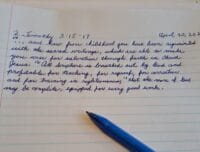 So I decided to be a doer of the lesson, rather than just a reader. I copied it out in cursive, rather than printing, as I have done for decades. That’s because I read recently that writing cursive is good for the brain. Something about hand-eye coordination. It might also have something to do with the rhythm.
As you can see, my cursive is a bit rusty, but it will get better with practice. I noticed I had to slow down to get this right, and while I slowed down, I had time to reflect on the text. So I’ll be copying more Scripture.
The text says the Scriptures “are able to make you wise for salvation through faith in Christ Jesus.”
I want to focus on that last phrase. It speaks of more than factual knowledge. Faith presupposes a relationship. And I believe that the Bible promotes that relationship by more than supplying facts. When we pray for the Lord to speak to us through His Word, we move to holy ground. We are in the presence of divinity. And that encounter with divinity changes us, even if we are not conscious of having gained greater insight – though that will usually happen. If we will open our hearts to His Spirit, this encounter will change the way we think, talk and act the rest of the day.
Prayerful reading of the Bible means coming into the presence of God. Think on it!
I believe that the Bible is the authority, and the authority is found in the Bible’s pages. The Bible is not only used as the authority in itself, it is the authority and foundation to writings of the Bible. Isaiah 8:20.
To help make clear the importance of 2 Tim.3:15-17, I want to encourage you to start reading from the beginning of Chapter 3. Paul addresses Timothy, his fellow worker in the cause of spreading the Truth as taught by Christ Jesus. He reaches out to Timothy because he considers him a fellow servant of God.
Do all readers of Scripture consider themselves to be ‘servants of God? Is it possible that a casual reader of the Christian’s Bible can feel compelled to consider Paul’s advise to Timothy as ‘authoritative’, applicable to himself? I do not think so, as God’s Truth is perceived, received, and applied only by those who see a need for their salvation.
Paul considers his fellow worker Timothy to know/understand all about his teachings, the “way of his life” – his purpose, faith, patience, love, endurance, persecutions and suffering – to be able to empathize with him. Can we ‘know’ Paul as Timothy knew him, can we ’empathize’ with him, can we understand his faith and unwavering dedication in the midst of persecution?
For those still in doubt about whether the Truth contained in Scripture conveyes our God’s Truth, Paul encouraging Timothy cannot be fully understood. But to those who believe the ‘Word of God’ – our ‘Bible’ – to be inspired by His Holy Spirit, Paul’s words provide reassurance for us to remain faithful in applying God’s Truth in our own life “so that the servant of God may be thoroughly equipped for every good work.” 2 Tim.3:16-17.
We need power from God to read the Bible and to do what it says.
I do believe in taking scripture as a whole. I definitely believe that all scripture is inspired and has value in teaching us about God. It’s been my practice to read the whole Bible through each year in a different version, and it’s been good to keep me familar with the Bible.
However, when people say that we need to study all the Bible and imply that every part of it is equal (I don’t know if that’s what the author intended but that’s what I got out of today’s lesson), I wish they would explain exactly what they mean. Because we do select certain passages to focus on. We read and study the gospels much more than the minor prophets. We avoid large chunks of the Bible (the instructions on how to build the tabernacle, the geneologies etc). Our church also has our favorite texts to focus on (and I can tell you which ones those are easily because they are found where there is a smudge in my Bible from my thumbs resting there regularly!)
I don’t actually know this is a bad thing. If the whole Bible points to Jesus, doesn’t it make sense to spend more time in the gospels? If we believe we are living in the last days, would we not read Daniel and Revelation more? Ellen White wrote large books about these texts (Desire of Ages and Great Controversy) while Patriarchs and Prophets and Prophets and Kings cover many pages of the Bible, some of them very briefly.
The reality is that we will never be able to study everything in depth. It took me several years to study Mark slowly and I’m only in Matthew 10 after studying Matthew for over 2 year. I doubt I will live long enough to study all parts of the Bible that way. So I must choose. So must we all. Perhaps we need more guidance on what that looks like in a practical way.
The whole Bible is God’s word, not only what we understand or think is important. Do we want real knowledge? Let us consider the love that God communicates to us through the compilation of the world’s history found in the Bible.
Subject: Job 23:12 NIV, KJV from Bible Gateway
Job 23:12 NIV, KJV
I have not departed from the commands of his lips; I have treasured the words of his mouth more than my daily bread. Neither have I gone back from the commandment of his lips; I have esteemed the words of his mouth more than my necessary food.
>Job clearly had a good CONSISTENT attitude towards the word of God as a result, he was able to stand in the most difficult adversity.
> We as well can make the same decision today.
Today,I came across one of the Chinese proverb that says”A TEACHER CAN OPEN THE CLASS,,BUT IT IS THE DUTY OF THE STUDENT TO ENTER INSIDE THE CLASS”.
At a time when our personal schedules are so tight,the lesson is calling upon all of us to spare quality time ,spend time with God in his word at a personal level.
Regards
Austin