
Thursday: Overcoming Idolatry

Daily Lesson for Thursday 30th of July 2026
In 1 Corinthians 8:1-3, Paul argues that love for God keeps one safe from idolatry. This argument is resumed and further developed in 1 Corinthians 10:23-33; 1 Corinthians 11:1. In 1 Corinthians 8:3, he speaks about our love for God. He says, “Let no one seek his own, but each one the other’s well-being” (1 Corinthians 10:24, NKJV). This is love for others.
Read Mark 10:17-22 and Mark 12:28-31. What do these two passages have in common, and how do they apply to the situation in 1 Corinthians 10:1-33?
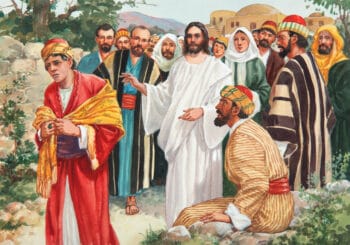
Image © Review & Herald Publishing at Goodsalt.com
Paul is doing in 1 Corinthians 10:1-33 precisely what Jesus did in Mark 12:28-31; namely, he binds together the two great commandments of the law: love for God above all, and love for others. In the story of the rich young ruler (Mark 10:17-22), Jesus unites these two kinds of love, and does so by respectively alluding to Deuteronomy 6:4 (see Mark 10:18) and the second table of the Decalogue (see Mark 10:19). The problem of that rich young man is that he loved his possessions more than he loved God and his neighbors (Mark 10:22). He valued his treasure on earth above the treasures in heaven. He valued his money above the poor (Mark 10:21). He was an idolater.
Following the teachings of Jesus, Paul hints that the principle of loving God above all and the neighbor as oneself is to be applied to the hypothetical situations he mentions in 1 Corinthians 10:27-28. This means that even lawful things may not be helpful or edifying since they can be offensive to someone else’s conscience (1 Corinthians 10:23). This principle is masterly synthesized in the words “Do all to the glory of God” (1 Corinthians 10:31, NKJV). By saying that all must be done to the glory of God, Paul indicates that idolatry can manifest itself in the most varied forms, for anything that usurps the glory that belongs to God alone is a form of idolatry (Isaiah 42:8).
Paul’s words in 1 Corinthians 10:31-33; 1 Corinthians 11:1 serve as a conclusion to chapters 8–10. He makes it clear he did not seek his own advantage, “but that of many, that they may be saved” (1 Corinthians 10:33, ESV). That is how he imitated Christ (1 Corinthians 11:1).
|
How can you learn to better love your neighbor as yourself? |

Humanity’s greatest problem is that, by nature, we are idolaters. Idolatry is not merely an ancient practice confined to carved images or pagan temples; it remains a present reality of the human heart. As descendants of Adam, our hearts naturally drift toward loving something more than God. We often elevate wealth, health, power, success, pleasure, or personal achievement above our Creator. The Athenians worshiped a multitude of false gods, but modern idols are no less dangerous. Whether it is money, prestige, traditions, careers, or self, anything that takes God’s rightful place becomes an idol. As Scripture reminds us, “Put to death, therefore, whatever belongs to your earthly nature… and greed, which is idolatry” (Colossians 3:5; see also Ephesians 5:5).
In Acts 17:16–34, Paul arrives in Athens during his missionary journey with the purpose of turning people from false worship to the worship of the one true God. Athens, located a few miles inland from the port of Piraeus on the Saronic Gulf, was renowned as the center of philosophy, intellectual debate, art, and magnificent architecture. Yet beneath its intellectual brilliance lay profound spiritual darkness. As Paul walked through the city and observed its countless idols, his heart was deeply troubled because the glory that belonged to God alone was being given to created things. “Now while Paul was waiting for them at Athens, his spirit was provoked within him as he saw that the city was full of idols” (Acts 17:16).
People naturally worship what they love most. As the preacher Martin Lloyd-Jones observed, whatever captures our time, energy, money, affection, and enthusiasm is ultimately what we worship. Worship is not simply expressed through religious rituals but through the priorities that dominate our lives. Jesus affirmed this truth when He declared, “For where your treasure is, there your heart will be also” (Matthew 6:21). Our greatest devotion always reveals our true god. In summary the following are the several key truths.
(1) Humanity is naturally prone to idolatry.
(2) Modern idols are as real and dangerous as ancient ones.
(3) Worship is revealed through what we value most,
(4) God alone is Creator, Sustainer, and worthy of worship,
(5) Christ will ultimately reign over all creation.
(6) Believers are called to live in hope as God restores all things in Him.
Idolatry is fundamentally the problem of the heart. We worship what occupies the centre of our hearts. What we are preoccupied with is what we ultimately worship. It is interesting to note how the Bible tell us how to overcome idolatry. It does not tell us to “stop loving idols,” but to love God more. We can only overcome idolatry by redirecting our hearts towards loving God.
Jesus says:
“You shall love the Lord your God with all your heart and with all your soul and with all your mind.” (Matthew 22:37).
If God occupies the centre of the heart, there will be no room for idolatry. Therefore, give God the ultimate allegiance and affection, and idolatry will flee away. Let us keep our hearts for God to occupy and nothing else. “Keep your heart with all vigilance, for from it flow the springs of life.” (Proverbs 4:23)
Today has been a busy day for me. My big bird-photography lens died an untimely death and was going to cost too much to repair. So I went and bought a new lens that had been on my wish list for some time. I wanted to get out and photograph birds, but before I could do that, I had to do quite a few chores around the house for Carmel. Carmel has been in acute pain for several weeks now with painful tendons. She finds it hard to sit and walk, and she can only lie on her back with reduced pain. So, despite my wish to try out my new lens, I had to take care of her and make sure she was comfortable. And I had to do a lot of things around the house that Carmel usually does automatically. Finally, I was out in the wild and photographing birds.
It is a bit like that with our spiritual lives. We sometimes have a wishlist of things we would like to do, but then we have to deal with people. We live in a matrix and are connected. We can either support one another, or we can cause dislocation in the matrix.
Paul recognised this in his epistle to the Corinthians. He takes a bit of a detour to get to the point, but I think he is saying that we need to look after one another, especially when there is an issue which can cause dislocation. Of course, if you know the structure of this epistle, you know where it is leading. 1 Corinthians 13 is just around the corner, so I won’t jump the gun and summarise it here.
Paul’s message was not really about idols and food; it was about providing encouragement and avoiding dislocation. He recognises that we will not always agree and offers us a perspective that helps us live with disagreements.
Maurice, I’m sorry that Carmel is still dealing with her pain issue. We will continue to pray for her. In fact, I would like to encourage all who read this comment to lift her up in prayer.
You chose the better thing by choosing to serve her first. When our spouses are incapacitated we learn how much they do by having to pick up the load ourselves. Isn’t that part of the gospel to serve others and to put their needs ahead of our own? Indeed it goes against our sinful, selfish nature, which really is the point. Our “toys” and possessions can easily become an idol if we aren’t careful. When I get out of balance in my life and my bicycle and cycling take precedence over my wife or my relationship with God, then my bicycle has become an idol. A recent bicycling vacation revealed how what we really enjoy can become a vehicle of blessing to others or an idol unto ourselves. We witnessed a woman fall from her bike and were the first on the scene. She had gashed her leg on the pedal in falling. I carry a first aid kit in my bicycling backpack since my serious bicycle accident last summer, and I immediately put it to good use. We cleaned up and bandaged her wound and after evaluating her sent her on her way.
We don’t do good to make ourselves look good, we do it to make the Christ within us shine forth to bless others and make him look good. Isn’t that the basis of Christianity to follw our Leader and desire to be more like him and less like ourselves? Yes, indeed!
Please, everyone say a prayer for Maurice’s wife, Carmel, that her pain issue would be resolved. Intercessory prayer keeps even our prayer life from becoming an idol focused on ourselves and our own needs.
Thank you, Tim. We are just thankful we were prevented from going on our big trip. If Carmel had had this occur while we were in outback Australia, getting her back home would have been both difficult and costly. Of course we wish that none of this had happened, but they have happened, and we have learned to look after one another as a result. Carmel is improving, but it is going to be a long slow journey.
Amen. Our prayere are with you.
It is interesting how Paul answers our questions garnered from 1 Corinthians 10:23-33, 11:1, also in a letter to the Colossians listing specific things to do to keep our minds and bodies focused on things that overcome idolatry. If we are to have a new life in Christ we are to put to death idolatry, which is defined not only in worship of stone and wood carvings, but also in selfish desires that make our own laws. It looks like Paul was sticking with the Gospel of Christ wherever he preached. Take for instance, Colossians 3:12-17. To have a new life in Christ, he says, “be of compassionate hearts, kind, humble, meek, and patient, bearing with one another and, if one has a complaint against another, forgiving each other; as the Lord has forgiven you, so you also must forgive. And above all these, be with love, which binds everything together in harmony.” Yes, excellent ways to stay out of the idolatry defined in Colossians 3:5-8. As well as 1 Corinthians 10.
What does Ellen White say about Idolatry? A quick search brings up her apropos statement from Acts of the Apostles page 316 just click on the link when we get to tomorrow’s lesson.
This week’s study has revealed that loving our neighbor as the Bible says goes as far as sometimes relinquishing our freedoms to help others come to the love of God.
Something just struck me; maybe the same thing, just in another form. Being Christian means being passionate for Christ.
I grew up in the church, and to some extent, I pride myself in being calm, cool and collective. However I find Paul’s theological slance a bit discomforting. I find it a bit difficult to describe the Apostle Paul as a calm, cool and collective follower of Christ.
In fact he appears radical, an extremist. Even our Lord and Saviour Jesus Christ appears to fall into the same category, when he instructs that wealthy man to sell all that he possessed and give to the poor and follow him. Is our Lord for real ?!
I am growing to realize that real Christianity is an “ALL” or “Nothing” buisness. I am beginning to realize that God was really serious when he commanded us to love him with ALL our hearts, souls, strength and mind.
The ongoing division over worship styles may be evidence that many Christians have not fully embraced Paul’s principle in 1 Corinthians 10. Too often the focus becomes, “What do I prefer?” rather than, “What will best glorify God and build up His church?” When we cling so tightly to a particular style of worship that we are unwilling to consider its effect on the unity of the church or the conscience of fellow believers, that style itself can begin to function as an idol.
An idol is anything we elevate above wholehearted submission to God’s will and the good of His people. Paul’s appeal is for believers to lay aside personal preferences when necessary, seeking first God’s glory and the salvation and edification of others. The question we should all ask is not, “Am I getting the worship style I want?” but, “Does my attitude reflect the self-sacrificing love of Christ?”
What is the difference between the first and second commandments? Don’t Catholics combine the two and split the tenth? Is it a matter of allegiance and trust vs representation?
I wondered about the quote attributed to Paul: “Imitate me, just as I also imitate Christ.” Paul did not sit at Jesus’ feet to learn the Truth contained in the Gospel like the Apostles did. He met Him on the road to Damascus through a miraculous manifestation. I see his personal relationship with Jesus to be singularly ‘fueled’ by/through this transformational, spiritual encounter.
This gives Paul a truly unique perspective from which he can teach elusive, spiritual truth to followers of Jesus who have not met Him yet in any form. He hopes, using his personal encounter with the Spirit of God, to encourage everyone, by ‘imitating’ him, to encounter Jesus for themselves.
I don’t think that he told them that they should be like him, but rather to do what he is doing – loving God with all his heart and being, and to love one’s fellow traveler. His dedication to live his life spreading the Gospel message of peace and love was how he loved his neighbor. And this is what those do who have been captured by the Love of Jesus – they share it.
“How do we overcome idolatry”? Paul, first and foremost, promotes unconditional love for our Lord Jesus Christ and our heavenly Father. He promotes the <transformed life – seeing oneself as a servant to the Gospel shunning the evil of this world, rather than being a ‘master’ promoting and managing its affairs. Paul set his heart and mind to fully share his trust in this transformational, spiritual power available to all who love God. And we can do likewise.
We all have tendencies that may not be physically, emotionally, or spiritually healthy. Thus, not everything may be safe to do. This applies to people around. Balance is a rule for yourself and others. The thin line between what is good and what is not may be resolved through prayer when facing doubts. If doing God’s will is my ultimate desire, I might be on the right track after all.