
Monday: Unity Through Diversity

Daily Lesson for Monday 3rd of August 2026
The language of oneness introduced in 1 Corinthians 12:4-6 (“the same Spirit,” “the same Lord,” and “the same God”) is developed in the rest of 1 Corinthians 12:1-31. This is evidenced by Paul’s use of phrases such as “one and the same Spirit” (1 Corinthians 12:11, NKJV), “the body is one” (1 Corinthians 12:12), “one body” (1 Corinthians 12:12-13,20), “one Spirit” (1 Corinthians 12:13 [two times]), and “the same care for one another” (1 Corinthians 12:25, NKJV).
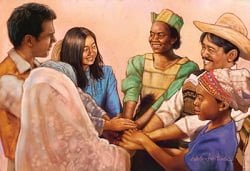
Image © Lars Justinen from GoodSalt.com
Alongside the concept of unity, Paul highlights the diversity of members in the body of Christ through such expressions as “many members” (1 Corinthians 12:12,20), “we were all baptized” (1 Corinthians 12:13, NKJV), “not one member but many” (1 Corinthians 12:14, NKJV), “the whole body” (1 Corinthians 12:17), “each one of them” (1 Corinthians 12:18, NKJV), “members of the body” (1 Corinthians 12:22-23), and “all the members” (1 Corinthians 12:26). This emphasis on both unity and diversity indicates that spiritual gifts aim to promote unity through diversity.
This unity amid diversity must reflect the character of God. The Father is one person, the Son is another person, and the Holy Spirit another. The three maintain Their individualities while working together to edify the church and empower it for mission (1 Corinthians 12:4-6, Ephesians 4:11-13).
Read 1 Corinthians 12:12-31. Why is the analogy of a body with its many parts appropriate to represent the church and its members?
One central thought in 1 Corinthians 12:1-31 is that although the body’s members are individually so different from one another (1 Corinthians 12:15-20), they are all dependent on each other (1 Corinthians 12:21-26). The feet depend on the eyes to see where they must walk; in turn, the eyes can’t touch anything—only the hands can. Also, the idea that some members are weaker (1 Corinthians 12:22) or less honorable (1 Corinthians 12:23) than others is only an impression, for all are necessary (1 Corinthians 12:22).
Unfortunately, there was a tendency among the Corinthians to value some gifts to the neglect of others. To rectify the Corinthians from making this mistake, Paul called their attention to love, which is “a more excellent way” (1 Corinthians 12:31, NKJV). In other words, no matter what the gift is, if practiced wisely and with love, it is pleasant to God.
|
See the lists of gifts in 1 Corinthians 12:8-10,28; Romans 12:6-8; and Ephesians 4:11. What is your gift? How can you use it to edify the body of Christ? |

I think the title of this day’s lesson slipped through under the radar in the editorial process.
“Unity Amid Diversity” as the text in the middle of the page says, would be an appropriate title.
“Unity In Diversity” is similarly appropriate.
“Unity Through Diversity” makes no sense except maybe in “Newspeak.”
So let’s treat this topic as “Unity Amid Diversity.”
Dear Inge, I love the phrase “Unity in Diversity” – to my mind it captures the very pinnacle of Unity; it is unity at its BEST!
It is this miraculous phenomenon that gives an undeniable and inescapable potency to our witness to a watching and wondering world – “By this shall all men know that ye are my disciples, if ye have love one to another.” John 13:35 KJV. People of different races, socio-economic backgrounds, ages, nationalities, etc.-united in love for each other as a result of their unity with Christ.
Unity in diversity captures the singular goal of the church to make Christ known through its multiplicity of Spiritual gifts.
The Rainbow of varied colours gives an universal message to every human being on the planet , regardless of nationality, geographical location etc. – that God will not destroy mankind again by a flood – ” I establish my covenant with you: Never again will all life be destroyed by the waters of a flood; never again will there be a flood to destroy the earth.” Genesis 9:11 NIV
What a fascinating symbol ! An array of Varied Colours designed to assist in communicating to the entire world for all generations One Message.
Exactly. Thank you. According to “normal” human behavior, diversity would create disunity, with each diverse group seeking to advantage itself. Unity in Christian love is a powerful testimony to the transforming power of God’s grace.
[28] There is neither Jew nor Greek, there is neither slave nor free, there is neither male nor female; for you are all one in Christ Jesus.
Galatians 3:28 (nkjv)
You must be an English teacher!
I didn’t notice the title, myself, but I think we often read it as we think it should be.
But unity through diversity does make it sound like diversity is necessary to have unity. We know that is not the case – there are plenty of entities with diversity and no unity.
Unity and diversity need to go together, but they don’t lead to each other. Our connection to God is necessary for that harmony.
Yes, Christina, I’m a dyed-in-the wool English teacher. 😅 But I read the day’s lesson too fast and didn’t notice that the author doubles down on the thought of “unity THROUGH diversity.” Maybe I’m missing something and someone can help me see how diversity can promote unity.
It seems to me that the natural human reaction is for diversity to be divisive.
It takes the supernatural love of Christ in the heart to change that human trajectory to divisiveness into unity, with an appreciation for each other’s gifts. That unity amid diversity reflects the character of God because it demonstrates self-renouncing love.
I would really like someone to tell me how diversity can produce unity because the lesson author doesn’t really explain.
I couldn’t agree more. “Unity through diversity” seems more like an oxymoron. However, thinking about it, I believe diversity can produce unity if we let it.
Unity through diversity describes a process rather than an outcome but you need to define what unites before it makes sense. I’d suggest Christian unity revolves around saying something about God through witness or demonstration.
If the purpose of the church is to say something about God, then diversity within the church must work toward that goal.
As per previous comments, we need the gift of doubt, which is only possible with the gift of humility. Rather than doubting our own facts and observations, we need to doubt the conclusions and assumptions we have by recognising biases and rationalisation we may not even be aware of.
Recognising I don’t have all the answers forms the basis of doubt about my conclusions leading to me to seek diversity (other conclusions) to evaluate my own conclusions. Easier said than done.
The Holy Spirit can use the challenge to my conclusions to highlight hidden pride or biases and invite me to grow in my understanding of Truth, as well as in my attitude toward those who disagree with me. This is a process, and God knows it takes time, sometimes even a lifetime. God doesn’t give up though, because the journey is probably more important as the destination.
This is basically describing what is known as the Priesthood of All Believers.
Thank you for sharing your thoughts, Randall. Your suggestion of valuing diversity of views about God is something I hadn’t though of in relation to this subject. I see an analogy in the many facets of a well-cut diamond. We each view the diamond of God’s character and His plans for us from slightly different perspectives. So we see different facets. When we share and bring all these facets together, we get a clearer, more complete view of God and His plans for humanity. This demonstrates that diversity is valuable. (But I confess that I still don’t see that unity comes through diversity. 😉)
Inge, I love your analogy with the diamond and have used it myself many times.
Thanks for pushing back, you really made me think this morning. Of course, whether I can transfer those thoughts into something meaningful remains to be seen…
Unity Through Diversity is like saying, Diversity Creates Unity.
In some ways, it depends if you view diversity as something that needs to be integrated or ignored. The Soviet Union in WW2 were united with the allied forces to deal with the Axis powers. This was “Unity Despite Diversity” where diversity is seen as an obstacle and needs to be ignored or managed to achieve a united goal (in this case, dealing with Axis powers).
“Unity Through Diversity”, which is like “Unity In Diversity” or “Unity Amid Diversity” is a stronger way of suggesting that diversity enhances unity. In this case, diversity is seen as a tool to create a stronger, more resilient form of unity around a shared goal (Paul’s body analogy is a good example). The Bible doesn’t go to extreme positions; there are certain shared Biblical values that must be agreed upon. As the saying goes, “In essentials, unity; in non-essentials, liberty; in all things, charity”.
Who determines what is essential? This is the pain-point for diverse views (facets of the diamond) and is where arguments for the sake of Heaven (Truth), rather than arguments for the sake of winning (power), become paramount. The former is win/win (in humility) while the latter involves a loser (in humiliation). In the former, Truth is strengthened or clarified which is a win even if you’re understanding was different going into the argument. (I’m not using argument pejoratively here). The latter produces humiliation and resentment that can lead to some very bad outcomes!
Arguments for the sake of heaven/truth strengthen unity and our understanding of truth. None of this is possible without the influence of the Holy Spirit and the vehicle He uses to produce unity is the Church… A diverse group of people with different perspectives of God around a common set of Biblical values agreed upon by the same group.
Yep – it’s messy, but necessary, which is why the journey “through diversity” is as important as the destination – unity in Christ enabling us to better reflect His character.
BTW – I certainly understand where you’re coming from in relation to “Newspeak”… and I loved that book!
There is a danger in this discussion of unity, diversity, spiritual gifts, and talents that we become very good at defining and describing them, but forget about applying them. We should probably look in the mirror and ask ourselves a couple of questions. What am I good at? How can I use those skills/talents to aid unity among my fellow Christians?
When I was a student, I studied Physics, Chemistry and Mathematics. I loved those subjects but it eventually dawned on me that I had to make use of my knowledge and experience and do something useful with them. I chose teaching and spent the next 40 years in classrooms among students. The theory was great, but it had to be applied to be useful.
I should add that I also found out things I was not good at. I did a stint of student colporteuring and found I had a negative doorstep personality. I am glad I learned that lesson early.
Unity is about using our skills and talents together, and we need to ask ourselves how we can contribute to unity. This is not something the church is going to fix with a vote at the next conference session.
Now I will do a little sharing in the hope that it helps draw us together. Yesterday, Sunday, I went out in the morning and photographed birds for two hours. Take a look, and enjoy God’s creation with me.
https://youtu.be/DspoHYKVJIc?si=AUwuRgfcjkthxink
What spectacular photographs! Thanks for sharing them. My cousin takes similar photos and produces a calendar each year. You must have one of those massive lenses.
Regarding your statement that you didn’t have an effective doorstep manner makes me think of my mother. When I was a child (1960’s) the church had an annual Ingathering Program in which members went door to door soliciting donations for humanitarian work. One night my mother spent two hours in the winter cold going door to door and came back to the pastor’s house with $0 donations. Another lady in the church, who had a very British accent, would come back night after night with large donations.
I have identified the swan, pelican, cormorant, and heron. There is a land-based fisherman, looks like a hawk , and a wading bird with a long slender beak someone else can identify. Beautiful expression of God’s creation.
Amen to your pointful illustration, admonishing our use of gifts and talent, rather than lack of action.
You are pretty close John. The birds are: Black Swan, Australian White Ibis, Australian Pelican, Great Cormorant, Osprey, and Great Egret. Incidentally, the HN5 Bird Flu virus has reached Australia, putting our birds at risk. The migratory birds are due to return next month, raising the level of concern.
“Unity in diversity” is an obvious statement about tension, and as soon as there is tension, the opportunity for trouble exists. However, tension is not a bad thing; without tension we wouldn’t grow. Making the statement a reality is where the challenge for us exists.
Unity must exist around something that is shared by the group. That shared “thing” needs to have some important attributes that the group agrees on. If this were not the case, there could not be unity.
Diversity suggests differences relating to either the “thing” the group agrees on, or how that “thing” is revealed, expressed, or understood.
So, how much diversity can the group tolerate before unity becomes disunity and the group splits? How many times has this happened within the context of church?
Unfortunately, there is another dimension to this little conundrum. Growth – both personal and corporate. We don’t all see things the same way (diversity), yet we are asked to unite (at least in purpose). How is this achieved?
I’d suggest that what is needed is humility, conversation, patience, doubt, and clarity. All of which are available gifts that God wants us to have. You may be surprised by doubt – in this world of sin, if there was no doubt, there would be no freedom, so don’t beat yourself up if you have doubt!
We need to cut each other some slack as we each wrestle with our understanding and application of truth for the purpose of saying something about God (the thing God wants us to unite on). The most important thing is to keep our eyes on Jesus – even if our version of Jesus is incomplete or distorted. His desire is to reveal Himself more fully and that revelation only exists within the tension found in the church with all it’s warts and bumps – unity in diversity.
Thank you, Randall! I think we may need the gift of doubting our own facts and observations. We need to recognize that we don’t have all the truth, and that we can learn from others. I think you also called that humility, and I believe it comes bundled with the “love that seeketh not her own.” 1 Cor. 13:5 That’s what Ellen White called “the law of self-renouncing love – the law of life for earth and heaven” in the first chapter of The Desire of Ages.
It is part of the design of God’s world that conflict, difference, and friction are not necessarily things to be avoided; rather, they are realities to be embraced and handled with understanding, wisdom, and sensitivity. The history of the church is filled with divisions, disagreements, and differences over how things should be done and what is the appropriate way to reflect God to the world. In the natural world, growth often emerges through processes of separation, multiplication, and transformation. Even within the human body, cells divide and multiply, resulting in new life and development. In the same way, God intends to use our differences to stretch our thinking, deepen our understanding, and mature us. The bible says, “As iron sharpens iron, so one person sharpens another” (Proverbs 27:17).
There will always be different opinions, perspectives, personalities, and ideas within the church because the church is made up of people from different ages, cultures, backgrounds, experiences, and levels of spiritual maturity. Diversity, therefore, should not be viewed as a threat to unity but as an opportunity to demonstrate the richness of God’s creation. Underneath all our differences, Christ is the glue that holds us together. This was at the heart of Paul’s message to the Corinthian church, where he emphasized that unity is essential to becoming the people God has called us to be. He declares, “The body is one and has many members” (1 Corinthians 12:12). Paul’s point is clear: unity does not mean uniformity. The body is one precisely because it has many different members, each with a distinct identity, function, and contribution.
As the modern church, we must reflect God to the world through both our words and our deeds. What people see in us can shape what they believe about the God we claim to represent, and therefore we must take seriously the responsibility of living in a manner worthy of our calling. Each of us must be mindful of how we conduct ourselves at work, at church, during the week, within our families, and when socializing, because our lives are constantly communicating something about Christ. We must therefore hold firmly to our unity, embrace and celebrate our diversity, support and encourage one another, and move together toward the mission God has entrusted to us. As Paul reminds us, “Make every effort to keep the unity of the Spirit through the bond of peace” (Ephesians 4:3).
I like the thought that diversity should be viewed as an opportunity to demonstrate the richness of God’s creation.
Thank you!
Happy sabbath Inge. Any information about Brother Tuvako? I have not heard of him (read his notes) on this blog for sometime now.
Thanks.
God bless you!
What does “unity in diversity” mean or refer to? It is a reflection of a community of believers who have different gifts, roles, backgrounds, and perspectives, and who remain united under a common identity, purpose, and Lord. People who are different can work together harmoniously because they have a fundamental unifying factor. The unifying factor (common bond) is so strong that the different gifts, roles, backgrounds and perspectives are of secondary value. Christian believers share the belief that they have one Spirit, one Lord, and one God. This fundamental belief is so strong that they want to forget their differences and unite as one.
It needs to be emphasised that unity in diversity does not happen in a vacuum. That is to say, there must be a common purpose/goal/mission. These are not mindless people dancing to one tune after drinking themselves off. Unity in diversity is purposeful, intentional and self-determined.
“For there is one body and one Spirit, just as you have been called to one glorious hope for the future. There is one Lord, one faith, one baptism, one God and Father of all, who is over all, in all, and living through all.” (Ephesians 4:4-6, NLT)
The church may comprise of members with different gifts, roles, backgrounds, nationalities, languages, perspectives, and status; above all, we belong to Christ. Christ is fundamental to us as believers, and all our differences should melt away. The church is called upon to unite to give God glory and advance His course. Without these fundamental missions, unity in diversity will not be possible.
It is also very critical to emphasise that unity in diversity is an asset and not a liability. The cost of achieving it is not an expense but an investment. What can the church of God not achieve in unity? Unfortunately, at times this most desired requirement is very elusive. But Paul provides us with a formula for how to achieve it.
“Always be humble and gentle. Be patient with each other, making allowance for each other’s faults because of your love. Make every effort to keep yourselves united in the Spirit, binding yourselves together with peace.” (Ephesians 4:2-3, NLT)
To find your place in the church, might I suggest an online spiritual gifts test? Here’s the website. It’s cleverly called http://www.spiritualgiftstest.com
Thanks, Rob. I assume it’s one of those tests that was popular when I was much younger. It was supposed to be the key to spiritual revival in the church. Except that it was only a blip on the screen.
Mind you, I think such tests are good for some people who think they can’t do anything. Or perhaps it can help some who are so gifted that they need a little sense of direction to channel their energies appropriately.
As for me, I love tests, any kind of tests. (Okay, you can hate me if you hate tests because your mind goes blank. That happened to me once in my life, and now I understand why some people don’t perform well on tests.)
As I recall, the tests didn’t tell me anything I didn’t already know, but others found them helpful.
I’d love to get feedback from others who have taken such tests. What did you learn? Did it make a difference in your life going forward?
I think they can be useful. I personally enjoy those kind of tests too. But I actually think we can sometimes skew results to what we want them to be.
I actually think the observations of other believers can be even more useful. Sometimes people see things in you that you don’t.
I got into teaching Sabbath School because of the influence of an excellent, veteran Sabbath School teacher. She would observe people in the class and their comments and tap them on the shoulder and encourage them to fill in. I was one of those people. I wonder if I ever would have gone in that direction without her encouragement.
In a lot of cases you have to try something to know if you’re gifted in it. That is why it has generally been my policy to give a church position a try if asked. Sometimes they have not been good fits and I’ve never done them again, but I probably wouldn’t know without trying.
I kinda like taking tests, too, except in school when classmates tried to copy my answers!
As a teacher for 12 years, I always believed that one of the spiritual gifts I received from God is teaching, another is administration.
Even before I enrolled to a Bachelor in Secondary Education and then eventually become a licensed professional teacher, I could still remember that at a young age as an elementary kid, I am already teaching other kids some Bible stories, memory verses, action songs and finger plays during Branch Sabbath School programs every Sabbath afternoon. And since I become a teacher, I am training young people to handle Branch Sabbath School programs and become program coordinators, teachers, and story-tellers themselves.
My childhood experiences were GOD’s honing phase of my spiritual journey to develop the spiritual gifts He will use later in blessing others.
Moreover, GOD allowed me to attend trainings for Children Ministries, Women’s ministries, Sabbath School and Adventist Youth Ministries to enhance what He taught me since my early age.
I also believed that along the process of molding a certain spiritual gift to me, GOD is also paving a way of letting me realize and develop other spiritual gifts as well like wisdom, knowledge, helps and others in the long run. All of these are to be used to encourage others and become a blessing wherever GOD called me to serve– primarily in HIS church.
Thank you, Saje, for sharing your story and demonstrating that a “calling” and “gifting” by the Holy Spirit is not necessarily a miraculous event happening at a certain place in time. But He bestows gifts on people in what we see as a “natural way,” and these are perfected through life experiences.
The Bible tells us of God calling people from their mother’s womb. (See Jer. 1:5; Isa. 49:1, 5; Luke 1:15, 41; Gal. 1:15; Judges 13:5; Psalm 22:9-10; Psalm 139:13-18)
And at Pentecost we have an example of God dramatically and supernaturally bestowing gifts on the apostles for the purpose of evangelizing the world. The fishermen from Galilee who grew up speaking the rough Galilean dialect so distinct that it was easy to tell where they came from where supernaturally gifted to speak grammatically correct Aramaic and Greek, as well as many other languages!
Most of the time nowadays, missionaries have to invest a little time to learn a new language, and God blesses them as they study and begin to mingle with the native speakers. That is also the Spirit bestowing the gift of languages.
May God continue to bless you as you seek to use your gifts to His glory!
Lord,please help us identity ,use and value every spritual gifts you have blessed us with. Amen!
I like the idea of unity amid diversity. God didn’t create cookie cutter clones. He didn’t create a second Adam, no he created Eve. Scripture reveals that God made Adam but built Eve. She was wonderfully unique than Adam. Yet, through a loss of unity sin entered the world. Was Adam taking a nap?
We don’t need to look alike, or even think exactly alike on every nuance of scripture to experience unity amid our diversity. What we need is more of the Holy Spirit. This will happen as it did on the day of Pentecost, when we are in one accord. That’s not a car, it’s a mentality. A oneness of purpose and mission.
The quartet in perfect harmony illistration a few weeks back still holds. Ironically they could all four sing in unison, but then the illistration falls apart.
I am glad to find Inge listing some of the ‘diversity-settings’ in which Christian unity may be found. Though I hold that it still does not address the underlying issue of finding and establishing the only true unity – unity in the SPIRIT of Christ – regardless of ‘diversity’.
Yes, the church is made up of individual members and no one is above the other in importance because we are all sinners and saved by God’s Grace. Unity is essential to the ‘body of Christ’, but not only to help to ‘manage’ the ‘organizational body’, but rather to help established ‘unity’ within the various groups – like the administrators; or the deacons; the teachers serving the children and adult members; the ‘kitchen staff’, and all the efforts the church needs willing members to engage in.
To me, the ‘Body of Christ’ is first and foremost in need of humble servants going about sharing the gifts God has seen fit to bless them with. I consider true unity to be achieved through focusing on the body’s spiritual unity first. What good is administering a ‘big’ church-program when everyone is unhappy about one thing or another? Do we truly respect and value each other’s contributions? After all, it is the Spirit of Christ, not man with his managerial skills which invites us to follow His Way of self-less service in words and actions – Mark 10:45; Phil. 2:3-4; John 13:14-15
Your lesson referred to God as being three persons. In Genesis 1:1, was Jesus in human flesh? When Jesus was resurrected He said that He was flesh at Luke 24:39 “Behold my hands and my feet, that it is I myself: handle me, and see; for a spirit hath not flesh and bones, as ye see me have?. My name is August Lamar Pellom. I have been a member of the Seventh-Day Adventist denomination since the 1960’s and my email address is [email deleted to protect author against spam]
Thank you for your comment, Lamar.
We believe that the divine Person we know as Jesus Christ existed eternally with the Father and the Holy Spirit. But He took on human flesh when He was born into the human family as a baby, so that He might be able to empathize with our condition and bear our sins in His body to experience the excrucitating pain of separation from the Father in our behalf. The victories over fleshly desired that He won, He will give us if we let Him be Lord in our lives.
In short, I believe the Son of God was able to be omnipresent like the Holy Spirit, but He gave up this quality and more for eternity, for our sakes. Since He went back to heaven in a human body after being resurrected from the grave, where Satan could not hold Him because He was sinless, the Holy Spirit acts as His representative.
As the lesson suggests, the three Persons of the Godhead are one in purpose, one Love and act in unity. The fact that God IS love seems to necessitate that God be three Persons. If there is only one, there can be no self-giving love. If there are only two, love can be possessive and thus selfish. It takes three to make true self-renouncing love a reality.
You can read more about our understanding of the Trinity at The Godhead or Trinity
Is it that you have determined that God must be three persons or that you understand the Scriptures as revealing these determinations?
Kenny, I believe that the Bible clearly indicates one God in three Persons, but a comment is not the place to explain a teaching that it will take eternity to plumb. If you are interested in more biblical reasoning, feel free to explore the posts and videos under the link I posted.
Jesus told the Samaritan woman, “God is a Spirit: and they that worship Him must worship Him in Spirit and in truth.” John 4:24
Whatever talent we may have, the most precious is life! (Genesis 2:7) Withou it, no other talent can exist. May all the habilities we develop be dedicated for the One Who gave not only our lives, but His for the reconnection with eternity again. (1 Cor 10:31; Col 3:23; Rom 5:10; 2 Cor 5:15)