
Sunday: Spiritual War

Daily Lesson for Sunday 13th of September 2026
Read 2 Corinthians 10:1-11. Paul’s meekness in his dealings with the Corinthians was sometimes confused with weakness. What words or phrases in this passage reveal Paul’s courage in dealing with the problem of false teachers in Corinth?
Paul begins 2 Corinthians 10:1-18 very personally: “Now I, Paul, make a personal appeal to you” (2 Corinthians 10:1, HCSB). This shows how concerned Paul was about false teachings infiltrating the church. His words in 2 Corinthians 10:1 ironically refer to his opponents’ accusation that he was a frightening bully when writing letters from a distance but a pitiful coward when dealing with people face-to-face (2 Corinthians 10:10-11). He responds that what seemed to be weakness should be seen as powerful meekness and Christlike gentleness.
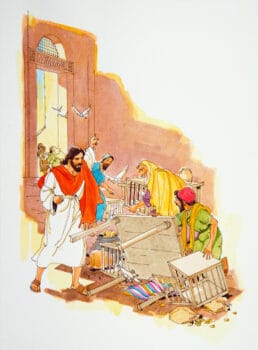
Image © Lifeway Collection at Goodsalt.com
False teachers must be faced with boldness and confidence (2 Corinthians 10:2) but mingled with the gentleness of Christ (2 Corinthians 10:1). Jesus once said, “I am gentle and humble in heart” (Matthew 11:29, NIV). However, Jesus also boldly confronted the money changers in the temple by overturning their tables and calling them robbers (Matthew 21:12-13). He also called the Pharisees hypocrites and whitewashed tombs right to their faces (Matthew 23:23-27). Like Jesus, Paul also knows that we are in a spiritual war that demands the use of God’s whole armor (Ephesians 6:12-17).
Paul’s language in 2 Corinthians 10:1-18 is military because lives are at stake (2 Corinthians 10:3-6). This is not a mere human conflict but a divine battle for winning people to Christ. In that connection, every false argument and lofty opinion must be faced and demolished, based on the Word of God, so that every thought may be brought into captivity “to make it obedient to Christ” (2 Corinthians 10:5, NIV).
In this spiritual warfare, Paul acts in the authority of Christ. This authority, however, aims at edification, not destruction (2 Corinthians 10:8). It is easy for spiritual leaders to affirm that they are acting in the authority of God. Nevertheless, they must remember that their authority is given by Christ, and, like Him, they must be meek and humble in heart. Paul’s claim of his Christ-given authority is due to his concern that the Corinthians were listening to the wrong people, thereby risking their loyalty to Christ.
|
How can we be simultaneously gentle and bold when dealing with false teachers? Why must we be both? |

Paul warns that spiritual war is not a passive activity but an active and vigorous fight, fought through the power of God and the spiritual weapons made available to us through the gospel. As the Spirit makes the truths of Jesus known to us, we must hold firmly to the gospel we have received and take our stand in it (1 Corinthians 15:1–2). Paul reminds the Corinthian believers that although we live in the world, we do not wage war according to worldly standards. Instead, “the weapons of our warfare are not of the flesh but have divine power to destroy strongholds” (2 Corinthians 10:3–4). Therefore, we must actively use the truth of God’s Word to take every thought captive and make it obedient to Christ (2 Corinthians 10:5).
Spiritual warfare is about the enemy (Satan) wanting to win human hearts and minds. This warfare is complex because it involves an invisible enemy using invisible weapons. The battlefields are the human hearts and human minds. Likewise, humans must respond with spiritual weapons covered with the blood of Jesus. However, the enemy uses humans as proxies to fight his battles. False teachers are his foot soldiers on the ground. How should humans face the “foot soldiers” who fight proxy battles?
It is profoundly important to note how Paul responded to such an encounter. Facing serious opposition, instead of reacting with hostility and vengeance, he deliberately decided to respond with Christlike meekness and gentleness. The world will always respond to a deadly enemy with power to exterminate and annihilate. But Paul responded to correct and call for obedience (2 Corinthians 10:1-2). We must not desire destruction for those who oppose the truth, but wish them repentance, restoration, and salvation. By the grace of God, we must avoid the temptation to fight those who oppose the truth with unspiritual weapons (hatred, arrogance, personal attacks, revenge, manipulation, and violence).
It is profoundly important not to miss Paul’s strategic approach when dealing with false teachers. “We demolish arguments and every pretension that sets itself up against the knowledge of God, and we take captive every thought to make it obedient to Christ” (2 Corinthians 10:5, NIV). Paul is telling us not to attack false teachers as people but their false teaching. We must avoid “labelling” people. We must avoid Character assassination. We can win an argument but lose a person. This is tragic, indeed. How then should we face spiritual warfare?
1. We must completely submit ourselves to God. We cannot effectively fight spiritual battles while we ourselves are in disobedience.
2. We must be firmly grounded in the Word of God.” Sanctify them by the truth; your word is truth” (John 17:17).
3. We must constantly examine our thoughts, imaginations, desires, and beliefs in the light of the biblical truth. Self-examination: whether we are still in the faith is a daily reality check.
4. Falsehood must be faced courageously. Paul did not run away from false teachers, but he faced them with humility, authority and care.
5. Spiritual warfare must be engaged with spiritual weapons and not with carnal weapons – intimidation, coercion, revenge, violence and hatred.
6. The manner of our approach must reflect Christlike character – “meekness and gentleness of Christ.”
7. We must always pray for those who have been deceived. Our desire for them should be repentance, restoration, salvation and not destruction.
Hi people
The father,the son and the olive tree. Australian geographic September to October 2026.
Michael Leunig was photographed under an African olive tree at st Kilda botanical gardens in 1996. This tree has such an abundant generous quality Michael said at the time. It is old and full and has a generous spirit about it. ….I want to plant it and have the memory of this tree that used to be such a comfort to me. Michael’s toddler son Felix was there too. A photograph was taken of the father,the little boy and the little tree.
The olive tree was duly planted on the family farm in north East Victoria.
The father,the son and the olive tree. A modern day fable?
God did not spare the natural branches….he will not spare the wild branches that were grafted in…..and the way is open for the repentant natural branches to be grafted back in. All Israel will be saved.
Your voice is the pen of a skilful writer in 2027.
Reneanne Anderson
Before we get into discussing how to face false teachers, it is useful to consider what teachings were considered heresy in first century. We must remember that this was the formative period for the church and early Christians were feeling their way to a certain extent. There were two main heresies at the the time; Judaistic teaching and Proto-Gnosticism.
Judaistic teaching is well documented in the New Testament, and it is recorded that Paul fought hard to counteract its influence. The Judaisers accepted Jesus but wanted to ensure that gentile converts became Jews and obeyed the Mosaic law including circumcision, feasts, and other rites.
The Proto-Gnostic teachings are harder to define because Gnosticism was not really defined until the second century CE. However there are clues in some of the epistles that the ideas were being circulated and given some traction. One idea was that you had to have special mystical knowledge (gnosis) to be saved. Only those who were spiritually in tune with the divine could be saved. This was often associated with the idea of dualism, which provided a mechanistic view of salvation. (Please note that I am simplifying this for the sake of brevity.) Both directions detract from the simple idea that Christ died for us, and we are saved by grace, and they replace it with either tradition or require special knowledge and understanding to be effective.
One could be excused for interpreting 2 Corinthians 10 and 11 as Paul trying to vindicate his teaching over the other alternatives being offered. But I think he is trying to get the idea across that he is presenting the Gospel not only by his preaching but by the way he is living. He is not in the business of making a heap of money out of the Gospel, or attracting a personal following. His message is Christ-centred and neither harks back to historical tradition nor replaces it with esoteric mysticism.
Is there a message for Seventh-day Adventist Christians today? Sometimes I see ourselves as torn between our history and our predictions of the future. A quick tour of websites purporting to have connections with Adventism show many that accuse the church of having lost its 19th century roots, or alternatively they try to give a current affairs commentary on present day politics. And in the noise we are in danger of losing the centrality of Jesus to salvation. We don’t need to vindicate the past or predict the future. We need to live the Gospel. Is that the message of 2 Cor 10 and 11?
Hello brothers and sisters, I am asking this question, was this an additional problem, or Paul first dealt with the consequences of the problem, and now he is dealing with the cause? This is what it seems like to me.
If we are to be defenders of Christ word, we must act as offense and defense. Defending God’s word in our words and actions, while actively standing up for what is right. In 1 Corinthians 10:1–11, Paul reminds us that the Israelites experienced God’s presence, guidance, and blessings, yet many chose to disobey Him, follow idols, and give in to sinful desires. Their story serves as a warning for us not to repeat their mistakes. As Christians, we must take a defensive stand by guarding our hearts, resisting temptation, and refusing to compromise God’s truth. At the same time, we must take an offensive stand by boldly sharing God’s Word, speaking truth, making righteous choices, encouraging others to follow Christ, and standing against actions that go against His teachings. Being a defender of Christ means more than protecting our faith when it is challenged; it means actively living out and proclaiming God’s truth through our words, choices, and actions.
Weapons of warfare God’s Word, prayer,fasting they always work.
Whilst one must be forthright and intensely serious in presenting the Gospel of Jesus Christ; our presentations must also be pervaded with the Charisma of the Spirit.
Of all the “Apostles” , Paul should be the foremost promoter of that gentle and quiet spirit which is of great value in God’s sight as he confronts false teachers. After all Paul had not only a false understanding of the theology of the Early Church but was it’s Chief Persecutor.
To be honest with you, my perceptions has led me to believe that comparatively fewer “false teachers” would knowingly proclaim a “Message” of which they are aware is false. Therefore the majority must be confronted intelligently with love, wisdom and sound Biblical teaching presented in a coherent and logical manner.
I have had the experience on more than one occasion to hear my fellow brethren explain the reasons that they believe in certain doctrines we embrace as a church ; and sat shocked and appalled at the incoherency of their argument.
This matter becomes even more fascinating as one encounters Christians of other denominations. I do not think that I will ever forget during my Theological studies visiting the Catholic Seminary and the Pentecostal Bible School in my country and hearing from these Professors why they believe in certain doctrines not espoused by the Seventh-Day Adventist Church.
Beyond the shadow of a doubt great humility supported by a mind fully knowledgeable of the Word of God is crucial in such times.
Being gentle and bold simultaneously is important because it’s a matter of life and death, and so correcting the ‘soul’ in love is of paramount importance. While someone has the choice to make whether to stay or leave, correcting them in love and patience us critical because satan is lurching, with intention for them leave
People often confuse meekness with weakness. The best working definition that I ever heard for meekness was, strength under control. Think of the times that Jesus seemingly “lost it,” they were times when representatives of God were misrepresenting him. Even when Jesus overturned the tables of the moneychangers who were making the sacrificial system a for profit business, he held back. One flash of his divinity in that moment would have vaporized them and the Pharisees. In that moment it was said that zeal for his Father’s house consumed him. (John 2:17)
Does zeal for our Father’s house and reputation consume us, or are we merely passive participants? A thought to ponder.
To better understand the false teachings of which Paul alluded to in 2 Corinthians 10 and 11, I went to Acts of the Apostles. And read about Apollos starting his ministry in Ephesus. Apollos was a living example that John the Baptist preaching was not in vain. Aquilla and Pracilla who were in unity with the full and true gospel had perceived that Apollos was not fully understanding the gospel of Christ. Aquila and Precilla taught Apollos and through their teaching Apollos obtained a better understanding of the gospel accepted it and became one of the most able advocates of the Christian faith. It helped me to go to the Acts of the Apostles to get an illuminated picture of another follower of Christ like Paul, Aquila and Priscilla, had the full gospel. The following link is the reference I mentioned page 270.
https://egwwritings.org/read?panels=p127.1192&index=0
Thank-you Maurice for your insight of what the false teachings were. That was my question that came to mind as I read Sabbaths lesson. Yes, the message is to understand and live the Gospel of Christ. Thumbing on down to page 272.1 emphasizes our thesis.
https://egwwritings.org/read?panels=p127.1204&index=0
There are SO many false teachers out there that proclaim they are right with God, but they are getting rich with their false beliefs. I know God is in control, He will take care of them.
Gentleness and boldness: strong characteristics for anyone to perceive. I guess one can only react like that when relying completely on the Spirit of Love.
This study gives me the opportunity to comment on a real life event that is currently all over the news in America, the trial of a woman who killed her three children while suffering from postpartum psychosis.
When someone goes through a severe mental health crisis like psychosis, it’s easy to pull into two separate camps. One camp looks only at medical charts and chemical imbalances. The other looks strictly at the spiritual realm, seeing it as spiritual warfare or demonic deception. But the truth is, we are whole people—body, mind, and spirit. Because these parts of us are completely intertwined, both realities can intersect at the exact same time.
A physical breakdown in the brain creates a very real vulnerability. I believe that at that time, when the mind is clouded by illness, demonic forces can capitalize on the biological chaos to weave in deeper deception, isolation, and destructive thoughts.
In such instances Christian practioners should reject the false choice between prayer and medicine. The approach should then be to use medicine to stabilize the physical brain and clears the cognitive fog. This should be followed by spiritual care to address the spiritual warfare taking place. We don’t have to choose one over the other. When we acknowledge both the physical and spiritual sides of suffering, we can truly care for the whole person.
In Ephesians 6:17, Paul calls the Bible “the sword of the Spirit, which is the word of God.”The Word of God is the Nail (or the Sword Blade): The nail is the sharp object that pierces through, holds things together, and does the structural work. On its own, a nail is solid and sharp, just like the truth of Scripture.The Holy Spirit is the Drill (the Driver): A nail sitting on a table can’t drive itself into a wall. It needs a power source. The Holy Spirit is the active power, the “driver” that pushes the Word of God deep into our hearts and into the spiritual battle.Why Paul Used This Imagery in Spiritual Warfare When Paul says we are in a spiritual warfare, he wants us to know that we aren’t fighting with human strength, logic, or willpower.The Tool is Divinely Powered. Just like a manual screwdriver takes a lot of human effort and can slip, a power drill drives a screw effortlessly. When we face spiritual attacks (like doubt, fear, or temptation), we don’t just repeat Bible verses like a magic spell. We rely on the Holy Spirit to activate that Word in our minds, giving it the piercing power to demolish the enemy’s lies.Precision and Grip: A nail driven by a powerful drill stays exactly where it belongs. The Holy Spirit takes the specific truth you need from the Bible and locks it into your situation, anchoring your faith so you “can stand your ground” (Ephesians 6:13).