
Monday: Boasting in the Lord

Daily Lesson for Monday 14th of September 2026
Yesterday, we saw that Paul and his fellow workers exerted their ministries as a spiritual warfare, and did so using God’s weapons. Today, we will see that false teachers act according to human criteria. They boast inappropriately. In turn, Paul boasts only in the Lord. As he wrote: “But ‘he who glories, let him glory in the Lord’ ” (2 Corinthians 10:17, NKJV).
Read 2 Corinthians 10:13-17. How can an atmosphere of competitiveness harm the preaching of the gospel?
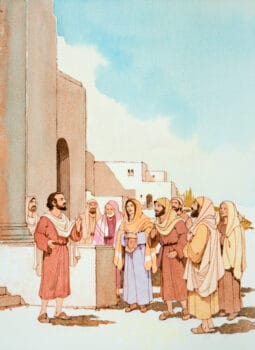
Image © Lifeway Collection at Goodsalt.com
Paul’s use of self-boasting language has intrigued interpreters throughout the centuries. However, self-boasting was a common practice in the ancient world and was controlled by social conventions to avoid offending the audience. Paul knew such conventions, and he followed them. In addition, Paul makes it clear that his way of boasting distinguishes itself from that of the false teachers. He boasts in the Lord (2 Corinthians 10:17). This is a quotation from the Old Testament: “ ‘Let him who boasts boast in this, that he understands and knows me, that I am the Lord who practices steadfast love, justice, and righteousness in the earth’ ” (Jeremiah 9:24, ESV). By quoting this passage from Jeremiah, Paul shows that it is Christ who is in focus—Christ’s love, justice, and righteousness.
In other words, Paul’s boasting focuses on God’s accomplishments in Christ. Thus, his boasting is biblical and, hence, inoffensive. On the other hand, his opponents got into an atmosphere of competitiveness by comparing themselves to one another. This is foolishness (2 Corinthians 10:12).
In 2 Corinthians 10:14-16, Paul hints that preaching the gospel is the primary focus of his ministry, both in Corinth and in regions beyond Corinth. Paul’s love for Jesus led him to talk constantly about the good news of salvation, found in the death and resurrection of Christ.
Unlike the false teachers in Corinth who commended themselves, Paul had been commended and approved by God (2 Corinthians 10:12,18). He was “called to be an apostle of Jesus Christ through the will of God” (1 Corinthians 1:1, NKJV). He was faithful to this calling until the end of his life (2 Timothy 4:7).
|
Reread 2 Corinthians 10:12-18. How can church leaders, or even members, avoid an atmosphere of competition? Why is it so easy to get caught up in things that really don’t matter? |

I have noted a trend emerging in my church, whenever, a new preacher (speaker) is introduced, his/her complete CV (resume) is literary read out. The academic qualifications, number of books written, scholarly achievements, articles written, number of churches pastored, number of baptisms, extra curriculum activities, what the wife/husband does for a living, her/his academic achievements. It sounds as if the congregation is being informed that the speaker qualifies to preach. It sounds as if one who has less credentials does not qualify to present the Word of God. It literary sounds like “boasting”, “here Am I, a worth person to stand before you”. “Look how impressive I am”. Is this the same thing Paul was doing in 2 Corinthians 10:12-17?
Absolute not!. Paul explicitly rejected self-measurement and self-commendation.
“Oh, don’t worry; we wouldn’t dare say that we are as wonderful as these other men who tell you how important they are! But they are only comparing themselves with each other, using themselves as the standard of measurement. How ignorant! We will not boast about things done outside our area of authority. We will boast only about what has happened within the boundaries of the work God has given us, which includes our working with you” (2 Corinthians: 10:12-23,NLT).
Paul was not inherently condemning credentials, but was rebuking the manner in which a man/woman of God establishes his/her authority and worth. Paul was responding to the manner in which some preachers were trying to establish their superiority as ministers. They were measuring their self-worth using human means and standards. It is truly remarkable to see how Paul responded. “If I must boast, I would rather boast about the things that show how weak I am” (2 Corinthians 11:30, NLT).
There is a huge difference between introducing the preacher and “credentialising” the preacher.
For instance, “Our speaker is Dr X, has four degrees, has published 15 books, written 75 scholarly articles, pastored 15 churches, conducted 4,000 baptisms, served on ten committees in the GC, and his wife has two master’s degrees, play piano and a guitar….”
The introduction is seriously saying , “this is the reason you should listen to this person”.
We lose the audience before the preacher even stands up!
“Our speaker is Dr X, has four degrees, has published 15 books, written 75 scholarly article … ”
In response to your assertion of the “emerging trend” in your church. I would suggest it’s a trend that seems to have become entrenched in the contemporary West. There appears to be a growing inclination among many, that unless a speaker has “qualifications” and/or academic achievements that can be listed, that you can’t take anything they have to say seriously, or that they do not have any genuine authority to speak.
It’s the phenomenon of the “expert class”, where listeners are able, or need to absolve themselves of any personal thinking and/or “testing”. ie – “just trust the experts”. It’s very curious, and I’d argue dangerous.
“Test all things; hold fast what is good.” – 1 Thessalonians 5:21
“To the law and to the testimony: if they speak not according to this word, it is because there is no light in them.” – Isaiah 8:20
You hit the nail on the head. During the introduction of the speaker, one himself says: he only has one wife, as if we allow polygamy in the church. It’s time for leaders to stop glorification and elevate Christ.
Thanks Omwenga for sharing. What I wish to share with us, is the significance of credibility in this aspect of sharing.
Jesus had a credibility problem with the Jews. ” Not until halfway through the festival did Jesus go up to the temple courts and begin to teach. The Jews were then amazed and asked, “How did this man get such learning without having been taught?” John 7:14-15 NIV
In fact one factor that gave Jesus’s teaching credibility,. was his miracle working ministry. In John 10 :34-38. Jesus provides his miraculous works as evidence that his teachings are credible. In John 3:2 a Jewish leader recognized Jesus as a teacher from God because no one could perform such miracles without God’s power. The point is this: everyone who seeks to communicate to us; regardless it is by speech or the written word; their communication is validated by their PERSON; that is, who they are. On what basis, does this person have the right to communicate to me on these matters, is a valid question.
When a person stands behind the pulpit I view him through my psychological lenses. His educational background on the subject, his age, his ethnicity , his command of the spoken language, his dress, his gesticulations, the atmosphere that radiates from his personal ambience – all of these and more I use in my judgement of his credibility.
Omwenga I know what I am telling you firsthand. I have been a salesman for years and what I have mentioned in the previous paragraph sometimes has to do with more than 50% of the effectuality of your sales presentation.
Therefore in introducing the Speaker, it should not be overdone; but it is extremely important.
I believe credentials have their place in God’s church. When legitimate preparation and credentials are joined with a genuine calling from God and the empowering presence of the Holy Spirit, they can become powerful instruments for accomplishing God’s work. Credentials alone are not what qualify a person for ministry, but neither should we dismiss the value of education, training, experience, and demonstrated competence. When these are surrendered to God and directed by the Holy Spirit, powerful things can be accomplished for the advancement of His cause.
A key distinction is that credentials are tools, not the source of spiritual authority. The ultimate qualification for God’s work is His calling and the Holy Spirit’s empowering presence; preparation can help us become better agents of that calling.
One time when a new, young pastor was being introduced by our conference president, the president commented that he interviewed several candidates but the one that he was hoping to hire had accepted a position in another conference. We didn’t hear much about “qualifications”.
It seems that the conference president wanted to hire someone who was “the most qualified”.
However, the pastor that was hired had the responsibility of pastoring four churches in a fifty mile radius, preaching a sermon at two churches every week. The pastor that was hired was from a southern state that didn’t have snow in the winter. Our location is in the snow belt. I remembering questioning if the pastor would be ready to accept the changing weather challenges. Possibly that was the real reason the favored pastor accepted another position.
Well said my brother.
Thanks, Omwenga. I agree that’s a cause for concern, but I’m not sure what’s to be done about it.
It’s an unfortunate trait of human nature to pay attention to “credentials,” without even knowing how they were obtained. (Most of us probably know that some “credentials” are not honestly obtained.)
But the bottom line really is that the best “credentials” are a Christ-like life. Without that, three PhD’s and 300 baptisms are worthless. (I know from experience that the Lord sometimes uses people in spite of themselves. In one case, the “evangelist” was in an active adulterous relationship while he was preaching. In spite of that, some people were drawn to Christ by the Holy Spirit – because they were seeking, not because the “evangelist” was qualified.)
A note to pastors who may be reading this: When it comes to the judgment, I believe that Christ is not going to ask how many degrees you earned, or how many articles or books you published. But He IS going to ask, “Where is your flock, your beautiful flock?”
Did you spend your time getting to know the spiritual condition of each sheep and lamb in your flock, so you could counsel in a godly way and preach appropriate sermons? Or did you spend your time writing articles and books for publication to bolster your “credentials”? Since we all have only 24 hours a day, if you spend your time writing articles or books, you likely don’t have time for the work He commissioned you to do as pastor, the job for which you are paid from the tithe.
I don’t think every church does this (mine certainly does not, thankfully), but it seems to be common in certain parts of the world.
Personally I find this very distasteful and I suspect the average unchurched person would be very turned off by it. That in itself is good enough reason to stop.
Introductions are fine, but all most people want is something to feel they know a little about the speaker.
And many uncredentialed people have preached powerful sermons. God can use the unqualified. In fact that seems to be His typical way of working.
Agree.knew a pastor who claimed the church building was his. In less than a year he left the church.
See people say it is okay to be introduced with all the credentials and accolades, however, what happens to a man who’s been called by God to speak His word yet has no proper education? How many of those profs, Doc’s have been introduced and yet no proper word of God came from them? In introduction, let God take precedence, He is the one who has called us all out of darkness into His marvellous light
Last week I was a guest speaker for a U3A group. It was not my local U3A where I have been involved for quite many years, but one in a neighbouring town. I was introduced as Dr Ashton. The interesting thing is that my PhD is in computer science but my talk was on action bird photography. My PhD was essentially a useless appendage. My real qualification was that I have spent the last 15 years of my life out in the bush and swamps photographing birds. Academic qualifications are important, but experience in the field counts even more. (If you would like to see the slideshow of my talk you can find it here. https://www.youtube.com/watch?v=nBDHGK9oQ6E&t=326s I put it up on YouTube so the members of my audience who fell asleep during the program could watch it without my boring voice on the TVs at home.)
Paul’s plea to the Corinthians sounds to our ears as though he is boasting about his humility and experience, but if we read carefully, he is pushing for Jesus as central to his message. Read some of these verses:
What is the lesson for Seventh-day Adventists today? Maybe we need to understand the importance of the centrality of Jesus. Ellen White had this to say:
When the focus is right, the lens has power!
To boast in Christ, I want to tell you that last week we became aware of OneVoice27.org
I recently received a notification in my e-mail that I am a member of the project of the Seventh-day Adventist Church to promote Christ worldwide. As a member of the OneVoice27.org project now, I have one vote to recommend the book Desire of Ages to be a companion book to the Four Gospels of the Bible. Just think Omwenga, Motanya, Reneanne, and Maurice, we could get 40 copies from the AdventistBookCenter.org to share with friends and neighbors. By all means put a card of your church’s address and your phone number in the book with an invitation to Bible studies.
Now if you are humble, you can put a donation in the plate for personal ministries they may have some Desire of Ages already on hand at your church. I would say that is living a Christian life the way Paul looked at it. I am ahead of you I have 40 DA books in a box at home. No boasting, no competition, just sharing. The early Christians shared their experiences, encouragements, and giving with each other.
There is an irresistible tendency in humanity to boast and take pride in personal accomplishments. All people are susceptible to it—the highest and the lowest, the richest and the poorest, the best educated and the most illiterate. King Nebuchadnezzar proudly attributed the greatness of Babylon to his own power and majesty (Daniel 4:30), while Goliath boasted in his physical strength and military prowess before the armies of Israel (1 Samuel 17:42–44). Yet David provides a striking contrast: although he achieved victory over Goliath, he refused to trust in his own strength and declared that the battle belonged to the Lord (1 Samuel 17:45–47). Indeed, even those who appear humble are not immune to the subtle temptation of seeking recognition and credit for themselves.
Paul reminds us that our remarkable accomplishments are not ultimately the product of our own ability but of God’s power working through us: “Not that we are sufficient of ourselves to think of anything as being from ourselves, but our sufficiency is from God” (2 Corinthians 3:5). Therefore, if we are to boast, let us boast not in ourselves or in what we have accomplished, but in the Lord and in what He is able to accomplish through humble vessels such as you and me (Jeremiah 9:23–24; 1 Corinthians 1:31). As we celebrate our union with Christ, may we glory in His accomplishments, His grace, and His power, remembering that apart from Him we can do nothing (John 15:5).
Hi people…
Gentle advice at Avondale from some lecturers that upskilling was a global trend and unskilled humility worked in earlier times but not in an educated and skilled contemporary society.
I respected rob MacIver for his heads up on this.
When ken and I preached around nnsw conference it was the third degree on our qualifications and experience that we encountered.
Reneanne Anderson
Reneanne,
I am not an University educated SDA. I am a retired blue collar believer in Jesus, so I have to ask questions when I don’t understand but want to…
Please explain what you mean by “it was the third degree on our qualifications and experience that we encountered.”
Hi people…
A voice that boasts of heaven in 2027!
From Ellen g. To thee…
Christ’s object lessons. Chapter: other lessons from seed sowing.
In everything that tends to the sustenance of man is seen the concurrence of divine and human effort. There can be no reaping unless the human hand acts its part in the sowing of the seed. But without the agencies which God provides in giving sunshine and showers, dew and clouds, there would be no increase. Thus it is in every business pursuit, in every department of study and science. Thus it is in spiritual things, in the formation of character, and in every line of Christian work. We have a part to act, but we must have the power of divinity to unite with us, or our efforts will be in vain.
Well people it is up to us weather we unite with God or weather we choose the uniformity of vanity.
A weather vane in the blinding rain?
Blessings of heaven in 2027 to all.
Reneanne Anderson
My second eldest brother had cancer of the stomach he was given two weeks to live (he wounds wouldn’t close). Our church at the time had a pastor who was such an inspiration he would visit my brother daily.
One day my brother said to him, Pastor Watson, I pray I could be like you, you have so much faith and humility. He turned to my brother and said, Ronnie we should never look to be like another person, we should always look up to Jesus because he will never fail us.
Hebrews 12:2 Looking unto Jesus the author and finisher of our faith; who for the joy that was set before him endured the cross, despising the shame, and is set down at the right hand of the throne of God.
I praise God, Ronnie was 25 at the time, the Lord cured him, he is 83 years old today.
First of all, you need to ‘work’ on self. Don’t see yourself as inferior/superior. That’s where you start to see yourself in human standards. And that can make or break you. One will think that they can’t measure up to the other person, then get despondent and leave church; while the other gets haughty and runs the risk of losing their soul. Each person strength (gifts) is different, so you should operate in your strength and keep your eyes on the Master. Ppl who has an obsession with competition may have something going on that needs to be addressed. Humility is required, and perhaps helping the person who you feel the need to compete with could bring both closer to Christ, thus brightening and lightening the journey for both.
In the context of 2 Corinthians 10, I boast in the Lord by celebrating His attributes—His steadfast love, His power, and His righteousness. This kind of God-centered boasting brings me comfort and strengthens my faith. As I focus on who God is rather than on my own limitations, I am empowered to press forward, persevere, remain faithful, and finish the race He has set before me. My confidence is not in myself, but in the Lord whom I serve.
I believe that deep inside most of us is a lingering question; “Am I good enough, intelligent enough, good looking enough?” A deep seated insecurity from the fall remains which only Jesus can satisfy and soothe. In him we are enough. We don’t have to prove anything. As much as we’d like to be someone that we aren’t, we are at our best when we are who God created us to be.
In my early twenties I came to know the Lord, and the change in me was noticeable, so much so that both of my younger brothers came to me and told me that they wanted to be like me. I told them that they were enough and to “be the person that God wanted them to be. It’s not about me. It’s about the Jesus in me.”
It’s not about our abilities and accomplishments, our diplomas or degrees. It’s about the One who made our bodies, minds, and mouths. We get the greatest joy and blessing when we give the glory to the One who was and is making us who we are. It’s not about us, it never was, or ever will be. We are merely instruments in the Master’s Hands. That is what makes all the difference in the world.
Touch of the Master’s Hand, Wayne Watson
There is absolutely nothing wrong with pastors furthering their education and adding to their qualifications. In fact, studying and developing professionally is commendable. However, education and qualifications should never come at the expense of caring for the flock entrusted to them.
A pastor’s ministry is not only about standing in the pulpit and preaching. Where is the visitation of new members? Where is the time spent visiting the sick, encouraging those who are struggling, and counselling families who are going through difficult seasons? These are also essential parts of shepherding God’s people.
Sometimes we hear, “I have been busy studying; I am now Dr. so-and-so.” But meanwhile, the pews are becoming empty, members are hurting, and there seems to be little concern about finding out what is happening within the flock.
Qualifications are valuable, but they should strengthen ministry, not replace it. A shepherd must know the condition of the sheep.
We need to ask ourselves honestly: are we caring for God’s people, or are we becoming more concerned with titles and qualifications?
Woe unto us if we gain qualifications but lose sight of the people God has called us to serve. May God help us to put the spiritual welfare of His flock at the heart of ministry and boast in Him.
Christ has to be more important to the Christian than the church itself.
Sharing on the samaritan woman and her lack of experience like the disciples but how she moved a whole city of “sinners” and she was also considered one. Yet just her testimony did the job, her love for Christ and her testimony… Thats what what i learn from Paul