
The Essence of Christian Life and Witness

Writing letters is an age-old activity that has not become obsolete. We’ve merely changed the way that letters are written. Yes, social media superseded paper. However, in their essence, emails and other forms of electronic letters exert basically the same function: they connect people by exchanging information, feelings, and thoughts.
Why do people write letters? A possible answer is that they have something to say. So it was with the apostle Paul. Although he had so much to say, Paul did not always have the chance to be face-to-face with those whom he wanted to talk with.
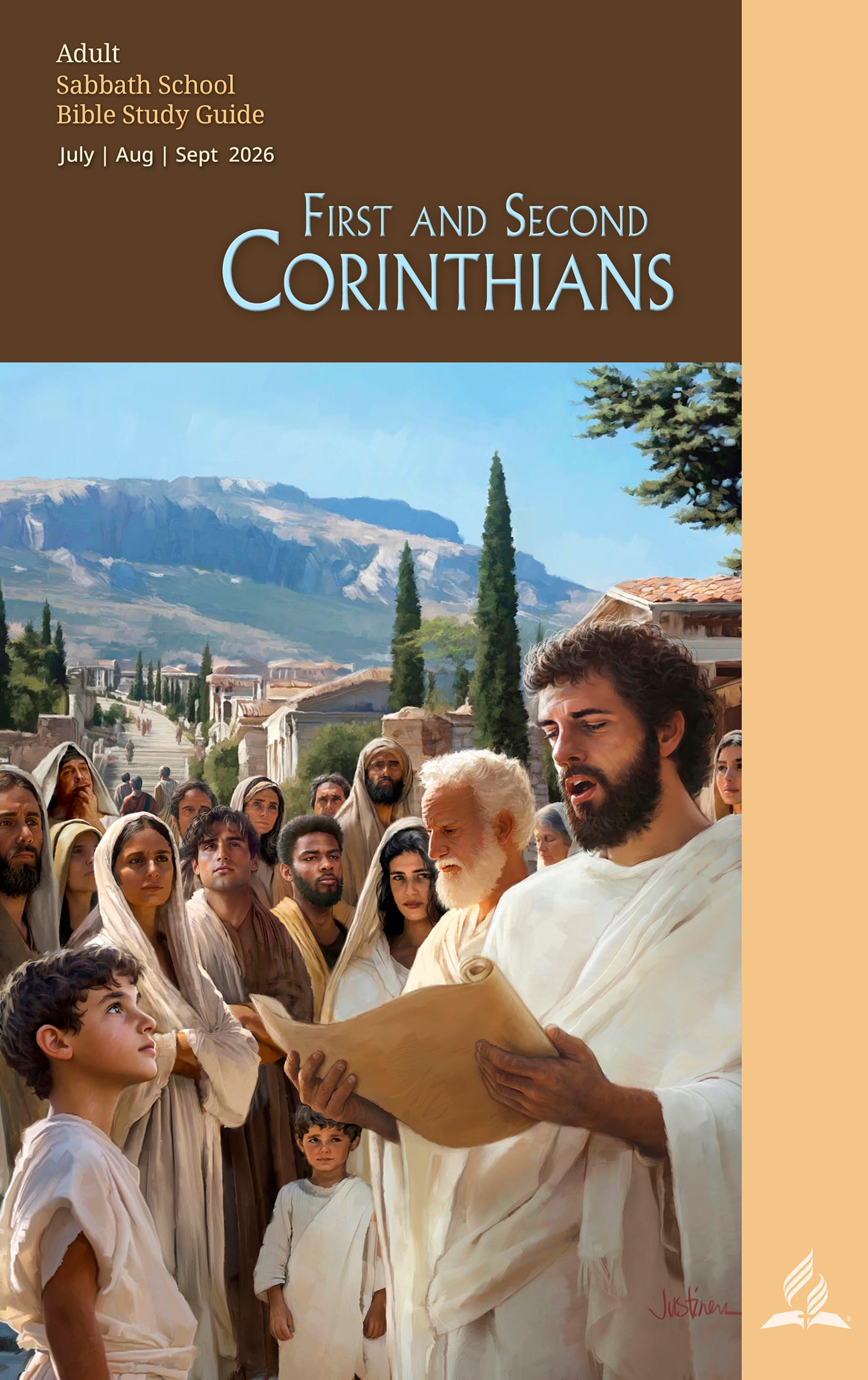
Image © Pacific Press
So, he wrote letters instead–such as to the Corinthians, which contain some of Scripture’s profoundest truths. Among them are: “I decided to know nothing among you except Jesus Christ and him crucified” (1 Cor. 2:2, ESV), and “For you know the grace of our Lord Jesus Christ, that though he was rich, yet for your sake he became poor, so that you by his poverty might become rich” (2 Cor. 8:9, ESV). And what about the stunning hymn to love in 1 Corinthians 13?
On the other hand, whoever reads Paul’s letters to the Corinthians will inevitably get perplexed, not only because of some substantial problems within the church–such as sexual immorality–but also because of the nitpicking that results from cheap factionalism among the members. If you think your church has challenging issues, get ready to see the avalanche of problems Paul had to deal with in Corinth. Perhaps your local church’s problems are not as significant as you imagine. Very likely, you will see that things in Corinth had been much worse.
As disturbing as the problems in Corinth had been, the letters to the Corinthians capture our attention, not because of the problems but because of the remarkable way Paul faces them. By exhorting the church members to evaluate themselves, their behavior, and the surrounding culture in the light of the gospel of Jesus Christ, he exalts the message of the Cross. To use the words of Paul himself elsewhere, any standard lower than the gospel message is to be seen as “anathema” (Gal. 1:8-9, ASV).
In Paul’s time, Corinth was famous for its wealth and strong commerce, all thanks to its port, architecture, shipbuilding, and ceramics. The city was an important financial center. Nevertheless, it was also known for its sexual immorality, religious cacophony, and shrines dedicated to various gods. Indeed, daily life in Corinth was marked by flagrant idolatry. This historical-cultural background helps us understand Paul’s main concerns regarding the Christians in that city and, consequently, his exhortations to them.
This quarter, we will survey Paul’s letters to the Corinthians. In these two remarkable New Testament books, the apostle presents the gospel message as the essence of Christian life and witness, the lens through which everything else is to be judged. No matter the challenges each of us individually or the church in general faces in our journey to heaven–the answer to the most puzzling issues in our work for Christ is the same as for the Corinthians: “Jesus Christ and Him crucified”! (1 Cor. 2:2, NKJV).
Jesus is coming soon. This is a time for more unity in Christ, for an openness to the Holy Spirit as never before, for diligent use of the spiritual gifts, and for a more profound experience with our resurrected Lord. It is time for a genuine Christian ministry, engagement in stewardship and mission, spiritual warfare against false teachings, and growth in grace, love, and fellowship. This is a time to hold fast and be faithful to the message of the Cross, and Paul’s letters to the Corinthians teach us to do just that.
Adenilton Tavares de Aguiar, PhD, is a professor of Biblical Interpretation at the Theological Seminary at the Adventist University Center of São Paulo (UNASP) in Brazil.

One of my big regrets in my life is that I never kept our courtship letters. As I have mentioned previously in my comments, Carmel and I were living in different countries during our engagement. We wrote letters to one another once or twice a week and we both kept all our letters. We married at the end of 12 months and moved to Perth in Western Australia for my first teaching job with the Adventist Church. We had only been there for 12 months when we were called back to teach in Melbourne. It was during this shifting process that we decided we had been married long enough and no longer needed all our courtship letters, So they were all thrown out with the garbage. Nearly 60 years later and we have grandsons who have fallen in love with young ladies and who do not know the joy of letter writing. They would probably think they were a bit quaint and old fashioned anyhow.
Paul’s letters to the early churches were love letters and I am so thankful they were treasured enough to be kept. 2 millennia later we can still read them and find value in them. There are some who think that such correspondence is quaint and out of date. But there is still much in them that bridges time and culture, and makes them very relevant to our time.
I will also issue the challenge to read these epistles right though to get the big picture before we start dissecting them. The sum is more than the parts!
It might require us, as we study these two letters to the Corinthians, to examine them carefully—word by word, within the context of their time and place. Overall, however, three things stand out most clearly: (1) the young church in Corinth was going through something ugly and devastating in its spiritual walk—the church had blended with the cultures and traditions of the people. The grapevine speaks of the same concerning the current state of the church today: infidelity is on a steep rise, along with corruption, lust, and deceit. (2) Even in such a condition, the church in Corinth still needed redemption and revival despite its state, just as the church today does. (3)God never stops calling; He never abandons His mission. Paul was deeply concerned about the condition of the hearts in the church. Through his letters, as communication went back and forth, he remained determined to correct, restore, and improve the situation.
The deep-cutting issues are so closely related to what is happening in our local assemblies today. Church division and leadership squabbles and contests, immorality and relationships, and Christian living will feature prominently, and they are not new to us. Just recently, there was news of church leaders in the Seventh-day Adventist Church fighting during the Sabbath worship hour. Church leaders and shepherds have become so accustomed to courtrooms, suing one another. And is immorality a stranger to our assemblies anymore? But wait a minute—stay with these letters. They will inspire and encourage us in spite of all this.
There have been arguments about a probable third letter, or even more (2 Corinthians 13:1–2), but that should not distract us. Even within these two letters alone, there is profound depth and a solemn warning. Let’s work with what we have because it is rich in the Spirit.
Interesting quarter it shall be…
I Agree with Adenilton. That the church needs more awareness of the soon coming of Christ. And that the church needs more of each member being a genuine Christian, innocent, not only in belief but also in action. As example more Christian love bring the love of Christ to others, should be near the top, or at the top of our list. I appreciate that in our pastor’s ministry. Though come to think of it Adenilton, most likely is talking about all of us in his last paragraph, because all of us are ministers for Christ in one form or another. Let me add to keep members we need to have the ideology that our church is only as friendly as we, we make it, with a goal of having at least 7 friends in our local church. Basically, win friends and influence people in the church and out of the church with the love of God. What is the love of God? You know.