
Tuesday: Being Confident

Daily Lesson for Tuesday 13th of January 2026
Read Philippians 1:23-24. What does Paul mean when he says that “to depart, and be with Christ” is “far better”?
This passage has been greatly misunderstood through the ages. In this week’s passage for study, Paul dealt with the contrast between living and dying. The Christian lives for Christ and may even die for Him. In that sense it is “gain” because our witness is that much more powerful and persuasive (Philippians 1:21). No doubt a person believes when willing to die for that belief.
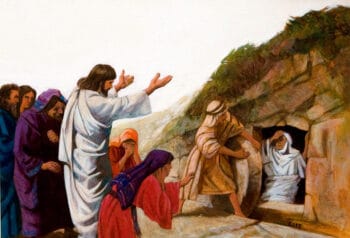
Image © Review & Herald Publishing at Goodsalt.com
But we must also recognize that the dead are really dead. They “know nothing.” They rest in the grave till the resurrection (see Eccl. 9:5; John 5:28-29). That’s why Jesus said of Lazarus, who had died, “Our friend Lazarus sleepeth; but I go, that I may awake him out of sleep” (John 11:11).
If, when people die, they go immediately to heaven, imagine how that would be for Lazarus. After four days of Lazarus frolicking in Paradise, an angel comes with the “bad” news: “Sorry, Lazarus, but Jesus is calling you back to earth. You can’t stay here.”
When we follow error to its logical conclusion, we see how erroneous it is. Death is like a dreamless sleep from which Jesus will awaken His faithful followers at the Second Advent; then, together with the living saints, they will be caught up and taken to heaven to be with Jesus forever (see 1 Thessalonians 4:16-17).
Paul’s “departing” from the present life to be with Christ means to be with Him in suffering and dying (2 Timothy 4:6) in order to “attain to the resurrection from the dead” (Philippians 3:11, NKJV). Also, he was no doubt aware that he would close his eyes in death and that the very next thing he would know, in the twinkling of an eye, would be seeing Jesus, who would take him, with all God’s people, to the place Jesus has prepared for all who love Him (John 14:3, 1 Corinthians 2:9).
Though willing to die for Christ, Paul knew it would be better for the Philippians if he would “remain in the flesh” (Philippians 1:24, NKJV). Interestingly, for the Christian, whether it is better to live for Christ or die for Him is not necessarily easy to answer. Paul was “hard-pressed between the two” (Philippians 1:23, NKJV), between staying alive or resting in the grave.
|
Again, however much no one wants to die, have you ever thought about how the moment you die, the next thing you will know is the return of Christ? How might that thought help you understand Paul’s thinking here? |

There is no doubt that the verses for today’s lesson are a bit ambiguous. The fact that we immediately go into defensive mode when we encounter this passage is evidence of that. In my own thinking, I take four considerations into account.
What else does Paul say about the state of the dead?
And if we look at his other statements, we find clearer expressions. eg 1 Thes 4:13
What is Paul talking about in this letter?
He is full of joy and is saying how much he appreciates the opportunity of interacting with the Philippian Christians.
Paul uses figures of speech
He would rather be alive that dead.
Paul may still be sorting some ideas out
Sometimes, we are a little hard on the idea of inspiration. We need to remember the Bible is the story of people learning about God. Paul’s theology grew with his relationship with Jesus. I don’t know where Philippians stands in the timeline of Paul’s experience and writing.
That is why it is good to compare scripture with scripture, and is one of the reasons I suggest reading the whole epistle in one setting. It gives a perspective to these challenging verses.
What are some of the key lessons to be learned from the state of the dead?
1. Since there is no second opportunity after death, the call to respond to God is now (Hebrews 3:15; 2 Corinthians 6:2).
2. The state of the dead teaches us that we should live wisely, trust God fully, hope confidently, and love deeply while we have life.
3. In death, all people are the same. This teaches compassion, justice, and the absence of favouritism in God’s eyes (Ecclesiastes 3:19–20).
4. The state of the dead reminds us that human beings are mortal and only God is immortal. It is only God who gives life.
5. The dead do not interact with the living; hope lies in God’s promise to raise them again (1 Corinthians 15:51–55).
6. Physical life has an end, our choices matter. Using our time wisely, loving others, and seeking God while we live is critically important (Ecclesiastes 9:10; Galatians 6:10).
7. The state of the dead reminds us that life is fragile and temporary. No status, power, or wealth prevents death, teaching humility and dependence on God rather than self-reliance (Psalm 90:12).
The world’s perspective of confidence is often blurred and overrated. It encourages people to believe in themselves in a way that eventually leads them to rely on their own strength rather than on Jesus Christ. In this sense, self-confidence can be misleading. Paul was not speaking of self-confidence, because he fully understood it as an illusion—something unattainable and unsustainable. He knew such confidence was fleeting and unreliable.
Throughout Scripture, we see the danger of confidence rooted in self. In the Old Testament, Elijah became suicidal after calling fire down from heaven, killing the false prophets, and witnessing a national revival through answered prayer and abundant rain after a long drought. Samson’s self-confidence led him into ruin through repeated relationships with women who ultimately caused his downfall. Peter’s confidence in himself failed terribly as well; after swearing he would never deny Jesus, he did so three times.
When Paul visited Philippi, trouble followed quickly. He and Silas were arrested, publicly stripped, and brutally beaten (Acts 16:22). After regaining consciousness, they found themselves in a maximum-security prison, their wounds still fresh and dirt ground into their injuries. Prison is designed for discomfort, yet at midnight Paul and Silas were praying and singing hymns to God, and the other prisoners were listening (Acts 16:25). Despite the absence of any immediate miracle during their arrest, humiliation, or beating, they remained confident that God had not abandoned them.
Paul understood and appreciated that true confidence does not begin with self. He acknowledged his own weakness when he said that when he wanted to do good, he ended up doing the wrong thing—showing he could not even fully trust himself. For Paul, confidence was rooted entirely in Christ. It is not about how much confidence we have, but about the foundation of that confidence and in whom it rests. Any confidence placed in self or anything other than Christ sets us up for disappointment. That is why Paul could confidently declare, “I can do all things through Christ who gives me strength.” That is true confidence.
Christ Himself has given us comfort for absolutely every sorrow in this life. And in the case we may think that this is not possible, He gives us comfort in death, as a sleep and awakening with Him, for eternal and happy living!
“Being confident of this one thing, that He who hath begun a good work in you will perform it until the day of Jesus Christ!!! complete it.”
Our confidence is not in ourselves but in the one who, in the end, will make all things well!!!!
Paul was contemplating about dying with Christ and living as an example for the world. But as we can see. Paul allowed God to lead out in his life. We too should allow God to lead us in our daily lives.
I can see how people can believe that they go to heaven right after death with reading this one text only and not having the story of Lazarus to explain death. Philippians 1:23. Yet not having Ecclesiastes 9:5 and the surrounding text. Ecclesiastes 9:4-6.
When I die my plans perish (no consciousness). Psalms 146:4. Than at Christ’s second coming I am raised from death to life by Christ who has the power over death. John 11:25-26.
I believe! Glory and Honor be to my Saviour, who is the resurrection and life through Him because I abide in Him. 1 Thessalonians 4:13-17. Revelation 20:1-10. John 3:14-16.
To the believer in Christ,the presence of God is with them in life or in death.
That was the belief of Paul and that must be ours too.
I didn’t really feel this lesson did the texts justice – we can explain them, but really, just reading these verses, I can see why people would think that people go to Heaven when they die. The same is true of II Corinthinans 5:8 (Absent from the body is present with the Lord). I have never really heard a convincing explanation for these verses. The fact that the lesson makes somewhat mocking references to Lazarus coming back to earth makes me uncomfortable as insulting the other side, which actually suggests that an argument is weak.
I had never heard of the idea that Paul desired to die and be with Christ in his suffering. That is possible, but given that Paul talked very specifically about sharing in Christ’s sufferings in Philippians 3:10, I wonder why he would be ambiguous here.
I do feel that there is a space between “die” and “be with Christ”, but is it a strong argument? I don’t know.
For me, I look at the whole of the Bible, and there is plenty of evidence that we don’t go to heaven until the Second Coming and there’s a good bit of it in Paul’s writings too. One that is very significant to me is II Timothy 4:8 which strongly suggests that everyone gets the crown of reward together.
We shouldn’t make doctrines out of one or two verses or look for verses to prove what we want to believe. The Bible as a whole explains things. The discussion about what hell is sparked by Kirk Cameron shows this – there are some problematic verses in relation to hell too but the Bible as a whole shows us what to focus on. Some verses we might not understand until later. But we all have blind spots and we should dialogue respectfully with those who see things differently.
Christina you may like our recent layman’s sermon on hell.
Copy this and put in on your browser tab.
https://www.facebook.com/share/v/1EyTtaD2i1/
Whether we live or we die we are the Lord’s. The living for Christ makes the difference for as long as we remain in Christ we will experience a glorious resurrection and that’s the reward.