
Thursday: John the Baptist, Preparing a People

Daily Lesson for Thursday 8th of October 2026
Read Mark 1:2-5. What was the purpose of John the Baptist’s ministry?
The Gospel of Mark informs us that the arrival of John the Baptist was the fulfillment of Isaiah’s prophecy (Isaiah 40:3). John’s development from childhood to manhood was marked by faithfulness to God. Satan feared losing his dominion over humanity after hearing John’s voice in the wilderness (see Ellen G. White, The Desire of Ages, p. 224). The wickedness of John’s listeners was unmasked in a manner that caused Satan to quake. Satan’s grip over Israel was being threatened. He repeatedly tried and failed to dissuade John the Baptist from his faithful lifestyle and trust in the Messiah.
Read Matthew 11:1-6. How did Jesus reaffirm John’s faith while the preacher was in prison?
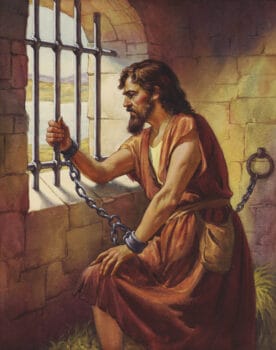
Image © Providence Collection at Goodsalt.com
Satan was unable to tempt Jesus into sin, and his defeat in the wilderness enraged him. He then changed tactics by having John, Jesus’ cousin, thrown into prison. John’s imprisonment hurt Jesus, even though Satan could not entice Him to sin. This was Satan’s way of breaking John, while emotionally burdening the heart of the Savior. But John received a word of encouragement from Jesus. And despite his terrible conditions, and certainly not understanding why he remained in prison when Jesus was so powerful, John nevertheless stayed faithful, even unto death.
Like the prophets of old, we, too, are called to proclaim a message of repentance and faith and the totality of Christ’s righteousness (Revelation 14:6-12). As he did with John the Baptist, Satan may use uncertainty to make us doubt God’s mission for our lives. We need not become despondent if we remember God’s leading in our lives, especially when things don’t go well for us, as happened with John, who was imprisoned and then killed by the actions of an evil woman and a weak-willed man. Whatever humans may do to us, we can reach out to God in faith, and He will answer us. He has promised us power to do His will (Acts 1:8). In the post-Christian and non-Christian world, it is imperative that we be faithful witnesses for Christ, whatever our circumstances.
|
Have you ever been in a position, as John was while in jail, where you just could not understand why such bad things were happening to you? How did you maintain your faith and trust in God? |

I have often wondered why Matthew mentioned John, the Baptist’s diet, locusts and wild honey. Was it just a description to indicate that he lived rough? That may be true, but as is often the case, the Bible has a second layer of meaning. Given that the Gospel of Matthew was written primarily for Jewish readers the reference to locusts and honey has a significant symbolic meaning. Locusts were one of the plagues in Egypt, and the Promised Land was described as flowing in milk and honey. There are some commenters who see this mention of food associated with Egypt and Caanan and deeply entrenched in the psyche of the Jews, as a call to come out of Egypt into the Promised Land. It was a bridge between the old and the new,
That makes a lot of sense. John was to prepare “the way of the Lord”, and his call for his listeners to repent, was also a call to embrace the richness of Jesus’ presence among them. It also makes sense that if we believe we are a prophetic fulfillment of John’s ministry in this modern age, we should be presenting a bridge message between Egypt (secularism) and the Kingdom of Heaven in the name of Jesus.
(An Explainer: There are some who suggest that the locusts were Carob pods. There is a long history behind this story and it is too long to detail here, so I will cut to the quick! The language in the Bible uses the Greek word “akrides” for locust in both the Old Testament Septuagint and New Testament. It uses the Greek botanical name. “keratia”, for Carob when it refers to the pods feed to the pigs in the story of the prodigal son. So it is highly unlikely that the locusts eaten by John the Baptist were Carob pods. I will also add that Locusts were permitted as a food in Lev 11:22. And for the squeamish, I have seen locusts and other insects on sale in Asian markets. Apparently they are quite tasty. This explainer has nothing to do with the lesson, but I thought you might like to know the textual evidence.)
I am oblivious to the origin of the belief that John the Baptist ate sweet locust pods. In my young youth we had two locust trees lining the entrance to the church. We lived across the street from the Seventh-day Adventist church and church school. I remember telling my mother these are locust pods, we should take them home and eat them. She got a big smile and said they have to be from the desert in the Holy Land to eat them. I never pursued the locust pods vs locust insects.
When one of our sons went to college, he chose Mission Collage about one hundred miles north of Bangkok Thailand. He wrote home one time telling us of his trip to Cambodia to visit a young lady friends’ family. He said he did not go to sleep right away as he was bothered by the family nearby crunching on grasshoppers. We lived in the subtropics of Florida for several years and can testify of the enormous size locust can get. Reading the letter sent chills up our spines as he described the audible crunch, crunch.
The value of John the Baptist in the wilderness was great. There he was not distracted from his mission, preparing the way of the Lord. This preparation was also a good preparation to make it plausible to go through the trials that lay ahead. Christ was very disturbed when hearing about John placed in prison, and the encouragement He gave to John the Baptist kept him faithful even unto death. The longer we are faithful to God the stronger our faith becomes. Still without the promises from the Bible, we garner from a Bible oriented relationship with God we would fail. 🙏
John was the herald of Christ, called not only to prepare the way for the coming King but also “to make ready a people prepared for the Lord” (Luke 1:17). His ministry provides a prophetic pattern for the work entrusted to God’s people before Christ’s second coming. As John proclaimed, “Prepare ye the way of the Lord” (Matthew 3:3), the final proclamation of the gospel calls the world to prepare for the judgment and the return of Christ (Revelation 14:6–7). John’s task was therefore more than announcing the King; he was to awaken hearts and lead people into readiness for His arrival. Such a work could not be accomplished in human strength. John needed the power of the Spirit, and the closing work of the gospel likewise requires the promised outpouring of the Holy Spirit (Joel 2:28–29). Those who would call others to readiness must themselves be surrendered to God and prepared by His Spirit.
John went directly to the conscience, calling people to genuine repentance: “Bring forth therefore fruits meet for repentance” (Matthew 3:8). He showed that repentance must produce visible change—greed must give way to generosity, dishonesty to integrity, oppression to kindness, and discontentment to contentment (Luke 3:10–14). This gives substance to the preparation God requires of His people. The final message is not merely a warning about coming events; it is a call to “fear God, and give glory to him” and to stand in faith and obedience (Revelation 14:7, 12). Thus, John’s ministry reminds us that readiness for Christ is revealed in transformed character. The issue before this generation is not simply whether we believe that Christ is coming, but whether our lives demonstrate that we are ready to meet Him (2 Peter 3:11–14).
Jesus acknowledged John the Baptist to be more than a prophet.
“As John’s disciples were leaving, Jesus began to speak to the crowd about John: “What did you go out into the wilderness to see? A reed swayed by the wind? If not, what did you go out to see? A man dressed in fine clothes? No, those who wear fine clothes are in kings’ palaces. Then what did you go out to see? A prophet? Yes, I tell you, and more than a prophet.” (Matthew 11:7-9, NIV).
John’s message was quite unique from the Old Testament prophets who largely called the people to return to the true God, repent their sins and be faithful. However, John’s message was dramatic and extraordinary urgent.
“Repent, for the kingdom of heaven is at hand.”(Matthew 3:2).
The Old Testament prophets were pointing into the future, but John was pointing to the present. “Behold, the Lamb of God, who takes away the sin of the world!” (John 1:29). John was an eyewitness. He saw the plan of salvation as it was unfolding. His message caused seismic response in Jerusalem and Judea. “People from Jerusalem and from all of Judea and all over the Jordan Valley went out to see and hear John” (Mathew 3:5, NLT). The people did not only listen, but they enquired what they should do. “What then shall we do?” (Luke 3:10)
I am profoundly astonished how John replied. “John replied, “If you have two shirts, give one to the poor. If you have food, share it with those who are hungry.” (Luke 3:11, NLT). John did not tell the people to do the usual religious observances: pray more, fast more, attend the synagogue more, do more sacrifices and keep the sabbath more rigorously. He simply told them to relate to other human beings with acts of love, mercy and kindness. How can we prepare for the second coming of our Lord and Saviour Jesus Christ if we ignore the practical aspects of Christianity? Jesus calls those who do these acts of love, mercy and kindness, “These righteous ones”.
“Then these righteous ones will reply, ‘Lord, when did we ever see you hungry and feed you? Or thirsty and give you something to drink? Or a stranger and show you hospitality? Or naked and give you clothing? When did we ever see you sick or in prison and visit you?’ “And the King will say, ‘I tell you the truth, when you did it to one of the least of these my brothers and sisters, you were doing it to me!” (Matthew 25:37-40).
Those who are heavenly bound, do these things with joy in their hearts because a greater reward awaits them. Dear Lord Jesus, please help us to be self-sacrificing Christians.
The question was, when bad things happen how do we maintain our faith? This is a tough question but for me I rely on past experiences. God brought us through in times past and He will see us through now. I also think of the various experiences people went through in the Bible. Like Peter, some people were delivered and like John, some of us will not see our prayers answered. As difficult as it may seem, because John was Jesus’ cousin, although we may be faithful followers of Christ, all our prayers will not be answered the way we want them to be answered. I go on trusting that God knows best and a better day is coming in this life or the next spent in eternity with God.
John the Baptist was a lesser light, not because his message was unimportant, but because his mission was to point beyond himself to the Greater Light—Jesus Christ. His purpose was never to become the focus, but to prepare hearts to receive Christ.
In a similar sense, Ellen White understood her prophetic ministry as a lesser light pointing people back to the greater Light of Scripture and, ultimately, to Jesus. Her writings were not given to replace the Bible or take Christ’s place, but to lead us more deeply into His Word and toward Him.
The test of any true prophetic ministry is therefore not whether it draws attention to the messenger, but whether it causes us to see Christ more clearly, love Him more deeply, and follow His Word more faithfully. The lesser light has done its work when it leads us to the Greater Light.
I would not like to describe what is presently occuring with me as “bad things”. It’s undesired things. Not quite like John locked within prison walls; but certainly not the freedom of the “open spaces of the wilderness and the fresh clean air.”
Fairly early in life I sensed a call to ministry. I began the theological program, however being challenged financially I eventually entered the Colporteur ministry. Unlike the big-shot colporteurs I struggled financially. In fact, the only reason I remained in the program ; was the sense of the “Call”. Due to my financial situation I was eventually “dismissed”.
I got involved in other selling enterprises, but the “Call” again confronted me. Therefore as an adult I returned back to school, always work and study.( except for my final term last year at the University of the Southern Caribbean).
This journey, for whose soujourn, I chose not to get married, enabled me to gain accreditation from three universities. Only to face another challenge my age. By no stretch of the imagination am I young. A bit to old for denominational employment. ( Although the brethren repeatedly tell me you look so good for your age)
So like John in the prison house, at times I sit and wonder, was all that time , money and effort to fulfill a Call to minister especially to younger people { the area of Psychology is one of my specialities} a waste.
I am convinced not. I know I am not young but I still think {once it is not rigourous} I can serve for at least five years.
As I sit in the “prison house” like John. I covet your prayers for divine guidance in this matter.
My brother in Christ. Nothing done for Christ is wasted. Serve the Lord in whatever capacity that you can. It is frustrating and discouraging at times, especially when circumstances don’t work out as we expected that they would. I am reminded of a couple of quotes. “Little in the hands of the Lord is much!” “Only one life, ’twill soon be past, only what’s done for Christ will last” comes from a Christian poem written by C.T. Studd.
While you wait for a door to open, serve Him in the hallway.
This side of heaven we may never know or realize the fruits of our labor for our Master. In heaven our reward will be realized.
Be blessed, my brother. Your labor for Christ is not in vain. Praying for God’s Wisdom and direction in your life. 🙏
Thank you!, Ray Boltz
Dear Steve,
Your comments on this blog always feel like a breath of fresh air to me because you write from the heart.
I would think that you affect people around you in a similar manner. Ellen White speaks of each believer being surrounded by an atmosphere that affects all with whom we come in contact in a very real way.
I am sure God is watching over you with compassion, and likely has plans for you that you cannot imagine.
In the meantime, the best way to be prepared for God’s plans for you is to be God’s hands, feet and voice right where you are — fulfill the duties that come your way with fidelity, and keep in mind that Christ would have left heaven for just one sinner. So if you can be instrumental in just one other soul’s entry into heaven, you will hear Christ’s words, “Well done, faithful servant!” (I am praying for you.)
Yes, Steve, I’ll pray for you! You wrote that you desired to share your love for God and His Son when you first met Them. You decided to learn everything you could by attending a formal education that would prepare you to share the Gospel with those you would meet, but you have not received an official calling by those you look to to give you an assignment.
I encourage you to find this ‘assignment’ within your heart. You are ready to share your love for God. Even though a formal type of employment by the church was/is unavailable, God still has a plan for you. I encourage you to trust Him – be open-minded to embrace available opportunities with an open heart and willing spirit.
May God reveal to you the type or form of ministry which He prepared you for.
Col.3:18-24 …. “Whatever you do, work at it with all your heart, as working for the Lord, not for human masters, since you know that you will receive an inheritance from the Lord as a reward. It is the Lord Christ you are serving.”
A gentle reminder:
We believe in and worship one God, not two or three.
If you believe the same, it is best to avoid the plural pronouns in referring to Him.
I understand your dilemma even though I have had a fairly clear picture of what I wanted to do and spent my life doing it. However, I have had students who for one reason and another, have not realised their calling or have had to change directions. And in retirement, I see some ex-students taking the changes on board and others struggling. The successful students are the ones who see life as a journey rather than a destination.
I have driven to Cairns several times in my retirement. It is about 3000 km from here and is a great destination for birding. But I always take my time. I don’t want to drive 800km a day and prefer to do it in short trips, stopping at a lot of my favourite birding places on the way. I have even arrived in Cairns only to find that it is suffering from continual rain, but the journey was still worth it because of the experiences I had on the way there.
Enjoy life and look around for local opportunities. I know a couple of farmers who became ministers in their retirement. They made good pastors because they knew how to look after sheep.
Hi my Brother,
Be still and know that God’s plan for you is specific with a timeline. Wait upon the Lord. He will reveal His purpose soon. Continue to work and be patient. God don’t look at the age but your obedience and willingness to serve Him faithfully. Praying for you!
Although frustration turned all hope into ashes, I’ve been through times when the only tie to heaven was a weak prayer. Prayer kept me connected with heaven. And my prior experiences with salvation would not allow me to go astray.
Thank you my family in Christ. Your responses are deeply encouraging.