
Wednesday: Daniel, the Faithful Seer

Daily Lesson for Wednesday 7th of October 2026
Most Christians know the story of Daniel 1:1-21, in which he stood for the health principles that he had learned as a child. Daniel was a model of faithfulness (Daniel 1:8). When presented with royal delicacies, he insisted on eating a plant-based diet and drinking only water instead of partaking of the diet offered him from the king’s table (Daniel 1:12-16). This was a small test in contrast to what would come later, such as in Daniel 6:1-28, when his faithfulness could have easily meant death for him.
Read Daniel 2:46-48; Daniel 4:18; Daniel 5:13-14; and Daniel 6:25-27. What do these verses tell us about the kind of witness Daniel was to the pagans around him?
Look at the testimony from these pagans to the power of Daniel’s God. However unique these stories, they all reveal a crucial principle: by our lives, by our faithfulness, and by the power of God working in and through us, others can and should learn about the God of heaven, and know that He is “a God of gods, and a Lord of kings.”
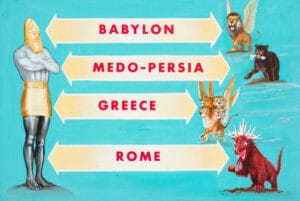
Image © Review & Herald Publishing at Goodsalt.com
Also, because the recurring theme of Daniel’s prophecies is judgment, culminating in Christ’s second coming (God’s ultimate victory), the meaning of Daniel’s name, “God is my judge,” is quite appropriate. His writings deserve careful study and attention as they are relevant today. Daniel’s prophecies serve as a reminder always to remain vigilant and keep God’s commandments, even in the “little” things of life.
Also, as a prophet, Daniel foretold the rise and fall of nations and the consequences of their disobedience to God. Through his prophetic visions, Daniel revealed God’s plan and the ultimate victory of God’s kingdom (Daniel 7:13-14).
Think, for example, about Daniel 2:1-49, written half a millennium before Christ. Daniel so accurately depicted the rise and fall of these four great world empires, even coming up to our time (that of the feet and the toes of the statue), clearly referring to nations of modern Europe, which, as the prophecy so clearly teaches, “shall mingle themselves with the seed of men: but they shall not cleave one to another, even as iron is not mixed with clay” (Daniel 2:43). What an amazing prediction about Europe, even to this day, in which, despite intermarriage and all attempts at unity, the continent would remain as separate nations with separate laws, customs, and traditions. When even a few years before the fall of the Soviet Union, no intelligence agency saw that fall coming, Daniel’s prediction gives us powerful reasons to trust God’s prophets.
|
All the kingdoms in Daniel 2:1-49 came and went as predicted. What should this tell us about trusting the prophecy, which talks about God’s eternal kingdom coming next (Daniel 2:44)? |

Daniel was like an academic who suddenly found himself in a tenured position he could not leave in a competing university. It was a bit like being forced to move from Oxford to Yale. The main thing to note was that he maintained his integrity. (I should add that secular records note that Babylon was noted for its academic freedom at the time.)
Daniel’s call to be a prophet uses his academic background. He is willing to say “I don’t know”, and seek further understanding, using prayer, before answering the question and publishing the results.
As a side note, I want to add that my spiritual development is intimately bound with Daniel. I can remember being introduced to the image of Daniel 2 at “colouring-in” in Primary Sabbath School. A couple of years later, our minister ran a mission program and, of course, the first meeting was, “Dead Men Do Tell Tales”. The second meeting was on Daniel 2, complete with a black-light artist’s representation of the image in Nebuchadnezzar’s dream. I went to Avondale College, and in my first year, I studied “Daniel and Revelation”. One could say I learned a lot about Daniel, even before I was an adult.
The danger is that I can easily recount all this information but fail to get to the real issue. We are to be part of the new kingdom, and that kingdom begins now. We need the academic integrity of Daniel.
Maurice – I am trying to understand what you mean by stating that “we need the academic integrity of Daniel. “I can easily recount all this information but fail to get to the real issue” – would you please explain – thank you!
… to search for answers ourselves rather than relying on what others say.
A seer is not simply a prophet who predicts the future, but one who also sees what God sees. A seer is a person whom God has enabled to see what God sees and communicate the revelation to the people. God knows all things which are unknown to us, and therefore He chooses to reveal some things to us through seers. These chosen few see things from God’s perspective. God is all-knowing, and He chooses to let us know some things for His purpose.
Through visions, God allowed Daniel to see certain realities about the future to reveal the truth that He, God, alone controls the future. He is the Supreme sovereign God.
“He was given authority, honour, and sovereignty over all the nations of the world, so that people of every race and nation and language would obey him. His rule is eternal—it will never end. His kingdom will never be destroyed” (Daniel 7:14,NLT).
God enabled Daniel to see that all the kingdoms of the earth will pass away and the Son of Man” will establish His kingdom that will stand forever. “I was watching in the night visions, and behold, One like the Son of Man, coming with the clouds of heaven!” (Daniel 7:13). The future does not belong to the country with the strongest military power, the greatest economy, the most powerful technology, or the strongest leaders; it belongs to God’s kingdom. Daniel the seer saw a comforting reality for God’s people. God is still on the throne.
“The kingdom and dominion… shall be given to the people, the saints of the Most High.” (Daniel 7:27).
If there is one thing that we must pick from Daniel’s visions and revelations, it is that we must remain faithful like him. We must live faithfully in Babylon without becoming Babylonian.
We must also in our hearts come out of Babylon, lest we partake of Babylonian sins. Revelation 18:4. You are right that is what without being Babalonian is. For our readers I on my trips with my wife and pathfinder’s, we had first-hand observation at the the national camporee. They had a large booth demonstrating their activity. We ran into a couple who were from our home Church. Also some may not know what ADRA stands for. It is Adventist Disaster Relive Agency run by the Seventh-day Adventist Church, a ministry that is admirable.
Daniel’s life demonstrates how faithfulness can become a living testimony through which others encounter the God of heaven. Daniel was not only a faithful servant in a pagan kingdom; he was also a faithful seer, entrusted with visions concerning kings, kingdoms, and the unfolding purposes of God. Though surrounded by idolatry, political power, and spiritual confusion, Daniel never allowed Babylon to reshape his allegiance. Through his wisdom, integrity, prayer, courage, and prophetic ministry, God revealed Himself to kings and nations. Nebuchadnezzar acknowledged Daniel’s God as “a God of gods, and a Lord of kings” (Daniel 2:47). Daniel did not merely proclaim God with his lips; his life and prophetic witness pointed people to the sovereign God who rules above earthly kingdoms.
That same calling to faithful witness belongs to us today. Like Daniel, we are living in a world of uncertainty, secularism, moral confusion, and competing loyalties. Daniel’s prophetic visions reminded his generation that human kingdoms rise and fall, but “the God of heaven shall set up a kingdom which shall never be destroyed” (Daniel 2:44). His faithfulness therefore became more than personal survival—it became a testimony to God’s sovereignty. When Daniel continued to pray despite the king’s decree, God vindicated his faith, and Darius declared that Daniel’s God “is the living God, and stedfast for ever” (Daniel 6:26). As faithful seers in our own generation, we are called to see beyond the confusion of the present and live in the light of God’s eternal kingdom. The question is not merely whether we will remain faithful in a changing world, but whether our lives will help this generation see the God of heaven. Like Daniel, may our faithfulness, our witness, and the power of God working through us point others to the King who alone will reign forever.
Interesting that the King fell down and worshipped Daniel, instead of GOD. He offered ablation to Daniel, even though Daniel made it known that the GOD of heaven gave the revelation. Could it be that many of us worship the church and not the GOD who set it up? Just asking a question? Look at the Laodecian experience.
Mark,Yes to your question. Nebuchadnezzar recognized the gift in Daniel, but missed the Giver behind the gift. In the same way, we can become so attached to the church, its institutions, traditions, leaders, or even our understanding of doctrine that we lose sight of the God who established and sustains His church.
The different parts of that image in Daniel 2 referred to world empires of that time. Perhaps the feet of clay and iron refer to “world” empires, not just the continent of Europe. Certainly, there is great separation between all countries in the world today.
In the ancient world, the sequence (Gold, Silver, Brass, Iron) was already found in local literatures. It is possibly a simple rubric for understanding the career of empires. The essential thing is the arrival of the Kingdom of Heaven–however it comes, however it grows–which was announced by Jesus: “the Kingdom is at hand”. (Mark 1:15). It is difficult to ignore the interpretation given in the NT–that the Kingdom arrives in the ministry and death of Jesus, and not at the end of the modern period.
Amen, His Kingdom shall remain forever.
Thanks be to God.
These lessons are really blessing my soul 🙏
Daniel’s prophecies were especially important to God’s people who went to Babylon as captives because they were living through a national catastrophe and could easily have concluded that God had abandoned them. Jerusalem had fallen, the temple had been destroyed, and they were living in captivity under a pagan power.
Through Daniel, God reminded them that He was still in control of history. Earthly kingdoms would rise and fall, but God’s purposes would prevail. His prophecies gave them hope, called them to remain faithful in a pagan environment, and assured them that ultimately God’s everlasting kingdom would triumph.
The same message is deeply important to us as members of God’s remnant church today. We, too, are living in a time of tremendous spiritual, political, and social turmoil. Daniel helps us understand where we are in the prophetic story, what is happening behind the scenes, and where history is ultimately headed. His prophecies call us to remain faithful, understand the times, and proclaim God’s final message to the world.
For Daniel’s generation, prophecy gave hope in captivity; for us, it gives hope as we approach the end of earth’s history. In both cases, the central message is the same: God is still in control, Christ is coming, and His kingdom will ultimately triumph.
The story of Daniel’s life speaks to people of all ages. Daniel along with many of his friends were taken captive to Babylon while they were teenagers, (around 15 to 18 years old) in 605 BCE. The final recorded events and visions in the Book of Daniel occurred around 536–537 BCE, during the third year of King Cyrus. This timeline means Daniel lived in exile for at least 70 years, placing him in his mid-80s to late 90s by his final recorded ministry. (Joselyne, can you imagine yourself being faithful to God under such circumstances?)
His life testifies how God can use a person for great and mighty things at every age of their life if they are faithful to him. From the diet test in his youth to the lion’s den in his eighties (80 to 84). The Lion’s Den event took place around 539 B.C. during the reign of King Darius the Mede (Daniel 6), roughly 66 years after his initial deportation. (Maurice, can you imagine being thrown to the lions?)
Through it all, only Daniel and his three companions (Hananiah, Mishael, and Azariah) are mentioned among the multitude that were taken captive. Were they the only faithful ones while the rest blended into society? (Factoring in the timeline of Daniel chapter 1 and 3, most estimates place their age around early twenties (roughly 19 to 23 years old) during the test of the fiery furnace.)
The story of the life of Daniel the prophet reveals how important seemingly small things can make a big difference. If Daniel and his companions aren’t faithful in the diet test, then there is probably no vision, no fiery furnace, no lions den, even no book of Daniel cataloging how God can take young persons and use them all throughout their lives in mighty ways.
At whatever age we find ourselves, may we be faithful, and experience the mighty ways that God can use us. May we “dare to be a Daniel!” (or Danielle 😉)
Yes, maybe the stories come from the 6th century BC or so, but they were probably written down–about 400 years later–a strong testimony to the resilience of these stories and their ability to speak to later generations. The Jewish people eventually collected and translated these into Aramaic and other languages for the Diaspora.
That is the critical approach to Daniel – I am currently reading a Bible that has footnotes that say just that. The same Bible also casts doubt on many other Old Testament passages.
It’s not hard to understand the issue – if you can somehow convince people that Daniel was written much later than was believed you can basically attack the idea of prophecy. I think I know who is behind that.
For me I choose to believe the authenticity of the books. I think there’s a lot of risk going down the other path.
All the kingdoms in Daniel 2:1-49 came and went as predicted. What should this tell us about trusting the prophecy, which talks about God’s eternal kingdom coming next (Daniel 2:44)?
The Lord said the test of a prophet is not only if they speak to the law and to the Testimony but also if their prophecy comes true. The latter can only be a test in hindsight. Daniel’s prophecy has all come true except the rock coming down out of heaven and crushing the ten toes of Nebuchadnezzar’s dream. And he met our 1st criteria. What/who is the rock. Represents Jesus second coming, of where we will rise to meet Christ in the air. Then we are whisked off with Him and His host of Angels to His Heavenly abode, the earth will be desolate for a thousand years. Then we will return with our King, landing on this earth after traveling for some 7 days from the area of the Orion Nebulous. Landing on this earth to be made new, by our Creator, to dwell with Him forever. (Yes, we who have Christ in our hearts can dwell with the Lord now.) All that I believe because the Lord made sure that Daniel’s prophecy was accurate, thus believable.
If we can be with God who can be against us.No one I see that all the people (governors) were against Daniel because of wisdom and understanding. The Lord is a winning master He shows His Mighty Power to the King Darius and grate fate falls to the families of governors not governors themselves their children and wives this is how serious was. Indeed God is King of Kings. This applies to what we learnt about Elijah on Monday. We observe that when we be for God no one can be against us at all cost and there is nothing that can separate us from the Love of God nothing. Let us be faithful to God always.
But it start with our habit,character that is formed with food we put on our table and body. Health diet is ideal we have observed what John the Baptist eat and what Daniel eat all lead to the formation of good character and right behaviour.
The king of food we eat result in the character we form.
God never leaves His Creation to itself; He cares and gives clues about the future. When we see what was foretold and what happened in the past, why would we not trust what is coming next?
There are about 14 “Health Principles,” and “Diet,” is not only just “One of them,” but it is also “The Least of all the 14.” And there is “One of those Principles,” that has 90 Per Cent Improtance to “All Health.” And that is the Principle of “Truly knowing how to ‘Trust in Divine Power.'” And “Below that Principle,” is a very important “Spiritual Science,”‘ that come under a very Important Prayer called, “The Divine Science of the Prayer of Faith.” We need to “Know, Understand, and Utilize,” this Divine Science on a moment by moment, hour by hour, day by day, regarding “All of God’s Promises that He has left for us in All of The Bible.” Then we can truly experience “Optimum Health in our lives.”