
Monday: The Elijah Message

Daily Lesson for Monday 5th of October 2026
Read 1 Kings 18:19-39. What can we see from this story about how the prophetic office can work?
Elijah’s calling and manner of speech reflected his role as God’s messenger. To stop Israel’s apostasy, God sent Elijah to King Ahab in order to announce a multiyear drought. God used this affliction to turn His people away from idolatry and back to obedience. King and country blamed the prophet Elijah for their woe and sought his death.
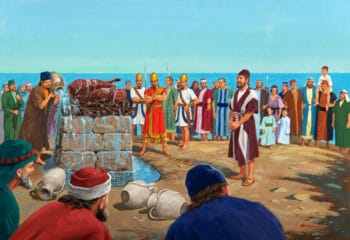
Image © Review & Herald Publishing at Goodsalt.com
On Mount Carmel, Elijah confronted the prophets of Baal and Asherah. God’s messenger made a Spirit-filled appeal to idolatrous Israel to denounce their false gods and return to the Lord. The people knew that their choices had led them into national apostasy. They were now ready to embrace the God of Elijah again, who had proved to be superior to their false gods, which, in reality, didn’t even exist.
Just prior to Christ’s second coming, God commands His church to proclaim the Elijah message again, and for people to turn away from their “idols” and be ready to stand in the great day of the Lord. God still communicates with His people through channels that He has selected. His Word and the gift of prophecy provide admonition, warning, counsel, and encouragement.
“A revival of true godliness among us is the greatest and most urgent of all our needs. To seek this should be our first work. There must be earnest effort to obtain the blessing of the Lord, not because God is not willing to bestow His blessing upon us, but because we are unprepared to receive it.”—Ellen G. White, Selected Messages, book 1, p. 121.
Read Malachi 4:5-6. How does the Elijah message impact the homes of those who follow God?
True revival starts in the heart and the home. The family is the cornerstone of the church and an indispensable building block of community. Revival in the home spreads a heavenly love to the church, the community, and the nation. This is God’s purpose for the Christian home. Revival also motivates God’s people for mission.
|
What kinds of idols, if any, exist in our homes, hearts, and churches today? |

I had to stop and think about why Malachi linked the Elijah message to the rebuilding of family relationships. We usually read the Elijah story and think about the idolatry of Israel. They had turned to Baal, which was essentially dedicated to the theme of fertility. Their temple prostitution was based on the idea that it would provoke Baal into an imitative union with Asherah and other consort gods which in turn would provide rain for the crops and fertility for their herds. It is not a big step to see why such a religion would become popular among the males of the Israelite nation and lead to the erosion of family values. It makes sense then, that Malachi interprets the Elijah message as a call to return to family relationships.
I know that we would like to jump in here and start condemning modern sexual behaviour but read the Malachi message carefully. He doesn’t say anything about sex, but concentrates on the healing of relationships. This is a call to heal our family relationships. Is it possible that in our modern life we are letting our children have a better relationship with social media than with their own families? Rather than condemning the practices of Baal, what steps do we need to take to develop the relationships in our own families?
What did Jesus do for fellowship? He found friends and disciples to fellowship. Also, many a time He went apart from the rest to be alone with God.
John 12:1-3.
Luke 9:10.
Let see what the companion book about Christ fellowship, the Desire Of Ages says: Page 524.2
https://egwwritings.org/read?panels=p130.2559&index=0
Nothing at all is known about Elijah until he suddenly steps onto the scene in the presence of King Ahab. He was a nobody from nowhere, but he was handpicked by the Lord to do His will and carry His message to a wayward nation. God does not necessarily call people because of their great name, position, or influence. He calls those who are willing to stand for Him, and He gives them a message. Elijah appeared at a monumental moment in Israel’s history, when God’s people were compromising their faith and mixing the worship of God with the values of the surrounding culture. Yet Elijah could boldly declare, “As the LORD God of Israel lives, before whom I stand” (1 Kings 17:1). That phrase, “before whom I stand,” is significant. Before Elijah could stand before Ahab, he had first learned to stand before God. His authority did not come from his position; it came from his relationship with God and his willingness to deliver the message God had given him.
The message of Elijah like that of malachi is loaded and speaks directly to us today pointing to the “the great and dreadful day of the LORD,” saying that he would “turn the hearts of the fathers to the children, and the hearts of the children to their fathers” (Malachi 4:5–6). Elijah’s message was a message against compromise—a call for God’s people to make a clear choice. On Mount Carmel, he asked the searching question, “How long will you falter between two opinions? If the LORD is God, follow Him” (1 Kings 18:21). This prophetic message ultimately points us to Christ, because the purpose of God’s messengers is not to draw attention to themselves but to point people back to the Savior. Like John the Baptist, whose ministry prepared the way for Christ (John 1:6–7; 3:30), our lives and witness should point others to Jesus. So perhaps the question for us is not, “Am I important enough for God to use?” but rather, “Am I willing to stand?” God can take a nobody from nowhere, place that person in the middle of a monumental moment, and use them to turn hearts, confront compromise, proclaim His truth, and point people back to Christ.
In our time, in the 21st century, the Elijah message is very relevant, as it was on Mount Carmel. In a nutshell, the Elijah message is an urgent call to return to the true God. It calls us to stop worshipping false gods and return to Jehovah God. It calls us to make a decisive decision about whom to worship. As the Children of Israel were challenged by Elijah to decide who is God, the Lord or Baal, we too have been asked the same question. Who do you worship? The Elijah message is our most urgent calling. The stakes are too high; we cannot ignore the calling. We must make our calling and election sure (2 Peter 1:10)
“How long will you falter between two opinions? If the LORD is God, follow Him; but if Baal, follow him.” (1 Kings 18:21)
In our time, we need the spirit and the power of Elijah’s calling. All we need is to repent of all our sins, for the kingdom of God is at hand. Every summon that we hear calling us to come back to the Lord is the Elijah message. Every summon that calls us to stop playing church is the Elijah message. Every summon that we hear calling us to stop loving the world more than the Lord is the Elijah message. Every summon that calls us not to be lovers of money has the spirit and power of the Elijah message. If there was a time to give wholehearted allegiance to the Lord, God is now. This is a wake-up call.
The time to repair the altar of our hearts is now (1 Kings 18:30). The time to seriously examine our worship is now. Before we can take the message of salvation to the dying world, we must restore true worship. What do we give most of our attention to? Is it money, status, power, pleasure, career, relationships, material possessions, self or religion? The Elijah message carries a warning, mercy and judgment. God always gives a warning, provides mercy and then brings judgment (Malachi 4:5).
This is a clarion call for God’s people to stop being spiritually lukewarm, return wholeheartedly to Him, restore true worship, reconcile broken relationships, and prepare for the second coming of the Lord.
Even though Elijah was blamed for everything that went wrong, his faith in God was so strong because he relied on God alone.
1 Kings 18:39 And when all the people saw it, they fell on their faces: and they said, The Lord, he is the God; the Lord, he is the God.
O for that flame of living fire: by William Hiley Bathurst
Verse 1
O for that flame of living fire
Which shone so bright in saints of old;
Which bade their souls to heaven aspire,
Calm in distress, in danger bold!
Verse 2
Where is that spirit, Lord, which dwelt
In Abram’s breast, and sealed Him Thine?
Which made Paul’s heart with sorrow melt,
And glow with energy divine?
Verse 3
That spirit which from age to age
Proclaimed Thy love, and taught Thy ways?
Brightened Isaiah’s vivid page,
And breathed in David’s hallowed lays?
Verse 4
Is not Thy grace as mighty now
As when Elijah felt its power?
When glory beamed from Moses’ brow,
Or Job endured the trying hour?
Family is indeed the cornerstone of the church, there are members in our churchers who are on their own and they depend on their church family more than we will ever know. So unless we, through the Holy Spirit befriend them, invite them to lunch, study God’s word and provide assistance where needed, we are neglecting our own.
Indeed Lorraine “families” are the building blocks of our churches. How we long for the days of the Pastoral visit to our homes to return. That our Spiritual leaders would sit with us awhile in our “situations” as we share with them the challenges we face in our walk with Christ. I do not think that I will ever forget, many years ago, when I was a child, one of our Leaders, a white man,came to visit Mommy and myself, in the small downstairs room where we lived. He came and sat on a chair and it broke sending him to the ground. We all had a good laugh.
What steps do we need to take to fulfill Malachi’s admonition for us, which is the develop healthy God oriented relationships. Go fishing, even though you are vegetarian. There is always friends and relatives that are glad to have fresh scaled fish. We were visiting grandkids a few years back and our oldest son arranged for such a fairly local trip. We all left our smart phones in the car, we could not hold a fishing pole and a smart phone at the same time. The other experience was taking off into the nearby mountains and fish with a friend who had stocked the lake with fish 2 years earlier. Arriving back my brother said, “I don’t understand you don’t eat fish,” then is when I told him we knew of a widow who cherished fresh fish, and dropped them off on our way home, of course we cleaned them for her. I am sure many have similar stories. Oh, one more when we get together we like to have the whole family play Mexican Train. Seems to be a good Seventh-day Adventist family table game.
No, there is no internet or cell connection up in the mountains. No we did not have probable starlink with us.
The family that prays together, stays together.
Whether it be our biological family or the family of believers
it is important that we pray with and for each other, even
more as we see the Day approaching!!!
Just as God raised up Elijah in a time of national apostasy, and John the Baptist came “in the spirit and power of Elijah” to prepare a people for Christ’s first coming, God has raised up an Elijah-like movement and message for the last days. Its purpose is to call God’s people back to wholehearted allegiance to God, restore true worship, repair the broken altar, proclaim the Three Angels’ Messages, and prepare the world for the soon return of Jesus Christ.
And there is something particularly powerful about this: Elijah’s work was not simply to announce that judgment was coming—it was to turn hearts back to God before it came. That is why Malachi ends the Elijah prophecy with the words: “And he shall turn the heart of the fathers to the children, and the heart of the children to their fathers.”
That makes the last-day Elijah message much more than warning. It is a message of restoration, reconciliation, revival, and preparation.
In that sense, Elijah’s repaired altar at Carmel becomes almost a picture of the last-day church: before God sends the fire, the altar must be repaired.
From the beginning satan has successfully damaged relationships, both vertical, with God, and horizontal, with others. Adam went so far as to blame both Eve and God for his failure. “The woman whom you gave to be with me, she gave me fruit of the tree, and I ate.” (Genesis 3:12)
It’s one of the most famous examples of passing the blame in history! A classic and epic failure of taking responsibility and being accountable for moral failure. This character trait is widespread. Men have abdicated their responsibility of being both protectors and priests of their households, and the enemy has decimated the family unit. Society rises only as high as the nuclear family and Satan knows this, which is why he seeks to keep the family fragmented.
The Elijah message then and now is intended to heal the wounds and close the chasm caused by sin. It calls people back into relationship with God and their families. It calls men to once again take up the mantle of spiritual leadership and to come away from our idols.
Idolatry is as rampant today as it has ever been. It has just become more “sophisticated,” subtle, and camouflaged. Into this world of idolatry and brokenness comes a clarion call of restoration of identity and families, of individuals, and society, to turn away from these false gods and return to the one true God.
One True God, Mark Harris
Ultimately, what happened on Mt. Carmel changed hearts. Though it took a miraculous, observable event to impress the assembled people, the result was that they became convicted of their need to come back and worship their true God – the God of Abraham, Isaac, and Jacob/Israel.
One could question if this was done out of fear or if it was true repentance. Maybe this is the question each believer needs to ask themselves: ‘Do I worship God because I love Him or because I fear His power? Why is the Christian’s God not more ‘popular’ since He is the symbol of Christian Love, offering the greatest benefit to all who believe in Him and follow His Will and Way?
Could one consider the Elijah message actually to mean that we who believe need to return to God with a loving, open, trusting, and repentant heart when seeking His presence? Maybe the true victory on Mr. Carmel is not that we acknowledge that the stronger, more powerful God won this contest, but that the right God receives again our love and allegiance because it is only He that loves us?
What does God ask of us?
Micah 6:7-8 – ”Would the LORD be pleased with thousands of rams, with ten thousand rivers of oil? Shall I present my firstborn for my transgression, the fruit of my body for the sin of my soul?
He has shown you, O man, what is good. And what does the LORD require of you but to act justly, to love mercy, and to walk humbly with your God!
Is this the Mt. Carmel message? If we do not understand what it means to ‘return’ to God, how could we possibly find Him? I suggest to examine our heart, finding what draws us away from loving God with all our strength, and then come to him in humble repentance to be a good start.
We need our God – we need His restoration! Once we humbly and whole heartedly take our place under the cover of and by the Spirit of His Son Jesus Christ, heaven’s gates will open to pour out His restorative blessings and show the world that He is the God that restores us to Himself through Love – 2 Cor.5:18-19; Lamentations 5:21; 2 Cor.5:18; Hosea 6:1;
Yes what can I say cause we can’t compromise our faith more especially in 1 king 18.21
The worst and most dangerous idol I’ve encountered in a person lately is money. Money can become a powerful god; some people live totally devoted to it, although some may try to hide this by getting involved in formal academic theology, thinking that God does ot know their heart. What a sad reality.
Mending our family relationships with God’s help is a vital component of the Elijah message. Within my research I see two important components: Prayer and Effort. (Jesus told us to “watch and pray” Matthew 26:41)
Intense praying produces miracles in the lives of others. Sometimes, I spend portions of my night in prayer.
Living a life of a loving attitude, along with spending time with our families making them happy is so life-changing.