
Sunday: Abraham, Defender of the Covenant

Daily Lesson for Sunday 4th of October 2026
From Genesis to Revelation, God has had a faithful remnant who have accepted the call to obedience in response to His grace (see Jeremiah 31:7,31-34). For example, years after the dispersion from Babel, God chose Abram (later Abraham) to be an example of covenant faith, not just to his family but for all future generations. Surrounded by apostasy and moral ambivalence, Abram proved faithful to God’s call. (See Genesis 12:1-9.)
God communicated the terms of the covenant to Abraham and showed him how humanity’s salvation would be accomplished through the sacrifice of Christ (Genesis 15:6-17). To test Abraham’s faith and to illustrate the future sacrifice of God’s Son, Abraham was called upon to offer Isaac, his son, as a sacrifice to God (Genesis 22:1-17). What an excruciating test for the father of the faithful. Think of all the reasons Abraham could have used to disregard God’s explicit command, yet he faithfully obeyed. God stayed the hand of Abraham from killing Isaac and provided a ram in his stead.
Not all prophets were called by God to warn of impending doom. All were called, however, to restore the people to faithfulness and often to warn against apostasy, against oppression of those who were poor and needy, and against violation of the covenant and its stipulations.
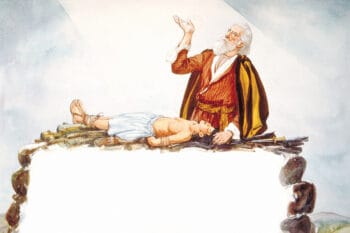
Image © Review & Herald Publishing at Goodsalt.com
Most important of all, however, the prophets were to reveal the promise of salvation found in the Messiah. The enduring testimony of the biblical prophets and of His Spirit in our post-apostolic era calls us to recognize and to warn others of the impending crisis that will come upon the world. Yet central to that warning is the good news of redemption for Jesus’ faithful people, those who have remained in covenantal relationship with Him (Revelation 12:17).
Read Genesis 15:6, Galatians 3:6-9, and Hebrews 11:8. What about Abraham’s life and character qualified him for God’s service, even though he was, clearly, a flawed man?
There are many parallels between Abraham’s day and ours. As paganism and idolatry ran rampant in Abraham’s day, so today many of the world’s competing ideologies aim to eliminate or marginalize Christianity. In contrast with much of the prevailing culture, God’s people today are called to reflect His image faithfully in their daily interactions with others, including their proclamation of the three angels’ messages (Revelation 14:6-12).
|
Scripture says that Abram “believed in the Lord; and he counted it to him for righteousness” (Genesis 15:6). How do you see the promise of the gospel powerfully revealed in this text? What hope can you take from this for yourself? |

If there is one lesson we can learn from the story of Abraham, it is that his faith grew over time. The fact that God had called him, did not stop him from doing really stupid things – like trying to pass of his wife as his sister, twice, and his scheme of using Hagar as a substitute for Sarah when the promised child took too long to arrive, But, there are other actions that show his compassion – his treatment of Lot, and his concern for Lot’s safety in the destruction of Sodom.
The most curious, and prophetic episode of Abraham’s life is the call to sacrifice Isaac, and the consequent substitution of a ram in his place. It is useful to remember that human sacrifices were part of the religious rituals of the surrounding religions at the time and apart from our prophetic messianic interpretation, it served as a graphic illustration that human sacrifices were not to be part of the Israelites religious practice. That is a reminder that the work of a prophet is not just about foretelling the future, but making a difference in current practice.
I am not sure how much Abraham understood about the messianic nature of the conversations he had with God. That does not make his message any less important, But it is a reminder for us today that we may not understand some of the end-time prophecies in the detail we claim. However, like Abraham, those prophecies should make a difference in the way we live now. Christianity is not about getting prophecy detail right. Just as Abraham grew his faith, even with his limited understanding, we should look to growing our faith, rather than vindicating our view of the future.
I’m a bit late on this, but I just now realized that what I read in Patriarchs and Prophets answers your question clearly. If you read the two paragraphs beginning with this reference, you will see that God clearly revealed the plan of salvation to Abraham, including Christ’s death on the cross and the earth restored to its Edenic perfection. So, yes , by the time he was called to sacrifice Isaac, he understood the plan of salvation. But he understood it more clearly when the Lord provided the sacrifice, just as Abraham himself had said to Isaac. He understood that the gut-wrenching decision he had made regarding Isaac only faintly mirrored the suffering of his heavenly Father in giving His own beloved Son to humanity.
The story of Abram (Abraham) “the father of the faithful” is one which demonstrate the sovereignty of God. God in His own mercy He calls us from our different backgrounds to His marvellous light. God not only calls us, but He helps us to come to Him. How possibly did Abraham become the father of “the father of the faithful” without the active hand of God in action?
“Long ago your ancestors, including Terah the father of Abraham and Nahor, lived beyond the Euphrates River and worshiped other gods.” (Joshua 24:2).
The Bible does not say that Abraham was searching for God, and eventually discovering Him, but God revealed Himself to Abraham. How did Abraham come to trust God whom he did not know? The story of the father of the faithful, is a story where God displays His grace to accomplish His purpose. Faith is a gift from God. Faith develops with active hand of God in full action. “You did not choose me, but I chose you and appointed you…” (John 15:16). Once God has called us by His grace, we need to respond.
Faith isn’t knowing everything. Faith is trusting the One who knows everything.
Abraham’s faith grew with his experience with God. As we experience God’s faithfulness, our trust in Him grows stronger. Abraham did not defend the covenant out of nowhere, but because he came know that the Covenant Giver is able to do that which He promised. Our spiritual growth is a gradual process. As we learn to trust God in small things, He helps us to trust in remarkable things. Abraham reached a point where he even reasoned that God could raise his son Isaac from the dead (Hebrews 11:19). Like God called Abraham, He has also called us from our individual circumstances. Now let us hold on as He develops our faith step-by-step.
”God will make this happen, for he who calls you is faithful” (1 Thessalonians 5:24, NLT).
Omwenga this is a little out of your content today, yet it still deals with Abraham. The question that came up last week was face-to-face with with the Lord. The Moses story was given where the Lord had to hide in the cleft of the rock to pass by close to him. A direct face-to-face with the Lord would at that time have consumed Moses.
Now, what about Abraham who stood before the Lord and stepped closer. Genesis 18:22-23? Say a new member of your church you have befriended has asked you this question. Or maybe a contact on one of your ADRA missions, which I find admirable.
Omwanga, I have an answer for you of my question above.
Abraham walked with Angels of God. Yet one day, three strangers came on the horizon. He showed them hospitality, and then two of them left to be about their business. He talked with the third of which after talking realized He was the Son of God.
We must look at the story of Christ resurrected and accending to His Father, also our Father, then coming back with His consuming glory hidden, so as to not consume the disciples and allow Thomas to put His finger in His side to prove He was not a ghost. The Son of God used that same Divine ability in walking and talking with Abraham and not consuming Him. God’s ways are not our ways, and I still do not fully understand this answer. I could be wrong. We will see in that land bright and fair some day soon.
Here is the passage in Prophets and Kings. You may thumb up and down to get the whole picture.
https://egwwritings.org/read?panels=p84.549&index=0
Abraham’s life is a demonstration that God calls ordinary, imperfect people who are willing to trust and obey Him. Abraham was not chosen to defend the covenant because he was flawless, but because he believed God and responded in faith. Hebrews 11:8 tells us that “by faith Abraham obeyed when he was called to go out,” even though he did not know where he was going. His faith was counted as righteousness (Genesis 15:6), reminding us that salvation is by faith, while genuine faith produces obedience. Abraham’s life therefore clearly shows that obedience is not the root of salvation, but rather the fruit of a trusting relationship with God.
As a defender of the covenant, Abraham was called to preserve and demonstrate God’s purposes to the world. Through him, God promised that “all the families of the earth shall be blessed” (Genesis 12:3), ultimately pointing to Christ, the promised Seed. His willingness to offer Isaac demonstrated profound trust in God’s promise, believing that God could even raise him from the dead (Hebrews 11:17–19). The provision of the ram pointed forward to the greater sacrifice of Christ, the Lamb of God who takes away the sin of the world (John 1:29). Abraham therefore reminds every messenger of God that the prophetic message must not merely expose sin or announce judgment; it must defend God’s covenant, proclaim His mercy, and ultimately lead people back to Jesus Christ.
Understanding “the Ordinariness” of Abraham before The Promise; his deceit and sub-plotting; and the subversive lying even. Should show that we have no excuse, to be lost, with what God has done and is continually doing to save us.
It is true that Salvation is matter of choice, just as much as we choose to be lost!
Abraham’s spiritual journey testifies even today of what to do, and what not to do. What to do? Believe God unequivocally, and don’t try to help God. Every time that man tries to help God he makes a mess of things. The world is still suffering from Abraham’s lapse of faith in regards to Hagar. To pawn your wife off as his sister to protect himself was a very cowardly thing to do, and he did it twice. Double facepalm.🤦♀️🤦♀️
The thing to do? Believe God, even when it doesn’t make sense to you. Abraham lived in a time when child sacrifice was practiced and yet he had to wrestle with God telling him to sacrifice the promised child whom he had waited so long for. That must have been the most difficult thing. However, by this point of his life he had learned to obey God even when it doesn’t make sense.
This is the takeaway from Abraham’s life for me. To trust God, especially when it doesn’t make sense is the most faith testing experience. It’s a test that we will all go through before Jesus returns. May we all pass the test.
It doesn’t pay to do wrong because even if it does not hurt you it’s going to hurt others and it’s still wrong to do. We need to be honest and trust God will work everything out for his glory and honor. God is almighty and he will save us or bring us through any situation in his time.
I’d say that Abram was nuts to be willing to sacrifice his only son to God, the very son that God Himself promised Abram. But his relationship with God was so deep that, even amid much distress from the order, he trusted His Creator. What a faith!
I’ve been recommending the digest versions of the Conflict of the Ages series, including Beginning of the End, and I had not previously noticed what was left out. But this morning I noticed something.
In Abraham’s time, people ratified covenants in a way we now find strange, when we go to an attorney’s office and sign our names before witnesses. But it was not so in Abraham’s day, and the modern version of the account just passes over this section. You can read this account in Gen. 3:15-21. And you can read Ellen White’s description of this rite, beginning in Prophets and Kings, page 137.
I can see why this was left out of the version intended to appeal to modern readers, but it also demonstrates that the longer version is still valuable. (I’m reading the short versions this week to cover most of the material in less time.)