
Wednesday: The Greatest Offense

Daily Lesson for Wednesday 15th of April 2026
Imagine being a disciple of Jesus. You travel with Him, eat with Him, sleep near Him, and learn from Him as He transforms countless lives, including yours. People clamor after Him, and you realize how special it is that He chose you to be one of the 12 closest to Him. Then you start to wonder: Who really is the greatest of all the disciples?
In Luke 22:24-27, read Jesus’ response to the disciples’ dispute about what greatness means. Which statement captures the heart of Jesus’ message in these verses?
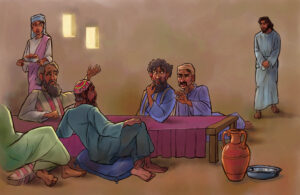
Image © Bible Adventure Collection at Goodsalt.com
One would have thought that after all this time of being close to Jesus, this kind of debate would have been the last thing on their minds. But that is not what happened.
Instead of these men being content with their calling, pride rose in their hearts to where each one thought he was better than the others. It’s easy to allow such thoughts to dominate our minds. But we are told that “there is nothing so offensive to God or so dangerous to the human soul as pride and self-sufficiency. Of all sins it is the most hopeless, the most incurable.”—Ellen G. White, Christ’s Object Lessons, p. 154.
This is very serious for us. Our pride offends God more than anything else, and it’s a character trait that is difficult to overcome because we often don’t see it for what it is. In our state of self-sufficiency, we choose not to self-evaluate, for surely pride is king. We need to stop, self-diagnose, and ask that God will open our eyes to our true state, because pride may be the number-one factor that keeps us from having a close relationship with Him today.
|
If you realize that God alone can do the work to remove pride and selfishness from your soul, pause and pray this prayer right now: “Lord, take my heart; for I cannot give it. It is Thy property. Keep it pure, for I cannot keep it for Thee. Save me in spite of myself, my weak, unchristlike self. Mold me, fashion me, raise me into a pure and holy atmosphere, where the rich current of Thy love can flow through my soul.”—Christ’s Object Lessons, p. 159. |

What on earth were James and John thinking when they, with the help of their mother put forward the idea that they should be part of the cabinet in the kingdom they thought Jesus was promoting/ What did a couple of fishermen know about running a kingdom? Mind you, we have a woman in Australia who used to run a fish and chip shop who has raised considerable traction in the political arena, so it is probably not all that surprising.
The Bible does not tell us much about Jame’s and John’s sense of leadership and we are inclined to dismiss their requests as simply misinformed and somewhat indulgent. We think they wanted the glory that comes with the proximity to power.
In our modern complicated world, leadership is often a mix of vision, political nous, networking, and personality.
I am currently reading the history of the Seventh-day Adventist Church in the late 1800s and early 1900s. Most of this occurred in the rather ironically named Battle Creek area. Church leadership was often challenging. It was in this period that our understanding of righteousness by faith developed, we moved from an Arian view of Christ towards a triune God, and we rejected pantheism. The personalities involved; Canright, Kellog, Jones, Waggoner, Butler, W C White, Prescott, Uriah Smith and Ellen White, all had considerable traction among the church membership. One notable example was Canright, who was a charismatic personality and thought he would make a good conference president, This was rejected and he became one of the most outspoken critics of Adventism. Ellen White went to Australia for nine years. Some say she was exiled. Certainly, it did her good to get away from the conflict and leadership battles that were going on in the USA at the time.
I mention this bit of church history because issues of leadership were very much part of the development of the Seventh-day Adventist Church. Some of them. Canright, Kellogg, Jones, and Waggoner left the church and became church enemies. Butler and Smith both apologised for their harsh attitudes towards others.
What has this got to do with church members studying a Sabbath School lesson on pride and humility and aspirations for leadership. I think we need to recognise that leadership is complicated and is very easy to confuse vision with ego. We may not have the opportunity to lead the church, but I have seen the same conflict play out in local churches and church institutions. Ask anyone who has sat on a nominating committee.
Hi brother Maurice. I am interested in the book you are reading on church history in the late 1800’s and early 1900’s. Could you please share the name of the book and author? Thanks!
The book is “W W Prescott, Forgotten Giant of Adventism’s Second Generation”. Author: Gilbert Valentine. Publisher Review and Herald, 2005.
I have a double interest in this book. Gil Valentine is a New Zealander, fellow student and later a colleague at Avondale. Secondly, my wife’s Grandfather was a student at Avondale during Prescott’s term as principal. Pop’s most notable memory of Prescott was that he allowed the men and women to talk and socialise together. Pop met Ma during this time.
For those interested WW Prescott was 89 years when he passed in 1944. Just a few years older than most of us. You can acquire W. W. Prescott Forgotten Giant of Adventism’s Second Generation, hardcover, by Gilbert Valintine at:
https://adventistbookcenter.com/w-w-prescott-forgotten-giant-of-adventism-s-second-generation.html
God bless you.
Pride remains a prison that perpetuates anger, hurt, and foolishness while preventing true conviction, humility, and reconciliation (Proverbs 1:2; 29:23; Galatians 6:3). The Bible says, “Pride goes before destruction, and a haughty spirit before a fall.” Not only is pride a great offense, but it is also a jail where many have been destroyed. Pride is subtle because it does not announce itself; it often hides behind spiritual language, religious activities, and even leadership. Scripture warns that it is not a small issue—it is dangerous because it blinds us, leaving us unable to see our true condition. Revelation 3:17 describes this tragic self-deception: “You say, ‘I am rich. I’ve become wealthy. I have need of nothing,’ and you do not know that you are wretched, poor, blind, miserable, and naked.”
Pride, by all means, avoids self-examination and keeps us from kneeling before God. In Matthew 23:12, Jesus said, “Whoever exalts himself will be humbled, and he who humbles himself will be exalted.” In Matthew 18, He also teaches that unless we become like little children, we will not enter the kingdom of heaven. True humility does not come from trying harder; it comes from surrendering deeper. We must pause long enough to examine ourselves—“take heed lest you think you stand, lest you fall.” We need to ask God to reveal what we cannot see, as in Psalm 139:23–24: “Search me, O God, and know my heart… see if there is any wicked way in me.”
Pride is very subtle. It is no respecter of persons or places. It was found in heaven, of the places! It is not surprising that Jesus’s disciples were fighting for better positions amongst themselves (Luke 22:24-26). It is indeed scary to think who can escape the clutches of this evil. As I have been highlighting this week, pride hide behind good intentions. Nearness to the truth is no insulation against pride. If the disciples who walked with Jesus struggled with this problem, what hope do we have to overcome it?
We should not be discouraged. After the cross, and particularly after Pentecost, the disciples were completely transformed into humble servants who were prepared to die for the sake of the gospel. This clearly demonstrates that humility is part of spiritual growth. All we need to do is to continue fixing our eyes upon Jesus and call His name to give us victory over self. Secondly, once the disciples changed their focus from self, they started to experience victory over pride. The way to win the victory over pride is to move our focus from the self. Finally, we must continually examine our actions, thoughts and attitudes of all that we do.
Unless we totally and fully surrender our will to the control of the Holy Spirit, we have no hope of escaping the clutches of this vicious evil.
“Those who belong to Christ Jesus have crucified the flesh with its passions and desires. Since we live by the Spirit, let us keep in step with the Spirit.” (Galatians 5:24–25)
That beautiful prayer against a prideful heart is my desire. Thank you Jesus for that gift.
As I read today’s lesson I am forcing myself to not only focus on the narrative of the disciples fighting for greatness and leadership, but to focus on the issues that I live with on a daily basis. Am I behaving the same way when I hold up my income level, my place of residence, my skin color, my country of birth, my education level, my accomplishments, my children’s successes, my spouse, the model and age of my vehicle, the texture of my hair, my age, the title of my job, my employer, my career, my business, my skills, my talents, etc. Lord only you could fix my pride. I want you to do it for me, so that you get the glory. Amen.
Amen.
I think pride is dangerous because it affects both our attitude and our judgment. It can make us come across as arrogant and cause us to mistreat people, often without even realizing it. When we become too full of self, it’s easy to dismiss others’ feelings, opinions, or needs.
Pride can also make us unrealistic and unreasonable because it keeps us from seeing ourselves honestly. It makes correction hard to accept and can cause us to hold on to wrong ideas simply because we do not want to admit we may be mistaken.
That is why humility is so important in the Christian life. Humility keeps us teachable and helps us deal with others more gently and fairly. The more we allow God to shape our hearts, the less room pride has to control our words, decisions, and relationships.
How to overcome the greatest offense, pride.
1. Do not excuse your pride because others are wrong.
Look unto Jesus sinless is He. Hebrews 12:2.
2. Ask Christ for strength to overcome pride. He giveth all good things. Then believe and don’t waver in your faith. To enhance our faith we say three times, you said it Lord, I believe it. 1 Corinthians 15:57, 58.
3. Accept the abounding mercies of God, by accepting God’s mercies, you are guarded from being blinded by the world and its pride.
4. We can increase our faith in God to overcome pride for us?
By making the Bible our foundation on a daily basis.
5. Focus on building others faith to overcome. Remind them that we are members of the royal family, subjects of the heavenly King, the old character of pride we have discarded, and we are now born a new with a new character unto God.
6. Turn away from, I can do it, rather I can do all things through Christ who strengthens not only invalidates our pride, also voids anxiety. Philippians 4:6-7, 13.
7. Last but last not least, if you stumble don’t forget that it may be because you have not consulted your guide, the word of God and followed through. John 1:1. John 12:46. And pray asking for forgiveness and power to be consistent in the word of God, Matthew 7:7, ask also for the Holy Spirit. Luke 11:13.
Yes, it is incredible to find that the apostles, which had been exposed to Jesus’ ministry and teachings for a long while, still found it important to address issues related to the old way of life. It seems that in their heart and mind, nothing fundamentally had changed their perspective regarding life, power, and status.
I agree that human pride is offensive, but God addressed it by extending His Grace and Mercy as soon as our first parents disappointed Him; choosing to bring us back from the brink of destruction instead of forsaking us. It was a long road of the work of His reconcilliation with man until the time came to give us His Son Jesus endowed with powers to change the hearts and minds of humanity. He showed us the Father’s Way of Truth and Light leading to eternal life, but we still need to accept it – Titus 3:5.
I think, the prideful person will find it very difficult to accept the greatest gift to mankind – God’s Son, Jesus Christ. Pride fills the prideful person, allowing only little room to be filled by the Holy Spirit; but it is still possible! Those rejecting the knock on the door of their heart, ultimately reject the healing voice of the Holy Spirit without which the believer cannot gain true life – John 6:63; John 15:5; Rom.8:9; Rom.8:11.
Pride and self-deception often go hand in hand. A person or being (Lucifer) don’t realize that they are prideful because they think they are right all the time. Only God is right all the time. Any lesser beings are right some of the time. Humility isn’t thinking less of yourself as much as it is thinking about yourself less.
Tim, may I interject? Lucifers pride was simply that he would not let go of his jealousy of the Son of God. And refusing to repent, seeking forgiveness, and allowing the power of God to make him a permanent overcomer. No, I am not smarter than you(a phrase to let go of pride). I just have been exposed to our truth all my life. Grade school, academy(high school), then college. God bless you.
Bad pride can lead anyone to tragedy. Good pride can even help others by serving as a role model. Good pride makes a balanced self-esteem, while bad pride despises others as worse than oneself. Real love can make all the difference in the meaning of pride.