
Sunday: Our Condition

Daily Lesson for Sunday 29th of March 2026
Have you ever wondered what Jesus might say if He were to describe your relationship with Him right now? Perhaps He’d say it is strong or that it has been stronger in the past. Have you ever wondered what Jesus might say if He were to describe His people in these last days? In Revelation 3:14-22, Jesus actually does describe them.
He begins by stating that He’s the “ ‘ “Faithful and True Witness, the Beginning of the creation of God” ’ ” (Revelation 3:14, NKJV). A faithful and true witness doesn’t lie but speaks plainly and honestly.
Read Revelation 3:14-17, where Jesus describes the spiritual condition of His people today. How well do these verses describe you personally?
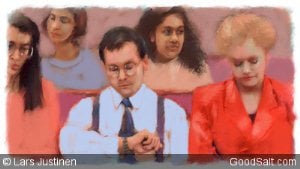
Image © Lars Justinen from GoodSalt.com
Jesus tells us, Christian individuals who live in the last days, that He knows us. We’re neither hot nor cold, because, from our vantage point, we don’t need anything. The days and weeks pass by, and we spend a little time with God here and there, and we think that’s enough. But it’s not. Instead, we actually need Him far more desperately than we realize. If only we could love and live for Jesus wholeheartedly or not at all. That would be better from God’s perspective than being lukewarm. Jesus says that He’ll vomit us out of His mouth because we taste as bad as we are. But He hasn’t yet done this, and He asks us to make some bold choices right now.
What is His advice to us in Revelation 3:18-19?
In ancient times, “buying” something meant bartering or exchanging goods. Here, Jesus generously offers an exchange: our apathy for His gold, for His white garments, and for His eye salve. He wants to make us rich in His eyes; He wants to cover us with His perfect robe of righteousness; and He wants to open our eyes to see the truth of how an abiding relationship with Him will change absolutely everything. He offers us all that we need, especially because what we need, we can’t provide for ourselves. He alone can, and will, but only if we are willing.
|
If you find it painful to look at yourself and your own spiritual condition, what hope is offered you in these verses for today? |

“The heart is deceitful above all things, and desperately wicked; who can know it?” (Jeremiah 17:9)
Is spiritual self-assessment feasible without the risk of failing to see the speck in our own eyes (Matthew 7:3-5)? Can we make an honest, spiritual, realistic check with the danger of a blind spot? Are we good self-assessors? We can succeed only in self-examination of our spiritual condition through divine help. “Search me, O God… and see if there is any wicked way in me…” (Psalm 139:23-24). Instinctively, we defend ourselves. We dislike correction. We suffer from self-pride and always justify our actions. At every turn, we have ready-made excuses for wrongdoing. Self-reality check can be partial at best. Only God, who searches the heart and knows the motives behind our actions. “I, the Lord, search the heart, I test the mind…” (Jeremiah 17:10). Even what might be seen as the best actions can conceal the worst deceptions. Only God knows ALL the things that we do (Revelation 3:15).
The Laodicean Church did a self-assessment of its spiritual condition and got it woefully wrong. In their own assessment, they were rich and self-reliant, needing nothing. But Jesus found them wretched, miserable, poor, blind and naked.
“You say, ‘I am rich. I have everything I want. I don’t need a thing!’ And you don’t realise that you are wretched and miserable and poor and blind and naked.” (Revelation 3:17, NLT)
Seventh-day Adventists have a long history of associating the message to the Laodicean Church with us. We are good at associating the symbolism with our perceived characteristics, but I ask if such association has done us any good. Sometimes, I think we just smile and say, “That’s us!” and we go on to remark how clever we are at interpreting prophecy. “We must be living in the time of the end!”
Being in need is bad enough, but thinking that being in need is a good thing because it is a sign of the end is the sort of complacency and self-justification that puts us in serious danger.
I know that some of us are going to respond that we need to read the Bible more, come close to Jesus and be led by the Holy Spirit. But, even that has a sense of complacency about it. How many times have we said that? We need a spiritual bomb put under us that exposes our complacency for what it is. I ask, what form would that bomb take? Maybe it is different for each of us. I would like to hear what spiritual bomb (real-life event) exposes or has exposed your complacency.
Maurice, thanks again for your inspiring comment and for your invitation for us to share our personal conversion experience. The last two sentences of today’s lesson are the most salient message for us today. We have to “want the Holy Spirit to change us.”
Even though I grew up in a Seventh-day Adventist home, and I listened to good preaching and seasoned church talk, I also felt that something was missing, that what I was hearing was, “pie is the sky comments that had no real life meaning.” Even when I talked with one of my pastors, his response did not make much sense.
Fast-forward to my early 40’s. While at church one sabbath, a visiting pastor stood to deliver the morning sermon. He began to cry, and he recounted his infidelity. His sermon broke me. For the first time, I found myself talking to God in a manner that I had never done before. I was invited to lunch with some of my friends after church ended, but instead, I wanted to be alone, and to spend the afternoon crying more, and talking with God. I didn’t eat, and without prompting, spent the afternoon standing with my palms open and head uplifted, talking with God. For the first time I understand what it meant to fast and pray. I wanted this, and God gave it to me. Praise God from whom all blessings flow!
My husband loosing his ability to reason and understand difficult concepts, financial, health and many others. Now I need Jesus my brother, and God to be my husband and guide.
Hi Grammy, I share your need. This week I went camping with my family. Both my son-in-law and brother-in-law are in cognitive decline, and we are making the most of the time we have left with them. Life is challenging and we need God’s grace and love to deal with it.
This is a no win situation. It doesn’t matter how much you read the Bible doesn’t matter how much you pray, doesn’t matter how much you do anything. Because we are in the last days or because we are the laodicean church it will never be enough. Because there will be a constant reminder that we are in the last days and that we are neither hot nor cold. The solution is to acceot righteousness by faith. Otherwise we will be spending our days nights weeks months thinking what else can we do
Righteousness by faith is a good answer, but we often use the phrase because it is acceptable Adventist vocabulary. In the 1890s, Seventh-day Adventists fought about this idea. Why was it so controversial?
Have pastors, lay activities directors, teachers, those Christians we fellowship with from time to time been spiritual bombs for us? Yes! My spiritual bombs from time to time are found in my reading Sabbath School net post and the Sabbath School lessons and teachers comments as well as the authors book, and Ellen Whites comments. I look back on spiritual bombs, looking at them as nudges out of being lukewarm. Then I rejoice in my assurance of salvation, because of His love for me. It is not live and let live, rather live out Thy life within me oh Jesus King of kings.
Without God, the human condition much like a patient’s chart in a hospital reveals our true state. When a patient is doing well, the graph rises; when the condition worsens, it declines. In the same way, without God, the human heart is empty and in desperate need of inner peace. Humanity has tried to fill this emptiness with possessions, achievements, or even addictions, yet these efforts prove futile and temporary. Without God, the heart continues to yearn for lasting peace. All human efforts may be attempts to improve our condition, but we remain unfulfilled until we seek true fulfillment in Him.
The Bible describes the human heart as “deceitful above all things,” and the current situation does little to improve it. Social unrest and political turmoil often deepen our despair, making our own efforts seem more desperate. Personal struggles can become overwhelming, causing the chart of our condition to decline further. At best, it paints a grim picture, we are, in many ways, like a critically ill patient. Yet there is hope: when we begin to seek fulfillment from God, our emptiness is addressed and our spiritual graph begins to rise. As it is written, “Come to me, all you who are weary and burdened, and I will give you rest” (Matthew 11:28).
Paul describes the human condition as a life weakened by sin, a state of godlessness that affects both mind and spirit and is evident in our actions. In response, the psalmist cried out to God, “Create in me a clean heart, O God, and renew a steadfast spirit within me” (Psalm 51:10). This is also my prayer: that God would create in me a heart that loves Him more each day, one that is increasingly inclined toward Him. A heart with His blood flowing freely through it, unblocked, free of plaque, and clear. God has long desired to create a new heart within me, yet many a times I have not given Him the opportunity. May I continually surrender, allowing Him to transform me from within.
My mom had a comfortable chair in the dining room where she could be found reading the bible and Ellen G. White books every day. I can remember as a teenager (more than sixty years ago) hearing her praying; Create a clean heart in me, oh God, and renew a steadfast spirit within me.
Personally, I am still growing in my relationship with God. Sometimes, the experiences are bitter and painful, but, other times there is hope and peace. All in all I ask the Holy Spirit to apply the verse “All things work together for good to them that love the Lord”.
“And I will ask the Father, and he will give you another advocate to HELP you and be with you forever.” John 14:16, this encourages me because I’m reminded that in this life, I will always be in NEED of help.
As I did the reality check in today’s lesson, I realized I worship regularly, worship with my family, and serve in the church. In my prayers, I notice I pray God’s word often as a way to acknowledge my faith in him, not my circumstances.
I then asked God this morning, although my relationship with you is consistent and full of faith, where am I in need?
I think the reality check gives us an opportunity to reflect on areas of our lives in which God is pleased, “without faith it’s impossible to please him.”
This reality check reminds me to acknowledge the ways in which God is pleased with my relationship with him and also never forget that I will always be in need.
I saw a patient last week. His clinical presentation puts this week’s lesson in perspective. His wife had raised a concern that he started to struggle with his vision, particularly reading the clock on the wall. Until this point, he had never exhibited visual deficits. The patient himself reported no complaint of visual changes. Subsequent ophthalmology review of the patient’s vision revealed that he could only appreciate hand movements. Despite this, he maintained that his vision was normal, a sign of visual anosognosia. When asked to identify a person in a striped shirt in the room, he pointed to someone present, even though no one was wearing a striped shirt, demonstrating visual confabulation. The rest of his neurological exam including pupil reflexes and fundoscopy were unremarkable, suggesting an intact anterior visual pathway. This combination of bilateral vision loss, anosognosia, and confabulation led to a diagnosis of Anton syndrome.
The man was blind but he did not know it. He insisted that he wasn’t blind.
I equate the case of Laodicea to spiritual anosognosia if you please.
I pray that the Lord cures us of this spiritual Anton syndrome.
By the way, my patient had bilateral occipital lobe infarctions (strokes).
The sad thing about deception is that it convinces us that lies are better than truth and fantasy preferable to reality.
Being indifferent – not caring one way or another about its impact on our relationships with our family members, friends, co-workers, or Jesus Christ. Considering not ‘needing anything’ can bring this about quickly, causing callousness when habitually ignoring others and their needs.
Jesus describes this state as: “wretched, miserable, poor, blind and naked’ and offers His Way to change this. He wants us to take our eyes off material wealth as our basis for ‘satisfaction’, and point them to the riches found in the ‘spiritual understanding of His Truth’ and its application. He offers to ‘cover our nakedness’ by providing us with ‘spiritual maturity’ in our inner being.
When I became aware of the two most significant commandments Jesus gave for calibrating our spiritual relationship with God and the resulting conduct toward our fellow man, I was relieved to find this easy to do. What does He say we ought to do? ‘To love God with all our being, which expresses itself by doing right by our fellow man’. When loving God first, He will change our coars ‘indifference’ to ‘caring’, so becoming the ‘Guiding Light’ in our walk of faith – Matt.22:37–39.
I really appreciate this lesson. It helps to force me to look at my relationship with God—not my church’s, my parent’s, my children’s, or my friends’, mine. I need to be more like Jesus and deep inside I know it and need His help. As He stands at the door and knock, I pray I will have the courage to let Him in so that every speck of sin can be cleaned up and I can become the person He wants me to be.
I will first say that I can accept the idea that the church of Laodicea prophetically parallels the final stages of Christian history, although I wonder why we always apply it to the Seventh-day Adventist church (I guess we have a tendency of thinking we are the only true Christians). I think it actually applies to Christianity as a whole, though of course Seventh-day Adventists are a part of that group.
Here’s why I have a problem with the constant theme of “We are Laodicea” that we read and hear regularly. No matter what we do, we will continue to hear it. Go to campmeeting and you will be told you are Laodicea. During the year, perhaps you make changes in your life to have a genuine relationship with Jesus. But when you go to campmeeting again, you will hear it again. It seems no matter what we do, we will be hit over the head with that message. And I wonder if that’s productive or even fair. Let’s face it – many people in the church don’t even study their Sabbath school lessons. The ones that do generally have a strong relationship with God. (Yes, I realize some are doing their “duty” out of show, but I would expect that’s not the majority) Is it fair that they be told their Laodicea year after year? And if there’s no hope of ever being anything else something seems wrong.
Also, certain parts of the world are on fire for God and I don’t think the message applies to them.
I tend to agree with Ranko Stefanovic’s views that the messages to the 7 churches are principally literal. Each church was a very real church with very real people. Now there can be a secondary application to prophecy. I’m not opposed to that. However, the message to one church may be more applicable than another personally. The Laodicea message may apply to you and I in some ways and we should consider it carefully but also consider whether other messages are more applicable.
If our eyes are roth, everything that we see may be contaminated, but if we look through the eyes of God, we may see that everyone, including ourselves, has a chance in God’s love. Today is the time to be open to God’s love. Forget the past and focus on the Present: this is our sole reality; let us live it with Him as intensely as we can.
I always felt I was never good enough. Until Jesus revealed to me that He Is.
Some time my eye glasses need to change and have a eye examination done by God himself.