
Monday: Rebuke, Repent, and Reward

Daily Lesson for Monday 30th of March 2026
“ ‘As many as I love, I rebuke and chasten,’ ” Jesus tells us in Revelation 3:19. “ ‘Therefore be zealous and repent’ ” (NKJV). None of us, for even a second, could justly say that Jesus doesn’t care about us or our future. How much easier it would have been for Jesus to give up on humanity and not travel the painful road He chose on this earth. It’s precisely because He loves us so deeply that He rebukes us in our current state. He wants a much stronger, deeper relationship with us. He’s not satisfied with our on-and-off attitudes, our “I’ll come to Him when I need Him” approach.
Instead, Jesus rebukes us for our own good. He tells us to repent. But we can’t repent unless we realize that there’s something wrong. Yet, He’s told us exactly what’s wrong with us: we think we’re rich, but we’re actually “ ‘wretched, miserable, poor, blind, and naked’ ” (Revelation 3:17, NKJV).
Read Revelation 3:20. What are we promised here? But what must we do to receive that promise?
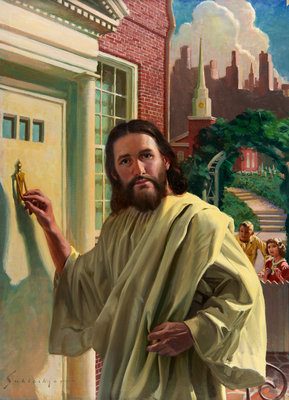
Image © Review & Herald Publishing at Goodsalt.com
This is such a beautiful and extraordinary word picture. The God of the universe wants to sit down over a meal with you, with me. He desires mutual engagement and conversation over good food. He wants a close, abiding relationship, and Jesus invites us to have this with Him.
Jesus stands patiently waiting and knocking at the door of your heart. Perhaps you’ve seen pictures of this in children’s books—a tall, graceful Savior, knocking gently. He doesn’t barge in and force you to talk with Him. He doesn’t impose on your time or your busy life. Time is short; so, if you hear Him, open the door. He will be there to step into your life.
This metaphor illustrates the kind of relationship Jesus wants to have with each of us. But one day, when you meet Jesus face-to-face, when you cast your crown at His feet in adoration and praise with thousands upon ten thousands of others in worship to the Creator (Revelation 4:9-11, Revelation 5:11-14), when you think back to your earthly trials and see that they dim into insignificance—do you think at that point you’ll ever regret the time you spent with Jesus on earth?
|
Right now, Jesus is knocking. He is calling. You, though, have to make the conscious choice to open your heart to Him. How can viewing the Cross and thinking about what it means inspire you to make that choice? |

When I was a chemistry student we often did titrations in our lab work. The idea was to do each titration 3 times and average the results. It was expected that the three results were pretty close together. On one occasion I remember being rebuked quite severely because I had written over the top of one of the results with a result that was closer to the other two. My tutor said that if the result was inconsistent, I should record it and then do another measurement and record that one too. I could then write an explanation for the inconsistent result. He pointed out that I could be accused of fabricating a result and it was important to record inconsistent results and not just cover them up.
I learned a valuable lesson that day, that laid a significant foundation to my research career. It is not about getting the “right” answer, it’s about doing it with honesty and integrity. (And I have seen some science go horribly wrong because that principle was not applied.)
The rebuke to the Laodiceans was in many ways the same. They thought that acting or appearing religious was the aim, but Jesus saw through their self-deceit and essentially told them they were fooling themselves with a paint job rather than making the changes needed at the heart. If the rebuke applies today, how much of our spirituality is a paint job rather than living with integrity and honesty.
“As many as I love, I rebuke and chasten…” (Rev.3:19).
How does God rebuke and disciplines those whom He loves? Love compels God to take corrective action to those whom He loves. It is not a punishment but a means for correction. Like a loving parent takes remedial measures, likewise, God’s love will not remain idle seeing a loved one go astray unguided. This might sound as if it is a figurative language, but God does really rebuke and discipline. “The Lord disciplines the one He loves…” (Hebrews12:6) . God values and cares for human relationship seriously and He cannot ignore us when step out of line. He gently steps in with corrective measures. How does He do it?
1. God steps in through the Holy Spirit by convicting our conscience (John 16:8). God does not harshly or physically shout at us but gently challenges our inner conscience to bring us to awareness that we have stepped outside the relationship.
2. God uses circumstances to rebuke and discipline us. God used circumstances to rebuke and discipline Prophet Jonah (Jonah 1:4–17). When we seem to ignore the nudging of the Holy Spirit, God uses means that makes use physically uncomfortable to get out attention.
3. God also can use His Word (Scripture) to convict us of our wrongdoing. The Word of God is alive and it speaks to our inner beings. “All Scripture… is useful for teaching, rebuking, correcting…” (2 Timothy 3:16). In fact, the Word of God is a lamp unto our feed to guide us in the right direction I(Psalm 119:105).
4. God also uses other human beings as instruments of rebukes and correction (Galatians 6:1). God often sends our fellow human beings to counsel us to change course.
5. When we become too comfortable, God at times can withdraw the inner peace to cause us to reflect. God can cause a storm of lack of peace to let us know that we need to be still and listen to His voice. “There is no peace… for the wicked.” (Isaiah 48:22).
“The Lord says, “I will guide you along the best pathway for your life. I will advise you and watch over you. Do not be like a senseless horse or mule that needs a bit and bridle to keep it under control.” (Psalm 32:8-9)
Besides salvation, one of the greatest God-given gifts is the ability to repent of our sins. Without repentance, sinful humanity would not enter heaven. Repentance leads the sinner into a better state, for it precedes the presence of God. In summary, repentance leads to a life that is refreshed, restored, and revived. Repentance is more than a mere turn or turnaround; it implies that the sinner turns 180 degrees, not 360 degrees. It is a total turning to God from whatever has taken His place in our lives, or from all that distracts us. Acts 3:19 calls upon us to repent, change our mind and purpose, and turn to God so that our sins may be blotted out and we may begin anew with a refreshing recovery from the effects of sin—something possible only in His presence. A sinful life is like that of a person gasping for air; without air, the physical body dies, and without repentance, the breath of the Spirit we all need disappears, and we begin to suffocate spiritually.
Repentance involves not only private prayers of confession before God but also public confession. It includes being sorrowful for our sins and making a declaration of repentance to those we have offended, leading to reconciliation. I remain convinced that our churches would be far healthier if we applied Matthew 18:15–20 and rebuked our brothers and sisters when they sin. Yet I am also convinced that this is not the only way sin should be addressed. As Jesus teaches in Matthew 5, repentance of sin and confession to others—even when they are not confronting us—are among the most practical ways of growing spiritually. Voluntary confession cultivates humility, strengthens relationships, and encourages accountability within the body of believers. When repentance becomes a shared practice rather than a reluctant reaction, the community of faith grows in grace, unity, and maturity, reflecting the transforming work of God in both individual lives and the church as a whole.
This week’s lesson, “Reality Check” has us explore the message to the church in Laodicea found in Revelation 3: 14-22. But, when I opened my Bible, I started reading at the start of the chapter and got stuck for a while on the message to the church in Sardis which also receives a rebuke from the Lord. Without reference to the prophetic timeline of Revelation and only interested in the fact that all scripture is God breathed for my edification, I found a reality check in the message to the church in Sardis.
The church in Sardis, like Laodicea, was a wealthy, commercial centre. But Sardis had another advantage – it had a natural defence with a steep 1500 ft cliff face that was impossible for enemies to scale. This natural defence made Sardis overconfident. According to Herodotus, in 549 BC a Persian solider in King Cyrus’ army saw a Sardis soldier accidently drop his helmet down the cliff walls. The soldier climbed down a secret passage to recover his helmet. During the night, the Persian forces used this hidden path to enter the city and found it unguarded. The Persians caught the inhabitants by surprise, defeated them, and absorbed them into the Persian Empire.
The soldiers of Sardis were so confident of their natural defences they neglected to keep a diligent watch. The problem was not that the city had been built above steep hills. That was a wise choice. It had taken great sacrifice and hard work over a sustained period of time to build a city above these inaccessible hills. The problem was that because the city had done all that hard work, they stopped being diligent for their security.
What natural defences in my Christian walk make me overconfident? Perhaps it is that I am a third generation Adventist, pastor’s kid and grandkid. Perhaps it is that I work actively in the mission field. It may be the fact that I attend church every week. I may be confident because I sent my children to Adventist schools. All these are good things. They may even testify of hard work and great sacrifices. But if I am not guarded, the enemy of my soul can still find a way to defeat me. I need a daily reality check. As Peter admonishes, “Be sober, be vigilant; because your adversary the devil walks about like a roaring lion, seeking whom he may devour.”
Amen.
Jesus’cross could symbolize many things but for me , it symbolizes love. He first showed us His love at the cross and this love needs to be understood, respected, and appreciated. We need the Holy Spirit to guide and provide discernment.
Love rebukes in and with love with the ultimate goal for transformation, repentance, and renewal.
It takes a love for Christ to be humble before the Lord and take to heart rebuke, recognize our need and do something about it, then receive our peace, rejoicing, and justice, which is our reward. Luke 15:6-7.
Love rebukes in and with love with the ultimate goal for transformation, repentance, restoration,and renewal.
I do not think that anyone ‘likes’ to be rebuked. Most likely, our defenses come up immediately. But our relationship with Jesus Christ is different. He rebukes because He loves us and wants a closer relationship with us; teaching us how best to love Him back. Rebuke is welcomed because it helps bring us closer.
To me, rebuke implies that we can do things better – improve our walk with our Lord and Savior Jesus Christ. When looking at spiritual ‘rebuke’, it becomes clear that shortcomings are addressed because they reveal the status of the heart and mind determining our thoughts and actions. The Spirit helped the churches, He will help anyone who lays their heart open to Him – Gal.4:6; John 14:26.
I do not think that any Christian wants to be found ‘wretched, miserable, poor, blind, and naked’ in their spiritual walk with our Savior. A willing heart, self-reflection, a thorough assessment of what has our ‘attention’ – assessing the value of what it produces in return -, is difficult. It would be best to include the help of a good, caring friend to stick with us whiles doing this reality-check – Prov.17:17; Prov.27:17.
When people really love each other, they cannot fake it. It is the same with Jesus; His love overflows the relationship, and others can see that. But love requires a daily decision, that’s why we have to let Him come in and dine with Him every single day!
For revelation 3:20 the question “What are we promised here? But what must we do to receive that promise?” I feel He has stopped talking to the church as whole in verse 20 and He is now reaching out to the individuals in the church to respond. To open ourselves to him.
If we are the bride of Christ, this feels like it relates to the Song of Solomon 5:2-6.
2 I sleep, but my heart is awake;
It is the voice of my beloved!
He knocks, saying,
“Open for me, my sister, my love,
My dove, my perfect one;
For my head is covered with dew,
My locks with the drops of the night.”
3 I have taken off my robe;
How can I put it on again?
I have washed my feet;
How can I defile them?
4 My beloved put his hand
By the latch of the door,
And my heart yearned for him.
5 I arose to open for my beloved,
And my hands dripped with myrrh,
My fingers with liquid myrrh,
On the handles of the lock.
6 I opened for my beloved,
But my beloved had turned away and was gone.
My heart leaped up when he spoke.
I sought him, but I could not find him;
I called him, but he gave me no answer.
We should repent, turn around our lives. Answer his call, answer the door before it is too late.
I’m reading this lesson with fresh eyes. Not the eyes of a 3rd-generation Adventist, but the eyes of a “new believer.” Because every day—after I’ve filled the previous day with sin and asked for forgiveness this new day—I become a “new believer.” God washes me with his blood and let’s me start over. I have childlike faith and read God’s word with wonder and hope.
This doesn’t mean I forget the lessons of the past. This doesn’t mean I forget all that God has done. Being a “new believer” means I recognize that I am poor and needy and that I don’t have all the answers.