
Tuesday: Everlasting Love

Daily Lesson for Tuesday 31st of March 2026
After depicting our apathetic condition, Jesus tells us that this is something to be overcome. “ ‘ “To him who overcomes I will grant to sit with Me on My throne, as I also overcame and sat down with My Father on His throne” ’ ” (Revelation 3:21, NKJV). For some of us, it may be the greatest battle we ever face—simply realizing our weak, self-sufficient condition; accepting Jesus’ rebuke; repenting; and receiving Jesus’ robe of righteousness over us.
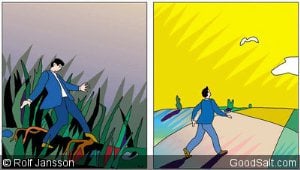
Image © Rolf Jansson from GoodSalt.com
What is so amazing is that Jesus understands our apathetic, lukewarm condition and identifies with us (not that Jesus was ever lukewarm). He says, “ ‘ “To him who overcomes . . . as I also overcame” ’ ” (Revelation 3:21, NKJV). Because He died to save us, Jesus has overcome sin and its penalty. He understands the battles of sin that we face and promises to help us.
Many people in the Bible responded to God’s invitation to be in a covenant relationship with Him. This is the overarching narrative or theme of the entire Bible. When we look at some of these people, we can see that God interacted differently with them at different times.
What do these accounts teach us about how God interacts with people in various situations?
Genesis 2:7, Genesis 3:8-10
Genesis 5:24
Genesis 6:13
Genesis 12:1-4
Exodus 34:29
Whether God physically walked with His children or whether He just talked with them, the truth is that He has always desired to be close to humanity. No matter what your relationship with God is like today, God wants to be close to you. We can read about this idea in Jeremiah 31:3-4 below:
“The Lord has appeared of old to me, saying: ‘Yes, I have loved you with an everlasting love; therefore with lovingkindness I have drawn you. Again I will build you, and you shall be rebuilt’ ” (NKJV).
Whether your day is beginning or ending right now, God is seeking you and waiting, wanting to draw you closer to Him. He wants to build—or rebuild—your relationship with Him. If it’s not happening, the fault is on your end, not His.
|
What are the things in your life right now that, unless overcome, can and do hinder your relationship with God? |

Since mankind fell into sin God has ever been pursuing him for reconciliation. Even one of the Godhead came down from heaven to assist in the reconciliation. Unfortunately, man has always been running away from God since Adam and Even sinned. As God came down looking for them, they ran away and hid from God (Genesis 3:9-11). Relentlessly, God has not given up pursuing mankind regardless of their rebellious attitude. What is so special with mankind that God has not given up on us? God created us in His own image unlike any other created being. It seems to suggest to me that when God looks at us, He sees some elements of Himself in us. Secondly, the eternal nature of God; love, mercy, compassion, longsuffering, kindness, faithfulness and goodness makes God to be inclined to us. Even when we stubbornly reject God, his love does not give up. Since the Prodigal Son moved away from home, his father never stopped loving him. In fact, every day, the father looked towards the direction he went, hoping to seeing him coming back. Yes, for sure, one day, looking in that direction, he saw his son coming back. Our Father, which is in heaven, is not only looking to seeing us come back to Him, but He is also actively seeking to find us. While we are able to locate our way back home like the Prodigal Son and before it is too late, let us go back home, our Father is waiting to receive us.
Omwenga, you asked
That almost sounds like self-interest on God’s part, but that cannot be because God’s character is self-renouncing love. I don’t believe that it is anything in us that makes us special to God. It is only God’s care for us that makes us “special.”
So maybe we should turn the question around like this
There’s a biblical allegory in which the Lord demonstrates how he cares for us. You can find it beginning in Eze 16:1-9, and that is followed by all the ways Israel (and we) sinned against His love. Yet in Eze. 16:62, He still promises to establish His covenant with His people. Read all of Ezekiel 16 to understand and feel what the allegory is meant to convey.
It sounds like Omwenga is inspired by Psalm 8:4. “What is man, that You are mindful of him…” I don’t think that it is bad self-interest on the part of God to be pleased when his children reflect His character. I know that when God looks at me, He does not see much of Himself. I also know that God’s love for me does not depend on that. But because He loves me He desires to see Himself in me for He knows that this is what will give me peace and joy. You are correct that the question “what is man” leads naturally to the question “what is God”. Thank you, Inge, for your thoughtful comments. I always look forward to reading and thinking about them.
Thank you, Joe! Yes, all of Psalm 8 is high praise, beginning and ending with
And inbetween the psalmist writes about the wonder that the Creator of heaven and earth should pay attention to man, crown him with glory and honor and gave him dominion over God’s creation!
It is God who made man “special.”
His character love, and He created us with the ability to appreciate His love and to return it in some measure.
Several years ago, Carmel and I visited Ubirr in Kakadu National Park in the Northern Territory. We listened to a young Aboriginal woman tell us some of the stories associated with the rock paintings in the area. Australian Aboriginals refer to their history of beginnings as the “Dreamtime”. One story was about the Dreamtime serpent that used to live in the deep pools in the rock art area. After telling part of the dreamtime story, she admitted that she though that one of the main reasons for these stories was to put the frighteners on the kids so they stayed away from the deep pools. The kids were more scared of big snakes than deep pools.
How often have frighteners been used to enforce moral behaviour? One only has to look at medieval church art with its pictures of hell and suffering to realise how people were manipulated into good behaviour and paying church imposed taxes to avoid ah horrific afterlife.
And I suspect that even in Seventh-day Adventism, the big frightener is the time of the end. The message, often covertly stated, is that you had better behave yourself because we are in the last days. Is it the snake in the deep pool dressed up with a bit of Adventist vocabulary?
While there is a place for pointing out danger, and making people aware of it, it is unhealthy to be obsessed by it. Christianity in terms of the dairy farm is more about the good pastures of ryegrass and clover than about the barbed wire fences. In the message to the Laodiceans, the big picture message is about the gold and rich raiment that is readily available. We sometimes read the messages to the seven churches as rebukes rather than encouragements.
God’s love is like an ocean—we may see where it begins, but we can never find its end. It is a love so steadfast, loyal, and unfailing. It is a love story with no beginning and no end, untouched by time, circumstances, seasons, or even political changes. This love is constant, the same in the day and in the night. It is the same yesterday, today, and forever—a love that will never let us go, no matter what. As Scripture reminds us, “Give thanks to the Lord, for He is good; His love endures forever” (Psalm 136:1). Indeed, it is an everlasting love that surrounds us at all times.
This love is a reality that God wants us to experience in our daily lives: a love that pursues us when we are unlovable, forgives us when we feel unforgivable, and accepts us when we think we are unacceptable. It is a love that sees our worth even when we feel worthless, and believes in us even when we do not believe in ourselves. It is a love that knows us intimately—our thoughts, fears, feelings, dreams, and hopes. It understands our past, walks with us in the present, and holds our future. It knows our strengths and weaknesses, our successes and failures. As it is written, “But God demonstrates His own love for us in this: While we were still sinners, Christ died for us” (Romans 5:8). This is a love that knows us better than we know ourselves—truly an everlasting love.
God’s love empowers us to love others, even when they seem unlovable. It enables us to forgive, even when forgiveness feels impossible. It inspires us to accept others and to recognize their worth, no matter their circumstances. God’s love is beyond our comprehension, beyond our imagination, and beyond our understanding. Yet He calls us to experience this pure love, to share it with others, and to live it daily. When we embrace His love, it transforms our hearts and reflects through our actions, becoming a testimony of His grace to the world
I can think about a whole load of things in my life ! Things that have crippled my soul and are making me cry right now! My own desire to sin ! Always running to sin instead of running from it ! How destitute I’ve been left ! What a toll sin can take on a man! I pray for grace and mercy I pray for the power to overcome these shackles that the devil has put on me!
Dear Kayihura – please, stay committed to your desire to ‘overcome these shackles that the devil has put on you’. God gives you the strength as you give it your all – no excuses! We pray for your success as you allow God to do His work of healing! Phil.4:13; 2 Cor.20:17.
Hi Kayihura, I feel your pain and I’ve been there at different times of my life. I hope you can know how much Jesus loves you and that He understands what you are dealing with. Though He never sinned, He faced everything we did and He knows what it’s like.
I would give you two pieces of advice from my own life that may be helpful to you.
1. Don’t focus on your sin. It is counterproductive. Take it to Jesus and ask Him to help you, but focus on knowing Him and having a relationship with Him. When you do this, He will begin taking care of the issues in your life. You may not even realize it until later when you see that something is no longer a problem for you.
2. When you are dealing with sins that just seem insurmountable, it can be helpful to try to understand the root of that sin. Sins are never isolated. I heard a pastor say that all sin is an attempt to meet a genuine need in an inappropriate way. If you can understand the root of your sin, you can better deal with it. If you don’t get to the root, you will often replace one sin with another (this is especially the case with addictions, which many sins are). I don’t think it’s an accident that the word for salvation and healing are the same in Greek. God wants to heal the parts of your life that are leading you into sin. Once you realize what they are, ask Him for that healing. He will begin the process – maybe it won’t end in this life, but it will end one day. When you stumble, just turn to Him again. He cast 7 demons out of Mary and that was probably 7 times, not 7 demons one time. He is patient with us.
Tell it to Jesus alone, He’s the friend that’s well known.
I was struggling with a particular thing in my life that caged me like a bird. Tried within my power to do away with it but to no avail until I surrender it to Jesus with all sincerity that I do not want to be that thing and I can confidently say Jesus set me free and I believe I’m free forever.
He’s right there with you, just tell him how you feel which he already knows. Hugs from this end.
Romans 6:14
For sin shall not have dominion over you, for you are not under law but under grace. From Slaves of Sin to Slaves of God.
Psalms 19:13
Keep back Your servant also from presumptuous sins; Let them not have dominion over me. Then I shall be blameless, And I shall be innocent of great transgression.
Be busy with the things of God and the gratification to sin shall gradually dies off. God bless you.
Gpd’s everlasting love compels us to overcome our sinful behavior in ordered reach Him. My sinful behavior could be lack of confidence in God to fulfill His promises.
The fact that the King of the universe invites us bad people to have an audience anytime of the day or night speaks volumes. Human beings love to admire successful people and some would do anything just to touch them see them talk to them etc. We want to find out what is happening in the lives of these “celebrities yet we can have presence conversation reasoning direction purpose and daily loaded blessings and we forsake Him the One who matters most many times for flesh like ourselves and still God is reaching out. We need to give priority to our God He is pleading with us to.
Have we noticed that the first negative emotion recorded in he Bible is fear?
When God came down to the garden and was looking for Adam, this was Adam’s response, “So he said, “I heard Your voice in the garden, and I was *afraid* because I was naked; and I hid myself.”
Fear in one shape or another has hindered the relationship we could have had with God, but today He is saying, “I have loved you with an everlasting love and with lovingkindness have I drawn thee”!!!
We only need to accept God’s love, without fear, and we will be saved!!!
I appreciate the perspective of Maurice Ashton.
Following Christ should evoke positivity instead of being fear driven.
Another example of fear mongering in Adventism is talk of the impending Sunday Law.
If we’re looking forward to the imposition of the Sundal Law as a harbinger of Christ’s return then shouldn’t we embrace it instead of viewing it with fear and trembling?
The author here says “For some of us it may be the greatest battle we ever face…” But from what I read in the message to the last Church in Revelation 3:14-22, I would say that this applies to “Every person before Jesus shows up the second time.” In this last “Seventh Church” God says “Because you say (I am rich and increased with goods…)” God is not saying here Because “Some say” He says “Because you say..” “You” refers to the entire “Last Seventh Church of Revelation 3:14-22 and not just “Some of us.”
With all due respect, Pete, just because a message applies to the church in broad strokes does not mean it applies to every person individually. Not every person in the dark ages (Thayatira) was an idol worshipper. The messages are by nature broad.
I know people who are living vibrant lives in relation with Jesus and they do not feel self-sufficient. Perhaps they did once, but that battle is over for them. To call such people Laodicea I think is almost abusive. It’s as I said on Sunday, they will be told it over and over no matter what they do. God has always had faithful people like Enoch.
The larger church does struggle with some of the issues of Laodicea, but perhaps we should look at these issues organizationally rather than always focus on the people in the pews who have very different degrees of spirituality and focus.
Surely God loves us. After Cain has killed his brother Abel, God still seeks him out. He still puts a mark in his forehead that none should kill him in his wandering. Surely, God is love.
Yes, God wants to be close to us, though what is important to understand is that we need to want to be close to Him and trust Him – that His desire to be close to us is for His benefit as well as ours!
Gen. 6:13 records: ”And God said to Noah, “The end of all flesh has come before Me, for the earth is filled with violence through them, and behold, I will destroy them with the earth.”
We are designed to be peaceful and to benefit the earth with the careful husbandry our Maker assigned to us. ‘Violence’ in all its forms – the fruit of a self-serving, hardened, selfish heart – leads to great harm. We need to overcome the inertia associated with being lukewarm because it tolarates sin.
What God desires and fosters is a peaceful, loving, caring – engaged in all good works – believer that glorifies Him with his life; a born-again believer filled with love for God and his fellow man. Instead of excusing our shortcomings, we ought to embrace wholeheartedly Jesus’ Way of Life illuminated by His Light.
John Ch.14 relates the words Jesus spoke to His disciples to comfort them, helping them not to worry when He departs – v.27: “Peace I leave with you; my peace I give you.” And this is at the heart of God’s desire for man – that they experience His Love and Peace in the presence of the Holy Spirit inhabiting His Son, Jesus Christ – John 14:30-31
Whatever is more important than God can hinder our relationship with Him: it could be family, job, car, clothing, music, pleasure, or food; basically anything that we spend more time on than developing God’s love.
Why pit rebuke against encouragement when Christ gives both?
The messages to the seven churches are not mere condemnations. Jesus joins honest correction with hope because His goal is restoration. The rebuke says, do not stay where you are; the encouragement says, by My grace, you do not have to stay there.
To separate the two is to miss the Shepherd’s heart. His warnings are themselves encouragement, because they show He has not given up on His church.
I think perhaps the issue, Beverley, is that the message to Laodicea is completely negative. For the other churches he commends them for some things and also may give a rebuke.
Certainly the church of today has problems and in a broad sense I agree the message to Laodicea applies. The issue is when we assume it applies to everyone in every way. Are the persecuted believers in North Korea or a country like Iran Laodicea? I think not.
Jeremiah 31:3-4: “The LORD has appeared of old to me, saying: ‘Yes, I have loved you with an everlasting love; therefore with lovingkindness I have drawn you. Again I will build you, and you shall be rebuilt.”
Praise God for being the Master Builder! He’s willing to build us and rebuild us, again and again.