
Sunday: Faithful Daniel

Daily Lesson for Sunday 3rd of May 2026
Daniel is one of the great heroes of the Bible. We know the first story too (see Daniel 1:1-21): “Daniel purposed in his heart that he would not defile himself with the portion of the king’s delicacies” (Daniel 1:8, NKJV). Also, to Daniel and his three friends, “God gave them knowledge and skill in all literature and wisdom; and Daniel had understanding in all visions and dreams” (Daniel 1:17, NKJV). The Bible describes Daniel as wise (Daniel 1:20; Daniel 2:14,21,23,48) because the Spirit of God was in him (Daniel 4:9,18; Daniel 5:14; Daniel 6:3), and he was greatly beloved by Heaven (Daniel 9:23, Daniel 10:11). These are some descriptors of a man who had a strong, abiding connection with God.
In Daniel 2:1-49, when King Nebuchadnezzar issued a death decree to all wise men in Babylon, Daniel sought God’s mercy concerning the secret of the king’s dream (Daniel 2:18). When God revealed the king’s dream to Daniel, he immediately prayed.
Read Daniel 2:20-23. Why did Daniel pray, and what can we learn from this prayer?
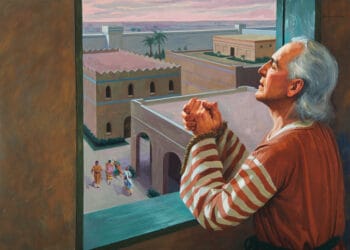
Image © Review & Herald Publishing at Goodsalt.com
As the years passed by and kings rose and fell, Daniel remained an adviser to the kings and was described as distinguished “because an excellent spirit was in him; and the king gave thought to setting him over the whole realm” (Daniel 6:3, NKJV). “He was faithful; nor was there any error or fault found in him” (Daniel 6:4, NKJV). Despite fierce jealousy and evil plotting (Daniel 6:5-9) from his peers, Daniel remained ever constant and fearless in his prayer life.
Read Daniel 6:10-11. What do these verses tell us about Daniel?
When faced with difficulty, Daniel prayed. Although the threat was against his life, he was consistent and persistent in prayer (three times every day, as was his custom), and predictable (at his open window three times a day as he prayed toward Jerusalem). His prayer was a physical act (he knelt) and focused on thanksgiving and supplication.
|
In light of a story like this, how weak are your excuses for not praying? |

How does one possibly become “a prayer warrior” like Daniel?
One does not become a combatant (warrior) soldier by accident or by being born as one, but through persistent and consistent training. Even after training well, one has to regularly do physical and mental exercises. Likewise, becoming a prayer warrior like Daniel demands discipline, consistency and perseverance. Using Daniel’s prayer life as a case study, we can pick some important lessons that can help us in our own prayer life.
1. Daniel was consistent and persistent in his prayer life. He prayed three times a day (Daniel 6:10). He was regular in prayer, which was built into his daily rhythm even when he was forbidden to pray. His prayers were not reactive but part of his spiritual life. Prayer should be part of the ordinary life of a Christian.
2. Most of Daniel’s prayers were God-centred, not self-centred. He spent much time acknowledging God’s goodness, holiness, faithfulness, justice and mercy (Daniel 9:4–19. Yes, we can tell God of our needs, but our talk to God should not always be need-based. Prayer time should be a time for worshipping as well.
3. Daniel’s prayers were scripture-centred. Daniel’s prayers, particularly in Daniel 9 is simply telling God what He said in the book of Jeremiah. Our prayers should not be in abstract but rooted in what God has said in His word.
4. Daniel humbled himself and repented before he approached God in prayer. Prayer is a request and not an entitlement. “O my God, lean down and listen to me. Open your eyes and see our despair. See how your city—the city that bears your name—lies in ruins. We make this plea, not because we deserve help, but because of your mercy.” (Daniel 9:18, NLT).
5. Daniel was a man of integrity. Even his enemies could not find any tangible accusation against him (Daniel 6:5). Prayer warriors should be men and women of integrity, both in their private and public lives. It is not the intensity or the multitude of words that make one a prayer warrior, but our relationship with God.
The Bible is very clear that as the end time approaches, life for believers will be intensely challenging. We are strongly encouraged to be honest and disciplined in our prayer life.
” The end of the world is coming soon. Therefore, be earnest and disciplined in your prayers.” (1 Peter 4:7, NLT)
I love Daniel’s prayer. Thank you for showing through this prayer how we can worship Him by focusing on Him. I had used the Our Father as an example of how to pray. It, too, focuses on our Heavenly Father first.
In the book “The Weapons of Prayer“, nothing is more important to God than prayer in His dealings with humanity. Daniel understood that failure to pray was a failure of duty, service, and spiritual progress in Babylon. In Daniel 6:10, “Now when Daniel knew that the writing was signed, he went into his house; and his windows being open in his chamber toward Jerusalem, he kneeled upon his knees three times a day, and prayed, and gave thanks before his God, as he did aforetime.” Daniel knew that neglecting prayer would rob him of God’s ever present help, placing him in a position where he could not fully experience divine assistance. For him, prayer meant faith, hope, patience, strength, and success in his assignment while in Babylon.
Just as in Daniel’s time, what the current Church and by extension the world urgently needs is not more machinery, improved organizational skills, or advanced methods. Rather, it needs men and women devoted to prayer people through whom the Holy Spirit can work. As affirmed in Zechariah 4:6, “Not by might, nor by power, but by my spirit, saith the Lord of hosts.” The Holy Spirit does not flow through methods but through people. The Spirit does not come upon machinery but upon men and women; He does not anoint plans, but He anoints those who are committed to God in prayer and yielded to Him.
Though Daniel, like the other Jews in exile, faced immense pressure to devise new methods, strategies, and systems to secure freedom from Babylon, he never lost sight of what mattered most—proximity to God. He sustained a consistent prayer life, understanding that God’s plan would only materialize through continued connection with Him. This truth echoes in Jeremiah 29:12, “Then shall ye call upon me, and ye shall go and pray unto me, and I will hearken unto you.” Daniel’s strength was not in innovation but in devotion, not in strategy but in surrender.
The secret behind Daniel’s bold witness in Babylon was his deep understanding of the power and worth of prayer. He could not have entered the lions’ den or stood before kings in his own strength. His courage and faith were the results of a life rooted in communion with God. As declared in James 5:16, “The effectual fervent prayer of a righteous man availeth much.” Daniel’s life stands as a testimony that true strength, endurance, and victory come not from human ability, but from a steadfast and faithful prayer life.
We have to remember that Daniel was not an ordinary citizen in Babylon. He was a foreign advisor to the king. This was not unusual. Headhunting for talent in ancient times usually meant that when you raided another country, you rounded up the university students and took them back to help the kingdom’s greatness. The downside of this is that the other “talent” in the court was often jealous and this led to intrigue as they tried to manipulate the king’s favour. Daniel is portrayed as being faithful, even in the face of this adversity.
In the context of today’s lesson we highlight Daniel’s faithfulness in prayer, even when he knew that some of the court were plotting his downfall. We should also note that Daniel was a person of integrity. He lived his relationship with God. It was not just the public display of prayer, but the fact that he lived a life of principle despite court circumstances.
Sometimes we focus on the issue of public display of religiosity in the story of Daniel, but maybe the real lesson is for us to live a life of integrity within our own horizon of influence. It is the relationship with God that is important. And our prayer life is one of the keys to ensuring the relationship grows.
To daniel,prayer had become natural to his life like the air we breathe.This was not a mere ritual, it was his lifeline to God. He was not going to stop praying just because someone had order it stopped. This could also explain why he openly prayed even when there was a decree not to pray.He was not being arrogant or presumptious.
We all need more prayer in our lives. Let us start now. God is always open to communicating with you and me. We can develop this ability; start now.
Thank you all for sharing such insightful and on point comments. What also grasped my attention was Daniel being described as greatly beloved of heaven. Can you imagine being seen in this way? It warms my heart that the Holy God of heaven took time to leave us this record. No doubt this beloved status was a key cornerstone of Daniel’s prayer life. Not only was he disciplined and consistent but I believed he felt the warmth of God wrapped around him when he prayed. He indeed had a living communion with his heavenly father. Why won’t you not want to pray then?
Our Salvation requires continous prayer. I want to encourage you to consider seeing life as an ongoing prayer. Every waking moment being a prayer/communication with our heavenly Father – this is reflective of our born-again nature. Seeing ‘faithful Daniel’ in this way, we can see him as a believer that never stops praying – formal or informal.
Daniel’s whole life expressed ‘prayer through being faithful’ – it testified to his relationship with God because he sought to hear God’s voice in all his decisions. We cannot separate prayer and life, because our God calls us to remember Him in all things we say and do – John 14:26.
Our heart and mind being focused on the ‘straight and narrow Path’ requires a constant, open awareness to do that which is right in God’s eyes – being and staying faithful is our ongoing prayer. If it is not, if we waver, lacking integrity, not being ‘cold nor hot’, we will soon become adrift on the sea of voices glamouring for our attention. Matt.14:29-31.
Conscious, ongoing prayer gives life to our quest to seek the right path in every moment of our day. We cannot ‘forget’ to do this. We ought to faithfully seek the Lord’s guidance with every breath we take. Yes, faithfulness in all we do is our ongoing prayer – it is the basis for maintaining our relationship with God. May our life be reflective of our ongoing prayer and praise of God – Psalm 63; 1 Thess.5:17.
Nothing touches the heart of God , like a complete surrender and having total dependence on him. Daniel put self aside and immersed himself fully in connecting to God through prayer daily despite what life presented.
An encouragement to us ,that our hope and daily strength can only be drawn through our intentional and commitment to maintaining our relationship with God through prayer
One thing we can learn from Daniel is to be disciplined in our faith. He was disciplined in his faith and prioritised obedience to Gid over his own safety. He knew that praying to God had become punishable by death yet he continued to pray three times a day and publicly so. It then poses to me a question, if your president wherever you are passed a law to say prayer is illegal and punishable by death, is your prayer life with God strong enough to choose Heavenly authority over the world’s authority?